


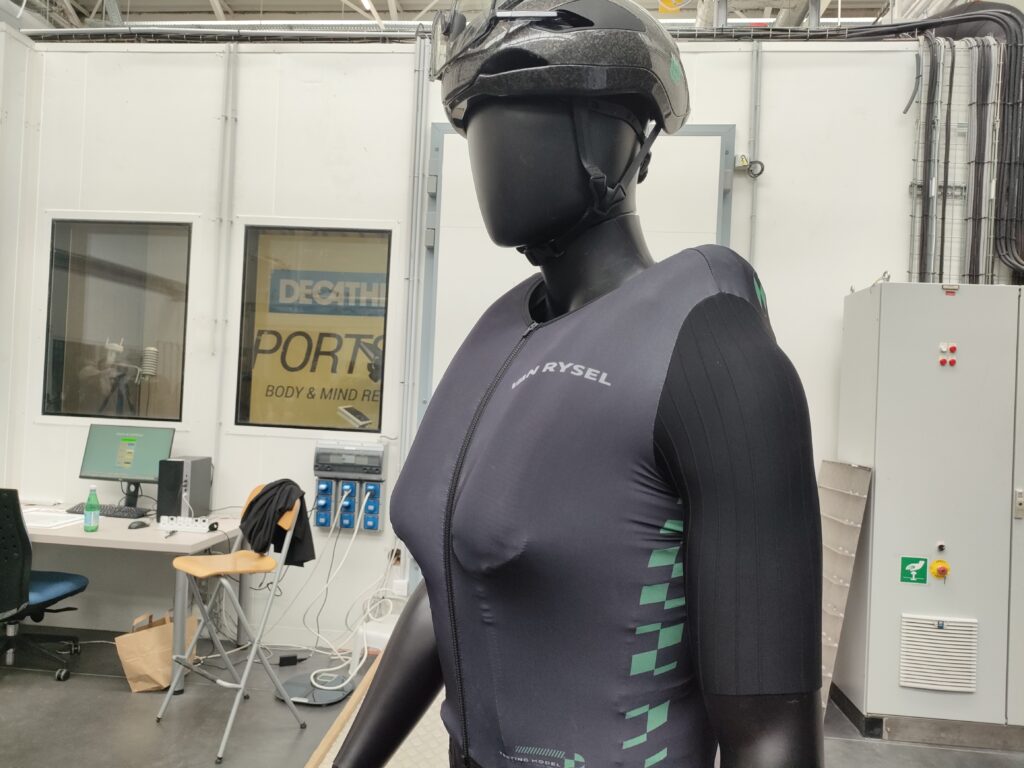

The loud pop that reverberated around Decathlon’s brightly lit lab on the outskirts of Lille, startling a few of the journalists present (including this one) and causing an unflinching model’s skinsuit to rapidly expand, Michelin Man-style, could prove a familiar sound in the professional peloton next year.
Or at least that’s what Van Rysel, the brand behind the first fully integrated airbag skinsuit developed for road cycling, hope for. In fact, the French company believe that loud pop in Lille will be remembered as the big bang for safety in bike races, a sport where they say the “unacceptable is accepted”.
View this post on Instagram
Rider airbags, it seems, are all the rage at the moment. In January, Belgium-based project Aerobag unveiled for the first time in public its new innovative safety tech at the Velofollies trade fair in Kortijk, prompting the UCI to call for the creation of a “clear regulatory framework” governing the future use of airbag systems in the professional peloton.
But while Aerobag’s system, developed in partnership with WorldTour team Picnic-PostNL, is carried in a pouch on the back of a rider’s bib shorts, Van Rysel’s Airbag is something new entirely.
Over the past few years, Van Rysel has been working with Annecy-based airbag specialists In&motion and wheel brand Swiss Side to create a “fully integrated airbag skinsuit designed specifically for WorldTour racing”.
That means the airbag component isn’t attached separately to a rider’s jersey or skinsuit, or worn as an underlayer. Instead, it was “built from the ground up” and engineered directly into the skinsuit, forming what Decathlon claims is a “race-ready garment”, designed to protect riders in “key impact zones”.
The combined weight of the airbag and skinsuit comes to 700g, with the airbag itself accounting for 500g, Van Rysel saying it folds into the kit “like an envelope”.
So, how does this integrated airbag system work? And how will it keep riders using it safer? According to Van Rysel and In&motion, the new Airbag’s protection focuses on three critical areas impacted by crashes during bike races, which they highlighted through a combination of biomechanical analysis, trauma research, and epidemiological studies of crashes.
These include creating a padded airbag system around the central core, aligned with the thorax and rib cage, the cervical zone, in a bid to stabilise the neck to help prevent hyperextension, and the spinal line, providing full protection to the back.
The first version of the system unveiled this week, Van Rysel says, has been “designed to prioritise protection for vital areas of the upper body that are not covered by a helmet”, and further parts of the body impacted by crashes will be “explored over time”.
Alongside the airbag itself, the skinsuit also incorporates abrasion-resistant materials which help reduce the risk of road rash and other typical cycling-related surface-level skin injuries.
And what happens when a rider crashes while wearing one of their skinsuits?
According to Van Rysel and In&motion, who have spent the last 12 years developing airbag systems for MotoGP and cross-county and Alpine skiing, the Airbag’s deployment technology is based on algorithms developed by analysing 450 million kilometres of user data and 30,000 falls, assessing riders dynamics up to 1,000 times a second.
All that analysis means the airbag’s sensors can accurately detect when a genuine crash has occurred, compared to a normal, ever-changing race scenario. In&motion claims that its long history of providing airbags for MotoGP, where the use of such safety technology is mandatory, has resulted in a 96 per cent accurate detection rate from 150,000 users – the best in the market, they say. And when a crash does occur, Van Rysel claims the airbag takes 60 milliseconds to detect what is happening and deploy, creating a protective layer around the rider, the sensors triggering a CO2 cartridge attached to the rider’s back.
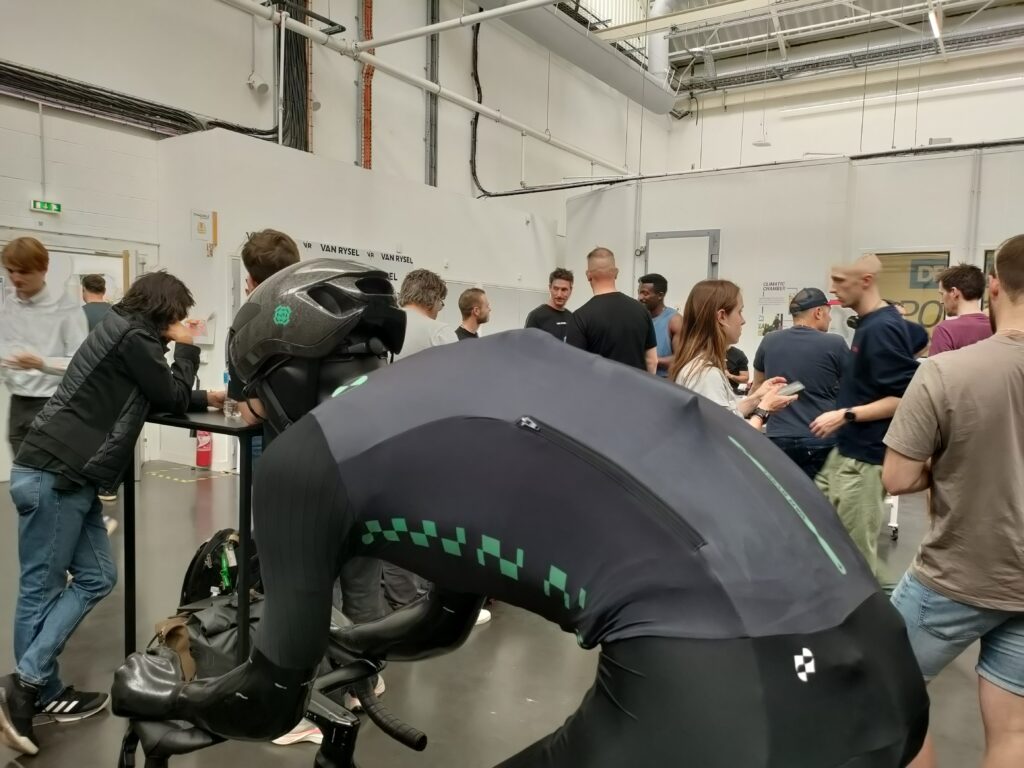
When asked about how their technology accurately detects when crashes occur, In&motion’s Valentin Honore described working out when to trigger the airbag as the company’s “core business”.
He said that the Annecy-based brand’s work revolves around visual simulations, crash tests, and feedback from users, which all feeds into their algorithm, based on their 12 years working in skiing and motor racing, and adapting it to the different demands of cycling.
The sensors in the back of the rider’s jersey also calculate accelerations, while a GPS system helps determine whether a rider has been brought to an abrupt halt, recognising the difference between a light shunt and a hard fall. Of course, professional bike riders don’t hang around much after a crash, if they can help it. So, they won’t fancy making their way back to the peloton resembling a beach ball.
In&motion says the gas cannister can be unzipped from the jersey and changed in under a minute by a mechanic, presumably leaning out from a team car window, with the air removed from the jersey and the cartridge’s valve in around 30 seconds. We weren’t able to see how exactly that plays out, however, as our willing model was whisked away to a back room as the change was made, though the airbag had started to deflate by that point.
However, while the technology may work, and prove instrumental in lessening the impact of crashes in the peloton, it’s an altogether different matter convincing riders, aiming for the highest optimal performance, to wear something that could compromise weight, aerodynamics, and temperature.
Nevertheless, Van Rysel stresses that their new Airbag is not a prototype, or a “gadget”, but a fully-fledged piece of equipment designed to work in the WorldTour. The designers stressed that the technology mustn’t negatively affect a rider’s performance, with Van Rysel and In&motion working with Swiss Side in the wind tunnel to assess its impact on aerodynamics. There are none, they claim, with the skinsuit matching the airflow characteristics of a typical WorldTour kit.
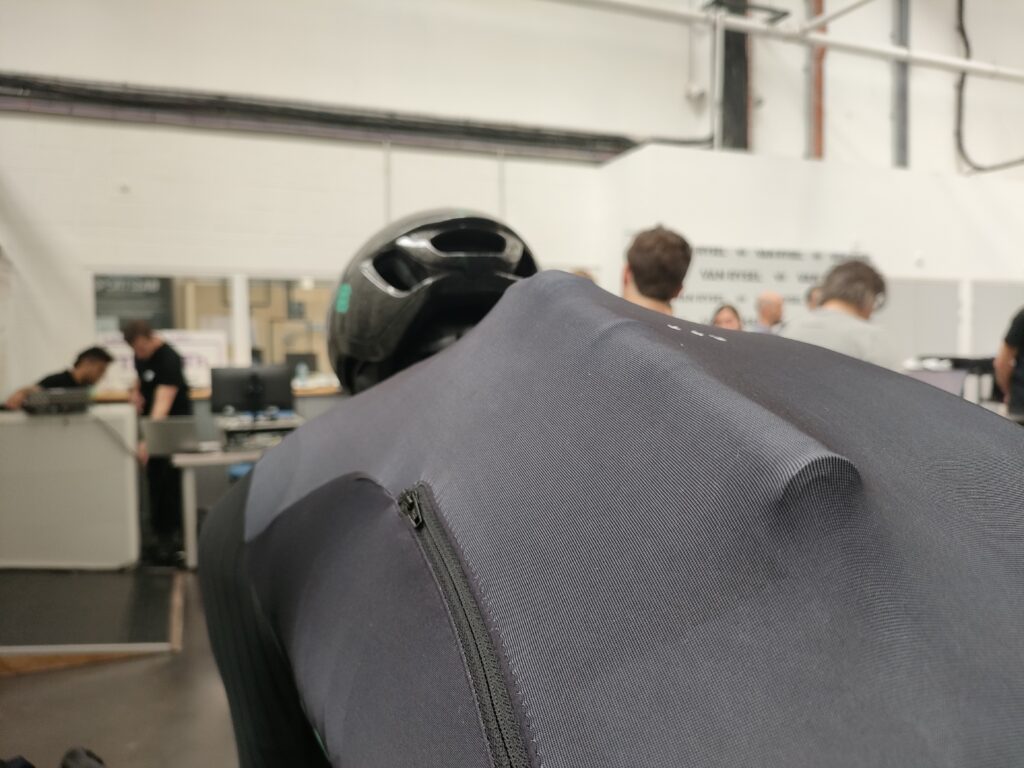
The skinsuit was also developed by heading to Decathlon’s climate chamber and simulating the most gruelling of Tour de France conditions, the designers concluding that the kit won’t make the sweltering July heat any worse. Next month, these wind tunnel and climate chamber tests will be carried out using riders from the Decathlon CMA CGM WorldTour squad, as well as Van Rysel Roubaix, as the brand continues to “refine” the kit.
According to Decathlon engineer Maxime Dezoomer, the new Airbag could prove as essential to modern road racing safety as the helmet. “In cycling, we’ve always thought you had to choose between performance and safety. We don’t believe that anymore,” he said.
“This isn’t something you add on, it’s a complete system, built into the suit from the outset, designed to protect the rider without changing how they perform.
“Our objective was very clear: with or without the airbag, the rider must feel exactly the same. That’s what guided every decision, aerodynamics, thermoregulation, weight, everything.
“The helmet in 2026 does the job for the head and brain – now we need to focus on other vital organs.”
There are a few kinks to work out, however. Firstly, the gas cartridge located at the back of the skinsuit is rather bulky, resembling a large hand pump. Hardly ideal for WorldTour racing. One In&motion engineer told road.cc that they are currently constrained by the limits of the technology on offer.
“If we decrease the size of the cartridge by 10 per cent, the level of protection decreases by many times that,” the engineer said. “But it’s something we will explore when we continue to refine the product.”
And what about the added weight? How will pros feel about lugging around an extra 500g in the mountains at the Tour? Here, the engineer points once again to helmets, and how riders adapted to the extra protection on offer at the expense of a few grams.
“Firstly, we want to appeal to older pros, who have perhaps had a few crashes and are thinking about retirement,” he told road.cc. “They will embrace the extra safety. Of course, there are some crazy riders, young guys, who will not like the extra weight.
“But we say this in Alpine skiing. Some didn’t like the airbags, but most accepted it as a good compromise and a net positive. Once we start seeing riders using them in the WorldTour, I expect to see the same in cycling.”
The potential use of airbags as aero fairings, particularly in time trials, is a matter for the UCI to deal with, In&motion says. The French brand also notes that due to the compromises required when using gas, and by implementing a hierarchy of body parts, the airbag can’t currently cover every crucial point impacted by a crash, such as the top of the spine, but once again pointed out that these elements will evolve over time.
While this technology is undoubtedly exciting, I think it’s extremely ambitious for Van Rysel to say it may be used by professional riders next year, and I doubt that will happen at the top level. As the brand says itself, some serious work needs to be done to reduce the bulk of the gas cartridge at the back before riders and teams will be confident their performance won’t be affected in the real world. Comfort, performance and aesthetics have to be at the forefront of the design, as is the case with helmets. Bicycle helmets afford riders nowhere near the protection they could offer, because even for recreational riding, there needs to be some serious trade-offs to make cycling safety equipment practical and comfortable to use.
As was the case with helmets, that were not made completely mandatory by the UCI until 2005, there will need to be an intervention from cycling’s governing body before we see every WorldTour rider donning airbag-infused skinsuits. If such a thing does become mandatory, where do we draw the line? Cycle sport will always come with an element of risk, so it’s also important to understand that no amount of technology or safety equipment will ever eliminate serious injuries from the professional peloton.
Jack Sexty, road.cc editor
With the kit expected to be rolled out to the pros in the next few weeks (with an aim to be used in elite racing from next season), Van Rysel says it wishes to work with the UCI to “create a standard” for airbags “focused on the athlete”.
This new technology could be coming your way soon enough too, the companies saying they will work on introducing a range of integrated airbag systems at different price points.
Are integrated airbags the “future” of cycling safety, as Van Rysel and In&motion claim? Unlike the rapid-fire response of the technology, we’ll just have to wait and see.








10 thoughts on ““In cycling, the unacceptable is accepted”: Van Rysel aiming to bring airbag skinsuit to WorldTour in 2027 – but tech firm behind innovation admits “some crazy riders” won’t use it”
Two things: the canister will break the rider’s back when they crash on it, and it must be terrible to wear in the heat.
If it’s functioning as intended, they shouldn’t be landing on the canister, because the airbag will have deployed around it. At least as long as they only crash once. Not clear what happens if they crash a second time…
We’re overdue airbag R&D for cycling. I welcome innovation in protection.
Airbags are old hat in motorcycling. Some (not all) of the knowhow could be adapted to cycling.
Hats are more Hovding’s thing – it’s more like waistcoats we’re talking about here.
Dunno if cyclists are overdue airbag protection – but if so surely pedestrians should be first in line?
Abrasion resistance too.
Lessening road rash will help riders sleep better in longer tours, marginal gains…
Van Rysel’s pro team agrees with you:
https://armaurto.com/blogs/news/van-rysel-x-armaurto-partnership
I can’t believe that with the technology available these days, the clothing manufacturers can’t produce shorts and jerseys with serious abrasion resistance built in, perhaps an interwoven mesh which stops the clothing ripping open and stops or reduces gravel rash. The pro clothing especially seems to be so thin and tears open so easily. The manufacturers must be able to do better.
There is that Armaurto fabric. I think Agu used it in some bib shorts – I have a couple of pairs where the outside panel is of that (or v similar) crash-resistant fabric, and it seems a good idea if works (I haven’t tested that aspect, but it feels fine to wear).
Crazy riders are those who believe that outdoor cycling is 100% safe with no risk at all. Crazy riders are those who want to wear Ninja-like warrior outfit to feel unbreakable. Decathlon is pushing a new gimmick product and campaigning for new regulations. Which in turn become sales revenue and profit margins. Good on them! Who at Decathlon Van Rysel has the balls to go and ask the Badger what he thinks of their new gadget?