


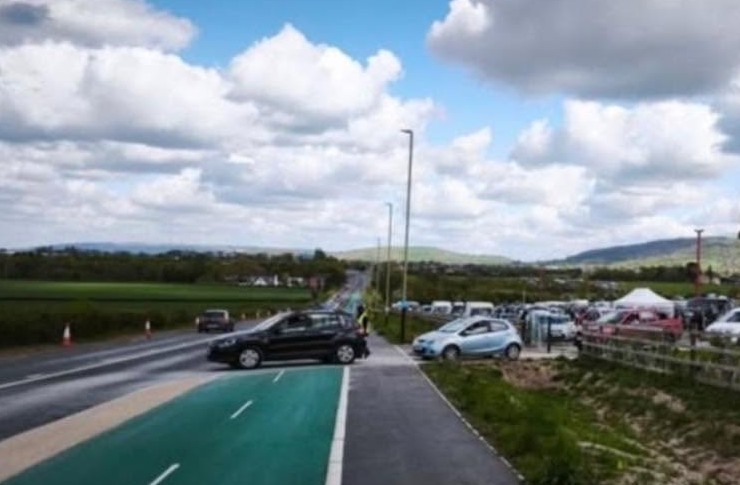

A car boot sale has been granted permission to continue using a site at Cheltenham Racecourse, located next to a newly installed two-way cycle, despite concerns from councillors and highways officers about motorists driving across the new infrastructure.
Earlier this week, Cheltenham Borough Council gave the go-ahead for Cheltenham Car Boot and Market to use an existing parking site near the A435 Evesham Road, north of the Gloucestershire town, for up to 14 days a year.
The 18-acre site is otherwise used as a coach drop-off point for punters visiting Cheltenham Racecourse and was previously the home of another car boot sale until 2014, according to the new market’s planning application, Gloucestershire Live reports.
Reg Daldry, who runs the car boot sale, which began operating at the site earlier this spring, says the plan is for the market to be held on non-race days, noting that it would not require any permanent operational development.
However, Daldry’s plans were opposed by dozens of locals, as well as some councillors and Gloucestershire Highways officers, who pointed to the potential for conflict between motorists accessing the site and the new Cheltenham to Bishop’s Cleeve cycleway.
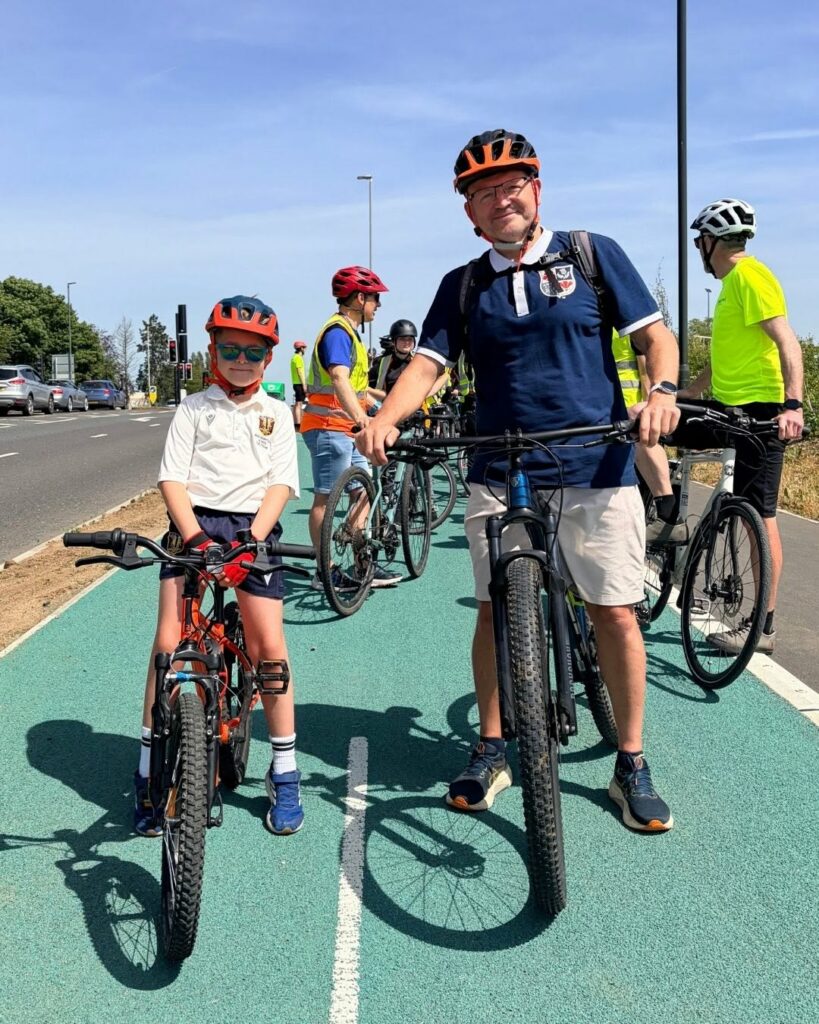
The two-way protected cycleway along Evesham Road was opened last month and marks the second phase of Gloucestershire County Council’s active travel improvements along the road, which also include a new speed limit change from 60mph to 40mph.
“This new cycleway is an important improvement for people travelling between Cheltenham and Bishop’s Cleeve and it’s great to be able to officially open it with the community,” Roger Whyborn, the council’s cabinet member for sustainable transport and strategic highways, said when the cycleway opened in May.
“By creating safer, more accessible routes like this, we’re helping to make walking, wheeling and cycling a realistic choice for everyday journeys, as well as supporting healthier lifestyles and more sustainable travel across the county.”
National Active Travel Commissioner Chris Boardman CBE also praised the new cycle lane, saying: “When you give people a safe, direct and attractive place to ride or walk, they use it – it’s that simple.
“This cycleway isn’t just a piece of infrastructure, it’s an invitation to thousands of people to leave the car at home and travel in a way that’s better for them and better for their community. This is exactly the kind of investment that makes a real difference to real people every single day. It’s particularly encouraging to see this ambition and connectivity in a rural setting.”
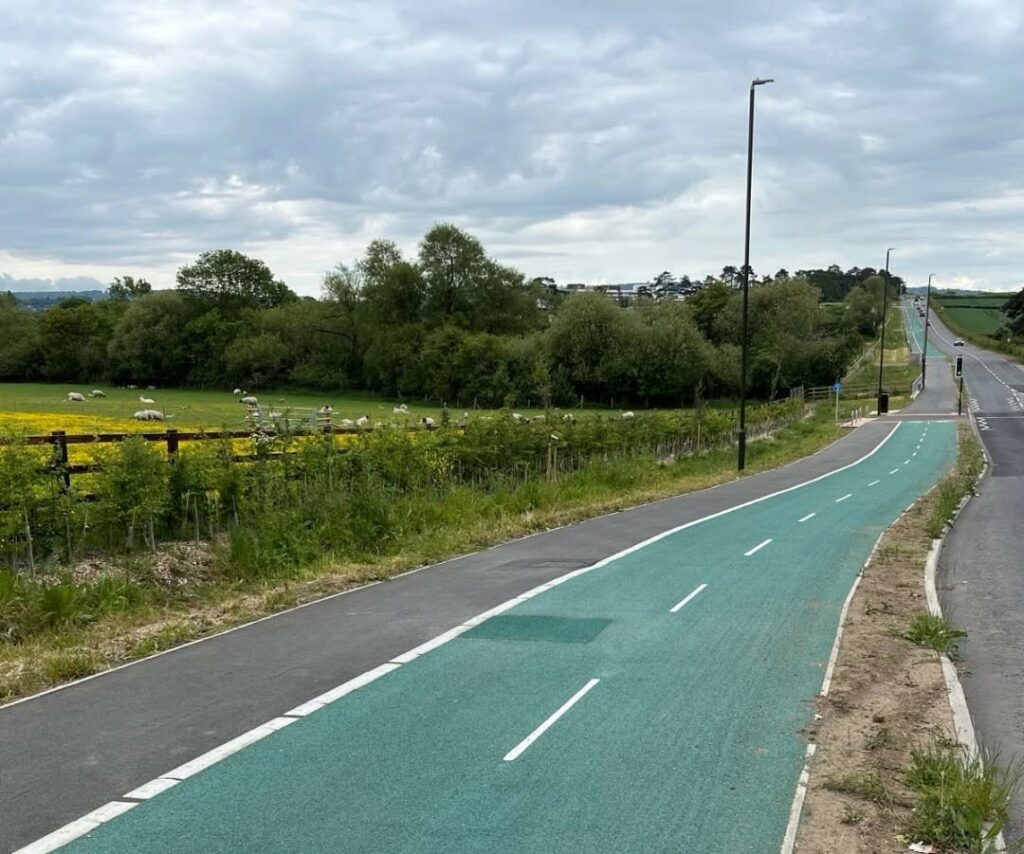
However, just a month after the cycleway’s completion, councillors raised concerns that drivers entering and exiting the new car boot sale will have to cross the two-way path, with the entrance to the site located on a descent, where local politicians say cyclists may be travelling at “moderate to high speeds”.
Liberal Democrat councillor Cheryl Agg posted on social media that the car boot sale posed “safety risks for pedestrians, cyclists, and motorists queuing along the A435 in both directions”.
In response, resident Gwyn Evans asked: “A few hundred cars are a problem, but race week isn’t?”
“During race week, GCC Highways implement a comprehensive traffic management plan under a Temporary Traffic Regulation Order,” Agg replied, “including timed road closures, one‑way systems, resident access restrictions and pedestrian safety measures, all designed to safely manage the significant increase in traffic and footfall.”
> Police seek Cheltenham races reveller who ‘rugby tackled’ cyclist
Speaking at a council meeting discussing the application, Agg’s fellow Lib Dem councillor Roger Whyborn, who holds the cabinet portfolio for road safety, noted that the local authority “recognises” there have been significant congestion problems near the site.
“There is risk to safety of road users where drivers are needing to turn and cross the cycle spine at this location, which needs to be resolved, and the County Council is working to identify further measures to promote safe driver behaviour,” he said.
Daldry, however, questioned why the application was being opposed, telling the meeting: “My planning consultant can’t believe that we are in discussions about this because [Highways] are the ones that designed [the cycleway],” he said. “The car park has been there for 30 years.”
Following the borough council’s decision, which ruled that the car boot sale’s use of the site was lawful and does not require planning permission, Daldry posted online: “Thank you to everyone that supported us on the planning application and the few councillors who also supported us and wrote in.
“Also to the cyclists who also supported us and said we are doing a great job, we really appreciate it.”






30 thoughts on ““The car park has been there for 30 years”: Car boot sale given go-ahead despite safety concerns over “high speed” cyclists on new bike path”
“This cycleway isn’t just a piece of infrastructure, it’s an invitation to thousands of people to leave the car at home and travel in a way that’s better for them and better for their community.”
Er no, a cycleway *is* just a piece of infrastructure. The idea that you need a dedicated cycleway in order to ride a bike is ludicrous and false, and gives succour to those who think that cyclists don’t belong on a road.
@jackcycles On a very busy NSL A road with heavy coach and HGV traffic it makes perfect sense to provide cyclists with a separate carriageway. It’s not saying cyclists don’t belong on the road, it’s saying here’s a great way that everyone can enjoy cycling this route safely, even if they’re a child or elderly person who can’t manage above 10mph. I can’t stand this posturing, usually from fit young racers who do feel safe on such a road, saying that separate cycling infra isn’t necessary. On this sort of road even if every single driver is highly skilled and obeys the law and the Highway Code to the letter cycling would still be a highly unpleasant and somewhat dangerous experience, especially for the aforementioned young or elderly riders, riders lacking in confidence, small riders easily blown around by turbulence etc. Everyone involved, from Chris Boardman down to local cyclists, seems delighted with it; the idea that having a cycleway here isn’t better for all concerned is what’s “ludicrous and false”.
Feels like you’re greeting an old friend there…
Pretty sure that people driving motor vehicles often think that most others are “in the way” and that is generally the case for *different* transport modes “sharing space”. No need to believe that infra will usher that in *!
Indeed Calton Reid’s work on the 1930s UK cycle path project (see britishcycletracks dot com) documents that the suspicions of cycle groups of the time eg. the Cycle Touring Club were correct – the planners *did* want cyclists off the roads! Of course the failure was not in providing cyclists with an alternative and trying to move them there but in letting the drivers of motor vehicles take the roads and streets over.
Between heavy promotion / accommodation for drivers and the resulting unpleasant and dangerous conditions that resulted from so many humans driving, most people ditched the bike.
Interesting to see where vehicular cycling folks fall: are they absolutist (“my right to ride on motorways”)? Do they believe in “accidents” (or maybe the cyclists who die weren’t … skillful enough)? What do they think of all the others not riding – do they (apparently) not care (“I’m alright Jack”), do they think they’re just weak / lazy, is it due to “dangerisation of a perfectly safe activity” (and if so why do many of them think that tiny active travel organisations manage to achieve this propaganda feat) etc.?
* Aside what must be billions spent over the years on pro-driving lobbying, advertising etc. there’s all that ancient human psychological kit of “us and them” and “detecting cheaters”. Plus the fact that while cycling may have partly replaced horse riding the car has taken on its prestige / rank-marking function.
@Rendel Harris Going down the hill was usually Ok ish, it was coming back up that was the problem, especially at night. Near the top it narrowed with hedges on a low wall, not somewhere you would chose to ride on your own in the dark. Best time was race days when it is all stationary!
@jackcycles “The idea that you need a dedicated cycleway in order to ride a bike is ludicrous and false”
You might not need one because you’re a brave cyclist. There are many people in this country who aren’t brave, who don’t like mixing with traffic, and who won’t cycle if they have to. So they need a dedicated cycleway, despite your protestations.
“Just be more assertive” will never, ever work as a tool to enable more cycling.
@jackcycles I’m not sure my grandchildren got that memo. Cycling should not be just for hardened road warriors.
In principle i agree; having ridden this road though more or less every day for 3 years when i worked in cleeve, this is a welcome piece of infrastructure especially in dark winter mornings i can’t tell you the number of times i’ve been within a foot of someone squeezing to get past despite the fact they will inevitably join a queue where I will repass them. They could have widened the road at most points but this now privides a safe route for kids on bikes.
@Rob Hart widening the carriageway increases driver confidence and consequently, driver speeds. Which makes the road more dangerous for all.
@jackcycles – no it reflects the reality that most folk are scared to cycle because of inconsiderate and dangerous drivers. Cycling numbers markedly increase when it is made safe to do so.
As long as cars crossing the cycleway have to wait for bikes to pass rather than vice-versa,.I don’t see a problem.
And maybe a planning obligation to have traffic Marshalls controlling access out of the site not obstructing the path and restricting it if cyclists are likely to be obstructed …one can hope
They might have to, but they won’t.
What they will do is pull out over the cycle path while they wait for a gap in motor traffic.
@bensynnock to be fair, there does seem to be a marshall shown in the picture.
Many years since lived in Cheltenham but if the coach park is where I think it is there is another car park on the opposite side of Evesham rd also part of the race course and has an entrance off the main road and off a side road unlike the coach park it has no hard standing though …
I’m not sure this is a problem really. How often does the car boot sale take place?once a week at most, and not every week either? And not all day. I’m sure all users can manage and it would mean everyone taking car at the entrance / exit.
That – if it is like the photo – seems to be an inadequate and very poor entrance design. Where are the physical features to enforce behaviour?
There will be a queue of cars sitting on the mobility track.
The LHA could have CPOd a small slice of land to make it adequate and given a one or two car standing area by the carriageway with a bent-in mobility track.
I’d say the designers have looked the other way.
They may have looked, but did they see?
Bi-directional cycle paths are very dangerous and councils should use extreme caution when deciding to install them. The problem is the complexity they provide motorists who have to cross them. There was a study made in Berlin that shows you are 12 times more likely to be killed at a crossing on a bi-directional cycle path than if you cycled on the road. https://www.bikexprt.com/bikepol/facil/sidepath/adfc173.htm
@neilmck Other studies have shown different results, however, e.g. a 2025 study in Barcelona showed injury rates on uni-directional cycle paths were slightly higher than on bi-directional ones – I’ll post the link below as otherwise might end up in the black hole of link approval quarantine. The study you cite is from 1990 when in many areas cycle provision was very much in its infancy and drivers were much less accustomed to watching for cyclists in separate infrastructure than they are now. As ever, in my experience at least, the issue is not the cycle lane per se but junction design, with proper mitigating measures e.g. raised tables at junctions, different surface colours, warning signage, set back give ways etc there’s no reason bidirectional lanes should be more dangerous.
@Rendel Harris https://findingspress.org/article/132491-are-two-way-bike-lanes-really-more-dangerous
I agree, the study was made after cycle paths that had been introduced in Berlin during the 70’s and 80’s caused a big increase in cycling deaths. It is an interesting study for cyclists to read in order to know what dangers exist at badly designed junctions. Here in Paris we have very few bi-directional paths. The ones I have cycled on have no building entrances or courtyards (so no cars crossing the path) and every junction is traffic lights to prevent accidents.
Almost any change to roads and streets is accompanied by a period of heightened danger, and in the UK “look out for cyclists” will need to be learned… practically. And over the time it takes for cyclists to become a regular feature.
OTOH once (if…) good designs are in and frequent enough such that drivers encounter them AND the cyclists on them regularly (another big if) I don’t think they should be much more difficult than a footway to deal with.
These things are all over NL – don’t have the collision stats but they should. (NL isn’t perfect but collecting info on the safety of designs to feed back into better designs as required is part of the “sustainable safety” philosophy – if they’re really a killer I think they’d be altering these.)
I use this cycle path regularly. It is used by commuters during the week but it is used more and more by families with young children evenings and weekends when the weather is fine. The car boot takes place on a Sunday which conflicts with this leisure use.
One problem is with cars stopping on the cycle path to wait for a gap in traffic (as in the picture). Even if the car is stopped and there is space behind it, as in the picture, you can’t be sure that the driver won’t reverse or the driver behind won’t close the gap so you have to slow down to almost a stop to get through safely. You would have to dismount as well as you would be using the footway part of the path. This isn’t a huge problem going up the hill into Cheltenham, (coming towards you in the picture) as it is relatively steep and usually against the prevailing wind if there is any, so you are going slowly anyway. Going down the hill however it is easy to reach 30mph and this is where cyclists are going to be seriously inconvenienced by having to slow down and dismount. I don’t think it’s a huge safety issue but it will be annoying.
Obviously the driver should not be blocking the cycle path at all and should wait in the entrance, which has good visibility, until there is a gap in both the road and the cycle path traffic. This is obviously beyond the skill set of the majority of motorists who would not dream of blocking the road but can’t see any problem with blocking the cycle path.
The main problem, however, is with drivers from Cheltenham crossing the oncoming traffic to enter the car boot sale. There may be nothing blocking the cycle path and the drivers will be looking for gaps in the (usually continuous) oncoming traffic. When a gap appears they will go but will they have checked that there are no cyclists on the track who will expect the driver to give them priority as instructed in the highway code. A cyclist coming from Cheltenham down the hill will be travelling at speed from behind the driver and the driver will cut across them from their left if they are not seen. Experienced cyclists will be watching out for this but that is not who the cycle path is intended for, it is intended to encourage new cyclists to get on their bikes.
Another concern is when a driver is turning into the site and does notice a cyclist and does give way. The driver behind may not be expecting the car in front to stop and there is potential for a rear ending incident. The speed limit is 40mph but it is only adhered to in heavy traffic. I rarely drive but I did drive the road recently and I was doing exactly 40mph when I was overtaken.
None of these would be a problem if drivers could be relied upon to obey the highway code but it seems to me that it is asking too much in today’s “drivers come first” and “must drive as fast as possible” mentality.
Finally one time I cycled when the car boot was on there was a person in a hi vis jacket directing the traffic. If the individual has received training then it should be safer but it will still inconvenience cyclists unless we are given priority.
I think you’re giving drivers too much credit. Many would not think twice about blocking the road if it makes their life easier, such as when turning right onto a busy road.
I came this way today with the car boot sale in operation. There was a marshal at the entrance, who stopped a car turning right across the cycleway as I was approaching. So that certainly works. I think it necessary for the marshal to be there, I couldn’t say if the driver would have turned if he hadn’t been there but you always have to suspect the worst.
Unfortunately there is no marshal at the exit, and there was certainly a car stopped across the cycleway as I was approaching it. But he pulled onto the road before I reached it, and the following car stayed off the cycleway as I went through. Ideally there should have been a marshal there too.
On the whole, though, it’s a really high standard piece of infrastructure. Just a pity it doesn’t extend a bit further.
It feels like there’s another answer here. There are lots of car parks at the race course. Originally the car boot was in the one that opens on to Southam Lane. Reverting to that would avoid people attending the car boot crossing the cycle path. Both of these things should be able to exist without conflict. Though Southam Lane is used by cyclists the majority will be using the new Evesham Road cycleway or are on the main routes over Cleeve Hill.
Yesterday, I organised “On Your Bike”, a christening of this new cycle spine from Pittville to Bishops Cleeve. Between 11.30 and 14.30, we recorded 539 cyclists using this cycle path whilst the car boot was still busy. Everybody was kept safe and moving by the car boot sale’s excellent stewards. I don’t see any risk to users of the bike path. I also think its an excellent opportunity for cyclists and other road users to rub shoulders in a positive and friendly way.
I cannot see why a cycling community would want to try and stir and stoke friction with an article like this.
@steve1968smith I wondered why it was so busy. Well done for organising the event. As you say, everyone seemed to be enjoying themselves. It really lifted my spirits.
It seems to me that as long as the Stewards have been trained to appreciate the dangers and give priority to cyclists there will not be a problem but the concerns were raised because, as far as I can tell, there was no requirement for Stewards in the planning application and that is my concern.
I have also been impressed with the number of cyclists using the route for commuting. It could be the weather but if the pattern continues over the winter then the aims of the project will be fulfilled. I also know of a number of families with small children who are using the path to get them on their bikes which bodes well for the future.
Almost every non cyclist I have talked to in the past has told me that no one will use the cycle path. I hope that they witness the nunber of users for themselves and eat humble pie.
Agree completely.
It was great to see the diversity of the people trying the path on Sunday, including many families. Now that they’ve realised that Racecourse Hill is actually rideable, I hope that for those people the path has become normalised.
An objective of the day was also to expose locals to increased traffic on the path so that they became practiced in giving way at the 3 crossings on the descent down through Pittville. Time will tell, but driver behaviours were brilliant and hopefully there’s a growing expectation that there might be a rider coming down the path 🙂
We need some good connectivity at both ends of the path now..
@steve1968smith I appreciate you being the reasonable cyclist here but it was only a matter of time before the locals started moaning about cyclists actually using the new path instead of not using it. As with most of these stories there is more background to the rage bait headline on here. The latest issue came about when the car boot organiser put a post on Facebook about how ‘speeding’ cyclists should be giving way. It was only when he was pulled up on this, and consulted the latest version of the Highway Code, that he edited the post to then start bleating about ‘shared responsibility’ instead. Councillors got involved and that led to the retrospective planning application. Presumably the marshals are sufficiently trained/qualified to direct traffic on the highway? The 14 day limit will likely have no effect either – apparently a previous organiser got round it by dividing the field into four parts and using a different bit each time! You should know as well as anyone that GCC Highways are experts in designing conflict points into their active travel infrastructure.