



Plans to reopen a road in Exeter to motorists – six years on from it being made ‘cycles only’ – have been beset by chaos and confusion this week, after the local authority paused and then reopened a public consultation within the space of two days, amid accusations that it was “sacrificing cyclists’ safety for the sole benefit of drivers”.
The confusion appears to have stemmed from Devon County Council initially stating in January that one option for the scheme would see two-way motor traffic reinstated on Dryden Road, along with a lightly segregated two-way cycle lane separating cyclists from motorists.
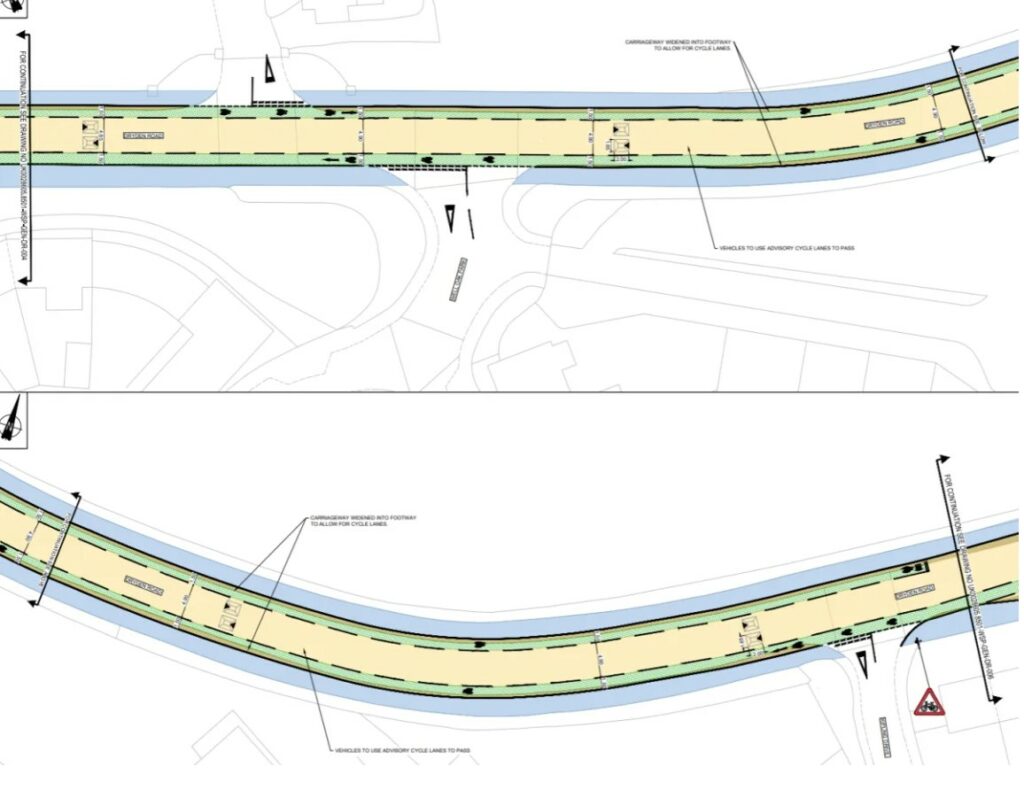
However, when the finalised options for the road were put to the council this month, this protected cycle lane had been replaced by an advisory, painted lane, which drivers could enter in order to pass oncoming vehicles.
According to the council, creating a protected bike route on the road, while retaining two-way traffic, would be “prohibitively expensive, impractical, and unviable” due to the width of the road and the apparent need to remove a retaining wall and encroach on private land to create enough space.
That announcement has been heavily criticised by local cycling campaigners, who say the proposals, which if approved will be carried out using funding from Active Travel England, would only benefit motorists while making a road, which since 2020 has been a safe haven for cyclists, suddenly too dangerous for people on bikes.
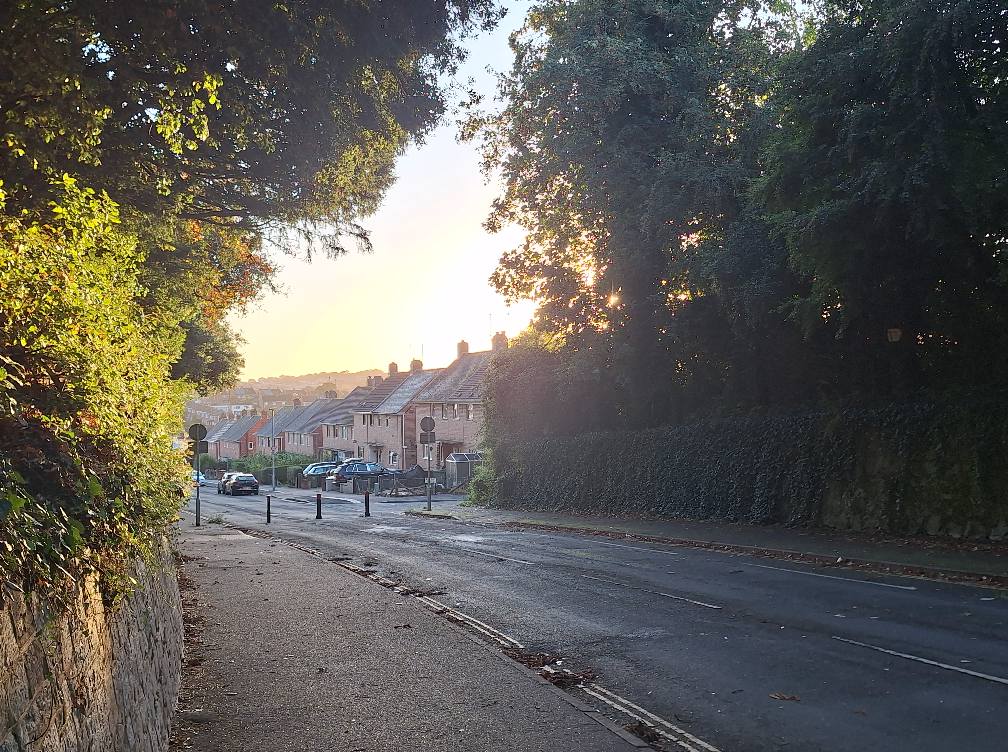
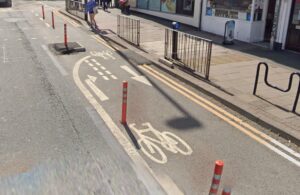
Dryden Road, a key active travel corridor leading to the centre of Exeter, was originally made a ‘cycles only’ route during the Covid pandemic, when Devon County Council opted to install bollards to prevent other traffic accessing the route and “helping to create a safer environment for people cycling”.
The closure was made permanent in 2022, the local authority stating at the time that the move aimed to maintain lower traffic levels in the area and improve the safety and environment for people cycling.
However, as we reported earlier this week, sections of the community have vocally opposed the closure with protests and online discussion, a petition urging the reopening of Dryden Road attracting around 2,500 signatures.
In response to this campaign, the council accepted “concerns were raised about the impact of diverted traffic on nearby roads” and implemented a review, leading to this month’s public consultation.
Giving residents three options, the council said any change would look to deliver on “supporting safe, accessible and attractive walking and cycling routes along Dryden Road, Bovemoors Lane, and the E9 corridor”.
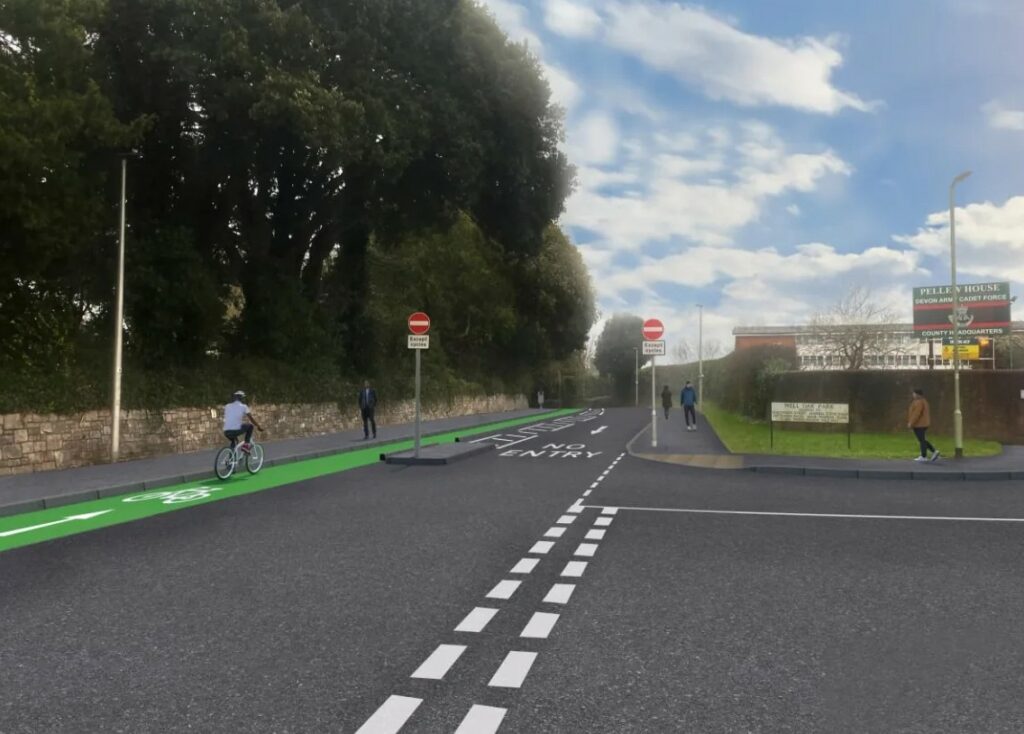
The first proposed option involves the installation of a bus gate which would allow access to “authorised vehicles” such as taxis, waste collection, and the emergency services, while imposing a 20mph speed limit.
The second proposed option would feature the same lowered speed limit, one-way traffic for all motor vehicles allowed, and a contraflow cycleway installed.
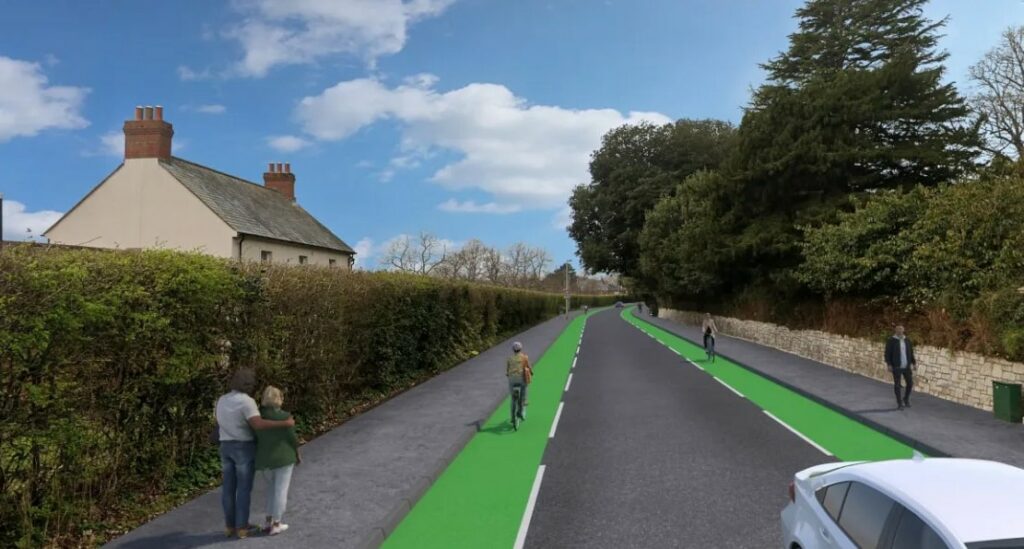
And the third option, the most expensive and most popular with those who have campaigned for the route to be reopened, involves two-way traffic being restored and two-way painted cycle lanes installed.
A further option, known as 3b, would see the road reopened with on-street parking maintained, effectively eliminating any form of cycling infrastructure from the road, something the council admitted would mean “poor” access for those on bikes, while also posing a safety risk.
However, the entire project was shrouded in mystery this week, after the council moved to pause the consultation process – seemingly due to confusion over the lack of protected cycling infrastructure included in option three.
On Wednesday, Devon County Council announced that it had “temporarily paused” the Dryden Road consultation “to clarify aspects of the options”. The council also said it would hold further discussions with the chair of Exeter’s Highways and Traffic Orders Committee at the “earliest opportunity to help identify the next steps”.
Following this announcement, road.cc contacted the council’s cabinet member for climate change, Green Party councillor Jacqui Hodgson, but we have yet to receive a reply.
“It’s a disgrace”
However, on Friday, less than two days after the consultation was halted, the process was reopened again – with no changes made to the options on offer.
In a statement issued to road.cc, Devon County Council indicated that the consultation was paused while councillors asked for clarification on the amendments made to option three between the initial discussions in January and the final designs presented to the public this month.
According to the local authority, in January councillors “agreed to consult on an option for two‑way traffic on Dryden Road with a light‑segregated cycle facility, which uses features such as planters or bollards rather than a full kerb separating cyclists from traffic”.
The council also noted that it was made clear during that initial meeting that the options were “indicative” and “subject to further design work”.
“That work has since shown that a light‑segregated cycle route cannot fit within the existing road width,” the council said.
“It would require third‑party land and the removal of a retaining wall. This was judged to be impractical, very costly, and unviable.”
The new option being consulted on, the local authority continued, “therefore proposes two‑way traffic with an advisory cycle lane, marked by paint”, which can be delivered “within current highway constraints”.
“Drivers may enter the lane when needed,” the council says.
During the pause, councillors “queried the difference between the two approaches and also discussed the sub options for different approaches to parking and cycling at the eastern end of Dryden Road”.
“The pause in the consultation allowed councillors to meet with officers to discuss the issues and agreed to restart the consultation with no change to the consultation options or materials,” the statement added.
That decision to forge ahead with proposals for a painted cycle lane on Dryden Road has come under fire from local cycling campaigners, who say funding specifically allocated for active travel will be spent making the road considerably less safe for people on bikes.
In January, Exeter’s Highways and Traffic Orders Committee confirmed that £55,000 of Active Travel England funding has currently been allocated to support public consultation activities and any ongoing work.
If option three is passed, the council expects to spend between £200,000 and £1m carrying out the work. It is expected that a substantial portion of this sum will be covered by government active travel funding.
“The worst thing is the funding to do this, which will increase danger to cyclists, is coming from the active travel pot,” cycling writer Edward Pickering, the vice-chair of the Exeter Cycling Campaign, told road.cc on Friday.
Pickering added that Dryden Road’s steep incline and blind bend could lead to motorists attempting dangerous overtakes if and when the road is reopened – with option three providing no protection for cyclists navigating their way up the hill.
“We were told by council officers that there was space for pedestrians, two-way traffic, and segregated bike lanes on Dryden Road,” he said. “Now it turns out there isn’t, and surprise, surprise, guess which is going to be the one to give?
“It’s a disgrace. They’re sacrificing cyclists’ safety for the sole benefit of drivers.”
In an open letter to the council’s active travel portfolio holder Hodgson, the Exeter Cycling Campaign said it had “significant concerns” about the plans, which appear set to cut off what has been a vital corridor for cyclists travelling to the city centre.
“We have only ever asked that Dryden Road is kept safe and attractive,” the group said. “The Exeter HATOC required that all consultation options were safe.
“What has emerged in the consultation this week are two options – 2b and 3b – that your own consultation states will not be safe or inclusive.
“We find it unimaginable that you would go to consultation on options for school bus transport or school toilet facilities which you acknowledge will be unsafe and uninclusive. Why is it acceptable for a route to school on a bike?
“This is a Strategic Cycle route. Your officers and those at Exeter City Council have already demonstrated that it has reduced traffic volumes in the areas, reduced air pollution, and grown active travel.
“It seems unbelievable that you are consulting on options to make a route to at least three schools unsafe and uninclusive.”
In a statement issued today, councillor Michael Mitchell, the chair of the Exeter HATOC, said: “It was right to pause briefly while we looked into why the option described to the committee was different in detail to what is now being consulted on.
“I would encourage the community to take part in this important public consultation, the outcome of which will help councillors to decide on the way forward.
“No decision has been made. That will follow at a HATOC meeting later in the year.”



















10 thoughts on ““Sacrificing safety for drivers’ benefit”: Plan to reopen ‘cycling only’ road to motorists using active travel funds branded a “disgrace” – as council dismisses protected bike lanes as “impractical, costly, and unviable””
“The worst thing is the funding to do this, which will increase danger to cyclists, is coming from the active travel pot,” cycling writer Edward Pickering, the vice-chair of the Exeter Cycling Campaign, told road.cc on Friday.”
How can it be that funds to make cycling safer will be used to make it less safer?
I hope Active Travel England will be casting a very sharp eye on this, and demanding that the money is used for what it is intended for, not the opposite. If it is used to make cycling more dangerous, they should demand that it is returned, so that the cost falls on the tax-payers of Exeter.
The article doesn’t mention whether there has been an examination of the economic case, which I suspect would show that there wasn’t one, with re-opening costing more in the long term than leaving it closed to motor traffic.
It’s only natural that they’d try to use the huge active travel pot as we all know that there’s never any money available for new roads etc.
Unfortunately the UK is covered with ill conceived cycle routes built in a rush with no real strategy. The “build it and they will come” mindset taking over from common sense. Routes, often costing millions, built where nobody actually wants them and patchwork provisions in places where they do.
We need to sit down and think what we actually want and then plan where it can go.
Birmingham is the prime example. A massively complex and over engineered bike route from the university to the city centre, built at the cost of a dedicated bus way, now stands largely unused, with ridership decreasing year on year with a sudden massive drop in the last few months. Why? Well it was built in the wrong place. Campaigning cyclists got it built despite being told it was the wrong route to the wrong destination.
Exeter has, it seems, fallen into the same trap. No clear idea of where the demand is, result, a route with no purpose to the many.
We can and should do so much better.
Fair point – not every bike lane is perfect. But in this case, it’s the only safe way for cyclists from the heavily populated eastern districts of Exeter into the city centre. Have a look at a map of Exeter, and you can see that the main thoroughfares from the east are Topsham Road and Honiton Road/Fore St/Heavitree Road. Take it from me that these are not conducive to cycling.
So Dryden Road and the E9 are a pretty well-placed and vital bit of infrastructure. The joining points aren’t all done yet, which is a pain, but it’s getting close to an actual strategic network, rather than random bits of bike path.
Agreed that Exeter needs strategic planning on a complete cycling network, and the roads I mentioned above could easily fit bike lanes as well. E9 is overall not too bad – it links residential areas via quiet and safe (currently) routes to the city centre, passing several schools and the hospital, plus out-of-town offices on the eastern edge. But shoving cars back into this stretch of it is a real backward step, and the council officers’ own report admits that it will be made unsafe enough that it will likely put people off cycling on it. Maybe there are a few bad bike routes out there, but this isn’t one of them.
@TrainWalkWheel RE: “We need to sit down and think what we actually want and then plan where it can go.”
Are you straying into “nobody is swimming the river, we won’t build a bridge” territory? (Or is it “not many are coaching from Brimingham to London, we won’t build a railway”? Only for cycling it’s many orders of magnitude cheaper…)
Certainly councils have “ticked the boxes, got the funds” and “built it not where most needed but where *possible*” ( eg. where they’ll only have complaints about wasting money on cyclists and not death threats from businesses and residents.)
However in many (most? ) cases the “let’s all agree” idea is problematic. Few people cycle, most places are seriously car-sick. And there are some very loud voices ready to steer things away from any change to the unsatisfactory status quo that doesn’t involve more motor provision. (Occasional exception: small areas of pedestrianised streets – that people can drive to).
Why bother then? We can ill afford the growing cost and side effects of growing motoring. Cycling for most would be enhanced walking – and most people walk. It can work together with public transport to genuinely replace car trips.
Places like parts of London, Manchester etc have found that after the dust settles people’s existences weren’t ruined at all and they just get on with life.
What would makes that work? Quantity and building networks. Along with some motor traffic reduction / displacement (alas – that’s the harder part).
But of course in most places – given the motoring push-back and “but costs” – piecemeal infra is all that seems possible.
@
“Unfortunately the UK is covered with ill conceived cycle routes built in a rush with no real strategy. …”
That’s no way to describe the Notional Cycle Network!
Where abouts are you? “Covered” – there’s certainly enough for eg. “(crap) cycling facility of the month” sure … but you’ll be saying that cyclists are “literally running the place” next!
Unfortunately the Cycling Embassy of Great Britain’s site and their “good cycle facility of the month” pages afloat to be no more … but you can still enjoy the unbelievable infra of the Netherlands (but also banal – almost no people making a big deal) care of:
https://bicycledutch.wordpress.com/
Perhaps a review of Britain’s cycle routes would be a good idea. Some weren’t very well thought out before they were installed. It’s obvious that an oil crisis is coming and the cycling infrastructure isn’t ready for those who will need to cycle. Time to work with councils and plan enough temporary routes to cope with it.
That would indeed be of (niche) interest. If you’ve ever time on your hands it can be instructive. A Google Streetview safari. Or much better go in person, get the current state, see how / what works and how it actually *feels* like.
Problem is: interesting for who / what? The politics of change is less about facts and information than it ever was (excerpt far in the past when knowledge was very limited).
And “How we could do it” in an “advanced economy” which has “people who need to drive”, ambulances, “weather”, “narrow streets” and “doesn’t have spare money to spend on people’s hobbies” etc can be experienced … by traveling a bit over 100 miles across the North sea. Or virtually, through probably years of videos available online, plus libraries-worth of reviews, analysis and technical documentation.
There are even “how *you* can get there from a motornormative here” examples around at varying levels of transformation, in Seville, Paris, many places in Scandinavia…
Anyway – having made some small efforts in understanding local infra what usually emerges is a complicated narrative. Even more so if you can actually find the history). Often you find efforts *were* made. Indeed some good designs and forward-thinking choices. In bursts going back surprisingly far. *
But … at the same time we kept rolling out more easy driving! Mass motoring.
Even where efforts were made to reduce conflict active travel almost always got diverted away from the direct route (given over to drivers). Or involved “safety through inconvenience” – long radius at lights, or going “up or down” (over/ under passes). Or was sent places which – at least now – lack “social safety” or have not been maintained.
Turns out that for urban spaces you have to make a choice! Either deliberately favour other modes over driving (including actively making driving less convenient, though still possible) or motoring will take over.
Mass motoring is just too space-inefficient to coexist happily with genuinely good other options. And in fact it makes using other modes less pleasant and convenient. It’s a good (if wildly expensive and destructive) generalist mode – but we’ve made it so that it’s most attractive for almost all trips.
* Ranty Higwayman’s blog has some interesting examples – others like Bicycle Dutch show things both ways eg. what was removed to make way for driving, and how in some places that had been reversed.
So it only take 2500 upset drivers to cause the council to backtrack and pamper to the drivers needs, even if it endangers lives?