


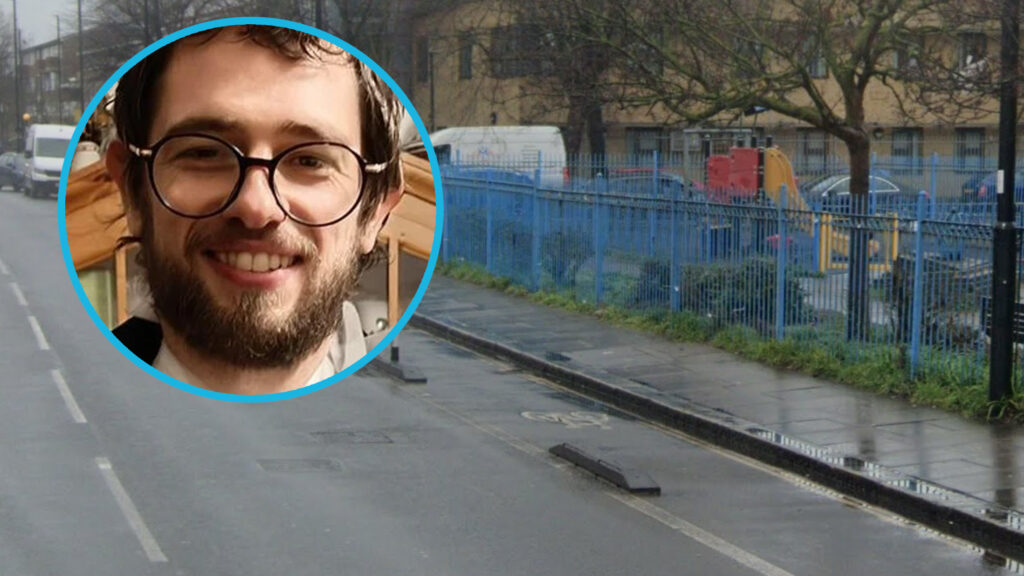

A London cyclist who broke both elbows and his jaw after hitting a plastic divider is suing Enfield Council. In February 2025, Greg Simmons, a screenwriter from Edmonton, was pulling out to pass a stationary bus when his wheel hit the divider, catapulting him over his handlebars and onto the road.
“I looked to pull around a bus and the next minute I was flying through the air over my handlebars. It was just a split second but felt like it lasted for ages and I remember thinking ‘this isn’t going to be good,’” said Simmons.
And it wasn’t good. Simmons attended A&E, where it was found that he’d broken both elbows, and a later X-ray revealed a hairline fracture to his jaw. Doctors have told him he’s suffered 20% muscle loss in his left arm, and he’s still unable to fully straighten it 18 months after the incident – though he has now returned to cycling.
“My left arm is not the same as it was and I don’t think it ever will be,” Simmons told ITV.
“I’ll never have the same strength that I did but I won’t let that affect my life.”
Simmons is currently pursuing a legal case against Enfield Council. However, the local authority is refusing to admit liability, stating that the divider was not defective as it was never designed to have a pole or reflectors.
“The divider is so dangerous without a wand. It’s the same colour as the road and has no reflectors, making it almost impossible to spot when travelling at speed, especially when coupled with other dividers that do have wands,” said Simmons.
“I am lucky that there wasn’t any traffic as I could have been killed. This could happen to somebody else who may not be as lucky.”
Solicitor Osbornes Law is now pursuing a personal injury claim for Simmons, having successfully represented Richard Lander, who suffered a similar incident with a comparable lane divider in Croydon.
> Croydon cyclist breaks wrist after hitting base of cycle lane wand removed by council
“My client suffered serious injuries through no fault of his own because of a safety measure that the council installed,” said Megan Lambert, a specialist personal injury lawyer at Osbornes Law. “He has suffered considerable harm and distress, which has been compounded by the council denying liability. I would urge them to reconsider their position and settle this matter as soon as possible.”
Lane dividers have been a common feature of UK streets since the days of the Covid-19 pandemic, and this writer very nearly had an accident like Simmons’ thanks to a similar wandless divider in Bath, although its smaller size may have helped negate a full-on OTB incident.
Whether Enfield Council will pay up is still in question — bigger dividers seem to be designed purely to keep motorists out of cycle lanes without any forethought on how they’ll affect cyclists. However, they also make cyclists feel safer and reinforce cycle lanes without the council having to dig up roads.














26 thoughts on ““I could have been killed”: London cyclist who broke jaw and both elbows after hitting ‘invisible’ plastic cycle lane divider sues council”
Almost any other color would have been safer. It’s like the council said “How can we injure as many cyclists as possible and also give motorists an excuse for wandering into the bike lane?” Find the idiot in charge of this project and pay Greg out of their pension.
PS Editing is back YAY!
I have every sympathy for Mr Simmons’ injuries but struggling to muster much sympathy for his claim against the council. As a cyclist you’ve got to be scanning the road surface constantly for hazards, be they potholes, broken glass, bin bags et cetera et cetera. Would we have any sympathy for a motorist who hit a cyclist in the cycle lane and blamed the fact that they couldn’t see the lane dividers? How about a motorist who mounted the pavement and hit a pedestrian and offered in mitigation the fact that the kerb was the same colour as the pavement? Sometimes you’ve just got to admit you made a mistake.
What doesn’t really help is that the cycle lane appears to be very narrow. Any cyclist pulling out to avoid a drain or pothole would come very close to those dividers.
The dividers will be very difficult to spot in the dark against oncoming headlights.
I also hope the dividers are not installed at any point where a cyclist may want to turn right off the road, as they are very close together
@Rendel Harris that was my reflex (same as with the folks who were laid low by the Keynsham “optical illusion” cycle lane)…
… but of course it’s easy to say “I would never…” and we know (and civil engineers definitely should) that *humans* operate in the public environment.
Seems foreseeable that low, tarmac coloured orcas/armadillos might cause more problems than they’re designed to fix.
I don’t think the motoring analogy is quite fair. Cyclists already have all the tasks of motorists to deal with. Then additionally “monitoring if we’ve *been* seen”. Plus much more interest in the road surface as you say.
Ultimately cycle *lanes* – even ones with “protection” (short of concrete barriers) aren’t good cycle infra either.
I’m a little confused by your analogies. None of us would have sympathy with driver hitting a cyclist in the cycle lane and blaming barely visible lane dividers, because they should have seen *the cyclist*.
Compensation claims for injury on hitting dangerous potholes are paid out when it is shown that the council are aware of their existence but didn’t fix them. Why should this be any different?
@AidanR Alright, bad analogy. What if a driver pulled in and parked in the cycle lane, inconveniencing cyclists, and claimed in mitigation that he could not see the dividers? I’m not defending the design of the cycle lane, which could indubitably have been done much better, but I maintain that a competent and careful cyclist will be scanning the road surface for hazards, especially when manoeuvering, and should have spotted the offending divider, which, contrary to the claim made, is not actually invisible even if it is less easy to spot than might be desirable.
@Rendel Harris being slightly pedantic, as I understand it, light segregation dividers have no legal significance and therefore irrelevant whether or not a driver saw them before parking in the cycle lane. It is the solid white line demarking a mandatory cycle lane and/or any separate parking/waiting restrictions that carry the legal weight.
More seriously, whilst I agree that of course all road users should be continuously looking out for hazards, it also behooves the council not to go out of their way to create hazards by installing infrastructure that is hard to see.
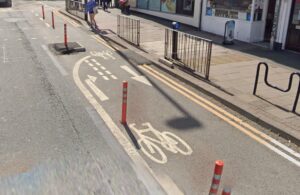
I’m not personally familiar with the relevant stretch of road, but from StreetView and the image on this article, it certainly appears to me that the offending divider is of the type that is meant to have a wand attached – the vast majority of otherwise identical dividers along Hertford Road do have wands. And presumably, the wands exist precisely because it’s pretty obvious that without the wands, the dividers are not especially easy to spot.
I would agree with the victim that this is further compounded by the highly variable approach to the cycle lane. Depending on where you are on Hertford Road (and in some cases which direction you are travelling), the cycle lane varies from entirely unprotected, through light segregation, to proper separation.
Finally, there’s the poor design of the cycle lane being interrupted by the bus stop that forces cyclists to leave the cycle lane to go around stopped buses, and navigate the dividers in the process. It can be tricky to scan effectively for hazards in front whilst simultaneously looking behind to find a gap in the traffic to move out, and then timing the manoeuver to be both in a gap in traffic and a gap in the dividers. Slowing down only makes it harder to merge into the traffic. So not an easy manoeuver to begin with, let alone when the hazards are hard to spot.
@OnYerBike
And a driver who gets upset, reverting to a wonderful blend of effs and cees and threats of bodily harm, when you congratulate them as you take the picture and advise them you are going to post it on http://www.iparklikeawanker.com
Poor infra design leads to poor behaviours.
Lack of enforcement ensures persistent re-offending amidst cries of “I’m only trying to do my job”
The divider wasn’t defective, it was deliberately designed in a dangerous manner? That doesn’t sound like a great defence.
@AidanR Indeed; they make it sound like it was designed to fuck him up. He could add that to the charge sheet.
We all know that if it a similar divider was present in a car lane it would have been painted in yellow and black stripes and covered in reflectors.
“the divider was not defective as it was never designed to have a pole or reflectors”
Or to paraphrase, “It was designed to be lethal and it nearly worked.”
From what I can work out, he left the cycle path due to an obstruction, but in doing so hit the divider.
If he’d crashed into the kerb would he also complain?
I feel it’s on the cyclist to ensure he leaves the cycle lane safely or waits until the bus has moved on.
As cyclists we seem to hate cycle lanes that are just painted on the road, and also hate them if they put a divider like this.
We can’t expect every cycle lane to be 3M wide and away from cars.
@Krislord
“I feel it’s on the cyclist to ensure he leaves the cycle lane safely or waits until the bus has moved on.”
The basic problem here is having a bus stop in the so called “cycle lane”. The safer thing to do is wait till the bus moves off and follow it. This is obviously very inconvenient and time wasting but it does provide a less confident cyclist with a relatively safe option. More confident cyclists should be able to use the road in this situation without constant abuse from irate car drivers.
“We can’t expect every cycle lane to be 3M wide and away from cars.”
Yes we can and we should. This is yet another example where poor infrastructure can be worse than no infrastructure at all.
It’s unfortunate that plastics are only available in black. Otherwise it would be logical to use yellow or orange. Also a shame that there’s nothing like some sort of retro-reflective material that could be placed on them. Something that works a bit like how a cat’s eye does with a torch.
Wow. I feel like an idiot. It turns out that not only does plastic come in colours, but somebody already invented a retro-reflective material. They’ve even made both these innovations available in traffic lane dividers. Then they’ve gone one step further and put a flexible bright and reflective pole on top. What a time to be alive!
I don’t accept that this strange, yellow, luminous plastic like material was made on earth. It is far more likely that it fell off a UFO (maybe as it close-passed a cyclist while travelling at 0.25 x the speed of light).
Obviously if they were only doing a quarter of the speed limit they weren’t doing anything wrong. I mean they had to get past somewhere – what do you want them to do? – sit behind the cyclist at impulse the whole way? Modern flying saucers aren’t designed to go that slow.
I think you could be on to something – that resembles the alien face-technology deployed by Count Binface.
While the failure is on the Highway Authority for installing something that the briefest H&S analysis would have show to be a serious hazard, the fact that these things are installed so widely implies that there is something very wrong with the system.
If they did a risk analysis and it said there was no problem, then that analysis was flawed: if it said that there was a problem but ignored that conclusion, then their decision was flawed: if they didn’t do a risk analysis, then they’re incompetent.
Any cyclist would have told them that having a black lump on a black surface is an accident waiting to happen, so did they even ask any cyclists?
I just did a quick google for ‘cycle lane dividers’ and the first eight were all contrasting colours, some with reflectors.
“… when his wheel hit the divider…”
Come on.
If a driver hits someone the reports would not say
“… when the bonnet/front grill hit the pedestrian…”
@mitsky right.
…when the divider struck his wheel…
…when the divider, which was not wearing a helmet or hi vis, appeared from nowhere in front of his wheel…
I suspect the hard part here will be is the divider really significantly less visible than a standard kerb.
Though I would argue that this can be argued on the basis that they put markers for the lane down, then put orcas/kerbs on the cycle lane side, despite the cycle lane already being substandard or minimum permitted width. (IIRC they are basically banned from putting them on the cars side ‘because it isn’t safe’…)
(See also road work signs; which are almost always put in cyclist or pedestrians path rather than drivers… IMHO they should be required to put them in the road – sure, drivers will occasionally crash into road work signs; But the drivers crashing into said signs because they aren’t paying attention is a LOT better than crashing into workmen because they aren’t paying attention…)
Really the barriers should be within a hatched area; And the cycle lane beyond said hatched area should still have to meet minimum design guidelines to avoid potential liability.
What? This means allocating more space to cycling.
Good…
I apologise for harping on about Marcus Wright’s Transit HN21 VXB, but it’s another example where the police try really hard to not find somebody. They’re pretty good at that sort of thing, looking the other way at all times, lying etc. No MOT for a year ( criminal offence), deliberately making it difficult for the authorities to find the registered keeper (criminal offence), no VED for over 2 years- vehicle regularly seen and filmed around Garstang by me, but apparently never detected by all the ANPR equipped police vehicles regularly seen outside Garstang Police Station or in the adjacent Aldi carpark. When they and the useless PCC want to help out an offender they can do so with impunity, as the Hillsborough protesters found out over decades.
I hope examples like this are considered when people complain about bus bypasses.
Good point – after posting earlier I realised that that would be a better suggestion. Albeit one that’s not so great where there aren’t yet separate cycle paths…