


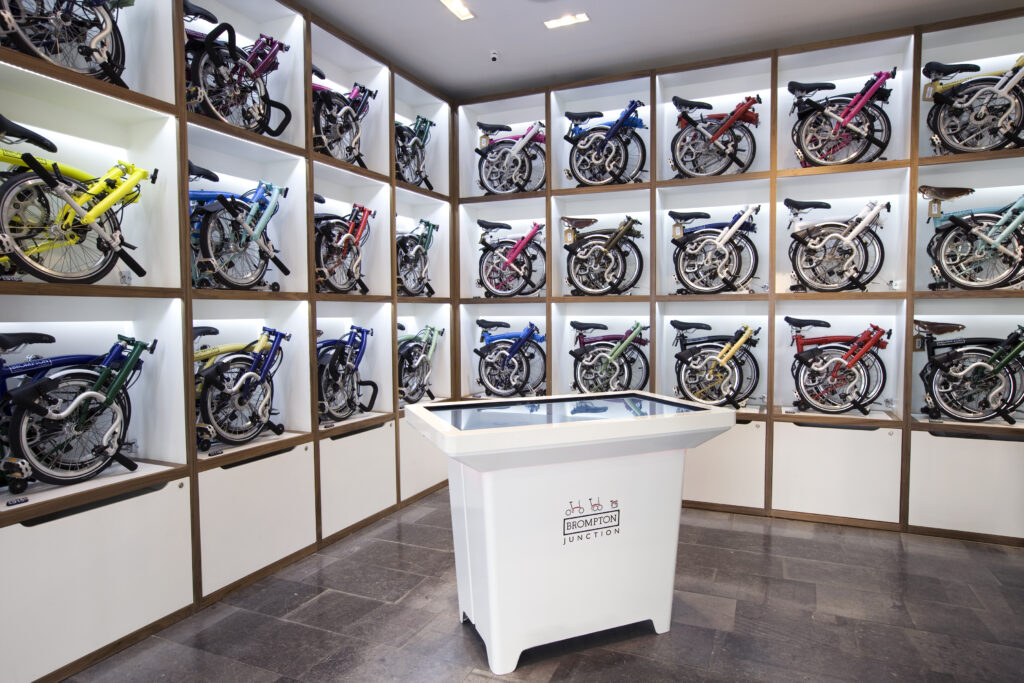

Folding bicycle maker Brompton has leased a warehouse near Heathrow Airport where it has stockpiled parts worth £1 million to minimise disruption to its supply train in the event of a ‘No Deal’ Brexit.
The news comes as the company files its annual report and accounts for the year to 31 March 2018, with turnover rising 11 per cent to £36.1 million.
The increase reflects the impact of increased manufacturing capacity in the first full year of operation at its factory in Greenford, west London.
But with the UK set to leave the European Union on 29 March this year and it looking highly unlikely that Prime Minister Theresa May’s proposed deal will be approved by Parliament, the company is making contingency plans.
The company’s CEO, Will Butler-Adams, has previously said that fall in the value of sterling following the June 2016 referendum had enabled Brompton to reduce prices in overseas markets.
However, its manufacturing capabilities would be threatened with disruption in the event that the UK leaves the EU with no deal and parts and components, whether from Europe or further afield, get held up at customs.
Quoted in the Guardian, Butler-Adams said: “Taking storage [has cost] £50,000 but the implications of running out [of parts] could be £50,000 in a few days.
He also confirmed that the business had engaged consultants Grant Thornton to assist with its “shit hits the fan planning.”
He added: “The most important thing is that we are going to continue to make [it] through Brexit. The rest we’ll muddle through.”
In the year to 31 March 2018, strong sales in the UK saw Brompton’s unit sales for export markets drop from 77 per cent to 71 per cent of the 45,410 units produced.
Pre-tax profit for the year rose from £2.5 million to £3.1 million, with an improvement in gross margin more than making up for the higher operational costs incurred through employing more staff, higher overheads associated with the new factory, and opening own-brand stores in key markets.
Domestically, while some parts of the UK bicycle industry, including distributors and retailers, have struggled in recent months, Butler-Adams believes that Brompton’s distinct products focus will help insulate it from wider industry issues.
“The bike market is still mostly recreational but we are selling in the ‘useful tool for living’ market,” he said. “When things are a bit challenging selling something useful is a strong asset.”
Adding to the company’s positive outlook is that as well as its factory now fully operational, the electric model of its folding bike is now on the market after several years of development costs hitting the bottom line.
The bike launched in the UK in August, almost six months into the current financial year, with 750 units already sold, ahead of a rollout to several European countries over the next couple of months.









60 thoughts on “Brompton stockpiles £1m in parts as contingency for “shit hits the fan” No Deal Brexit”
The only winners from Brexit
The only winners from Brexit are warehouse owners. No doubt part of the 52%.
NPlus1BikelightsNJerseys
And Brompton, who have increased their overseas sales thanks to a weaker pound.
The only winners from Brexit
The only winners from Brexit are warehouse owners. No doubt part of the 52%.
Duplicate comments bought to you by F-At’s laggy servers.
NPlus1BikelightsNJerseys
We wanna delete button now!
burtthebike wrote:
Warehouse owners won’t be
Warehouse owners won’t be winners when they have to recruit a whole new workforce as they can’t get EU labour to come here anymore.
muhasib wrote:
This is an important question about Brexit – what will employers do when their access to relatively cheap, well-motivated and relatively skilled labour is restricted?
They could invest more in training UK workers/potential workers, or invest more in other productivity improvement (e.g. IT, automation, leaner processes) – which would be good.
Or they could pass on their own increased costs to consumers, or perhaps even (depending on their business) move activity overseas – which would be bad.
The answer is almost certainly all of the above depending on cirumstances – but the balance will be critical.
Duncann wrote:
Indeed it is. We will see a lot of investment in automation and an accompanying increase in productivity; hopefully it’ll be UK companies supplying the kit too, as we are generally very technologically capable (UK.gov IT excepted). Productivity has been on its arse in developed economies for years because it has always been cheaper to simply import more cheap labour.
Screw Brompton for their
Screw Brompton for their treachery! I shall boycott them and ride to work on my unicorn instead, munching on extremely bendy bananas as I go, and stroking my precious blue passport.
handlebarcam wrote:
Which pocket are you keeping the passport in?
burtthebike wrote:
We Brexiteers don’t need a passport, because we facking hate facking foreigners. Who’d want to leave this glorious isle?
srchar wrote:
Fair point, but I was more wondering whether the action of stroking it could be misunderstood.
Surely there must’ve some pro
Surely there must be some pro Brexit readers of road.cc who can string an amusing sentence together. No? Perhaps not.
Still don’t see how this is
Still don’t see how this is going to effect the supply chain, that has no lofgic behind it?
Given most parts come from outside the EU and it’ll cost less to buy from outside the EU post leaving this is a bit of a risk, unless they beleive that the pound will drop massively in the near future?
Remember what happened in 2008 when all the analysts got it completely wrong, remember how the pound bounced back, suppose none of you remember when the travel shops were offering 96-97p to 1 Euro?
They already saw an upturn post Brexit announcement, what makes them think this is going to dramatically change? Isn’t there going to be greater demand for bikes due to finances of families/individuals, the pushing of motors out of towns and cities, particularly places like London which are having an ultra low emission zone so most people can’t afford to run cars and some might actually buy bikes.
Good luck to them whatever happens but it’s a typical panic reaction IMHO that has already cost them 5% of the total purchase at the very least.
BehindTheBikesheds wrote:
Go on, how will that work?
don simon fbpe wrote:
The EU mandates import duties on bikes and bike parts. I can’t remember the exact figures off the top of my head, but it’s something like 15% for bikes and 5% for parts.
One would hope that the UK government would see fit to lower import duties post-Brexit in order to improve competitiveness.
srchar wrote:
Why would the EU impose such a tariff? I see that some countries are targetted to nearly 50%…
don simon fbpe wrote:
Protectionism, which I don’t find as distasteful as many free-market economists.
However, when you’re forcing everyone to pay more for their food than they otherwise would, in order to keep the inefficient French farming industry afloat, and your central bank sets monetary policy with the sole aim of keeping German manufacturing dominant, it starts to taste rather sour.
srchar wrote:
Given that btbs is promoting cheaper cycling in a no deal brexageddon, how bad an idea would it be to scrap these tariffs? And we’ve touched on the currency fluctuations as being a bit too risky. How are we going to achieve this cheap cycling utopia?
don simon fbpe wrote:
It would be an excellent idea, but we are currently prevented from doing so by dint of our membership of the customs union.
srchar wrote:
Then what would happen? And we’re back to why they are there in the first place. Wouldn’t it just allow cheap (and nasty) manufacturers to fill the market place with more junk. For protectionism to work, surely you need a manufacturing base to protect?
don simon fbpe wrote:
I don’t follow you Don. We’re leaving the customs union, which means we’ll be free to set our own tariffs. What happens next is up to the government of the day. Readers of this article may prefer to leave tariffs in place on folding bikes, to protect Brompton, set them low or zero on other types of bike in order to make cycling cheaper and therefore more attractive, and set them to a zillion percent on eBikes to stop people arguing about them.
srchar wrote:
I’m trying to establish how BTBS is so sure that the cost of cycling will fall after Brexit. It won’t be imo, as the tariffs are set to prevent the dumping of cheap bikes (good if you’re a capitalist) and cost us more to get kit from Europe. Simply the fact of having freedom to set our own tariffs isn’t a sufficient answer in my book without knowing why they are there and what the consequences will be if and when they change. of course, there will always be a market for BSOs too.
don simon fbpe wrote:
How? There aren’t any tariffs on goods from other EU member states.
srchar wrote:
We won’t be a member state after brexit and after the “easiest negotiation ever” there won’t be a deal, hence stockpiling and trucks playing around airfields. But at least we’ll be out.
don simon fbpe wrote:
Where did I say “cheaper cycling”? I said that the tariffs will reduce and that the pound isn’t necessarily going to get worse (based on previous shit hitting the fan situations) whilst Brompton will have greater opportunity for new business as even the UK tries to get more people on bikes, never mind international sales. They’ve had a significant upturn DESPITE the Brexit vote and all the fall-out from that.
However Brompton have at the very least cost themselves 5% additional costs upfront at the least (not including notional losses due to the large sum spent on stock). It’s a considered risk/contigency but based on what, that the pound is going to slump further? It’s certainly not going to be supply chain as mentioned, that’s laughable nonsense even worse case scenario unless their suppliers have a complete factory shut down/ship sinks or we go to war, basically biblical events and extremely rare scenarios that would/could occur and zero to do with Brexit.
But please tell us where I said cheaper cycling, maybe you think inflation doesn’t exist either?
srchar wrote:
have you travelled much? I have, and groceries in the U.K. are generally a lot cheaper than any other similarly developed country. France, for example, is at least 25% more expensive for the average shopping basket, and so is North America in my experience. As soon as anyone trots our lines like yours I just assume they get their opinions from the latest moggmentum press release
Nick T]
Yes, lots. Not my experience at all. Did you not visit a Carrefour, Lidl or Walmart? More a Whole Foods person?
srchar wrote:
I’ve lived in France so I’m familiar with all things monoprix, carrefour, super U etc thank you very much. I rarely eat strawberries in France when they’re sold for 10€ per punnet in those shops, I haven’t tried Lidl over there and I’ve never been to one in the U.K. either – I gather they are very cheap in the U.K. though, which is handy for my argument. Not just food either, cosmetics are vastly cheaper in the U.K. than either France or the US. My girlfriend would spend $50 on dry shampoo from Sephora in San Francisco, that’s under a tenner here.
Trader Joes was my local in the US, I went to Whole Foods from time to time if passing though. Both pricier than Tesco in my experience.
Nick T wrote:
I still do live in France, and the Strawberries are a good example of the difference between UK and French shops: French shoppers tend to respect the seasons. In Spring they live on cherries and strawberries when they are cheap, in Summer its melons and courgettes, and in winter, cabbages and cauliflower. Strawberries in winter, just like cauliflowers in May are extortionate. British shoppers in contrast, expect to buy their plastic wrapped baby corn at any time of year, flown from the far east or South America and fcuk the planet. Follow the French example here and food is cheaper than the UK. Try to live like a Brit, and money won’t go far.
Griff500 wrote:
I’ll pass this advice on to my French family members who’ve lived in Paris all their lives
Nick T wrote:
We were subsidising our own farmers long before we joined the EU. It is totally wrong to pin farm subsidies as an EU invention. Moreover our own farmers have made it clear to their Conservative MPs that they require subsidies to continues pots Brexit! (We subsidise our own to drive Range Rovers, we subsidise French farmers to drive Berlingo vans. Go figure.)
srchar wrote:
Nail head hit, as in this is the inherent issue/attitude which has landed us in this mess…. all the logic and good reason and intent behind the portion of 17million voters who did not get fooled by a bus sign and yet still voted to leave…. “ONE WOULD HOPE THAT THE UK GOVERNMENT could would should be able to project manage the ginormous without precedent project of leaving the EU right for just once..’oh yes’ says Nigel Farage, ‘of course we can… if a pissed up fool like me can make a living with one storyline for 10years, then we can do anything’
Of course if anyone had stopped to think prior to that referendum, when has any political persuasion of government in recent years managed any ‘project’ on time, without compromise, or general fuckwitedness.. I still cringe when I remember Holyrood being built… which was costed out to a £40m spend for a ‘new parliament in Scotland’ to be built.. and was delivered three years over time and at a cost of a whopping £414m (that’s not a typo).. (yes I know it’s Scottish, but it’s a great example). Stopping mid-rant cause I’m boring myself.
peted76 wrote:
Indeed. Brexit was a vote against something, not for something. Lots of people voted for what they wanted, not what was offered. As someone said, it was like a vote to paint the room a different colour without agreeing what the new colour would be. Lots of people seemed to assume they would get their desired outcome but instead we haven’t a clue what the hell we’ll get and there’s a strong possibility it will be an extreme of Corbynista left or Moggish right that actually very few people wanted.
The Holyrood criticism is a bit unfair on project management grounds – that particular design was never a £40m building. But it does say something about politicians and voters more generally – that the former think the latter will only vote for too-good-to-be true promises about how cheap and easy it will all be and that the reality of hard work, focusing through detail, and making choices and compromises won’t win votes. I think Brexit tend s to support that view.
Duncann wrote:
Probably the best analogy I have heard Sir! We all knew what we had wasn’t white, it certainly had beige tinges, but ask 4 Brexiteers what colour they voted for and you will get 5 different answers.
peted76 wrote:
My fear is that without tariffs, the likes of Brompton wouldn’t exist. So much for supporting British manufacturing.
[img]
https://images-na.ssl-images-amazon.com/images/I/61207nH%2BgUL._SL1000_.jpg%5B/img%5D
Anyone for a top quality Chedech?
I though part of the confused argument was to not give give Johnny Foreigner our jobs and money. Can you sort yourselves out, please?
don simon fbpe wrote:
I quite like that Chedech – a carbon folding bike. Does Brompton do one? Not actually looking to buy a folding bike, but I’m always intrigued by the designs of them.
BehindTheBikesheds wrote:
I’d say it’s sound contingency planning and, essentially, a bet worth placing; due to our comedic politicians, nobody knows what shape Brexit will take even at this late stage. IMHO, the government would be mad to try to process every inbound lorry if they’ve not put a workable system in place by the end of March; goods should continue to roll through the ports unimpeded, however there’s always the chance that the government will f*ck it up. I’m an optimist about most things, but this is the UK government we’re talking about.
I also have my eyes on the ground. I’m not going to go into too much detail, because I wouldn’t fancy being identified and dogpiled, but I own and run a small IT consultancy based in the City and have a part-share of two widget-manufacturing businesses based in the provinces. Business has never been better; EU sales have shrunk a little as the Eurozone enters recession, but sales to the US and Canada have more than doubled as we’ve become cheaper while maintaining quality, and the Chinese more expensive while still shipping junk. All three businesses have taken on more staff and increased staff remuneration and, if the trend holds up, at least one of the manufacturing firms will be investing in plant and, yes, we will be buying British. Big Business loves the EU and the barriers to entry it throws up; SMEs that make up the bulk of UK GDP, not so much.
When you’re consuming the reportage of our broadly pro- Big Business news media, don’t forget to follow the money…
BehindTheBikesheds wrote:
Ah, the boost to GDP from the
Ah, the boost to GDP from the project fear tax. Still, I suppose its slightly better to store their Schwalbe tyres in Crawley than watch them get burned along with our sheep in Calais…or maybe we could burn our own livestock, just like the old days… We could have pyres along the Channel Coast
Ah, the boost to GDP from the
Ah, the boost to GDP from the project fear tax. Still, I suppose its slightly better to store their Schwalbe tyres in Crawley than watch them get burned along with our sheep in Calais…or maybe we could burn our own livestock, just like the old days… We could have pyres along the Channel Coast
Ah, the boost to GDP from the
Ah, the boost to GDP from the project fear tax. Still, I suppose its slightly better to store their Schwalbe tyres in Crawley than watch them get burned along with our sheep in Calais…or maybe we could burn our own livestock, just like the old days… We could have pyres along the Channel Coast
Ah, the boost to GDP from the
Ah, the boost to GDP from the project fear tax. Still, I suppose its slightly better to store their Schwalbe tyres in Crawley than watch them get burned along with our sheep in Calais…or maybe we could burn our own livestock, just like the old days… We could have pyres along the Channel Coast
Chris Hayes wrote:
JHC, bring on the delete button now!
If a weak pound is such a
If a weak pound is such a boon to manufacturers like Brompton, moreso even than tens of thousands of pounds of costs every few days, and work the negative effects on other types of businesses, then there are other ways it could have been achieved other than by becoming an international laughing stock, stripping people of their rights, and emboldening racist scum.
handlebarcam wrote:
It isn’t. A weak pound only helps exporters in the short term, typically as long as their forward currency hedge lasts . As everything from steel to orange juice is traded in dollars, and the UK imports everything from steel to orange juice, a falling pound damages manufacturing industry. (Take a look at Jaguar. In 2016 they could export every car they could build. Now they are on a 3 day week)
Griff500 wrote:
This is incorrect. Let’s say you make widgets out of 500g of aluminium that costs $2/kg. You sell those widgets for $10.
When GBPUSD is 2, your aluminium costs $1, or 50p. Your sale price is £5, or £4.50 profit per widget.
When GBPUSD is 1, your aluminium now costs £1. Your sale price, however is now £10, so £9 profit per widget. However, we’re going to take this opportunity to cut the price of our widgets, so we win more business, driving growth.
Obviously, it is even better if you hedged your FX exposure at 2, as your raw materials still cost 50p, but it’s plain wrong to suggest that it all goes to shit when your last FX option expires.
That is a very simplified example, but it illustrates the point; manufacturing is all about adding value. If you’re an exporter, the value you add is essentially priced according to the home currency of your customers.
Jag are f*cked because nobody wants to buy their diesels anymore.
srchar wrote:
You’ll have to explain the immediate doubling of sale price. I would imagine that unless the customers’ salary increases at a similar rate that there would be a dramatic drop off of unit sales. I would expect the sale price to remain the same and profit to decrease. As my profit decreases I’d start looking for a cheaper source of employee, perhaps even join a trading block in order to source these people and increase my market…
don simon fbpe wrote:
In the example, we are exporting to the US. Customers in the US pay $10 for our product. At 2 bucks to the pound, that’s a fiver. At 1:1, it’s a crisp tenner.
However, like Brompton, we would cut our prices in that example to a level that will increase units sold while maintaining an increased margin, in order to increase overall sales.
You’d have to be mad to join a trading bloc with which you’d run a perpetual trade defecit, unless you are happy to take on the increased debt that inevitably comes with it. How are we doing on public and personal indebtedness in the UK at the moment…?
srchar wrote:
You of course missed the orange juice. Devaluation leads to wage inflation because much of our food is imported and the Jag workers still need to feed their kids oj and pork bellies, and the cost of gas to heat the factory is priced in dollars, and the robots to do the machining priced in dollars… .
Then of course there is the fact that we aren’t selling in dollars, 42% of what we sell is sold in euros, and the euro is also suffering partly because of Brexit, so buying in dollars and selling in euros, we lose.
As I said, long term, devaluation doesn’t help manufacturers at all.
As for Jag diesels? Sales of F type (all petrol) have plummeted, as have their hybrid SUVs. German manufacturers don’t seem to be struggling, despite being at the centre of the diesel scandal.
It isn’t binary. srchar makes
It isn’t binary. srchar makes a very good case for a British company that sees an opportunity for growth and is making investment in the UK to realise that potential. He is taking a view, taking the risk with his capital and will hopefully stand to make the rewards if things work out as he expects.
Leaving aside the economic impact of Brexit which the overwhelming majority of UK industry view as having negative consequences. I personally resent that so many of the freedoms, rights and opportunities that I and my children had to live, work, travel and study in Europe are no longer guaranteed. I never lost my country, I never felt under threat of EU regulations (most of which act for my benefit) and above all I have never resented migrants who come to the UK to fulfill vital roles and contribute to our society.
Mungecrundle wrote:
I agree and think both the UK and the EU will be poorer (in many senses) for Brexit.
The European Union is like a
The European Union is like a girlfriend you’ve broken up with and have since found out was only using you for you money and preferred her other friends to you anyway. Half of you is torn with fond memories of good times but after you’ve split it turns out she really never felt the same way and actually used to treat you with disdain but really you were too love struck to see it.
It’s a bit like if Scotland split, they’d soon regret it but we wouldn’t give a duck.
Anyway, what sort of person rides Brompton?
Yorkshire wallet wrote:
Alternatively, the EU was a loyal girlfriend that provided you many years of peaceful if unexciting living. You’ve now had a mid-life crisis, shagged Tracy from accounts as she promised much with her low cut blouse and wonder bra, now you’ve co-habited you realise they have swung below the belly button, she made a strange comment about your last taxi driver and she pissed herself round at your mothers on boxing day!
alansmurphy wrote:
That sounds far too detailed to be simply a metaphor. Good Christmas Alan?
Oh, and fuck Brexit.
Surely the go-to folding bike
Surely the go-to folding bike is the Bikerton; beloved of city gents, nuns and helicopter-owning playboys.
https://www.youtube.com/watch?v=shxHFCi673A
The Brompton is just a wannabe.
She makes a lousy brew as well 🙁
Currently EU tariffs are set
Currently EU tariffs are set to protect industry across the EU.
So, for example, if the EU sets tariffs on the import of bikes or components to protect German/French and Italian manufacturers then everybody pays more for their bikes regardless of whether their country actually produces any.
There are currently tariffs of 15% on bikes and 5% on components.
In a no-deal Brexit we would be able to adjust our tariffs to only protect industries in the UK. So tariff free standard carbon road bikes and high tariffs on folding bicycles.
Most bikes would get a lot cheaper which will encourage more people to cycle.
Even if the £ fell by 15% the price paid by the consumer would still be no higher than it is now.
Tariffs are even higher for other products so you’d likely see a big drop in living costs if tariffs were set to zero on anything not produced in the UK.
Rich_cb]In a no-deal Brexit
And so it goes on. Reducing tariff (and non-tariff) barriers is a good objective but a no-deal Brexit is just as likely to see them increase. We’re leaving a tariff-free area of half a bilion consumers and entering… well, what? More barriers to trading with our largest market for a start (in the case of a no-deal Brexit).
Brexiteers often talk about how we could negotiate better deals as if other countries are queuing up to give us whatever we want (also what they said about the EU…). Where’s the evidence? As far as I can tell, trade deals take a long time and plenty compromise. Other countries want concessions to lower their tariffs: will the Great British Public give India the immigration visas it wants? Or accept US genetically-modified food or liberalise access to the sainted NHS?
I’m not sure it’s really the cost of bikes which is deterring people…
Duncann wrote:
Cost is a barrier to entry. Reducing barriers to entry can never be a bad thing.
Trade deals do come with compromises.
Our current deal with the EU involves compromises on immigration, taxation and law making.
Despite these compromises it isn’t even a true ‘single market’ for the service sector which makes up 80% of our GDP.