


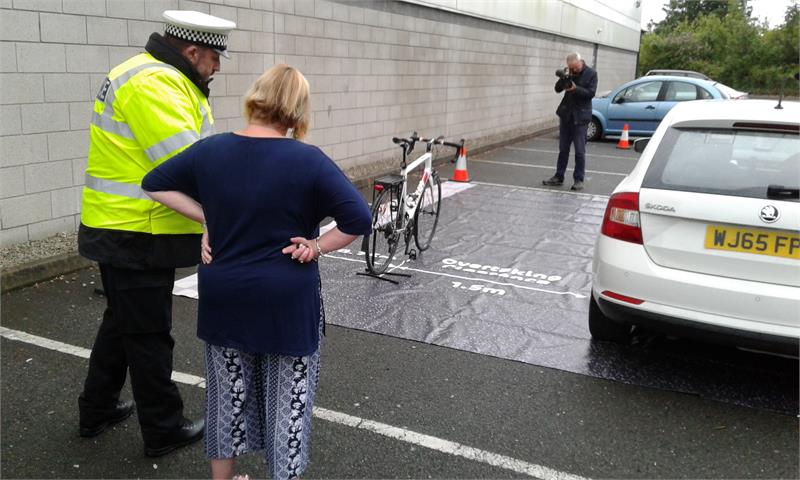

More than half of British drivers are not aware of Highway Code advice for safely passing cyclists, according to a survey carried out for Cycling UK. Eight per cent said that drivers should only give cyclists space that is at least the width of their handlebars.
The ComRes survey of 2,039 British adults found that 52 per cent of motorists weren’t aware that the Highway Code recommendation is to give cyclists at least as much space as you would a car when overtaking.
Duncan Dollimore, Head of Campaigns at Cycling UK, said: “These figures show most close passes come from a position of ignorance rather than malicious intent.”
Government needs to change Highway Code rules on overtaking cyclists and car dooring says Cycling UK
The data was released as the Department for Transport (Dft) announces that driving instructors are to be offered bespoke training on cycle safety.
Speaking at the Cycle City Active City conference in Manchester today, Transport Minister Jesse Norman will say: “The benefits of cycling and walking are enormous. We shouldn’t only concentrate on catching and punishing drivers when they make a mistake but try to ensure that they have the skills and knowledge to drive safely alongside cyclists in all conditions.”
Dollimore said: “Cycling UK has long argued that the driver training and testing processes should ensure that drivers are made aware of and understand both cyclists’ needs and their safety. Training the trainers, and embedding cyclists’ safety in the mindset of driving instructors, is a fantastic first step towards achieving this.
“But education and awareness on its own is not enough, which is why close pass operations by police forces have proved so effective in places like the West Midlands.”
As part of today’s announcement, the DfT also says that police forces are to be provided with training materials and support to educate drivers on how to safely pass cyclists.
“It’s fantastic that there’s now a commitment to make additional government resources available to help the police crackdown on close passing,” said Dollimore. “Cycling UK looks forward to working with the Department for Transport, as we have with willing police forces, to try to make sure this initiative helps lead to close pass policing being the norm, not the exception.”
In July 2017, Cycling UK launched its Too Close for Comfort campaign. Following a crowdfunding initiative, it has so far provided 38 out of 45 police forces across the UK with close pass mats with which to conduct public awareness campaigns and road traffic operations.
The close pass mats are modelled on those used in West Midlands Traffic Police’s pioneering road safety operation ‘Give Space, Be Safe’.
The operation resulted in a 50 per cent reduction in reported close pass offences in its first three months. The force also reported a 20 per cent reduction in casualties among vulnerable road users over the course of a year when national road casualty figures had shown an increase.











48 thoughts on “Half of drivers unaware of Highway Code advice on passing cyclists”
And most of the other half
And most of the other half know what it says but wilfully ignore it.
While getting driving
While getting driving instructors informed about how to pass cyclists is welcome, it is utterly staggering that they need to be informed. How do you become a driving instructor without knowing this? If you are instructing someone in the safe operation of a machine which regularly kills and you don’t know the basics, should you really be allowed to carry on doing it?
The fact that most drivers don’t know what the HC says isn’t really a surprise, as they’ve studied to pass their test and then forgotten almost everything that doesn’t impinge on their own safety. Top marks to CUK for their close pass campaign, but why aren’t the government doing it? Sorry, forgot, it’s only cyclists.
How about making the HC less
How about making the HC less ambiguous and state a minimum 1.5m passing distance?
Looking at that picture,
Looking at that picture, should the 1.5m not be taken from the outside of the handlebar, not the line of the wheels of the bike?
Got close-passed against
Got close-passed against oncoming traffic on a bend by a DI a couple of years back. Apparantly my fault because I was in the middle of the road #cockwomble
kil0ran wrote:
Yep been close passed several times by driving instructor cars,one overtook me once crossing a solid white line with oncoming traffic,obviously was late for his next lesson. I’m more bothered when it’s clearly a learner driver under instruction, and the instructor isnt doing their job properly and they let them overtake in dangerous situations like between pedestrian refuges or close to junctions or one I had priority on the road,and the learner still drove straight at me to pass a parked car on their side
kil0ran wrote:
Sadly instructors seem to be no better (especially whe on thier own) that any other idiot. In the last couple of months alone I’ve had one carve across from being parked facing the traffic waiting to board a ferry – Was firmly told to shift it, which he did, straight into a flow of traffic without looking.
I had one with a pupil clearly tell the pupil to pull out (saw his hand gestures) straight in front of me while riding, despite solidly visible clothing and a front light on flash.
A close pass along the cycle lane as he drivted onto the white line, checking his mobile. . . caught up with him in his convertible BMW at the next lights and enquired if he’s like me to refer the incident to the Police .. his reply was not exctly polite.
No pupil also tends to mean no indicators when on the motorway.
I did my motorcycle licence
I did my motorcycle licence last year, and on chatting about stuff with the instructor, I was absolutely staggered to discover that there is no ‘curriculum’ for driving/motorcycle instructors to follow when teaching.
What this means is that once they have done the instructor training and test, instructors are left to teach however they like, which for the most part means whatever is necessary to pass the test (as most instructors will be judged on pass rate and speed at which students get through to and pass the test).
I chose my motorcycle instructor based on the fact he’d teach me how to ride safely and how to properly handle the motorcycle – the test became a simple formality.
The other issue is that the annoucement will only impact on new drivers or those required to retrain due to ban or whatever. It will not pick up on those already on the road. The close pass initiative is a good step, but it only picks up on one issue and only gets to a minority of road users.
Solution? Simple. Require everyone to go through refresher training and maybe a re-test every 10 years until 60 years of age, and then every 5 years after that. This will pick up on all ‘bad habits’ that drivers (myself included) tend to fall into and also offer the opportunity to inform people of new rules, advice, best practice, etc.
joules1975 wrote:
But first… a mandatory theory test for anyone who has never passed one, seeing as knowing the rules seems to be a large-scale problem. I think this should be done immediately, ie. your licence is revoked after, say 6 months from now, if you don’t pass the theory test in that time. Probably more practical to not renew licences when it’s renewal time until they pass the theory test … although, I’ve never needed to renew mine after 20 years, so there are cracks in the system.
[/quote]
But first… a mandatory theory test for anyone who has never passed one, seeing as knowing the rules seems to be a large-scale problem. I think this should be done immediately, ie. your licence is revoked after, say 6 months from now, if you don’t pass the theory test in that time. Probably more practical to not renew licences when it’s renewal time until they pass the theory test … although, I’ve never needed to renew mine after 20 years, so there are cracks in the system.
[/quote]
All driving tests since the thirties have included an element of theory. Unlike the modern computer based test it was previously an oral section, conducted by the examiner after the drive ended.
I grant that it wasn’t as lengthy as today’s test but it still frightened many candidates.
I had a close pass last week
I had a close pass last week and I managed to catch up with the driver as she happened to be going the same route as me, so I confronted her with “you almost killed me back there” and she responded with “I was nowhere near you”! I submitted footage to Avon & Somerset Police and they sent her a nice little letter with some pictures to demonstrate how close she was.
I propose mandatory retests for drivers every 10 years as a single test for a lifetime of driving is simply not practical.
hawkinspeter wrote:
And as I say every time someone suggests this why do you think your arbitrary 10 years is any better than 9 years, or 8,7,6,5,4,3,2 how about annually or even every week, why not retest daily. The test purely proves you are fit to pass that day, the very next day you can drive however the hell you like because the real issue is there’s precious little enforcement of traffic law !!! Retests will never solve that problem
Awavey wrote:
I propose mandatory retests for drivers every 10 years as a single test for a lifetime of driving is simply not practical.
— Awavey And as I say every time someone suggests this why do you think your arbitrary 10 years is any better than 9 years, or 8,7,6,5,4,3,2 how about annually or even every week, why not retest daily. The test purely proves you are fit to pass that day, the very next day you can drive however the hell you like because the real issue is there’s precious little enforcement of traffic law !!! Retests will never solve that problem— hawkinspeter
It’s an arbitrary length of time, but I think 10 years is long enough to not create an unacceptable burden on drivers. Personally, I’d be happy with drivers taking a test every year along with the MOT, but I don’t think that would be at all popular.
The other think that retesting would help with is people with slow degenerative conditions that may not realise that they’ve become unfit to drive or maybe just need new glasses.
Totally agree about the enforcement aspect. I’ve long been a fan of ordinary people being able to submit photo/video footage for things like red light jumping and bad parking with maybe some percentage of the driver’s fine going to the submitter(s).
Awavey wrote:
I propose mandatory retests for drivers every 10 years as a single test for a lifetime of driving is simply not practical.
— Awavey And as I say every time someone suggests this why do you think your arbitrary 10 years is any better than 9 years, or 8,7,6,5,4,3,2 how about annually or even every week, why not retest daily. The test purely proves you are fit to pass that day, the very next day you can drive however the hell you like because the real issue is there’s precious little enforcement of traffic law !!! Retests will never solve that problem— hawkinspeter
I had to sit a driving test when I moved to Canada for a short period after 12 years of driving in the UK. It was the best thing I ever did for my driving. Assuming that the majority of people are reasonably sensible a chance to reflect on your skills and approach to the road will improve things – it will also weed out those whose skills have deteriorated due to age or illness. Over there you driving licence only lasts 5 years. When you renew it they check your eye sight and update you on any rule changes.
hawkinspeter wrote:
Did she give any reason for not using what appears to be an empty lane in which to overtake?
hirsute wrote:
When she denied it being a close pass, I declared it a police matter and cycled off (slowly and in primary just because I’m an asshole).
In the police report, I did stress the unnecessary nature of the close pass and the other lane was clear for her to use as far as I can tell (I’ve got front camera footage as well).
The stupid thing is that if she had just apologised to me, I probably wouldn’t have bothered submitting it to the police.
hawkinspeter wrote:
— hawkinspeterThanks. I think I would have behaved likewise (and not for the first time).
The problem as I see it is
The problem as I see it is the highway code needs changing to be more specific.
The last point of Rule 163. “give motorcyclists, cyclists and horse riders at least as much room as you would when overtaking a car (see Rules 211-215)”
Some drivers overtake cars with inches to spare, guess they see this as plenty of room, so then apply the same to overtaking cyclists.
Can we get a 1.5m rule in the highway code?
tugglesthegreat wrote:
Yes, this. I think the HC is ambiguous.
Simple solution to me would be 1.5m, but that is hard to visualise… better perhaps as suggested to say ‘cross completely over the white line when overtaking’.
But then what about narrow country lanes with no centre line?
I suspect many motorists have
I suspect many motorists have a deep-seated fear about crossing a line – they won’t give room because they fear they’ll get in trouble for “crossing the line” (as if it’ll be like crossing the streams or something…).
It’s like those cases you see
It’s like those cases you see on Youtube where a motorist goes off the deep end because a cyclist touched their car (I know! apparently that, like, attracts an actual death penalty in some Merican states ) – anyway, they don’t ever seem able to grasp that if the cyclist could touch their car then they were way too close…
Mind you, many motorists also seem unable to grasp that a cyclist passing stationary motor vehicles on their inside with just enough room to get their handlebars through (we’ve all done it) is in no way the same as a motor vehicle close passing a bicycle at 10-20 mph speed difference.
I’ve been close passed, caught up with the motorist (who stopped in a traffic queue fifty yards further on, naturally), and had them tell me that it was fine because they’d seen me going just as close up the inside of the queue (of stationary traffic!).
brooksby wrote:
I can’t remember where I read this, but a comparison that might make the difference between passing and being passed clear to people in general: Go to a car park and walk between the rows of parked cars, get as close as you can, brush their wing mirrors. Then stand still while someone drives past you with the same clearance.
Having been close passed by a
Having been close passed by a learner driver under instruction a few months ago it’s pretty clear a significant portion either don’t give a fuck about safety of people on bikes or they are not fit to be instructing the next generation of killers.
learner coming towards a row of three/four parked cars on their side of the road, I’m already well in view before they get to the parked cars and they carry straight on to overtake, I’m in primary to dissuade the manoeure but still they prress on. We meet and there are two inches between me and the motorvehicles wing mirror.
He eventually, I presume, tells his charge to stop, I ask why hasn’t he told her to give way to me, “there’s enough space” says he, no there isn’t I respond and tell him you’ve taken no account whatsoever for my safety, there’s simply not enough space to drive past me and no leeway whatsoever for either yourself nor for me, if a gust of wind, a pothole, a micro incremental change of direction occurs there’s a collision. He’s adament there’s space, he’s a fucktard so I reported him to DVSA. Got a blah blah response back, no evidence yadda yadda.
My road is fairly quiet leading to where I live and is used by learner drivers all the time, I’ve seen some very poor instruction, failure to indicate or simply leaving the motor in the middle of the carriageway 9like a metre away from the kerb ffs!) facing in the opposite direction of travel thus causing an obstruction, not parked so should be indicating they are waiting/alighting, that’s what the fecking indicators are for!
BehindTheBikesheds wrote:
Did you consider sticking your elbow out a bit?
I had someone go past me last week at 40mph+ with only a few inches to spare – not a pleasant experience.
What I don’t understand, is
What I don’t understand, is why should motorists be suprised by this rule? Surely if you are passing a a more vunerable road user, you’d think common sense would tell you that you should give them as much room as possible. Why would you just give a a few inches if you have a whole lane you could move into?
Well you’ve gone and asked
Well you’ve gone and asked and answered all the question for me. I guess there’s nothing for me to do. I’ve even changed the argument from consistency in direction into safety in your last post…
Parking facing one way or the
Parking facing one way or the other makes no difference to anything, unless it’s on a one-way street. Making drivers do a u-turn or whatever to park in the direction of travel for that side of the road would probably be more dangerous.
I sometimes probably don’t signal when overtaking a cyclist if there’s no-one else to see me signalling. A cyclist shouldn’t really need to be aware that you’re about to overtake if you’re doing it appropriately.
Also, if you encounter a learner driver, probably a good idea to anticipate that they might make errors, after all, they haven’t passed their test yet. Could be their first lesson, could be Maureen from Driving School. Obviously, some things shouldn’t be allowed to get out of control though.
I hope not annoy anyone or
I hope not annoy anyone or actually join in the getting shouty arguement, but this thread is about the Highway Code and-
Rule 239
…If you have to stop on the roadside:
do not park facing against the traffic flow
Now it’s not a MUST or a SHOULD but it is in there.
I appreciate the thinking
I appreciate the thinking behind the advanced drivers use of indicators, but it’s really poorly thought out. If you only indicate when you can see the “target” of your indicating then you are going to be compounding any situation where you don’t happen to see the other road user or pedestrian. However, if you mindlessly indicate whenever you make a maneouvre, then I can’t think of any situation where that actually causes a problem.
Unfortunately, it’s all too common to see cars pull out of parking spaces or side roads without indicating and the perps never look like advanced drivers to me, otherwise wouldn’t they have recognised the possibility that traffic could approach unseen and thus need the warning that a vehicle is about to perform a maneouvre? Don’t even get me started on people’s observation skills and the number of drivers that don’t spot cyclists and thus don’t indicate for their benefit.
Another situation where drivers may not indicate is when there’s 2 lines of slow moving/stationary traffic and a vehicle changes lanes. Most of the time, they wouldn’t be able to see a cyclist filtering between the lines yet the only advanced clue that the cyclist would get would be the indicators.
hawkinspeter wrote:
That’s not what has been said, read again what actually has been said, indicate IF someone else in the vicinity will benefit from an indication. You assess where there might be people you could reasonably expect to appear from, a blind junction for instance, an overgrown hedge, possibly even dark shadow. That’s why I said it’s about making you think about the why, you’re not just assessing the overtake but those around you and possibilities of those that might come into play. There are many circumstances where indicating is utterly futile and wasteful, it shows lack of thinking/assessment on the part of those that do it ‘automatically’. That automatic/little thinking driving gets replicated all the time and people get into bad habits/stop thinking enough about each and every manoeuvre they take whilst behind the wheel of a killing machine. This is in part why we have over a million crashes/180,000+ injuries on the road every year in the supposed third best country in the world. Driving is reduced to moronic levels and even those with the best intentions fail to grasp why they do x all the time and from that mistakes are made.
If you aren’t assessing your driving and why you do stuff all the time then you aren’t doing it right.
BehindTheBikesheds wrote:
Okay – that’s a fair point about indicating for a possible target and that does mitigate some of my concerns.
However, it’s the failure mode that worries me. If you make a mistake in judgement and decide not to indicate when there is a hidden cyclist then you compound the mistake in a dangerous fashion. If instead, you mistakenly indicate when there’s no-one around who cares, then you’ve just wasted a tiny bit of effort.
I certainly agree with the continual self-assessment/improvement aspect of driving/cycling and the idea of being mindfull/aware as lack of awareness is probably the biggest driving mistake. It’s interesting to get the reasoning behind the advanced driving tuition even though I’ve never got around to learning to drive as I see it just from the cyclsts’ point of view. Personally, I’m not concerned about drivers indicating when overtaking so much as it’s usually easy to tell from the sound of a vehicle that it’s about to overtake (and also I’d have to look behind/use a mirror to see the indicator).
The big problem for me is drivers pulling out or turning without indicating and the idea that drivers dont have to indicate for pedestrians (I’m not saying that you’re pushing that idea) really bugs me. On my bike, I always make an effort to indicate (stick out a hand) when it could be useful for a pedestrian and, following my own advice, sometimes do it when noone’s around.
hawkinspeter wrote:
Unfortunately BTBS is convinced of his own infallibility. He’s absolutely certain that every time he looks carefully he will see everything he needs to see. This is categorically, neurologically, physiologically, and logically utterly indefensible. He is trying to make out that an intense effort that has catastrophic costs if it fails is somehow a superior strategy to a simple habit that has no cost if it is unnecessary. The silly thing is, the good driver will do all of his things, and still indicate because they recognise their own fallibilty, and that it is a superior, safer strategy. .
madcarew wrote:
I’m more interested in why driving instructors (advanced or not) are teaching the “optional” indicating philosophy rather than any one person’s driving ability/safety. BTBS is not the only person who has been taught this method, so I’m wondering why this is so.
If a driver does a good job of considering all relevant blind spots, then their behaviour becomes indistinguishable from a driver that habitually indicates.
hawkinspeter wrote:
In my case, the driving instructor explained it as careful observation and then not indicating was prefereable to careful observation and indicating for the sake of it because the latter could just be habitual, without the careful observation bit.
I totally disagreed with him over that interpretation and the assumption of careful observation, we had a brief debate about what was more useful in The Real World vs impressing an examiner, then another about omniscience, and then I signalled all the time just to piss him off.
davel wrote:
“Careful observation” is one of those things that can cover any idealised situation (e.g. you should have spotted from the direction of the wheels of a parked car that it may suddenly pull out) but realistically human observation has a number of known weaknesses (despite mitigations).
As long as someone is paying attention on the road, then most incidents can be avoided, so it’s the inattentive people that need to improve their skills. Inattentive and indicating is not ideal but is much better than inattentive and not indicating.
hawkinspeter wrote:
or when turning into a side road, even though indicating would inform pedestrians intending to cross what the driver is intending, especially key as the majority of drivers are unaware they should give way to pedestrians crossing side roads when they are turning into them.
1. “give cyclists at least as
1. “give cyclists at least as much space as you would a car” is not good enough and needs changing. some drivers would happily give another car inches.
2. “driving instructors are to be offered bespoke training” This is also not good enough, tell them they have training they need to take, or they will have their training license removed.
kie7077 wrote:
give as much room, not pass as close to, a car does not fit in inches, not sure if you are misinterpreting the rules, or suggesting that drivers all misinterpret them as they are not clear.
wycombewheeler wrote:
The problem is that the rule is ambiguous – when you ‘give room’, is the room that you are giving that between you and the other road user, or is it all of that available to the left of you for the other road user to occupy? Someone who interprets it as the former would leave a lot less space than someone who assumes the latter, and it’s not clear which was intended when it was written.
Last December the driving
Last December the driving test manoeuvres in the UK changed. Stopping on the right was (controversially) introduced, which is why people now see Approved Driving Instructors teaching this. Many ADI’s strongly disagreed with this decision however the DVSA took advice from the Association of Chief Police Officers who agreed that it was not an illegal act during daytime. (Tests only occur during daytime). DVSA also released information on a H&S audit on the manoeuvre to support it’s introduction.
I neither support it nor oppose it.
How’s the hangover, I will
How’s the hangover, I will assume that you were pissed. And yes, apology accepted.
Interestingly, you’re not, are you?
I wish we could set up a poll
I wish we could set up a poll: how many road.cc people have ever been overtaken by any other road user with a separation at the distance shown in the photo at the top of the article? Ever??
brooksby wrote:
My guesstimate is about 50% of overtakes are at that distance or even greater. It also depends on the road as overtakes in and around cities tend to be a lot closer than on less congested roads. I’ve got no stats to back that up, though and usually people only remember the bad overtakes.
brooksby wrote:
Odlly enough, I went out for an amble on my bike on Saturday in S London and was pleasantly surprised to note that not one single driver failed to overtake with an acceptable degree of respect and caution.
brooksby wrote:
Loads of times – town and country – and i’m in the same neck of the woods as you. A decent group of passes are nearer but still not at all worrying due to relative speed or other conditions. Rarely get a really shitty pass, more pull-outs than those, but then again I hardly ever go through the city centre and tend to not bother with busy urban roads where it makes sense / have another, nicer route even when I commute.
Are motorists going to get
Are motorists going to get their imaginary rulers out for each pass on a cyclist? Giving a measurement is dumb. The rule should simply be: use the other side of the road (defined by the white lines down the middle!).
Mr Blissta wrote:
If a motorist can’t judge a simple distance without a ruler, then they shouldn’t be driving. Do they need their ruler for stopping distances too?
Using “the other side of the road” would be nice except for all the exceptions (e.g. one way roads) and I think it would lead to more confusion.
The advantage of specifying a minimum distance is clarity – everone knows what 1.5m is.
hawkinspeter wrote:
To your ruler point- frankly many drivers haven’t a clue what their stopping distances are either! Actually they do have those chevrons on short sections of motorways to show recommended separation between cars. Maybe they could start painting those on roads to show the recommended gap between car and cyclist.
My rule of thumb in a car is always to give enough room so that if the cyclist fell off sideways as I passed, I would avoid them. If there was not enough room to do this on a narrow road, then I slow down to pass at a speed at which I could stop if necessary.
A minimum distance of 1.5m would at least give a quantifiable threshold for prosecution if a complaint is raised.