



It was five years ago that Classics specialist Philippe Gilbert won Paris-Roubaix, and you could hear the cheers not just in the iconic Roubaix Velodrome, but also at Specialized HQ in California, the new Roubaix road bike that he piloted to victory having been launched just a few days previously.
After winning in 2018, Peter Sagan – also riding the new Roubaix – was one of the hot favourites to take victory, but it wasn’t to be. An exciting and dramatic race full of crashes and punctures resulted in a popular victory for Gilbert. In an incredibly successful career, the Belgian rider had already won the World Road Race Championships, Tour of Flanders, Liège–Bastogne–Liège, Giro di Lombardia, Strade Bianche, and stages in all three Grand Tours. The 2019 Paris-Roubaix was Gilbert’s fifth and final Monument victory.
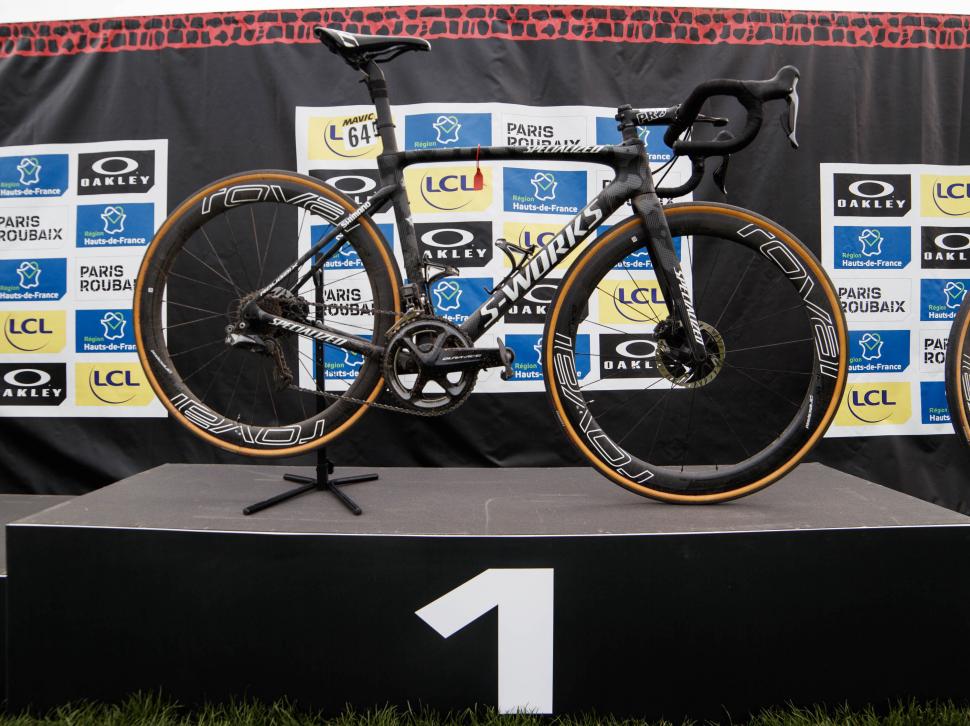 Gilbert beat Nils Politt in a sprint, riding the brand-new Roubaix endurance bike. It featured a frame that was lighter and, Specialized said, more aerodynamically efficient than previously, plus an improved Future Shock 2.0 system with rebound and compression damping and on-the-fly adjustment. The new bike came with disc brakes and space to fit tyres up to 33mm wide.
> Specialized Roubaix 2020 First Look: Everything you need to know about the new endurance bike
Like the rest of the Deceuninck-Quick Step riders, Gilbert was riding a Roubaix with a special ‘pro fit’ geometry with stack and reach measurements matching those of the Tarmac lightweight road bike. The regular Roubaix was a little shorter and had a front end that was a touch higher to suit riders less used to spending all day in an aggressive race position.
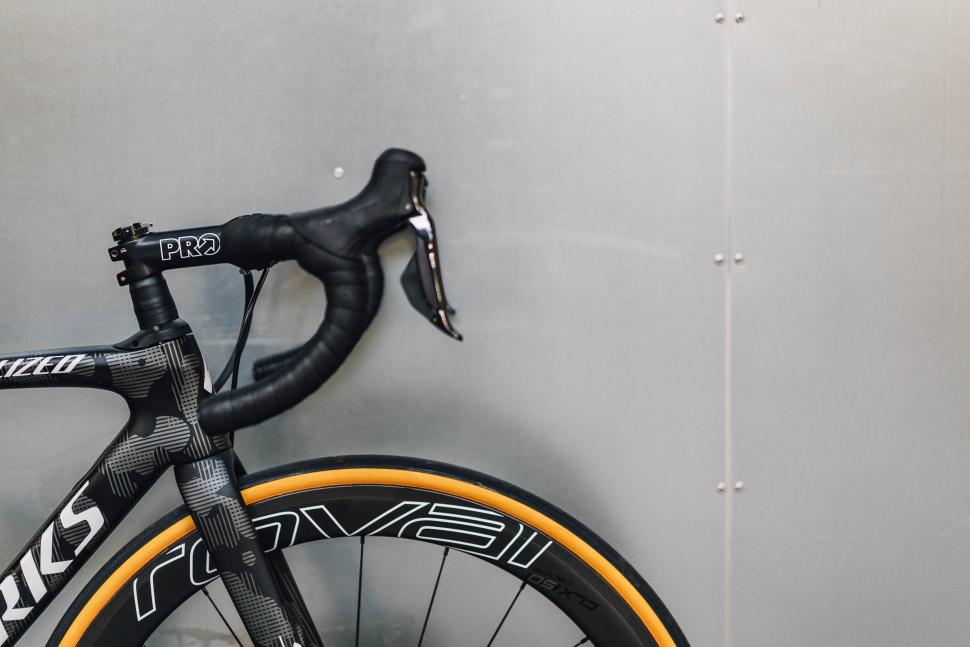 Key to the bike was the 20mm of suspension provided by the Future Shock 2.0 (Specialized has updated its Future Shock designs since then; we’re up to Future Shock 3.0 now), which could be locked out via a dial on the top of the fork steerer. Specialized has also introduced hydraulic rebound and compression damping designed to provide a smoother, more controlled action over the repeated hits of the cobbles.
There was also a new Pavé seatpost which was held in pace with a 65mm dropped internal seat clamp, the idea being to allow the saddle to move back and forth to try and match the bump-absorbing action of the Future Shock 2.0.
Those features were wrapped up in a frame that was a claimed 900g – lighter than Specialized’s Venge, the aero road bike that has since been discontinued. Speaking of aerodynamics, this Roubaix was the first that had been specially designed to reduce drag, Specialized claiming that it was more efficient than its Tarmac SL6 road bike.
The Deceuninck-Quick Step made a few special modifications for Paris-Roubaix. First, the team used a prototype Future Shock 2.0 dial with more pronounced edges and grip tape, so they could rotate it with their palm if needed. There was also a blob of white paint so the rider could easily tell if the Future Shock 2.0 was open or firm.
Some people on social media suggested that Gilbert didn’t have a functioning Future Shock and that it was permanently locked out. That wasn’t the case. You could see him operating the dial before and after cobbled sectors and the riding photo at the top of this page shows the rubber boot below the stem slightly compressed.
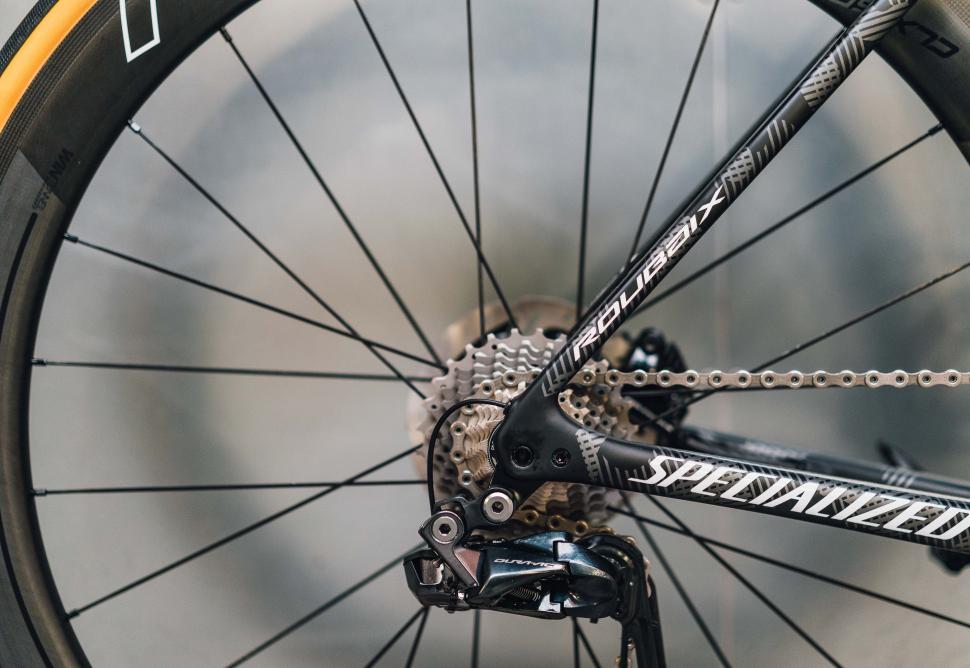 Although Sagan went with a mechanical groupset, Gilbert used a regular Shimano Dura-Ace Di2 groupset which served him well where others had issues. He had small Di2 sprint shifter buttons inside the hoods for changing gears in the drops. Gilbert also used a Shimano Dura-Ace power meter and Shimano SPD-SL pedals.
All Specialized sponsored riders were rolling on Roval CLX50 wheels with a choice of 28 or 30mm-wide Specialized S-Works Turbo tubular tyres. Gilbert opted for 28s. None of the Deceuninck-Quick Step riders suffered a puncture during the 257km race.
While Sagan opted for a special Roubaix with rim brakes to win Paris-Roubaix in 2018, all Specialized riders used disc brakes in 2019, as did many others, including second-placed Nils Politt whose Canyon was specced with the new version of SRAM’s Red eTap AXS groupset.
Gilbert’s race notes were taped to the 125mm Pro Vibe aluminium stem and an aluminium Pro handlebar was double-wrapped with bar tape right up to the stem. A K-Edge out-front mount secured his Garmin computer in place. His handlebar was a traditional shape, with a deep drop to provide a very aggressive and aero position.
One intriguing detail was an Allen key taped behind the seatpost. It was there so that the rider could remove the thru-axles holding the wheels into the frame/fork while waiting for the team vehicle/neutral service to arrive with a spare wheel. Interesting, but maybe it would have been more sensible to revert to thru-axles with levers for this race because that would surely be easier than fumbling with a tool taped to the post.
Although it was a brand-new bike when Philippe Gilbert rode it to victory, the Roubaix has been updated since then. The latest version, the Roubaix SL8, was unveiled last year, and you can find out all about it here.



















12 thoughts on “Check out the Specialized Roubaix that Philippe Gilbert rode to Paris-Roubaix victory in 2019”
A nice bike, here’s mine…
A nice bike, here’s mine… photo has C38s (38mm depth) with 25mm tyres on it, I’ve since put CLIIs (60/51mm depth) on with 30mm front tyre and 28mm rear tyre, fast and comfortable.
Looks good. Nice low position
Looks good. Nice low position too.
A 140mm rotor at the front?
A 140mm rotor at the front? How does it perform?
Absolutely fine – they’re
Absolutely fine – they’re Shimano ICE tech rotors & pads which helps. It’s fairly hilly where I live (Dorset) and I’m 87kg so they get tested on some biggish descents. No fading and no warping to report.
Useless and not needed. I
Useless and not needed. I have an endurance bike from prev gen and its unconformtable as f***. I ride a SSE4 now with wide wheels (reserve) and 28mm tires that blow up to 30. The bike floats on bad roads and is faster then anything I rode before on good and bad roads. Just fit a 30/32mm tire for very bad roads. Tires and rims make the different not these gimmicks and then riding 25mm tires …
wickedstealthy wrote:
So useless, in fact, that Gilbert won the hardest pro monument on it. What suits you best may not suit a pro and vice versa. I can’t speak for the 2019 version but I have a 2014 Roubaix Dura Ace SL4 Pro and I can assure you that the shock absorption systems on that are far from useless or not needed, they work beautifully and make it easily the most comfortable race bike I’ve ever owned.
The bike after which a cycle
The bike after which a cycle race and a town in France were named.
Yup! Like the city in Italy
Yup! Like the city in Italy and the famous French caesar were named after a cake… (ask Shelly Tambo from “Northern Exposure”)!
Like the cycle race named
Like the cycle race named after a pastry?
And did the patissier try to
And did the patissier try to sue the race organisers for infringing his trade mark?
Is that a torte in law?
Is that a torte in law? ?
If so, it is to be hoped that
It’s certainly to be hoped that any wrongdoers got their just desserts.