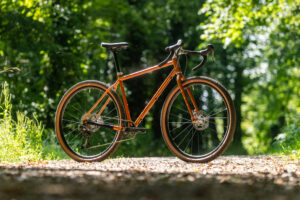
After a relatively quiet spell in the gravel bike market, Whyte has returned with a new line-up, including the Verro. Marketed as a go-anywhere, do-it-all machine, it comes with mounts for almost every accessory you could need and a geometry designed to inspire confidence rather than intimidate. It’s a bike built for pushing limits, although it does seem to be crying out for a suspension fork to make the most of its potential.
- Best gravel bikes 2025 — drop-bar bikes for off-road riding
- Canyon Grizl CF 7 gravel bike review
- Gravel bike suspension and dropper posts – do you need them?
Whyte Verro – Technical Details
Within Whyte’s updated gravel range sits the Tourus, aimed at light gravel, utility, commuting, and touring. It uses a double chainset, comes with 45mm tyres, and is priced at £1,299. The Verro shares the same alloy 6061 frameset, but steps things up with different components and specifications.
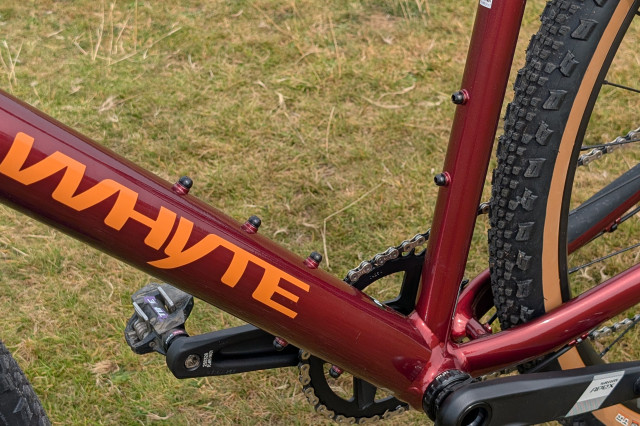
Both the Verro and Tourus use a 6061-T6 alloy frame and fork, offering ample clearance for a 50mm tyre with room to spare for mud. The use of an alloy fork over carbon allows Whyte to prioritise component quality while keeping the bikes at their intended value and price point. According to Whyte, pairing a wide tyre with a wide rim enables lower pressures, which they argue offsets much of the performance benefit a carbon fork might otherwise provide.
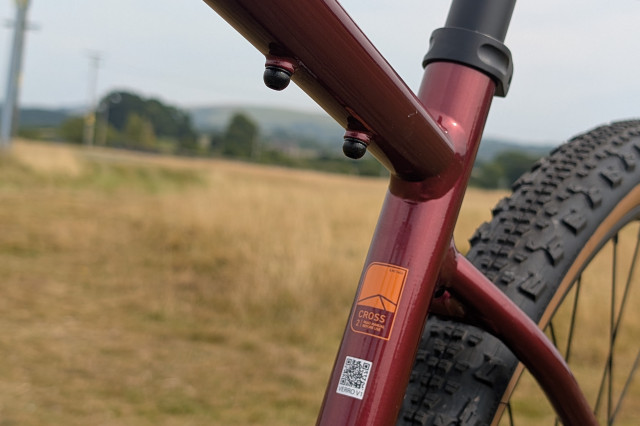
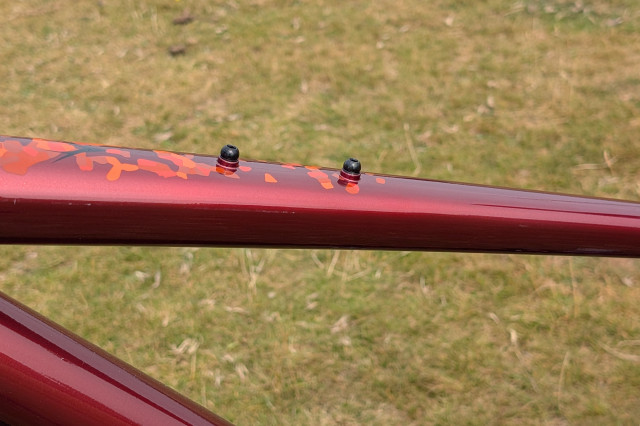
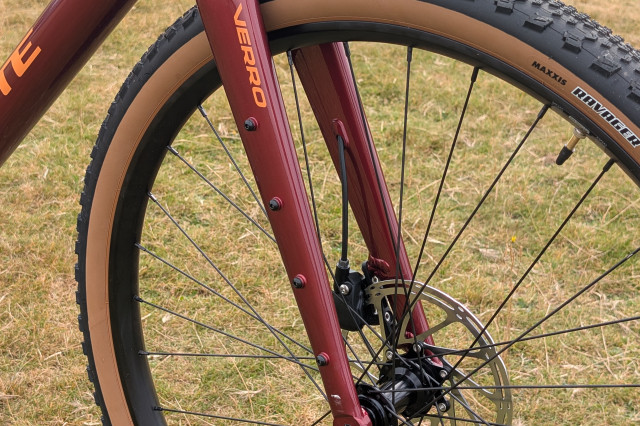
What stands out immediately on the Verro is the sheer number of attachment points. The frame and fork are littered with bolt mounts: front and rear mudguard mounts, four-bolt fork mounts, a three-bolt bottle cage mount on the down tube, two bolts under the down tube, plus further mounts on the seat tube, top tube, and even underneath it. If you have an accessory that fixes with bolts, chances are it will fit. Another neat detail is the integration of mounting points. The top tube bolts, for example, are positioned to allow the use of a 600ml Fidlock bottle, freeing up the entire main triangle for other storage options.
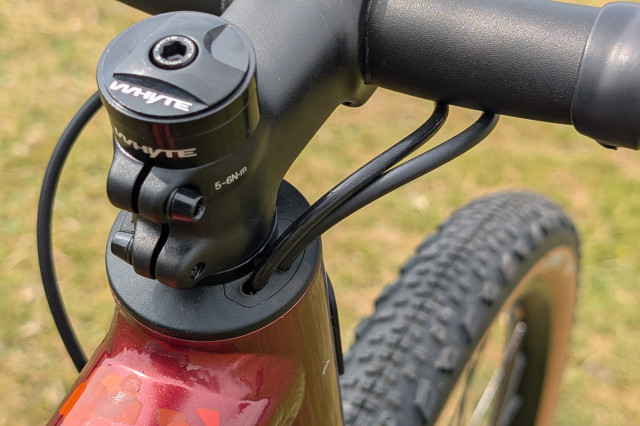
The frameset also features internal cable routing. Access is through the headset, which is relatively clean and quiet, while the fork includes its own wide routing port and a chunky rubber bung to keep rattles at bay.
Whyte has carried across its long-standing Total Geometry concept, borrowed from its mountain bikes, to the Verro. While it sounds dramatic, the numbers are not out of step with other gravel bikes.
A medium frame has a 70-degree head angle and a 74.5-degree seat angle, giving it a familiar feel on paper. The bike is intended to run a short stem, fitted with 60 or 70mm, depending on frame size, which makes the reach figure look longer than it feels in practice.
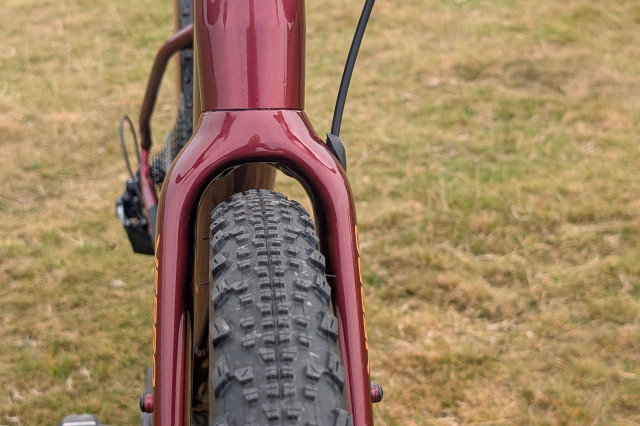
Total Geometry also plays a role in the Verro’s fork offset, which is 38mm rather than the 50mm or more you’d usually see on a gravel bike. By bringing the mass closer to the steering axis, the shorter offset works with the frame geometry to give the bike a calmer, more neutral feel through the bars, especially when the terrain gets rough or speeds pick up.
Our medium test bike tipped the scales at 11.86kg without pedals. That may sound on the heavy side, but it is in line with plenty of other gravel bikes we have tested, including more expensive models that lack some of the Verro’s features.
The bike is available in five sizes, from XS through to XL, covering recommended rider heights from 152cm (5ft 0in) to 197cm (6ft 5in).
Whyte Verro – Componentry
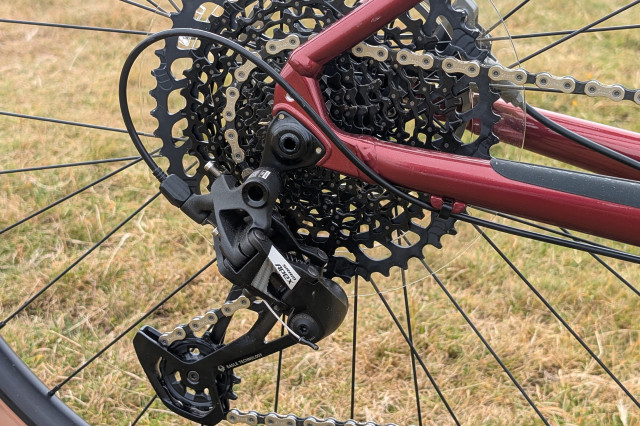
The Verro comes in a single build, but the specification is strong for the money, with a full set of branded components. The drivetrain is SRAM Apex Eagle, using a 42-tooth chainset and a wide-range 10-52T cassette, with no shortcuts taken, such as opting for an 11-52 on an HG freehub to save costs. Braking is also handled by Apex, with a 180mm front rotor that underlines the bike’s off-road intentions.
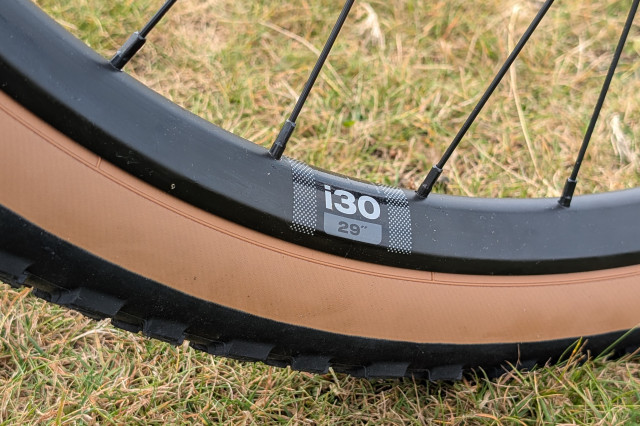
The wheels are WTB ST i30 rims, an OE-only model more commonly found on mountain bikes, built with 32 plain-gauge spokes and unbranded hubs. It is a sensible, durable build that has stayed true throughout testing, though it does come with a weight penalty. They are fitted with Maxxis Ravager 50mm tyres, a long-standing option at the more aggressive end of Maxxis’s gravel line. On the wide rims they measure 51mm, but still with plenty of clearance, and feature a fast-rolling centre tread paired with deeper, more widely spaced shoulder knobs for added grip.
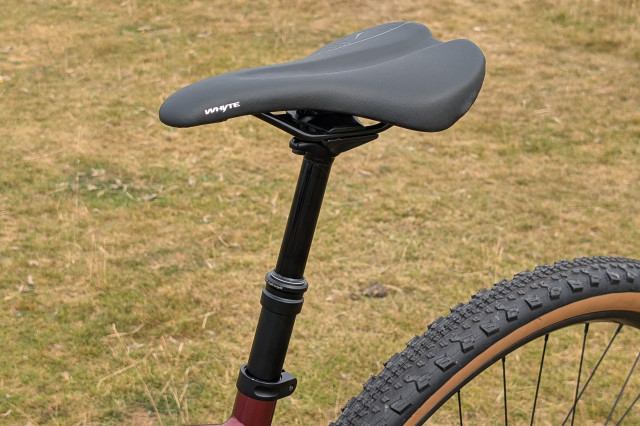
One component likely to split opinion is the Trans-X dropper seatpost, controlled by a remote lever mounted below the brake lever. Travel is size-specific, with 70mm on XS and S frames, 90mm on M and L, and 110mm on XL.
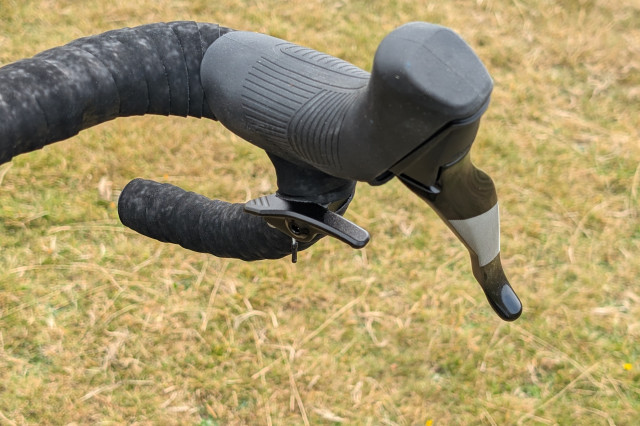
The handlebar choice is another indication of Whyte’s intentions for the Verro. While many brands are moving towards narrower, aero-focused cockpits, the Verro sticks with more traditional widths: 400mm on XS, 420mm on S, 440mm on M, and 460mm on L and XL. It is not extreme, but it feels more in line with the sizing we were used to seeing a few years ago.

Whyte Verro – Performance
Testing the Verro naturally meant heading onto more demanding routes to see how it copes — and whether a gravel bike can start to edge into mountain bike territory for certain rides. Longer days that mixed in rougher, rockier tracks once seen as mountain bike-only felt like the best way to explore its limits. Nothing extreme, nothing like today’s trail centres, but more in keeping with the kind of off-road riding many riders from the ’80s, ’90s, and early ’00s would recognise as classic mountain biking.
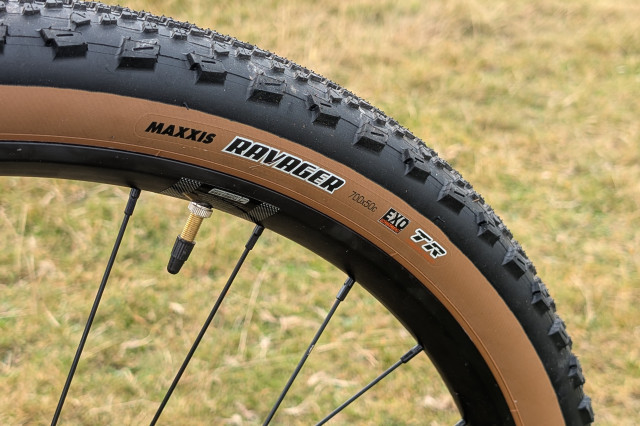
In practice, the Verro excelled on mixed-terrain rides, linking forest roads, bridleways, rougher byways, and the odd rock-strewn section. I expected the wider tyres to feel sluggish over distance, but they rolled surprisingly well. They are quiet too, and while they will not appeal to racers, they strike a good balance between comfort and efficiency.
The wheels feel solid, but they are chunky, and that extra heft makes itself known on climbs. Whether this is down to the rims alone, or more likely the combination of rim, plain-gauge spokes, and brass nipples, the weight is noticeable. For most buyers, though, the upside will outweigh the downside. The Verro is unlikely to be bought primarily as a gravel race bike, but if you choose to enter a race, it would be fine for completing one, and I’d bet you would have fun ripping past people on the downhills. The wide rims and stronger build provide a reassuring ride, the broader tyre footprint adds grip, and there is no flex at the front wheel.
Geometry is another standout feature. Whyte’s Total Geometry concept, borrowed from its mountain bikes, gives the Verro a very different character from most gravel bikes. On paper, the numbers don’t look extreme, but on the trail, the bike feels far more confident, especially on descents. I deliberately avoided looking at the geometry chart before riding, and based purely on feel, I’d have guessed the head angle was at least two degrees slacker, given its downhill composure. Yet uphill it remains steady and direct, climbing without the need to consciously load the front wheel.

The one area where the Verro can feel slightly held back is the front end. It’s one of the few bikes I’ve ridden that I’d genuinely like to try with a suspension fork. The geometry, wide tyres, and sturdy wheels inspire confidence to push harder, but on rocky tracks, it could be noticeably faster with some front travel.
That said, Whyte is right not to spec a suspension fork as standard, as it would add weight and cost, and not every rider would benefit. For some, however, the Verro feels like a bike that could really come alive with a suspension option, and perhaps an alternative suspended version could be a worthwhile addition in the future. The alloy fork might seem unusual compared with carbon, but at the low tyre pressures the Verro can run, you’d be hard-pressed to notice the difference, and it still covers ground quickly.
The dropper seatpost is another feature that will divide riders. Out of habit, I rarely used it, and I don’t have one fitted to my cross-country bikes, although dropping the saddle on steeper descents does boost confidence. With the combination of wide tyres, good bar width, and stable geometry, the Verro handles steep tracks well enough, but riders who use droppers regularly will welcome its inclusion.
SRAM Apex Eagle gearing gives the Verro a huge range, and it proved itself on some very steep, technical climbs in South Wales, even drawing compliments from off-road motorcyclists on one very rough byway section. The 40-tooth chainring strikes a sensible balance, and I didn’t find I was either spinning out or running out of gears, even on the steepest of climbs. Perhaps for very adventurous, and loaded bikepacking trips, a smaller chainring might be advisable, but otherwise, the standard option will suit. Shifting is quite slow, although you do get used to the speed, and I do find Apex frustrating when riding on the hoods, as it can shift down accidentally, but this is not a fault of Whyte, and it has happened with SRAM Apex since its inception.
The Verro comes with an abundance of mounts. You might wonder why the forks have four, when most forks top out at three. This is another clever touch from Whyte: the bottom mount is for a mudguard while still allowing a 3-bolt cage to be fitted. If you’re not running a mudguard, you can mount a cage lower, keeping the centre of gravity down and improving overall handling. The Verro is not pitched as a dedicated tourer like the Genesis Vagabond, but the potential is clearly there for loading up.
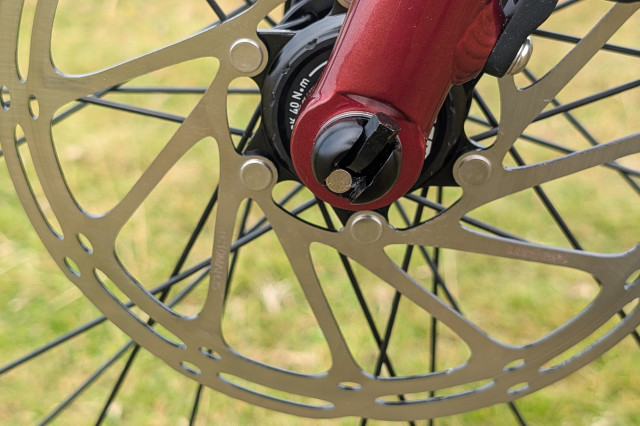
Frustrations were few, but the thru-axles stood out. They use a built-in allen key that slots inside the axle and is held in place by a magnet. It looks clever on paper, but in practice, the key rattled and the system felt awkward to use when required. A simple tool-free lever would be a far better solution, with little or no weight penalty. Alternatively, ditching the integrated key altogether and carrying a proper allen key as a spare would be more practical.
Whyte Verro – Verdict
The Verro is not a niche bikepacking tourer, a dedicated adventure rig, or a specialist downhill gravel bike. Instead, it is a versatile all-rounder that does almost everything very well. Its geometry makes it especially fun and rewarding on descents, and riders coming from a mountain bike background will appreciate the longer reach and confident handling. Those same riders, myself included, may occasionally wish for suspension, but whether you need it depends on the type of riding you plan to do. On less technical terrain, the Verro is easy-going, comfortable, and a pleasure to ride over longer distances.
Whyte offers the Verro in a single build, priced at £1,799 with SRAM Apex Eagle and a thoughtfully chosen kit that prioritises durability over weight. It might not be the lightest bike, but it is solidly specced and unlikely to need immediate upgrades. Few bikes match it at this price. One of the closest competitors is the Boardman TRVL 8.9 DB, which is a strong option but only available for riders above 170cm, excluding shorter riders. In contrast, the Verro is available from XS to XL, comfortably covering heights from 152cm to 197cm. Another alternative is a custom build of the updated Sonder Camino, which allows a suspension fork, but even then, it cannot match the Verro for rugged versatility and all-round capability.
Ultimately, your choice depends on where and how you plan to ride. If racing is your main focus, there are sharper, lighter bikes available. But if your goal is simply to have fun, take on the occasional adventure, and ride a bike that feels confident across a wide range of terrain, I believe the Whyte Verro is the best gravel bike currently available under £2,000. Mountain bikers will feel at home straight away, while general riders will simply enjoy a capable, adaptable bike that lets you go where you want, carry what you need, and ride with a big smile.
You might also like:
- Gravel bike racing – everything you need to know
- 2025 UCI Gravel World Series – everything you need to know
- 2025 Gravel Burn stage race – everything you need to know
About the bike
Tell us what the bike is for, and who it’s aimed at. What do the manufacturers say about it? How does that compare to your own :
Go wherever the trail leads
Whether going far or going for fun, our adventure gravel bike is engineered and equipped for capability and confidence so you can ride and thrive through even the most demanding terrain. With a fully featured frame and fork loaded with mounting points, a dropper post for confidence when things get wild, and much more, Verro is ready for every adventure you can find.
State the frame material and method of construction. List the components used to build up the bike.:
Whyte specification:
Frame & Fork:
6061 alloy, hydroformed T6 aluminium, multi-butted, tapered head tube, internal cable routing and custom Whyte dropouts
Whyte straight bladed 6061 alloy, alloy tapered steerer, internal cable routing, 12mm thru-axle, flat mount with mudguard and mounting bosses
Drivetrain:
SRAM Apex Eagle, 10-52t, 12 Speed
SRAM XG-1275, 10-52T, XD Driver cassette
SRAM Apex D1, DUB Wide, 170mm, 40t chainring
Components:|
Seatpost – Trans-X YSP38 dropper post, 27.2mm Rocker remote, size specific drop (sizes XS and S: 70mm travel; sizes M and L: 90mm travel; size XL: 110mm travel).
Saddle – Whyte Custom
Handlebar – Controltech, 6061 alloy, 70mm reach, 115mm drop, 10mm rise, 16° flare, 31.8mm x 400mm wide (size XS), 420mm (size S), 440mm (size M), 460mm (size L+XL)
Stem – Whyte Alloy, +-7° rise, 60mm length (XS, S), 70mm (M, L, XL)
Bar tape – Whyte anti-slip, ‘cross bar tape
Wheelset:
Alloy, double sealed cartridge bearings, 32 hole
2.0mm, PG, black stainless, brass nipples
WTB ST i30 rims, 30mm internal width, tubeless ready, 32 hole
Brakes:
SRAM Apex D1, Flat Mount, internal routing, 180mm rotor front, 160mm rotor rear
SRAM Apex D1
Tyres:
Maxxis Ravager Tanwall 700 x 50c, EXO 60TPI, folding bead
Frame & Fork
How much suspension travel does the fork have?:
Was the bike comfortable to ride? Tell us how you felt about the ride quality.:
How was the bike in terms of sizing and angles? How did it compare to other bikes of the same stated size and intent?:
Overall rating for frame
How much suspension travel does the rear end have?:
Did the bike feel stiff in the right places? Did any part of the bike feel too stiff or too flexible?:
Tell us about the build quality and finish of the frame:
Tell us about the geometry of the frame:
Key figures for a medium frame include:
Head angle: 70-degree
Seat tube angle: 74.5-degree
Reach: 428.5mm
Stack: 591.4mm
Tell us about the materials used in the frame:
Riding
How did the bike transfer power? Did it feel efficient?:
How would you describe the steering? Was it lively, neutral or unresponsive?:
Tell us some more about the handling. How did the bike feel overall? Did it do particular things well or badly?:
Rate the bike for sprinting:
Rate the bike for high speed descending
Any comments on high speed descending?:
Rate the bike for technical descending:
Any comments on technical descending?:
Rate the bike for flat cornering:
Any comments on flat cornering?:
Rate the bike for technical climbing:
Any comments on technical climbing?:
Rate the bike for climbing efficiency:
Any comments on climbing efficiency?:
Rate the bike for agility:
Drivetrain
Rate the drivetrain for performance:
Any comments on drivetrain performance?:
Rate the drivetrain for durability:
Any comments on drivetrain durability?:
Tell us some more about the drivetrain. Anything you particularly did or didn’t like? Any components which didn’t work well to:
Rate the drivetrain for value:
Wheels & tyres
Rate the wheels for performance:
Any comments on wheel performance?:
Rate the wheels for durability:
Any comments on wheel durability?:
Rate the wheels for weight:
Rate the wheels for comfort:
Rate the wheels for value:
Rate the tyres for performance:
Rate the tyres for durability:
Rate the tyres for weight:
Rate the tyres for value:
Tell us some more about the tyres. Did they work well in the conditions you encountered? Would you change the tyres? If so, what:
Controls
Rate the controls for performance:
Any comments on controls performance?:
Rate the controls for durability:
Rate the controls for weight:
Rate the controls for comfort:
Rate the controls for value:
Tell us some more about the controls. Any particularly good or bad components?:
Anything else you want to say about the componentry? Comment on any other components (good or bad):
Summary
Did you enjoy riding the bike?:
Would you consider buying the bike?:
Which components had the most effect (good or bad) on the bike’s performance? would you recommend any changes?:
Would you recommend the bike to a friend?:
Rate the bike overall for performance:
Rate the bike overall for value:
Use this box to explain your score:
All the deals displayed on our review pages are pulled from a constantly updating database feed of the best affiliate deals available. The criteria for deciding on what are the best deals is who is offering the lowest, delivered price. In most cases we will be showing the very best deal available online, but sometimes you may be able to find an item cheaper. If you can please feel free to post a link in the comments box below. To find out more about affiliate links on road.cc click here.