



A controversial cycling ban in Bedford has been lifted as part of a new suite of measures designed to prevent anti-social behaviour in the town centre, after thousands of cyclists were “aggressively” fined in recent years, prompting backlash from local campaigners who branded the ban “discriminatory” and claimed it “made nobody safer at all”.
This week, Bedford mayor Tom Wooton signed off on a new, revised Public Spaces Protection Order (PSPO), which will enable locals to ride their bikes in certain parts of the town centre for the first time since 2016.
The revised order, which will run for three years, now only prohibits “dangerous or aggressive” cycling in these areas, following concerns that the previous PSPO was unfairly and disproportionately impacting responsible and co-operative cyclists, especially those with mobility issues.
Like many other towns and cities throughout the UK that we’ve reported on in recent times, Bedford’s PSPO banning cycling in certain pedestrianised areas was brought in with the cited aim of cracking down on “anti-social behaviour”.
However, just as in Grimsby, where its shopping street cycling ban has become something of a saga in recent years, the bike ban in Bedford has been viewed by critics as a money-making exercise that only serves to discourage locals from riding their bikes into town to visit the shops, while failing to clamp down on actual instance of anti-social or nuisance behaviour.
Under the previous PSPO, which according to Bedford Borough Council was put in place “following a consultation suggesting that reckless riding of bicycles in Bedford town centre was reducing the quality of life of residents”, cycling was not permitted in certain parts of the town centre between 9am and 6pm.
Since the ban was introduced, thousands of Fixed Penalty Notices have been issued to people riding their bikes in Bedford town centre, perhaps most famously when, in 2019, ultra-distance cyclist Josh Quigley was slapped with a £75 fine for cycling through the town just a week into his second – and ultimately successful – round-the-world ride.
During the same year, cycling advocate Jeremy Vine offered to pay the fine of a woman caught breaching the PSPO, because the broadcaster didn’t “want her to be put off cycling for a second”.
The order, which was also the subject of protest group rides by local cycling campaigners, was originally due to expire in 2022 but was extended by the council – despite a consultation revealing that 54 per cent of residents were opposed to the town centre cycling ban.
In October 2024, the “aggressive” nature of the fining process, which like elsewhere is carried out by externally contracted wardens, a local Labour councillor claimed that she had been “inundated with complaints from residents that have been fined dismounting their bikes” in the town centre.
“We are supposed to be encouraging people to cycle into town. Should we be fining people who are using their bikes to go into town?” asked councillor Caroline White, prompting the council’s chief environment officer Paul Pace to claim that he had witnessed “bicycles flying through the town centre” and that the order enabled pedestrians to have a “safe place where they can actually not worry about bicycles”.
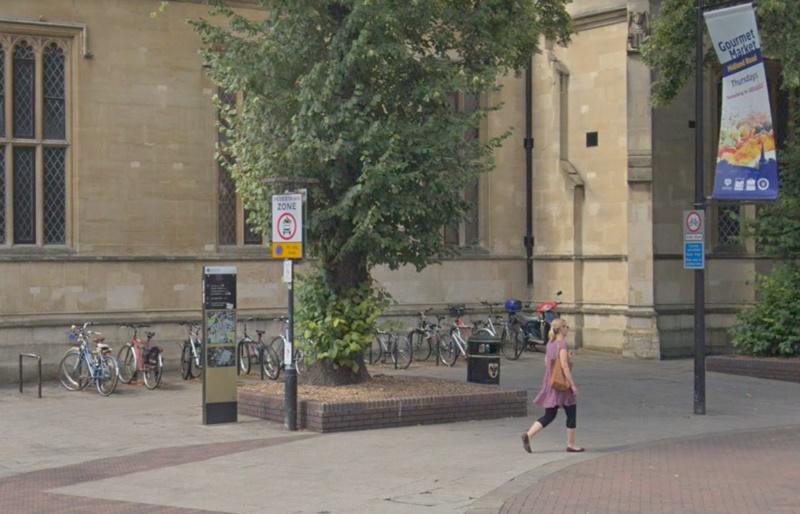
Later in October, Peter Blakeman, Chair of the Cycling Campaign for North Bedfordshire, said in a letter to the local newspaper that, despite initial assurances from the council that only those “irresponsible” individuals displaying “anti-social behaviour” would be fined, thousands of cyclists have indeed been stopped and issued financial penalties.
“A number of these were UK/European tourists while the perpetrators who caused the anti-social behaviour remained fine-free,” he suggested. “In the last few months, a further 738 cyclists have been fined. The outcome has been a large drop in residents cycling to the town to do their shopping, etc.”
He also argued that part of the reason why some cyclists use the pedestrianised areas is because “there are currently no safe north-south or east-west cycle routes through the town centre” and that “the majority of cyclists are reasonable people and will dismount if an area becomes too congested”, without need for being slapped with fines just for cycling to the shops.
Earlier this year, the council launched a consultation on the planned update to the PSPO, prompting a renewed wave of campaigning from cycling activists.
“The current system is fines imposed on slow and co-operative cyclists, ignoring those who are too fast to stop. It makes nobody safer at all,” Cycle Bedford said in April.
“We need as much input as possible so that safe and considerate cycling is not lumped in with anti-social behaviour.”
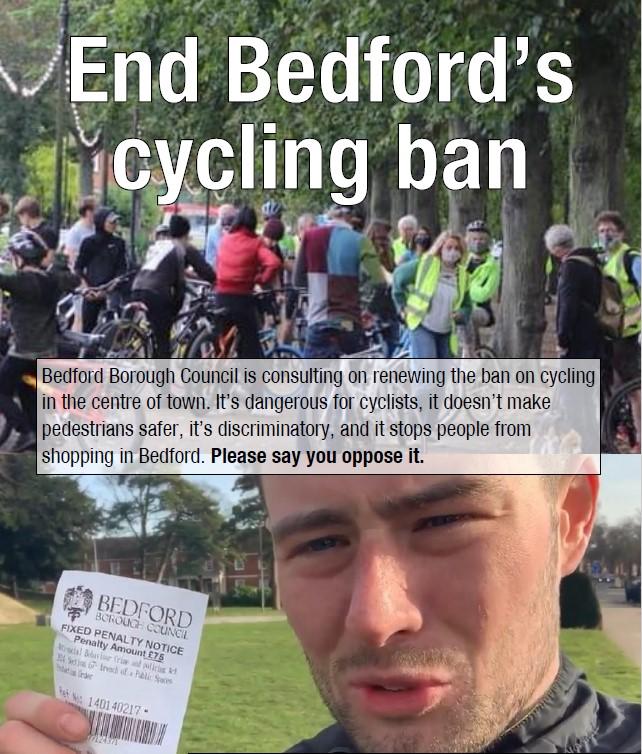
Of the 656 locals who responded to the consultation, 72 per cent said they either strongly agreed or agreed with the proposal to introduce a new PSPO in Bedford town centre.
And this week, Bedford Council approved the new measures, which will introduce expanded restrictions on issues such as alcohol consumption, spitting, and defecation in public spaces, and will be in place for three years.
Most of the new PSPO, which also includes littering in enclosed public spaces, the use of illegal drugs, begging, and riding e-scooters or skateboards, constitutes an even stronger clampdown on anti-social behaviour than the previous order.
However, due to concerns raised during the consultation, the original proposal to retain the ban on cycling in pedestrianised areas between 9am and 6pm was revised.
The order now prohibits only dangerous or aggressive cycling or e-bike riding, with the council saying that the revised ban will address safety concerns while avoiding a “disproportionate” impact on responsible cyclists, especially those with mobility issues.
According to CCTV analysis carried out by the local authority, 459 incidents involving “dangerous” cycling in the proposed PSPO area took place over a three-month period in 2024, those figures “further reinforcing the need for intervention”, the council says.
Active travel charity Cycling UK has long been a prominent critic of PSPOs, which it claims have the effect of criminalising cycling.
“Some councils have used PSPOs as a geographically defined version of an ASBO to restrict the use of public space and criminalise behaviour not normally regarded as illegal,” Duncan Dollimore, Cycling UK’s head of campaigns, has previously said.




















7 thoughts on “Controversial town centre bike ban overturned after thousands of cyclists “aggressively” fined – as new order aims to crack down on “dangerous” cycling, not responsible riders”
I have not been to Bedford
I have not been to Bedford centre since the cycling ban. I am now thinking a visit is in order. Perhaps it deserves a second chance.
No, it does not. Although
No, it does not. Although they’ve allowed riding in the city centre, you will find some of the most un-bike friendly traffic decisions- from a three-mini-roundabout of death, to unavoidable dual carriageways, to “bike lanes” that exist as painted stripes down the side of one-way, one lane bridges. And yet this is better by far than the rest of Bedfordshire’s cycling network, where bike lanes disappear in the middle of routes, or demand that you walk for 800m in case you disturb anglers, cows, or hikers. One of the least interesting areas of the uk.
I think younare probably
I think you are probably right, especially as I read in the news a private security firm is being deployed to deal with the crack heads. https://www.bbc.co.uk/news/articles/c93d71xyy5po
MK all the way then. 😆
Although to be fair to Bedford, I’m currently sat outside a pub in Bath and, well, it’s a bit rough! Seen quite a few inebriated individuals throughout the daytime too – I thought it was “posh” 😲🤣
If a third party contractor
If a third party contractor is appointed to police cycling infringements their overriding concern is making a profit. It is hardly surprising that they will pick on easy targets and be over zealous.
So the overzealous fining is
So the overzealous fining is going to stop right. Right? Who is going to judge how someone is cycling and decide whether to fine or not. How does this work with performance related pay?
This is a genuine question,
This is a genuine question, which being a ‘newbie’ on here, I hope someone can give me an answer to? Reading various similar stories over the years about cyclists getting fines etc imposed by local councils or their appointed companies, what is the situation [legally] with respect to not talking to these officials at all [ie not giving any of your details, not conversing with them at all?] I know a police officer can demand your details and if you refuse, you can be arrested but surely no such arresting powers are available either to a council official or an appointed company that normally gives out fines, so you could just simply cycle off, having not said anything?
My understanding (not a
My understanding (not a lawyer and this is not legal advice) is that if the Council have done everything by the book, then failing to give the authorised wardens your details would be an offence in its own right. But they have no power to arrest or physically detain you.
If you were to simply cycle off without having spoken to them, I don’t know how likely it is for that to come back and bite you in the ass. Most of them nowadays have bodycams, so you may well have been recorded on that. Are they going to spend hours trying to identify someone from blurry bodycam footage? Probably not.