


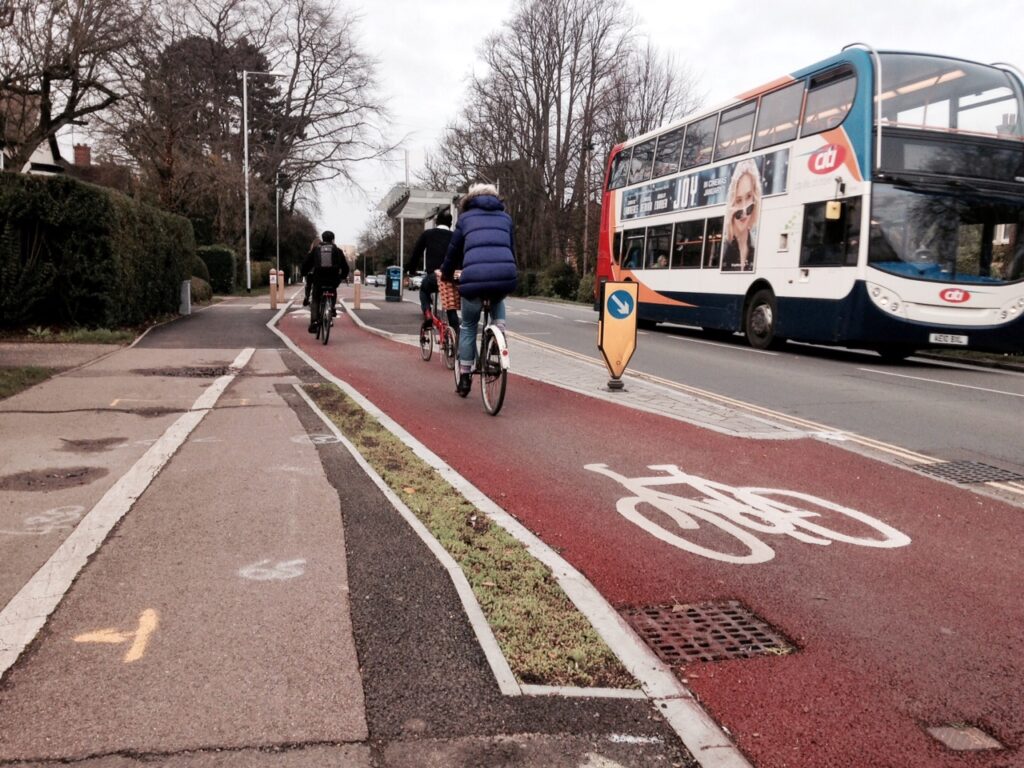

The Sunday Telegraph has been accused of using divisive rhetoric in an article that claimed that floating bus stops next to cycleways were a “death trap” for pedestrians – although the newspaper did not provide any casualty figures in support of that assertion.
In its article, it claimed that more than nine in 10 cyclists had not given pedestrians priority when they were waiting to cross to floating bus stops it had observed at three locations in London, and quoted a spokesperson from the National Federation of the Blind as saying that they were a “death trap.”
Sarah Gayton, the charity’s shared space co-ordinator, told the newspaper: “Our concerns, our evidence and our accessibility needs have been ignored, diminished and ridiculed for far too long over the inherently discriminatory floating bus stop design.
“We need a complete halt on any new ones being installed, getting the ones installed in lockdown taken out and all the others removed. It beggars belief that they’re still putting them in. This research should be a massive wake-up call. It’s crazy.”
Will Norman, London’s walking and cycling commissioner, defended the infrastructure, saying: “Bus stop bypasses are a nationally recognised approach for avoiding the dangers of cyclists going around buses into oncoming traffic.
“TfL, like many cities across the country, have integrated this approach into our cycleway programme and we’ve seen a dramatic increase in [the] number of people cycling in the city.
“We are continually working to make all our infrastructure as safe as possible for all road users. All cyclists are required to stop for pedestrians at zebra crossings in accordance with the Highway Code.”
While the article claimed that a number of near misses between cyclists and pedestrians had been observed at the locations in question, a number of Twitter users pointed out that it lacked figures regarding collisions and injuries to back up the assertions being made about the supposed danger being created by cyclists, with one also pointing out the numbers of pedestrians typically killed in a crash involving a bike rider each year, and contrasting that with the number who lost their lives due to motorists driving on the pavement, for example.
Tell me, @ewansomerville , how many pedestrians have been killed by cyclists at floating bus stops?
Answer: none.
How many pedestrians are killed on pavements by cyclists?
Answer: 1 or 2 a year.
How many pedestrians are killed on pavements by motorists?
Answer: around 70 a year. https://t.co/21hUj3Ymqn— PaulM ????????? (@Onebiskuit) March 19, 2023
Twitter user the Ranty Highwayman, a highways engineer by profession with experience of designing active travel infrastructure, including bus stops, said that the article “both puts the lives of people trying to get around under their own steam under threat and it makes my job as a designer much harder trying to get our streets changed to make it safer for people walking, wheeling and cycling.
“The headline of ‘death trap I,s without foundation because nobody has died,” he said. “This outright lie is designed to sensationalise.”
He acknowledged that some people may have “genuine concerns” over floating bus stops “because they are unfamiliar and that both needs working through with them and a good design response.”
But he added that “The problem is the rhetoric in the piece and the language of some of the people you quote are more widely generating anti-cycling and anti-better streets noise to the point where those who do have concerns are drowned out and they really should reflect on how they behave.
“[Sadiq] Khan is mentioned, but of course, there were many floating bus stops built under Johnson, but the use of Khan is deliberate because it plays to your reader base. In fact, there are floating bus stops all over the country with some dating back to the 1930s,” he added.
Ranty Highwayman also highlighted one in east London that he designed more than 15 years ago, which separates a service road rather than a cycleway from the main carriageway.
Floating bus stops have become increasingly common in the UK over the past decade where segregated cycling infrastructure has been built.
However, they have at times faced opposition, with Guy’s and St Thomas’s NHS Trust for example launching a petition in 2016 calling for a planned floating bus stop on Westminster Bridge outside St Thomas’s Hospital to be scrapped, claiming that it would put both cyclists and pedestrians at risk.
> Top London hospital tries to block segregated cycle lane
The petition gained a little over 1,100 signatures, and the proposed floating bus stop was built.
Last October, the NFB joined with 162 other disability groups to call for floating bus stops to be axed, with a registered blind man from Glasgow claiming that they made using the bus “like playing Russian roulette.”
> “Like playing Russian roulette” – Blind people raise concerns about floating cycle lane bus stops
Sustrans undertook a detailed analysis of potential conflict between pedestrians and cyclists at two floating bus stops in Cambridge in 2016 on behalf of Cambridgeshire County Council.
> Floating bus stops improving safety of Cambridge cyclists suggests report
The sustainable transport charity reviewed 28 hours of footage, and said that “all interactions” between road users at the location concerned reflected “safe, normal behaviour.”
It also found that 99 per cent of the cyclists who passed through the location did not have aby interaction with pedestrians.
Some 42 instances in which there was interaction between cyclists and pedestrians were recorded, all of which took place at peak times.
Sustrans said that each interaction had scored either one or two on a five-point hazard scale, although it should be noted that no analysis was performed on interactions between cyclists and blind or partially sighted pedestrians.
At the time, Cambridgeshire County Councillor Ian Bates, Chairman of the Economy and Environment Committee, said: “The report’s findings are particularly pleasing, and give reassurance of the safety benefits offered by this new design of bus stop for Cambridge.
“The County Council is committed to providing safe networks for all road users. I welcome ongoing engagement with disability groups, pedestrians, cyclists and bus operators to see if the designs require any further enhancements,” he added.




















67 thoughts on “Sunday Telegraph accused of using divisive rhetoric in “death trap” floating bus stops article”
The word “research” is doing
The word “research” is doing a lot of heavy lifting in that telegraph article
Steve Bird seems to write
Steve Bird seems to write alot of those types of articles about cycling for the Telegraph
(No subject)
Is it just me that can’t read
Is it just me that can’t read that article except in a Lynn Faulds Wood accent.
Awavey wrote:
Just wait until they find out
Just wait until they find out how many people are killed in incidents involving the actual buses!
Mungecrundle wrote:
Being sombre for a moment.
15 yeart old girl. Birmingham. Yesterday.
https://www.bbc.co.uk/news/uk-england-birmingham-65006354
Wait till they find about bus
Wait till they find about bus stops that are on the other side of the road.
IanMSpencer wrote:
I’ve made this suggestion before. Putting in a bus stop bypass does create an additional obstacle for pedestrians – and in particular disabled pedestrians, much that many of us on here would argue it is a relatively minor one. But this could be redressed to some degree by – at the same time as putting in bypass – putting in a zebra or pelican crossing over the main carriageway to facilitate use of the bus stop on the other side of the road. That means that whilst there would be a minor inconvenience on one side of the road, there would be a big improvement on accessibility to the other side of the road.
It might also flush out the motivations of some of those who protest against bus stop bypasses.
In Europe, lots of places
In Europe, lots of places have trams running down the centre with mini-stations for boarding. Invariably they have crossings at either end and in both directions. The alternative I’ve seen is traffic lights that stop all traffic while the tram is stopped – especially if there is no room for a platform.
Meanwhile back in 2019…
Meanwhile back in 2019…
https://www.standard.co.uk/news/london/new-road-safety-fears-after-71-people-are-hit-by-london-buses-at-pedestrian-crossings-in-under-two-years-a4038481.html
and undated:
https://www.livingstreets.org.uk/news-and-blog/press-media/two-thirds-of-london-bus-fatalities-are-pedestrians
The problem is the rhetoric
The problem is the rhetoric in the piece and the language of some of the people you quote are more widely generating anti-cycling and anti-better streets noise to the point where those who do have concerns are drowned out
It’s naive to expect any better from the Torygraph, even though it doesn’t quite achieve hyper-junk status like the Mail and Express
The Telegraph definitely has
The Telegraph definitely has an anti-cycling bias but when those criticising the article are criticising the ‘rhetoric’ and not mentioning the principle observation in said article that also reveals bias.
The main point of the Telegraph article was that cyclists do not routinely give way to pedestrians at the crossings for the floating bus stops.
They had photos and video to back this up.
If cyclists are riding illegally around more vulnerable road users then we can’t just shrug our shoulders and engage in whataboutery. The design of the bus stops should be reviewed perhaps with some form of traffic calming integrated in.
Well designed infrastructure should make everybody safer.
Rich_cb wrote:
I certainly agree!
However it is unfortunately probably impossible to get from where we are to many more people cycling without causing some kind of conflict or worry to some people. (In a similar way that we can’t have better cycling conditions for all – or even mass cycling – with zero impact on motoring convenience).
I foresee a certain period of occasional unpleasantness (which in x years – should we achieve mass cycling – everyone will of course forget about…)
The UK is certainly very good at making more conflict between modes than necessary though!
For ages UK policy has been “OK, maybe make some provision for cycling – but we must slow down those dangerous scorchers!” Which is quite sensible until we realise that we mostly have selected for cyclists who *do* feel they have to go very fast (to run with the cars) and the “normal people” found what infra there was too inconvenient for them.
I wouldn’t like this to happen like it did with the motor car (can’t find the quote but I think it was a minister saying essentially “adults, children and animals will just have to learn to get out of the way of the car – or else!”) However even in NL while it is now safer AND more convenient for pedestrians than the UK there *are* a few conventions which you have to learn eg. if there is a separate footway (which they mark very clearly there) you should be on that, not in the cycle path.
Well, they seem to work in
Well, they seem to work in plenty of other countries. NL examples (Denmarks has too):
https://www.aviewfromthecyclepath.com/2013/08/ten-bus-stop-bypasses-for-bicycles.html
and here including some historic perspective
Do the Telegraph have the current casualty figures (allowing that they’re probably increasing on a daily if not hourly basis)?
I’d be shocked – shocked, I tells you – if a quality national paper had made a paper tiger out of something cycle-related…
TL/DR – things where modes *interact* may not magically work. They may require some understanding of “what to do”, enough users of *both* modes in society (for “empathy”) AND maybe a minimum frequency of one or other mode. (No cyclists? Pedestrians may habitually also use the cycle space).
Could just be crap design? Not looked at Telegraph but the UK does seem to be world-leading at taking a perfectly straightforward concept from elsewhere and “improving it” / “making it fit local conditions” until it’s useless or even dangerous.
2) There’s a “bootstrapping” phase needed to get round the “chicken and egg” problem with growing cycling. New infra where there are modes interacting means *behaviour changes*. (Just like persuading motorists not to park in cycle lanes…). Part of that is having enough folks who already know what to do about – then others copy them. This is almost never the case initially. A part of this understanding comes from you and your relatives having used the infra using *both modes* – again most UK people don’t cycle currently.
Finally changed behaviours need to be self-reinforcing as we won’t have police standing round everywhere. It strikes me this *does* work by *modal dominance* a bit like cars and pavements. People don’t impede cars by walking on the road because it doesn’t feel pleasant – AND they (sometimes…) have a footway where it does feel safe. Drivers don’t drive on the footway (except when they do…) because it doesn’t feel convenient.
If people feel perfectly comfortable standing in the cycleway next to a bus stop it probably won’t work for cyclists.
I think the concerns of blind
I think the concerns of blind pedestrians and those with disabilities should get more of a look. There should be some useful data – even from the UK – by now. See eg the Sustrans study.
Again since this kind of infra has been in very widespread use for decades now in other countries (and the odd one in the UK for over a decade) there should be ways to ensure what the UK is building is no less safe, and reassuring the most vulnerable.
…unless we’re just building sub-standard conflict-increasing versions of an otherwise good type of design
because “our streets are too narrow” AKA “we can’t have any less space for motorists”?
They’ve been all over the Uk
They’ve been all over the Uk since the 1930s, where the “bypass” is a service road by a major road used by motor vehicles eg people going shopping.
The current campaigners are bad faith actors, and for some reason never mention these as a problem.
More sensible groups such and RNIB and Guide Dogs have been engaged with the research and improvement process.
Sorry to sound harsh, but that’s what’s going on. NFBUK have in many respects just become useful idiots.
It’s a good point, and a
It’s a good point, and a demonstration of how embedded car culture and design is that I am now trying to think of reasons why this arrangement is different… but it’s not.
It’s the shock of the not old
It’s the shock of the not old enough / uncommon. It’s concerning to people because it appears new. And “bicycles on the ‘footway’ “. It’s like suddenly being able to see the cars…
TL/DR – if you’re actually interested in this stuff plenty of people have in-depth articles about this in various different countries / different designs. Robert Weetman’s Copenhagen one is good (with updates about these kind of debates). Also BicycleDutch on “crossing the cycle path” and he also has one specifically on bus stop bypasses.
I’m not aware of any data which show this is particularly dangerous, from anywhere. If there was it ought to be easy to find.
Note it took thousands of casualties from cars and many years for pedestrians to “learn” the expectations and behaviours which (mostly) keep us safe. We’ve some routines – but they don’t always work. However everyone’s just used to what is. We don’t see it – until something changes.
We certainly don’t want that again. And it won’t happen. However: given that some people are apparently worried (change) perhaps the authorities should be putting out a campaign with helpful / reassuring information? It wouldn’t hurt to monitor these. (And also actual road zebra crossings too, as a baseline…).
Maybe if we had “standards” not “guidelines” for cycle infra (yeah, LTN1/20 is ignored everywhere…) we could at least spot where someone in the UK had screwed up a safe design?
Maybe there are a few specific problem places / populations? Maybe it’s just those aggressive youth gangs / financial services executives in London?
I don’t think it will help reassure people – simply put they don’t want cyclists in their space – however I guess they could be made with some sharp-radius turns in the cycle path – like rich_cb’s chicane idea. However if I was building them I’d make sure there was space to make it so those could be made more shallow or just removed once people adapted to the new infra.
After all, you don’t increase the popularity of an activity by deliberately making it less convenient than its competitors.
That’s a fairly routine
That’s a fairly routine feature and has been researched to death over the last 7-8 years, but it also has a downside in that eg runble strips can be painful for people with arthritis, or power wheelchair, or mobility scooter, or potentially E-scooter, users, who are all probably best encouraged to be in the cycle track rather than on the pavement – for the safety of blind / visually impaired / frail.
The big issue with the Telegraph piece is that it is promoting an utterly unrepresentative extreme uncompromising and misleading position from a tiny splinter group, that will result in many more casualties if introduced.
Obvs it’s also tied up with the exploitation of the issue from Tories in London making a Hail Mary pass to save their political skin.
I predict once we have the election it will bubble under again.
I’m not a fan of rumble
I’m not a fan of rumble strips in general but chicanes around bus stops, if adequately signposted, can reduce speeds effectively and safely.
Rich_cb wrote:
No, because the principal observation is not what was actually claimed by the biased article. The problem is with the article, not the video. Nobody is denying the video is real, the principal observation of the video is that there doesn’t seem to be an issue.
The article claimed 1/10 cyclists did not stop, these are different things and should not be conflated. I don’t believe 1/10 makes this “routine” either.
IF doing a lot of the heavy lifting there. Are the cyclists illegally cycling around other vulnerable road users. Are you sure it is illegal to do so? Shoulder shrugging does seem to be the appropriate response to a non-issue, I’m not sure there is any real whataboutery.
It’s illegal to not give way
It’s illegal to not give way to a pedestrian on a zebra crossing. The Telegraph are claiming that 92% of cyclists did not comply with the highway code but doesn’t break down the proportion of legal breaches.
In the videos there are several examples of legal breaches but there is undoubtedly cherry picking from the Telegraph in that regard.
https://www.telegraph.co.uk/news/2023/03/18/sadiq-khan-cyclists-floating-bus-1-10-stop-pedestrians-analysis/
These crossings don’t seem to be working to protect pedestrians and should be redesigned to increase compliance with the highway code.
Rich_cb wrote:
Difference between “protect” and “inconvenience” here maybe?
An actual study here from Sustrans / Cambridgeshire CC (2015). Very small (2 sites but only 42 cyclist interactions!)
The only “issues” reported:
“Large groups of pedestrians were observed using the cycle lane as an extension of the pavement at Hills Road especially when the bus stop was congested.
After school has been let out many young people can be seen crowding around the bus stop … usually do not appear to be as attentive to the flow of traffic …”
“Protection” – are these any
“Protection” – are these any different (apart from probably being safer!) from the current situation where the zebra crossing goes across a carriageway with motor vehicles driving on it? I haven’t watched the Telegraph’s videos but I’d guess that there are 3 “issues”:
– pedestrians will wait for buses or just stand in the cycle path area (not limited to floating bus stops…) because “it’s the pavement” and they won’t expect a cyclist.
– pedestrians crossing will not look out for crossing cyclists for the same reason.
– pedestrians wanting to cross will stop and wait for an approaching cyclist to come to a complete halt before they cross, like a mini-road – inconveniencing them both, or getting annoyed should the cyclist not do this.
Cyclists will presumably expect people either to move out of the cycle lanes or if crossing to “negotiate” visually with them.
Again – apparently works fine elsewhere (including other places in the UK, some of which were “controversial” in the past, including the St. Thomas’ hospital one covered e.g. on road.cc)…
However since it’s “new” people will take time to work it out. Given that the idea of infra is to get previous non-cyclists to cycle unfortunately there will doubtless be some people who aren’t “careful and considerate” – either through ignorance or just because for a large enough sample some people are arsy.
You seem to think this merits something competely different for this “transition period” (“These crossings don’t seem to be working to protect pedestrians and should be redesigned to increase compliance with the highway code.”)
What would that look like then?
Absolutely this. I find it
Absolutely this. I find it embarressing the disregard a large number of cyclists have for these crossings through Chiswick. If I stop there is usually a surprised look from pedestrians. Of course the telegraph is going to blow it out of all proportion, but the fact is this is an issue. Brushing it away becuase no one has died doesn’t stop it being a problem for pedestrians, particularly the more vulnerable.
They refer to zebra crossing,
They refer to zebra crossing, but is it legally a zebra crossing when it doesn’t have the flashing orange lights like typical zebra crossings? If so isn’t it is just a marked crossing point and nothing more surely…? I’ve had a couple appear on my commute recently, but you never need to worry about people using them, as they just walk down the middle of the cycle lane like it is standard pavement and if they cross they do it anywhere.
Indeed. Without the orange
Indeed. Without the orange globes, it’s just a confusing bit of paint.
Source: https://www.legislation.gov.uk/uksi/1997/2400/schedule/1/made
According to Ranty Highwayman
According to Ranty Highwayman, who I asked a week or two ago, they *are* to be treated like any other Zebra crossing. I can’t give you a legislative authority, but that’s enough for me.
I had been arguing your approximate espressed position – that they were indicative, in my case because no “controlled area” could be off the carriageway, but I accept the correction.
LTN 1/20 notes that for cycletrack Zebras, the Belisha Beacons are optional.
There is also the road user hierarchy, of course, which says pedestrians first.
I’m sure this is correct but
I’m sure this is correct but Isn’t this another case of “bikes are not mini cars”? In places where most people cycle it seems to work that cyclists don’t need to stop (like motor vehicles should) when a pedestrian is waiting to cross. This doesn’t seem to be dangerous or very inconvenient *.
I think because in the UK cars are normal and bikes are not everyone expects motor vehicle rules should apply.
So I suspect this is a temporary state on the way to mass cycling. If we get closer to there we’ll find that pedestrians almost never need formal cycle path crossings despite more cyclists.
* This works due to several factors I think.
The smaller size of cycles, narrowness of cycle paths compared to roads and generally much lower speeds allow pedestrians to easily move around them and cross quickly. Cyclists are more manoeuvrable than motor vehicles and can also slow slightly to allow someone to cross. There are other factors like clearer visibility between them to “negotiate” and both are vulnerable road users, one isn’t hidden in a box etc. Before someone makes a ridiculous statement this obviously means that this doesn’t “work” if someone is hooning head-down in a TT position – however I’d suggest even if that were common (it isn’t) this would still work better than our current zebras with cars!
I’d see it more as a suitable
I’d see it more as a suitable reuse of familiar symbols, which engages existing cultural expectations.
mattw wrote:
Nope. A zebra crossing is defined in law as:
A place on the carriageway—
(a)where provision is made for pedestrians to cross the carriageway;
(b)the presence of which is indicated by—
(i)a yellow globe of the type provided for at item 27 of the sign table in Part 2 of Schedule 14 at each end of the crossing (except that globes need not be present at a crossing that only crosses a cycle track);
(ii)the black and white stripes shown in the diagram at item 52 of that table and in respect of which provision is made at paragraph 18 of Part 1 of that Schedule (including provision for the black stripes to be a different colour); and
(iii)where used, the marking provided for at item 55 of that table; and
(c)the limits of which are indicated by the stripes except that, where used, the limit is indicated by the marking at item 55
Note the use of “and” in the list.
Source: https://www.legislation.gov.uk/uksi/2016/362/schedule/1/made#f00024
Btw, I’m not saying that one shouldn’t treat stripes across the highway like a zebra crossing, I’m only saying that stripes across the highway (without the globes) are not a ‘zebra crossing’ and cycling through them when a pedestrian is crossing is not illegal only by it’s own virtue (like it is for an actual zebra crossing). It can of course still be ‘wanton and furious cycling’ if the threshold for that is met (for example).
Although I’ve just noticed the but about not needing them to cross a cycle track, so you should basically ignore this entire post!!
ShutTheFrontDawes wrote:
According to Ranty Highwayman, ….
— ShutTheFrontDawes Nope. A zebra crossing is defined in law as: A place on the carriageway— (a)where provision is made for pedestrians to cross the carriageway; (b)the presence of which is indicated by— (i)a yellow globe of the type provided for at item 27 of the sign table in Part 2 of Schedule 14 at each end of the crossing (except that globes need not be present at a crossing that only crosses a cycle track); (ii)the black and white stripes shown in the diagram at item 52 of that table and in respect of which provision is made at paragraph 18 of Part 1 of that Schedule (including provision for the black stripes to be a different colour); and (iii)where used, the marking provided for at item 55 of that table; and (c)the limits of which are indicated by the stripes except that, where used, the limit is indicated by the marking at item 55 Note the use of “and” in the list. Source: https://www.legislation.gov.uk/uksi/2016/362/schedule/1/made#f00024 Btw, I’m not saying that one shouldn’t treat stripes across the highway like a zebra crossing, I’m only saying that stripes across the highway (without the globes) are not a ‘zebra crossing’ and cycling through them when a pedestrian is crossing is not illegal only by it’s own virtue (like it is for an actual zebra crossing). It can of course still be ‘wanton and furious cycling’ if the threshold for that is met (for example). Although I’ve just noticed the but about not needing them to cross a cycle track, so you should basically ignore this entire post!!— mattw
As you obviously didn’t read what you copy pasted I’ve highlighted it in the quote above!!
makadu wrote:
I hang my head in shame. Still, I learned something new today, so it could be worse.
ShutTheFrontDawes wrote:
According to Ranty Highwayman, who I asked a week or two ago, they *are* to be treated like any other Zebra crossing. I can’t give you a legislative authority, but that’s enough for me.
I had been arguing your approximate espressed position – that they were indicative, in my case because no “controlled area” could be off the carriageway, but I accept the correction.
LTN 1/20 notes that for cycletrack Zebras, the Belisha Beacons are optional.
There is also the road user hierarchy, of course, which says pedestrians first.
— ShutTheFrontDawes Nope. A zebra crossing is defined in law as: A place on the carriageway— (a)where provision is made for pedestrians to cross the carriageway; (b)the presence of which is indicated by— (i)a yellow globe of the type provided for at item 27 of the sign table in Part 2 of Schedule 14 at each end of the crossing (except that globes need not be present at a crossing that only crosses a cycle track); (ii)the black and white stripes shown in the diagram at item 52 of that table and in respect of which provision is made at paragraph 18 of Part 1 of that Schedule (including provision for the black stripes to be a different colour); and (iii)where used, the marking provided for at item 55 of that table; and (c)the limits of which are indicated by the stripes except that, where used, the limit is indicated by the marking at item 55 Note the use of “and” in the list. Source: https://www.legislation.gov.uk/uksi/2016/362/schedule/1/made#f00024 Btw, I’m not saying that one shouldn’t treat stripes across the highway like a zebra crossing, I’m only saying that stripes across the highway (without the globes) are not a ‘zebra crossing’ and cycling through them when a pedestrian is crossing is not illegal only by it’s own virtue (like it is for an actual zebra crossing). It can of course still be ‘wanton and furious cycling’ if the threshold for that is met (for example). Although I’ve just noticed the but about not needing them to cross a cycle track, so you should basically ignore this entire post!!— mattw
I now have th elegislative authority.
Para 25 of this page specifies that Belisha Beacons are options for Zebras across cycle tracks, and there is no need for a “controlled area” (which can only exist on a carriageway) to be present:
http://https://www.legislation.gov.uk/uksi/2016/362/schedule/14/made
General provision about crossings placed across cycle tracks
25.—(1) Sub-paragraph (2) applies where, but for this paragraph, these Regulations impose a requirement for there to be a controlled area.
(2) Where the crossing is placed across a cycle track, no controlled area in that part of the carriageway that is a cycle track is required.
(3) In relation to a Zebra or Parallel crossing which only crosses a cycle track, a yellow globe (provided for at item 27 of the Part 2 sign table) is not required.
They’re informal zebras.
They’re informal zebras. Legally not a zebra crossing, which is clearly defined in law, but there to denote a crossing point that is to be treated like a zebra.Ignore me, I was wrong.
monkeymike wrote:
That implies the existence of formal zebras
As they always dress in
As they always dress in monochrome I think of zebras as formal horses.
chrisonatrike wrote:
What’s black and white and eats like a horse?
Steve K wrote:
A very hungry penguin?
Steve K wrote:
A greedy nun.
Chorizo! Hmm, no, that’s red
Chorizo! Hmm, no, that’s red… I don’t know!
monkeymike wrote:
We’ve got one by our school. Only places you can get to is the school itself and about 10 properties. It’s a no through road. Still… if a local woman sees a 5 year old at that crossing she speeds up rather than slows down because she couldn’t wait seconds to badly park outside her flat.
One day I’m gonna get crafty with honey and glitter and some pages from the HWC.
No, as explained above.
No, as explained above.
Are these just mini zebra
Are these just mini zebra crossings (without Belishas)?
Rule 19 says should for waiting, but only must for crossing. Presumably a cyclist will stop for anyone in the middle of what must be a narrow lane? Or be hurt themselves.
Can’t read the full article, of course.
theyve a catchy video which
theyve a catchy video which summarises it https://www.youtube.com/watch?v=bWPHJsGrK-A
They’re technically informal
They’re technically informal zebras, which essentially means the council paint it like a zebra to denote it’s a crossing point, but legally it isn’t a zebra crossing and it’s the same as if there wasn’t any paint there at all.Ignore me, I was wrong
Once a foot is on the
Once a foot is on the crossing then giving way is a ‘must’.
There were several examples of this being breached.in the videos accompanying the articles.
NFBUK is an odd organisation,
NFBUK is an odd organisation, it claims to be “The Voice of Blind People!” on its Twitter feed and yet has fewer than 3000 followers (there are approximately 350,000 registered blind/PS people in the UK); said feed seems almost exclusively concerned with anti-cycling/scooter messages, including sharing content that has nothing at all to do with interactions between blind people and cyclists such as the FIA’s decision to ban cycling on track walks. It seems no coincidence that the Telegraph should go to them for quotes rather than the RNIB, which has also expressed concerns about floating bus stops but has taken a constructive approach to try and work with the authorities to find the best solution rather than simply screaming that they must be banned and pumping out as much anti-cycling propaganda as they can find.
Ranty Highwayman pointing out
Ranty Highwayman pointing out some facts. The Telegraph making up ‘facts’. Hasn’t this all been done before (facts vs made up stuff) recently? And that didn’t turn out well either.
And yet not even a month ago,
And yet not even a month ago, a pedestrian was killed and another seriously injured, when a CAR was driven into a bus stop near Leeds.
https://www.bbc.co.uk/news/uk-england-leeds-64765215
And a teenager killed and three injured when a car was driven into a bus stop three years ago
https://news.sky.com/story/teenager-dies-and-three-injured-as-car-hits-bus-stop-11203217
And just over the hill, another a few years further back
https://www.thetelegraphandargus.co.uk/news/12930849.bradford-man-dies-after-being-hit-by-a-car-at-a-bus-stop/
All in west yorkshire alone.
But yeah, it’s cycling infrastructure that is the ‘death trap’
Well of course cars are
Well of course cars are driven by right thinking conservatives you see. Bicycles meanwhile are the preserve of lefty, tofu eaters who are a danger to the very fabric of the nation.
OldRidgeback wrote:
I need to find my place in the culture wars. I ride a bike but I don’t like tofu. I’m probably illegal in Texas.
JustTryingToGetFromAtoB wrote
It depends. Are you scared of pronouns?
hawkinspeter wrote:
It depends. Are you scared of pronouns?— JustTryingToGetFromAtoB
He believes in Critical Race Theory and follows all the Grand Tours on Eurosport.
hawkinspeter wrote:
It depends. Are you scared of pronouns?— JustTryingToGetFromAtoB
I’m more of an amateur noun and I identify as an eldritch being
JustTryingToGetFromAtoB wrote
It depends. Are you scared of pronouns?
— hawkinspeter I’m more of an amateur noun and I identify as an eldritch being— JustTryingToGetFromAtoB
I’m in awe of your Google
I’m in awe of your Google speed
JustTryingToGetFromAtoB wrote
It’s more DuckDuckGo-fu (which is probably closer to being Bing-fu)
JustTryingToGetFromAtoB wrote
Well of course cars are driven by right thinking conservatives you see. Bicycles meanwhile are the preserve of lefty, tofu eaters who are a danger to the very fabric of the nation.
— JustTryingToGetFromAtoB I need to find my place in the culture wars. I ride a bike but I don’t like tofu. I’m probably illegal in Texas.— OldRidgeback
Where do you stand on Tempeh? There might be a way around you’re dislike of Tofu.
IanMK wrote:
What in the name of seitan is that?
IanMK wrote:
Demonstration was great but not so keen on husband recent stuff
OldRidgeback wrote:
…and the most arrogant people on the road – apart from the bloke who said it, despite admitting to riding a bike ( and insisting that he doesn’t wear his wife’s leggings, whilst doing so – although he didn’t reveal when he does wear them)
Well the video appears to
Well the video appears to show how well everyone is getting on with the floating bus stop on a busy street. Clearly it is a No News Day at the Telegraph.
I see the Daily Mail got
I see the Daily Mail got bored over the weekend and promoted the NFBUK filming Londoners “dicing with death” at floating bus stops
https://www.dailymail.co.uk/news/article-11941229/Video-expose-bikers-Sadiq-Khans-cycle-highways-REFUSING-stop-pedestrians-bus-stop.html
https://www.dailymail.co.uk/news/article-11945723/Moment-cyclists-refuse-stop-blind-man-wheelchair-user-London-bus-stop.html
Usual quality.
Usual quality.
It’s not a floating bus stop.
Even for the sort of Bus Stop it is, it doesn’t meet design guidance.
Could be better.
Could be better.
However pedestrians are not boarding from / alighting onto the cycle path at least – there is a metre (?) of space between bus and path (EDIT red line on my pic – also illustrates plenty of pedestrian space compared to cycle track). Should have had this wider with shelter there ideally. Presumably the “rationale” is that if you did that you’d recreate the existing conflict but at the point where pedestrians left the shelter moving away from the road – and then neither party might have as good sight lines?
Cargo bike acting like an impatient delivery driver and using footway. Not right but not entirely a shock (and safer than a van…). However the final cyclist past leaves them ineffectively scrabbling about for outrage IMO.