


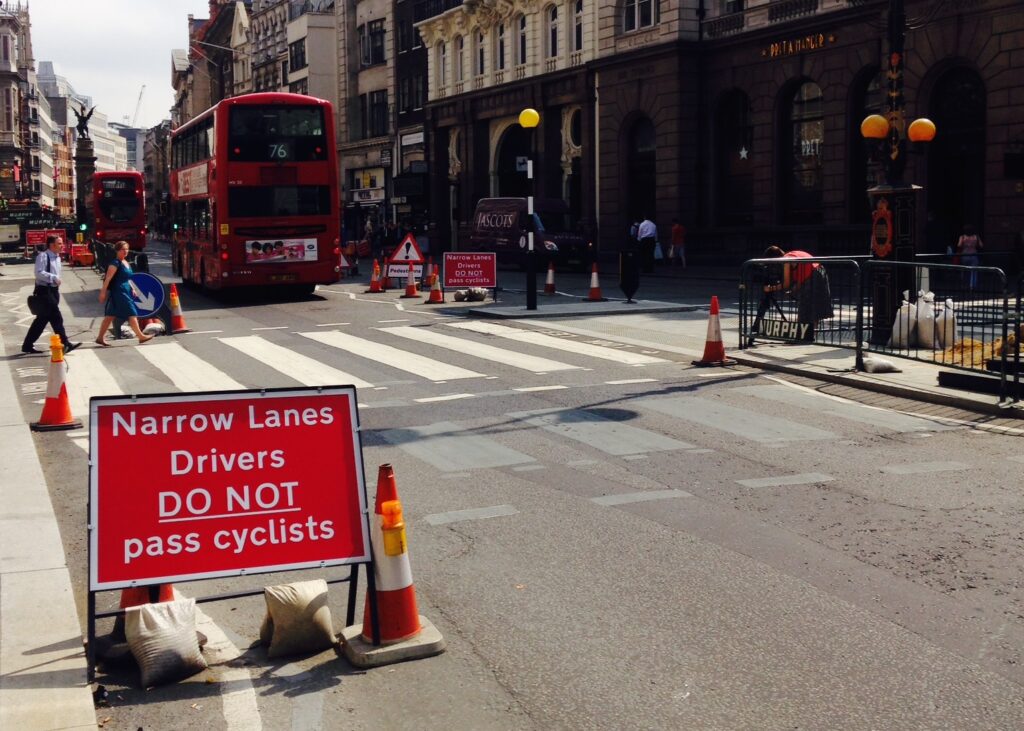

New government guidance says that roads that are either narrower than 3.25 metres or wider than 3.9 metres are considered safest for cyclists.
According to Active Travel England’s review, Critical safety issues for walking, wheeling and cycling, on traffic lanes under 3.25 metres wide, it is clear to motorists that there is not enough space to safely overtake cyclists. It is also clearer to cyclists that they need to ride more centrally.
At the other end of the scale, traffic lanes wider than 3.9 metres are also safer for cyclists, as they allow for a vehicle to give the 1.5 metres of space that the Highway Code suggests.
Whilst the risk of collision is reduced at this width, it still might not be wide enough for motor vehicles to safely overtake.
> Drivers give cyclists more space on roads without central markings, study finds
The guidance states that “lanes between 3.25m and 3.9m should be avoided”, which includes a painted cycle lane, for example, 1.2 metres inside a 2.5-metre lane.
It also says that unprotected cycle lanes within standard traffic widths are unsafe, as advisory cycle lanes increased injury odds by 34 per cent.
“It might seem like tinkering with history, but not only is shifting lane widths good for helping cyclists stay alive, it’s also good for making places nicer too,” Simon Munk, Head of Campaigns and Community Development at the London Cycling Campaign, told Zag Daily.
“At 12ft 8in or over, it’s easier for drivers overtaking cyclists to avoid a ‘close pass’. At the other end, narrowing lanes to 10ft 8in lanes can mean more room for busy pavements and bus stops, while making it clearer drivers shouldn’t overtake cyclists.”

The review recommends that either buffers between the cycle lanes and parked cars (either outside or inside of the cars), or removing painted lanes so cyclists are encouraged to ride in a more defensive position.
This advice is regarded as good practice and will be applied to a £43 billion road building programme across England.
For the current 3.65m roads, the study recommends that either the centre line should be removed, or it should be split into a 3.25m lane and a 4.05m lane.
It also says that the “strongest evidence for improving cyclist safety is linked to reducing general motor traffic speed” and recommends 20mph zones in residential areas or protection for cyclists.




















24 thoughts on “Roads need to be narrower or wider to protect cyclists, says new government guidance”
I’m all for going with “what
I’m all for going with “what is”, but I can’t help thinking that the majority of councils will read:
… and simply remove any cycle infra!
Removing worthless paint isn’t a bad idea. But I think this should have been clearer that “no cycle infra” is *not* the way to better cycle conditions and certainly not all the benefits that active travel can help bring.
I absolutely agree that
I absolutely agree that simply removing cycle infra isn’t a solution.
But I would say that some (maybe even most) painted cycle lanes are worse than “worthless” – they are actively harmful, and removing them would be an improvement on the current situation.
I’m increasingly of this
I’m increasingly of this opinion. The only queries I have are: if this might help by acting as “optical road-narrowing”? But that’s irrelevant when drivers park in it. Then – does it accustom people to the idea that cyclists should have space? I increasingly doubt it – certainly once they get worn by all the driving over them nobody notices them anyway.
Much of the cycle *lane* stuff in Edinburgh would be little loss – although I have spoken to a couple of people who were positive about the wand-protected bits.
On the other hand we do have a few bits of cycle infra which are almost “good enough”.
And we have an “accidental network” of the (shared use) paths on former railway lines. I find these genuinely pleasant and almost always *much* more convenient than the best of the “road infra”. Sadly they are not socially safe at times. And when (rarely) there are more than a handful of pedestrians there is conflict. Which might eventually be avoided if we had a consistent policy of separate space for cyclists AND pedestrians…
chrisonabike wrote:
I think this is actually part of the problem – most of the lanes as they exist in Edinburgh (and most other places I’ve seen in the UK) only serve to accustom people to the idea that cyclists should hug the kerb and as long as a driver stays outside the paint, that is enough “space”.
If you’re going to use nothing more than paint, at least use it to send the right message. The picture from Ambleside that HoarseMann has posted above is actually not complete madness (IMHO). I would say it makes it clear to drivers that, whilst it might be impossible to avoid entering the cycle lane, at least make sure you leave that much room when overtaking a cyclist, and therefore it is evident that it is only safe to overtake when there is no oncoming traffic.
Although I would say 1.2m from the kerb is not enough space. This is a better example: https://bicycledutch.wordpress.com/wp-content/uploads/2020/08/cyclelanes06.jpg As per the original blogger’s post (https://bicycledutch.wordpress.com/2020/08/12/cycle-lanes-in-the-netherlands/), cars (and bikes) are legally allowed to use any part of the road, which is just as well as it’s evidently impossible for motorists to use no part of the red section. But the layout makes it clear how much space to give a cyclist.
It feels safe enough cycling in the wand protected bits themselves. The main problem I have with the wands is that pretty much all the wand protected bits simply vanish the moment things get slightly tricky (i.e. any junctions or narrower sections of road) – which is where protection would be most valuable!
OnYerBike wrote:
I agree. Although … there are some of the bits which are protected which I sometimes find sketchy. Turning into the Ponton Street protected lane which is a bit narrow isn’t brilliant.
They can be traps too – both spontaneously where a motorist parks in the cycle lane immediately after some blocks. But also one at the west end of Silverknowes Parkway which led you into a kerb. (The idea was “cyclists dismount and cross to access Silverknowes Road to the shorefront” but you might have wanted to continue straight on. I think this has been removed now along with the rest of that scheme.)
And the fact that the same blocks and wands were also used to protect pedestrians also – and there are places where it looks like there’s a lane but you can’t actually get into it and would crash into one of the blocks if you tried. Plus where the some of blocks are not quite aligned so you have to stay keenly aware.
Agree that the main issue is the same as always – side roads and driveways (can’t suggest to motorists they should wait…), bus stops (give up) and junctions (also give up, or just paint bike boxes or – worse – two-stage turns).
I’m still of the opinion they
I’m still of the opinion they can be better than nothing, not always,but there are roads i felt safer cycling on with a “worthless” painted cycle lane, than i remotely do now since they removed the paint to add more car lanes.
and theyre far better than the alternatives most councils adopt now, which is shared space paths.
The reality is one size doesn’t fit all.
stonojnr wrote:
In general I think shared-use paths are at best pretty poor sticking-plaster solutions (sign it better). And bake in “fighting over scraps”.
But as you say it can depend … currently the *best* “infra” in Edinburgh by far – and a mini-network even – is the North Edinburgh path network. Shared-use Sustrans-built former railway lines. Zero motor vehicle interactions, no traffic lights etc. – and a quiet green environment!
*BUT* … as soon as the weather narrows them with snow or leaf sludge, or because it’s good weather and everyone went out walking their dog, or there’s a football or rugby match on – they go from “bicycle freeway” to “avoid”.
And they simply aren’t considered safe (not “socially safe”) by a lot of people – and not just at night. (With reason – you might sometimes find yoof with “challenging behaviour” and sometimes motorbikes there – and I believe there have been violent crimes).
Again – what do they do in the place with the highest proportion of journeys travelled? They have a network of high-quality continuous cycle routes – often with few junctions or traffic lights requiring stopping – through the urban areas. AND they have lovely green routes which are recreational but may also serve some specific journeys. And they are getting rid of the cycle lanes… (in favour of full protection or – where enough motor traffic has been removed – cycle streets)
Just to note: *if* the
Just to note: *if* the section of the CCWEL from Haymarket running west was brought up to full Dutch quality (increased width, fixing the motorist parts of the “continuous footway / cycle path” at side road crossings which currently don’t sufficiently discourage bad behaviour, and eventually removing the cyclists stop signals at pedestrian crossings just line in NL) that would be the best overall.
Not as pleasant as the Roseburn Path can be but it would be as safe as it could be for everyone at all times. Of course it would still be one to avoid when the rugby or football were on but that is just part of urban life!
There’s a painted cycle lane
There’s a painted cycle lane on both sides of the A28 from Sturry into Canterbury, a road which has a 40mph limit. Regularly ignored of course and I am often tailgated when I drive along there at the limit. Unfortunately it seems to encourage close passing as some drivers seem to view the road outside the lane as ‘their’ space and don’t realise that they should still pass at least 1.5m away – further as they are usually driving faster than 30mph. I’ve even had a Stagecoach double decker bus driver pass me barely 30cms away, and move back just in as the back of the bus passed me! Yet on roads without painted infrastructure close passes are less common, though they still happen but at lower speeds too. I now avoid cycling along there, a shame as I enjoy the descent into Fordwich – a very pretty place and Britain’s smallest town.
Found a screenshot. I now
Found a screenshot. I now have a front camera too.
I’ve even had a Stagecoach
I’ve even had a Stagecoach double decker bus driver pass me barely 30cms away
https://upride.cc/incident/sk19evw_stagecoach42_closepass/
https://upride.cc/incident/px12dnd_stagecoach42_closepass/
https://upride.cc/incident/px12dne_stagecoach42bus_closepass/
https://upride.cc/incident/px12eez_stagecoach41_closepass/
https://upride.cc/incident/px12dnu_stagecoach40bus_closepass/
https://upride.cc/incident/px62cea_stagecoach42_uwlcrossclosepass/
They were frequent up here because of the Lancashire (and Kent!) Constabulary decrees that a close-passing offence does not exist- if they didn’t hit you, it wasn’t close enough. However, I haven’t detected this frightening practice for over a year now.
Quote:
Just in case you’re wondering what the madness of a 1.2m cycle lane inside a 2.5m traffic lane would look like – there once was such a thing heading into Ambleside… (thankfully now gone!)
It’s effectively a ‘removal
It’s effectively a ‘removal of centre line’ design except they haven’t removed the centre line.
That design isn’t appropriate for a busy A-road.
Ah yes, the times I’ve TT’d
Ah yes, the times I’ve TT’d it on that road trying to get to Holbeck Lane with traffic up my arse…
Absolutely pointless piece of infra really.
This chimes with my
This chimes with my experience – the best roads are either the not-quite-two-cars-wide country b-road, where all the drivers have to behave as if they might have a head on collision, but there’s actually bucket-loads of space for a cheeky cyclist, or the ex-3-lane roads, where a car can give you 6 feet of space without crossing the middle white line, so even the knobbiest of knobs ends up being vaguely polite.
Really not my experience of
Really not my experience of either, on b roads drivers seem quite happy to want head on collisions the way they drive, leave you as a cyclist often trying to leap into hedges to escape.
And there’s an old part of the A45 runs alongside the current A14, its still dual carriageway width in some places, super super wide. Do you know how many times drivers in the past 20 years have so much as moved off their existing near side of the road line to pass me. None that’s how many, two lanes of space, barely any traffic for them to even have to think about checking mirrors to move over, and the assholes still close pass you, at 60mph.
Its not really new stuff but
Its not really new stuff but a reiteration of LTN1/20. See Table 7-2 Minimum Acceptable Lane Widths (p76), although it says 3.2-3.9m instead of 3.25-3.9m
Yes and it was already on
Yes and it was already on Active Travel England’s website.
It also says that unprotected
It also says that unprotected cycle lanes within standard traffic widths are unsafe, as advisory cycle lanes increased injury odds by 34 per cent
For the current 3.65m roads, the study recommends that either the centre line should be removed, or it should be split into a 3.25m lane and a 4.05m lane
The recommendations will be ignored for decades! Certainly, the police won’t be interested in supporting them
The Daily Express take on
The Daily Express take on this storyhas come up on my Facebook today – it’s not entirely a hate fest, but I do wish drivers would make up their minds whether they are victims or perpetrators. Here’s a couple I found:
Dave Bower is my favourite, I think “the trouble with cyclists is it takes ages to wash the blood off your car ??[fucking]?”
David Halfacre
“How do pavements taste? as I can see a lot of impatient drivers just knocking the off out of the way travelling at 15 mph for 3 miles.”
It never ceases to amaze me what cars do to people.
It’s about time anti-cycling
It’s about time anti-cycling actions or rhetoric needs acting on massively! – if Kier Starmer can jail jail people for wordings that are ‘wrong’, this type of behaviour is outright criminal, given a word is slightly different compared to a cyclists life lost on the roads, it’s relatively small recompense
Starmer did not jail anyone,
Starmer did not jail anyone, a judge or court did.
But if you think inciting violence to burn people alive in hotels is just wrong words then you fail to understand the seriousness of what they said/wrote.
leedorney wrote:
I think there’s a strong case for treating cycling/cyclists as almost a protected characteristic although there’s the problem that cycling is a choice whereas other groups don’t have a choice about who/what they are.
Maybe rather than using the justice system, we should have politicians/leaders acting like adults rather than spoilt 6 year olds complaining about made up issues and deliberately “othering” cyclists to stir up hate. Cycling needs to be treated as the solution that it is – better health, reduced NHS spending, reduced congestion, less pollution, happier populace (if they cycle), better appreciation of outside spaces etc.
Tempting to say “that would
Tempting to say “that would be splendid to observe from a distance of several parsecs” although I think in reality it would be some media getting violently dizzy for a bit, followed by indifference. People care a lot less about cycling than about the other isms.
Given the historic depth of motor dependence and the vast business interests therein I think change is a massive challenge. But not impossible as had been show in multiple places now. The question is how to show that doing more of the same will not fix the problems. And also that cultural tropes around “cyclists” and using public transport (smelly buses full of impoverished nutters etc) are not immutable either.
And to government and local authorities: “promoting and providing for cycling and walking – your least shit option”.