


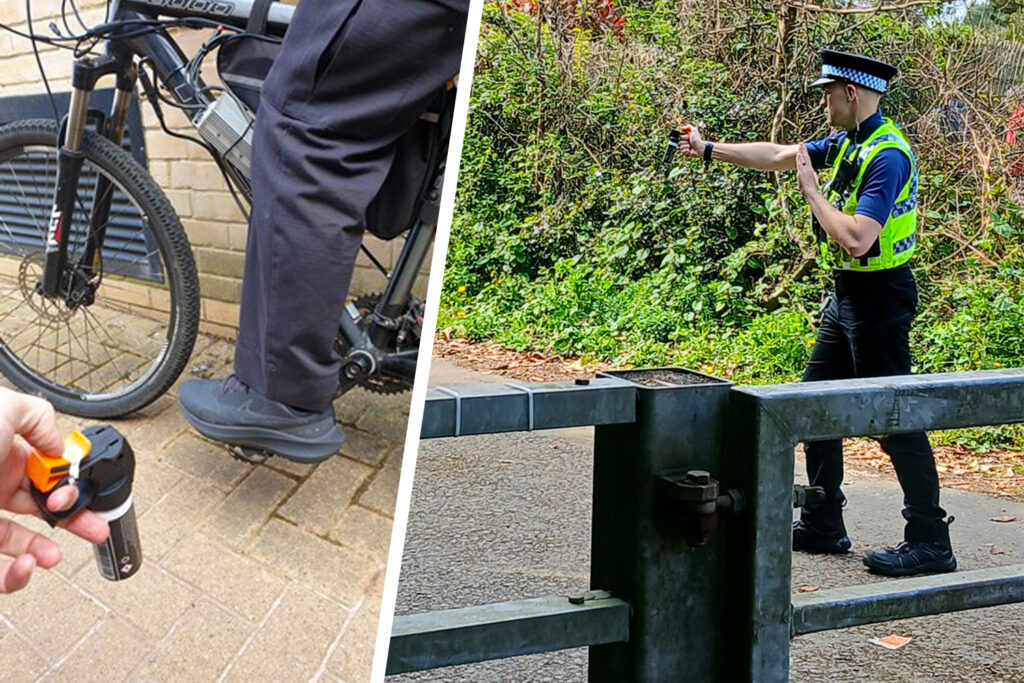

A branch of Dorset Police is trialling the use of a device that deploys ‘forensic spray’ to tag alleged anti-social riders of e-bikes and motorbikes using a water-based marking solution. Though the force hasn’t ruled out deploying the spray on conventional pedal cyclists, it clarified that the method is currently being trialled by officers dealing with a spate of reports relating to anti-social behaviour involving illegal e-bikes, quad bikes and motorbikes.
In an approach that might make the ears of overzealous council enforcement officers in towns such as Grimsby and Colchester prick up with interest, officers from Bournemouth North and Poole Neighbourhood Policing Teams have been given cannisters filled with SmartTag spray, a traceable forensic substance developed by Telford-based DeterTeck UK, that allows officers to ‘tag’ an offender and their bike using a water-based marking solution.
The SmartTag solution contains a unique forensic code linked to the cannister it was sprayed from, which can link a suspect and their bike to the scene of an offence, and help officers identify them in future using UV light to highlight the tag.
Dorset Police decided to begin the trial, funded by its innovation hub, following 112 reports of ‘the anti-social use of bikes off-road’ across Poole and North Bournemouth between May and July 2024, equating to as much as 20% of all anti-social behaviour reports in these areas.
So, are cyclists in the UK facing a future where police officers will be stood at the road/pathside waiting to spray those deemed to be committing offences? It’s unlikely, according to Dorset Police’s communications officer, who admits the “majority” of offenders they have identified are riders of illegal e-bikes and motorbikes, and that the trial is in its very early stages:
“There are a large number of adapted pedal cycles in the community that are being adapted by individuals who are fitting kits to turn a pedal cycle to an e-bike”, the spokesperson told road.cc.
“This can be very dangerous as the bike has not been constructed to deal with the extra power. The legality of such bikes will be looked at on an individual basis as we are seeing such variety.
“The trial is very much in its infancy. The intention is to review the data in conjunction with Bournemouth University and test the success of the wider plans. This will be reviewed by the Force and a decision made as to the next steps.”
When asked if the spray is deployed on moving or stationary riders, Dorset Police told road.cc that it can be “deployed in either scenario”:
“Officers must be risk assessing its deployment upon its use. We are not deploying when a subject is riding at a speed that it would be unsafe to do so for the rider.”
Inspector Nick Lee, of Poole’s Neighbourhood Policing Team, added: “We remain committed to reducing reports of ASB [anti-social-behaviour] across the county.
“We are aware that ASB on bikes and motorbikes causes considerable concern to members of our communities and so we are delighted to be able to trial this new device in our bid to tackle the issue.
“The SmartTag forensic spray allows us to mark these bikes and the clothing of the rider so when we do come across them again, we can tag them to previous incidents with a view towards prosecution and conviction.
“We hope that the use of this innovative technology will act as a significant deterrent for those who are thinking of committing ASB on motorbikes, e-bikes and quad bikes in Dorset.”














17 thoughts on “Police force trials use of ‘forensic spray’ to identify anti-social bike riders”
I guess it depends on what
I guess it depends on what this police force would class as anti-social behaviour. They shouldn’t be able to just spray at an e-biker for simply riding on a footpath in a considerate manner because that’s not a criminal matter, it’s just civil trespass. But if e-bikers were intentionally intimidating people that could be aggregated trespass and warrant them getting involved and using tools like that.
Surely HC Rule 64 applies, in
Surely HC Rule 64 applies, in that you MUST NOT cycle on a pavement.
(Laws HA 1835 sect 72 & R(S)A sect 129)
With it being a MUST NOT, it’s the law of the land and therefore enforcable, whether or not you are being considerate
With it being a MUST NOT, it
With it being a MUST NOT, it’s the law of the land and therefore enforceable
It’s also a ‘must not’ to go through red traffic lights, cross double white lines, use handheld mobiles while driving, but the police choose to ignore these offences when the offenders are drivers. The problem we have is that the police can choose to enforce only those laws where the offender is somebody they don’t like – such as a cyclist
Your logic cannot be faulted
Your logic cannot be faulted there, given your experience. However, we don’t all live and ride in Lancs.
I was only commenting from my own perspective, here in the PRoSY, how selfish of me.. Sorry! I’ll just be off to find a big flat stone to hide under until the heat dies down.
Like many many many others on
Like many many many others on the internet you have gotten confused about difference between a footway and a footpath. The pavement by the road is a footway, and the one that has a fixed penalty notice. A path away from the road, for example through the woods, that’s a footpath, and is just civil trespass.
If it’s a lawful EAPC then
If it’s a lawful EAPC then yes, just civil trespass. But from the article, it sounds like the problem is mostly illegal “e-bikes” i.e. electric motorbikes, and using motor vehicles on footpaths is a criminal offence (S34 RTA).
I will give your comment all
I will give your comment all the care and consideration it merits, honest. In my post I mentioned a pavement, knowing full well the definition of what a pavement is.
I was going to add another question relating to eggs, Granny and sucking but thought that might just be a bit too sarky for this place, so I won’t.
Spangly Shiny wrote:
I would be interested to know which definition of “pavement” you are using; because it is a term that falls into the same area of confusion to which thrawed referred.
Does “pavement” mean “footway”? If so, does it include the raised part of the road set aside for both pedestrians and cyclists? If so, do we use “pavement” for both segregated sections of footway + cycle path, or only shared use? Does “pavement” mean a section of sealed surface, like it does in the USA (and in some technical references in the UK)? In which case motor traffic is permitted on some or all of it. Does it refer to the definition in the Business and Planning Act 2020, which provides for a “pavement licence”? That licence is, of course, a permit to use and put removable furniture on that part of the highway immediately adjacent to the premises of the relevant business. Which could be a footway (“pavement”, see, geddit!)… or indeed, part of the cariageway (oh). The practicalities of that would be sorted out by the LHA, but a quiet, unsegregated section of the road in a sleepy village might still be given such a licence; and the definition of the pavement licence is a licence for that purpose.
The problem with Rule 64 is that it does not define “pavement”. Nor do the acts to which it refers. Rather confusingly, the Highway Act 1835 refers to “footpath” (although it does specify footpath by the side of any road set apart for ”foot passengers’). That term is no longer applied and subsequent acts refer to the footway.
So the problem with saying, “knowing full well the definition of what a pavement is”, is: there isn’t one.
I used the Cambridge
I used the Cambridge University Press definition, which I will reproduce for your information.
“In the UK, pavement is a path with a hard surface on one or both sides of a road, that people walk on. It is also known as a sidewalk in North American English. Pavement is the artificially covered surface of a public thoroughfare. In British English, pavement is also used to refer to sidewalk.”
Copyright Cambridge University Press.
Thus, from that description, the pavement would appear to be the sealed footway on one or both sides of a road. Were the rule intended to mean a shared footpath and cyclepath it would have been described as such within the HC, particularly to prevent any intentional misinterpretation of the meaning of pavement.
The bottom line is, you know full well what a pavement is and just like thrawed did, you are trying to use semantic manipulation to try and score points. The trouble is, I can’t tell who, if anyone, is counting the points, or to what end.
Part of me thinks – police
Part of me thinks – police state. Part of me thinks – yes!
there are lots of illegal ninja e-bikes and riders on the streets. They seemingly dress to intimidate (face covered, all in black) and they speed, silently.
however, if this became an over zealous spraying of people on cycles, that would be concerning.
Rome73 wrote:
I’ve never seen them?
What law is ninja-ing(?)
What law is ninja-ing(?) illegal under anyway?
I think it’s disapproved of
I think it’s disapproved of in public. Also apparently these days you can’t get the staff * when it comes to ninjas – or indeed apprentices, grasshopper.
* Can’t do a “boom boom” – that would be to noisy for a ninja, although apparently tactical use of explosions was in.
The next cool must have range
The next cool must have range of road bikes introduced by Colnago, Giant etc, will presumably have a SmartTag style paint finish.
Same for jerseys, bib shorts etc.
I’m not sure what this
I’m not sure what this achieves in these situations. Sure if a serious crime has been committed and it links an individual to the scene great, but 6 months later and they catch the scrote doing something else, find a marker tag on the bike, what exactly are the police going to do with that information? Certainly with motoring offences you’ve only got 14 days to get a NIP to the driver. What’s different about antisocial riding?
Capt Sisko wrote:
It also worries me that a less-than-honest police officer could keep some of the spray for later use, and then choose to frame someone by spraying them. The SmartTag doesn’t necessarily link an individual to a specific place, but merely links them to having been sprayed by a specific can. Unless they are one-shot devices (though someone could presumably catch some of the liquid sprayed anyway), it’s going to be tricky to prove that the spray was only used at a specific time and place. Presumably, they could later identify that the spray was also on the specified location unless it gets washed off in the rain.
In BCP there are multiple
In BCP there are multiple vehicle crashes across the borough every day of the week caused by antisocial driving, but it’s great to know the police have got the right focus.