


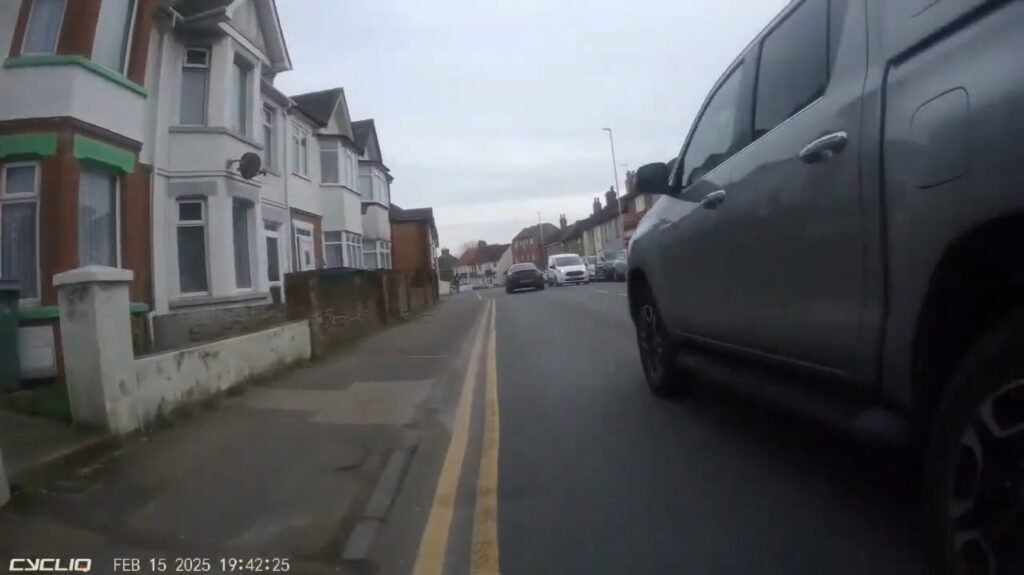

Active travel campaigners have called for “urgent action” to be taken to tackle ‘carspreading’ and its threat to vulnerable road users, after new research revealed that the number of US-style pick-up trucks – where children can’t be seen over the bonnet – has almost doubled in the UK over the past 10 years.
The analysis, based on Department for Transport data and published by the Clean Cities campaign, found that registrations of the 10 most commonly sold pick-up trucks in the UK – including the Ford Ranger, Toyota Hilux, Mitsubishi L200, and Nissan Navara – have leapt from 308,103 in 2014 to 590,587 at the end of 2025, an increase of 92 per cent.
According to Clean Cities, hundreds of thousands of these vehicles are “longer than a World War II tank”.
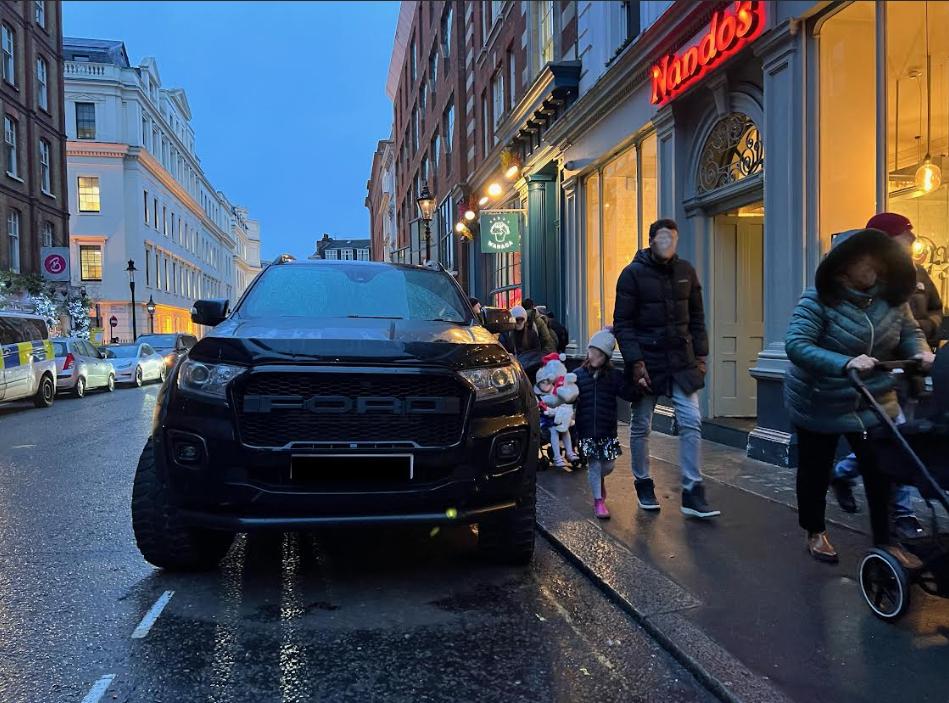
A recent study of 7.5 million road crashes by the Economist also found that pick-up trucks are three times more likely to kill cyclists, pedestrians, and other vulnerable road users compared to regular cars.
Another study of international crash data, undertaken by the Vias road safety institute, showed that a pedestrian or cyclist hit by a pick-up was 90 per cent more likely to face serious injury than one hit by a regular car, and almost 200 per cent more likely to be killed.
With their bonnet heights often exceeding one metre, children can be completely invisible from the driver’s seat of most pick-ups, particularly at close range. Seated behind the steering wheel, a driver of average adult height cannot see children aged up to nine standing in front of many pick-ups, Clean Cities says.
“This boom in US-style pick-up trucks is lifestyle over practicality in exchange for parking mayhem and dangerous roads,” the group’s UK head Oliver Lord said in a statement.
“City leaders must act to discourage these menacing vehicles from our streets. How is it acceptable to have a vehicle so tall that children cannot be seen?”
Meanwhile, Jemima Hartshorn, the founder of Mums for Lungs, said: “These pick-up trucks are built like battering rams and pump out pollution like chimneys. For children, that’s a deadly combination — invisible at the front of the vehicle and breathing in the fumes from the back.
“No parent wants their kids in daily danger, yet we’re allowing these trucks to become normal on our streets.”

The UK government’s road safety strategy, published earlier this month, acknowledged “concerns that larger vehicles, particularly the emerging trend for increased bonnet height in SUVs, may have a detrimental safety impact on vulnerable road users, particularly pedestrians, cyclists and children”.
It also highlighted the work Cardiff Council has done to charge owners of SUVs and other large vehicles a higher fee to be able to park.
However, Clean Cities has warned the situation could soon get worse, following an EU-US trade pact made in August, which will see the European Union and United States “intend to accept and provide mutual recognition to each other’s standards” for cars, opening the door for the import of more pick-ups with lower safety standards, campaigners say.
Pedestrian road deaths in the US are now three times higher than in Europe, after recording roughly similar numbers as recently as 2009, the rapid rise in “monster SUVs and pick-ups” heavily linked by activists to this sharp increase.
EU safety standards include pedestrian protection on vehicle fronts currently not mandatory in the US. Unlike its American counterparts, the EU also requires automatic emergency braking (AEB) on newly sold cars and vans, and seat belt reminders for all seats. The UK is consulting on plans to introduce similar standards.
However, last year, HMRC re-classified a double cab pick-up truck as a car to close a loophole which saw the vehicles being purchased as commercial vehicles when they were in fact intended for personal use.
“Typically these vehicles are equally suited to convey passengers and goods and have no predominant suitability,” HMRC said.




















44 thoughts on “Number of US-style “battering ram” pick-up trucks on UK roads almost doubles in a decade, leading to “parking mayhem and dangerous roads””
Uncontrolled government
Uncontrolled government-subsidised car sales of bigger heavier and faster cars with no regard to the capacity of the roads nor their speed limits nor other road users is a natural part of the glorious enshittification of the UK. It doesn’t look like it is going to stop anytime soon.
The last government should
The last government should never have climbed down on the VED changes for these stupid tanks; it might have made some folk think. I find especially ironic, the parents who buy them because they think their kids are more safe inside!
Whats ironic about that?
Whats ironic about that? Thats literally the arms race when it comes to cars. Most people take their little darlings everywhere in their massive wankpanzers so the only thing they have to worry about is someone in a larger one. Fuck everyone else and fuck pedestrians and cyclists.
Irony would be those people in these horribly oversized cars explaining why they don’t cycle and saying that its because its too dangerous.
I had a prime example of this the other month. Residential side road on a very steep hill with cars parked either side. Shit visibility and its a 20. A woman comes fly around the corner doing well over 30 with her 2 kids in the back. Its OK though, shes in a massive mercedes SUV that will keep her and her children safe unless she hits a bus.
Not sure she would even notice if she hit a child in it. Even if she did, she would make up some BS excuse and suffer no consequences.
she would make up some BS
she would make up some BS excuse and suffer no consequences These days, it seems the go-to dodges for crims and their Shyster Lawyers are medical episode and the ubiquitous flying sack of potatoes or fridge dropping from Heaven. PS wonder what happened to that woman GrossPanzer driver who crashed through a school fence/ wall killing a couple of children, who then came up with the Medical Episode. The police later reopened the case. My suspicion is that they’ve abandoned it again, and I wouldn’t be especially surprised to find that she’s already driving again – for deterrence we have to rely on insurance companies!
https://www.moorebarlow.com
https://www.moorebarlow.com/services/personal/injury/major-trauma/wimbledon-school-tragedy/#:~:text=The%20criminal%20Investigation%20reopened%20in,causing%20death%20by%20dangerous%20driving.
Doesn’t appear to have been updated for a while. The Wiki page has more information, but doesn’t say anything after the driver’s second arrest in January 2025. It could well be she is still driving.
It could well be she is still
It could well be she is still driving
Thanks. Useful link. It’s a fairly safe assumption that the sympathies of GrossPanzer drivers across the UK are with the driver and in support of her continuing to drive
Jbnuts wrote:
Here is an update from July 25. Still no answers!
https://www.bbc.co.uk/news/articles/c89e1kynjjko
“Our thoughts are with Nuria and Selena’s loved ones at this particularly difficult time,” the force said.
“Our investigation continues and we remain in regular contact with the families.”
I find it horribly ironic
I find it horribly ironic that folk who want to protect kids buy those things that kill kids. Kids are more likely to come to harm inside or out!
Have a look at @chrisonabike ‘s vid and whilst its been common know for a while (outside the idiots who buy these things), it explains well the dangers for passengers and those outside.
They want to protect their
They want to protect their kids. They don’t give a shit about anyone elses. I’m sure the irony is completely lost on them that other people are doing exactly the same and the net outcome is more danger for all.
Yeah, your right, I’m sure
Yeah, your right, I’m sure the irony is lost on them too, but their own kids who they are trying to protect are endangered by those things too.
road.cc wrote:
Which was good, although it’s a shame we don’t have an “impractically big on the outside antisocial car” category which would fit them better
I agree with notjustbikes * that they don’t seem well suited for almost any passenger or goods transport application. And their primary suitability would appear to be “for transporting fragile egos” or “the MD’s son who is cosplaying as a blue-collar worker”.
* eg. https://m.youtube.com/watch?v=jN7mSXMruEo
Compensating
Compensating
My neighbour’s son drives a
My neighbour’s son drives a monster Mercedes. He is a really nice bloke, friendly and polite and has a respectable job (in central London) But he thinks he’s a gangsta. His huge, black vehicle blocks out the sun and shakes the foundations when he come around to visit his mum. His pumped up girlfriend needs a step up to get in. It’s the most ridiculously pointless vehicle for North London. Or any part of London. Or any part of anywhere to be honest.
This is unlikely to change
This is unlikely to change any time soon, as long as it’s the sons and daughters of plebs who are killed and the sons and daughters of the rich are riding in the tanks.
Kindermort anyone?
One of these things
One of these things occasionally parks at work, complete with US plates. Needs four spaces in the car park. Owner definitely compensating for something.
Worth putting a note saying
Worth putting a note saying “Big Car = Small Richard” on display under the wipers?
HMRC wrote:
So who in HMRC has such a lack of personality, and a fetish for Americana Excess to fill the void, such that the reclassification fell so favourably?
In fairness these vehicles are even in their applicability to Goods use and Personal transport, in that they’re shite at either function.
The reclassification didn’t
The reclassification didn’t fall favourably; quite the opposite. Vans bought by companies have favourable tax treatment over cars for:
1) Capital allowances (how quickly you can write off the expense against tax – 100% for vans but generally 8% of the cost per year for cars).
2) Benefits in kind (lower tax on the employee who has personal use of vans rather than cars, diverging most for the most polluting diesels).
3) VAT (claim back VAT on the business use element of vans, but not cars).
Double cab pickups have been reclassified as cars for points (1) and (2), but oddly not (3).
My next car is a BIG 4×4 end
My next car is a BIG 4×4 end of. My current car is a Peugeot 107. Pot holes are a nightmare. They won’t be in my BIG 4×4 though.
The higher VED, insurance,
The higher VED, insurance, fuel costs and parking fees will be though.
Yes that’s true . I only
Yes that’s true . I only drive about 3000 miles a year so I recon I could ditch the car and go on cycling holiday instead .
Oooh, lovely.
Oooh, lovely.
Make sure you get those ‘3d letters’ on your number plates.
That way we know for sure….
😉
I thonk we already know for
I think we already know for sure. End of
Oh yeah I hadn’t thought of
Oh yeah I hadn’t thought of that. Thanks. I’ll try for the ‘reflective’ plates to avoid camera traps. Do they actually work ? I doubt it personally.
thax1 wrote:
3D letters! Amateur, the car parts shop near me advertises that they make 4D number plates. Not sure how they’ve mastered time travel when they struggle to find service parts for very common vehicles.
Yeah – that makes sense given
Yeah – that makes sense given your new 4×4 will create 15 times the impact on the road surface as the P107 and so causing many more pot holes. This is just an arms race with the main looser being the tax payer and the vulnerable road user. The relationship between axle weight and impact on surface is exponential rather than linear (look up generalized forth power law). Its crazy that the UK has known this since the 70s and yet we allow these “beast vehicles” on our roads.
Yes, the Morons are Out There
Yes, the Morons are Out There! With illegal plates.
wtjs wrote:
Nothing illegal about that plate…
Other than being too small,
Other than being too small, without maker’s name, you mean?
wtjs wrote:
There’s no way of knowing about the presence of the maker’s name, postcode and BS marking at no less than 5mm high in the photo from that distance, and the vehicle is a non-type approved import which means regulation 14A applies to the number plates. This is why, I suspect Lancashire Police won’t act on it, it’s perfectly legal.
This is why, I suspect
This is why, I suspect Lancashire Police won’t act on it, it’s perfectly legal
Well, you suspect wrongly, then. The reason they won’t do anything about it, is that they never do act on anything. Perhaps you, and any other ‘number plate apologists’ can work out what’s wrong with this one below?
There’s no way of knowing about the presence of the maker’s name
Yes, there is, it’s called looking. There isn’t one
wtjs wrote:
I’m not a number plate apologist, but if you’re going to call out a number plate for being illegal when it isn’t, I’m going to point it out. Perhaps if you reduced the number of vexatious or inaccurate reports submitted, then you might get better or more effective results.
Perhaps if you reduced the
Perhaps if you reduced the number of vexatious or inaccurate reports submitted, then you might get better or more effective results
Perhaps, if you were less of a blithering idiot you wouldn’t write nonsense like that. I don’t report illegal number plates, because there are so many in Lancashire it’s not worth the effort, especially when there are numerous worse offences which the police refuse to even consider. So, idiot, now select from the large number of reports I put on here, a vexatious or inaccurate one and publicise it. At the same time publish a report you have made. I’ll help you out: it’s illegal to alter a number plate to misrepresent B16 NEA as B1G NEA
wtjs wrote:
Get some help FFS.
Then when you have, read that message back and see who is doing the blithering here.
As I said, find a vexatious
As I said, find a vexatious or inaccurate report made by me and publicise it, and cite a case of your own. Here’s my latest – where’s yours? It will be obvious what what your failure means: All Mouth, No Trousers.
wtjs wrote:
…says the person calling me an idiot on the internet from behind a keyboard.
“However, last year, HMRC re
“However, last year, HMRC re-classified a double cab pick-up truck as a car to close a loophole which saw the vehicles being purchased as commercial vehicles when they were in fact intended for personal use.”
This isn’t closing a loophole. This is making the loophole unnecessary by just allowing what the loophole was being used for.
andystow wrote:
The loophole was not people using double cab pick ups as their personal vehicles, that’s allowed anyway (shouldn’t be, but that’s another matter), the loophole that’s been closed is that people with their own businesses were buying them for personal/family use but claiming that because it was a pick up it was a work vehicle and entitled to the fairly substantial tax benefits work vehicles accrue.
I can’t remember which Bette
I can’t remember which Bette Midler movie, but the acronym rings true BCSD ‘big car, small…..’ deffo compensating for something.
I have one idiot around the corner from me that drives a Hummer H2.
His wife always looks sngy or disappointed. ? ? ?
Probably worth leaving large
Probably worth leaving large notes on display under the wipers saying…
“Big Car = Small Richard”
mitsky wrote:
Richard is cockney rhyming slang for something else – to rhyme with Richard the Third. The correct epithet would be “small Hampton” (to rhyme with Hampton Wick).
All right, keep your Alans on
All right, keep your Alans on!
These trucks like the Ranger,
These trucks like the Ranger, Navaro etc aren’t even that big, they’re regarded as compact trucks in the US, a Transit van can carry more stuff. You can’t fit much in the bed compared to a full sized F150 or a Silverado – now those things are absolutely massive, the bonnet higher than the roof of most cars
“A recent study of 7.5
“A recent study of 7.5 million road crashes by the Economist also found that pick-up trucks are three times more likely to kill cyclists, pedestrians, and other vulnerable road users compared to regular cars.”
Come on Ryan.
The trucks are more likely to kill cyclists?
Or should it be something like
“Cyclists, pedestrians and other vulnerable road users are 3 times more like to be killed when in collision with THE DRIVERS OF…”
?