



A new study has once again highlighted the enormous health benefits commuters can enjoy simply by cycling to work, notably with heart health boosts of up to 30 per cent compared with driving.
Significantly, the research — titled ‘Commuting by bicycle (vs by car) is associated with improved aerobic power, microvascular function and diminished CO2 output in the atmosphere’ and which has been published in Experimental Physiology — suggested that riding as little as 4km (2.5 miles) one-way routes, four or five times a week is sufficient for health benefits.

It is the work of academics from the University of Udine in Italy, as well as Professor Federico Formenti from King’s College London who said the “most surprising” plus point is that their study suggests that “even short ~4 km bicycle commutes at a leisure pace, a few days per week, are sufficient to improve our health”.
The study compared cycle commuters with people who drive to work, the cyclists having a 31 per cent higher cardiometabolic fitness (peak aerobic power), something the researchers explain is “a key indicator of cardiovascular health”.
At comparable body weights, the cycle commuters also had a greater proportion of fat-free mass, enhanced skeletal muscle oxidative metabolism and femoral artery blood flow, suggesting “superior overall circulatory function”.
A group of 20 people who drive to work were then tracked for six months as they switched their commuting to cycled journeys, the study finding that they soon also saw improved cardiometabolic fitness and blood flow, indicating that the health benefits were likely a result of their newly active commute.

The research also notes that by switching from car to bike a commuter’s metabolic CO2 output would be ~12 times less over the same distance. It concluded that even at relatively accessible distances, such as four kilometres, commuting by bike at a moderate pace positively impacts cardiovascular function, skeletal muscle
metabolism and environmental sustainability.
It concluded: “We investigated in healthy adults of both sexes the physiological responses associated with bicycle commuting over a relatively short distance (~4.5 km, ~17 minutes one-way, 4-5 times per week), compared with car commuting. Both a cross-sectional and a longitudinal experimental approach was utilised. Although the training stimulus associated with bicycle commuting was moderate, we demonstrated clear beneficial effects of bicycle commuting in increasing maximal aerobic power and exercise tolerance, improving microvascular/endothelial function, skeletal muscle oxidative metabolism, cardiometabolic fitness and body composition.
“Blood biochemistry variables provided evidence of a reduced cardiovascular risk. CO2 emission in the atmosphere was substantially reduced (10-12 times lower) during bicycle commuting vs commuting by car. The obtained results stress the need for educational and urban planning policies aimed at favouring cycling mobility in urban areas.”
Dr Caterina Ursella from the University of Udine, Italy said: “This study provides a strong case for encouraging active transportation as a simple
and effective way to improve personal well-being, reduce our carbon footprint and
the environmental impact of transport.
“As urban centres grapple with rising public health costs and climate challenges,
these results support initiatives that promote cycling infrastructure and active
transportation policies. Employers and city planners are urged to consider
infrastructure and policies that make bike commuting a safe and accessible choice.”
The research follows a study into cycle commuting which last year found that getting to work by bike can improve mental health, with those who cycle to work less likely to be prescribed antidepressants.
> Cycling linked to lower dementia risk and better brain health, researchers find
Numerous other studies have looked at similar health impacts. Last summer, research published in the British Medical Journal found that cycling your commute can lower risk of death by 47 per cent, as long as you aren’t hit by a driver.
Likewise, cycling to work has been linked to needing fewer sick days and reducing blood pressure.


-300x199.jpg "“He wants bikes in traffic lanes. Give him what he wants”: Cyclists urged to “slow every street down to bicycle speed” and ride in middle of lane amid premier’s war on cycle paths + more on the live blog")








14 thoughts on “Cycling a couple of miles to work enough to boost heart health by as much as 30%, new study finds”
4km, moderate. Tomorrow’s
4km, moderate. Tomorrow’s front pages…
It’s not a case of ‘tell it
It’s not a case of ‘tell it to the Marines’, more ‘tell it to the police’ because, in my opinion, the biggest barrier to increasing cycle commuting is the perception of danger from motor vehicle drivers who have been led by dismissive police attitudes towards complaints from cyclists to believe they can get away with anything.
All welcome but clearly
All welcome but clearly another “common sense makes no sense”:
– it doesn’t have to be new, or expensive, or high tech.
– just doing a little is often lots better than none.
In other news:
– “don’t eat too much, mostly vegetables” diet advice shocks health influencers
– “if you drink, do so in moderation” described as “unproven” by journalist.
Another version of “count your steps” as suggested by David Hembrow here: https://www.aviewfromthecyclepath.com/2017/12/cyclings-recommended-minimum-daily.html
Excellent cycle infra optional, but very helpful.
The photograph from the title
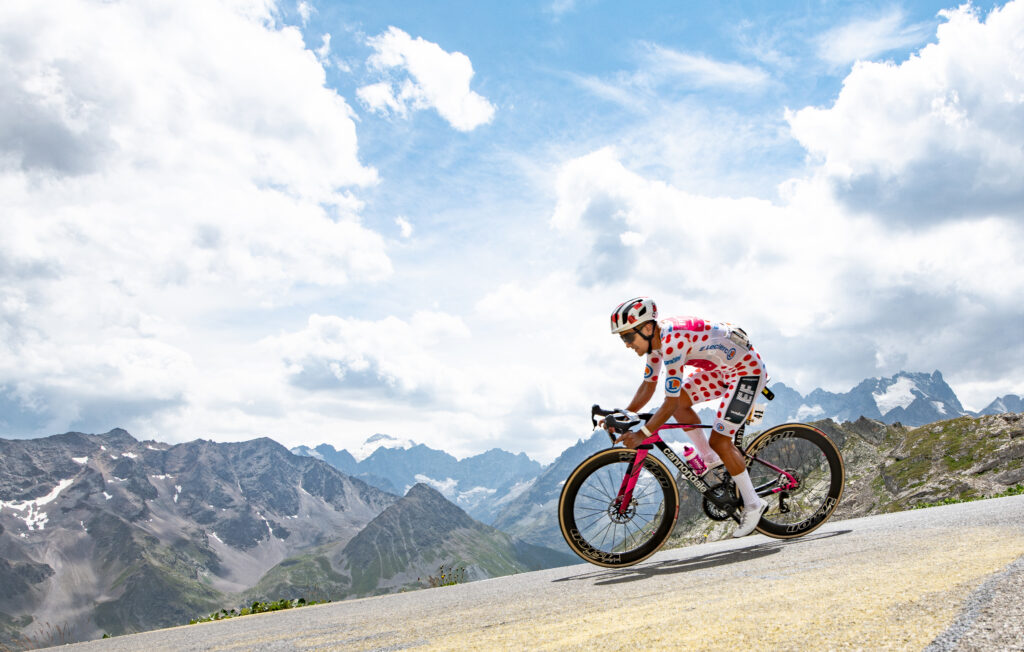
The photograph from the title, of a person riding towards the camera, appears to show a rider with incredibly long arms? Is that just the way the angles of the camera and subject make it look or does the rider have a super long right arm?
Looks like a perfectly normal
Looks like a perfectly normal arm to me. Perhaps you’re being misled by the proximity to their extremely short right leg?
People are often surprised
People are often surprised when they start anatomical drawing that the ratio of arm to leg length is about 3.5:4, because we see people standing with straight legs often but usually the arms are bent. On that ratio the cyclist’s arm compared with her extended left leg looks pretty standard.
A couple of my colleagues
A couple of my colleagues live close to the office. I’ve told them that cycling would take them the same time but cost less. Both want to lose weight and I’ve pointed out cycling would help their fitness and trim their weight. But they won’t cycle and continue to drive. Some people just won’t listen.
I’m here to offer another
I’m here to offer another ‘actually, it’s not that surprising’ comment.
I think people involved with health & fitness often have that as their hobby and underestimate just how normal it is for large swathes of the population to do little to no exercise, and don’t grasp that many people don’t think of exercise as fun, but a slog to be endured. Even those who wish to do more will think of it as another chore they can’t quite find time for, and it becomes so low priority it never happens.
Cycling short or moderate distances to work is ideal for those people. The time is already allocated, and even if it takes a little bit longer than the alternative, it’s still a good use of time. That point becomes further re-enforced once people experience the benefits of arriving at work/back home in a better mood than if they’d driven or taken the bus.
My moderate commute (7km each way) is mainly pleasant with nice views and I only have to worry about traffic on some sections. This means I can listen to podcasts of audiobooks (via bone conducting headphones) and I’d say my subconsious thinks of cycling to work as a positive experience to enjoy, not be endured. But I am only able to do this because nice neighbours let me use their garage to store my bike and bike gear, and then because I have a local not-for-profit bike place whose advice I trusted that persuaded me me that I’d get a much better experience from a reasonably priced reburbished bike compared with the hand-me-down I’d been battling with.
Potential utility cyclists will not identify with the sort of cyclist that spends lots of money on gear, does long distances, or has cycled for years without a break. I’d go so far as to say the image of super-keen cyclists is one of the barriers for new utility cyclists. I’ve often seen it argued that media coverage of Tour de France etc encourages the uptake of cycling, and I’m sure it does for a certain sort of person (usually men), but it has to be balanced by much greater representation of slightly overweight people on comfortable bikes with baskets or panniers getting from A to B.
FionaJJ wrote:
There’s something to be said for that.
The best bit is that if that was the reality after some time they’d perhaps be slightly less overweight people on comfortable bikes (or at least healthier)… and possibly substantially happier people? (Correlation not causation and all that of course…)
People looking pretty normal here, would you say? Key thing is – all kinds of everyone is cycling and even perhaps slighly more women than men. Whereas in the UK it’s *far* more men than women.
Yes. But the reality is that
Yes. But the reality is that most people in the UK are at least a bit overweight, and I’d say at least 95% of the population has more padding than professional cyclistsis. That look, bike type and approach to cycling is not something most people can or want to identify with.
Also (and not saying you would say it) – don’t ever say ‘it will help you lose weight if you cycled to work’ to a woman. Not even if she’s mentioned wanting to lose weight. Situations vary, but if it’s clear you are trying to persuade any individual to take up cycling to work, I wouldn’t say much beyond ‘I was surprised at how much better I feel after cycling in/home compared to driving’. If you have lost weight or got fitter, you can talk about that separately and they will be more receptive to that information if it doesn’t feel like it’s aimed at them.
The danger is always that cycling (or any other) policy is made by the self-selected group aka enthusiasts confident of their own opinions and who spend time talking to others that share those characteristics. Easier said than done, but we need the input of dabblers.
It’s a bit like doing a survey on wheelchair accessibility from the viewing turret of a castle only accessible by climbing a four storey spiral staircase followed by a rope ladder.
All good points.
All good points.
On “The danger is always that cycling (or any other) policy is made by the self-selected group…” Where a (rather large-scale) change is being introduced that is always the challenge. If most people don’t do something, who is going to make / advise on policy? Most people are (mostly) expert in what works for them in their current lives. But that doesn’t always translate well into “how it looks over there” when things have changed.
Otherwise – the most popular campaigns may end up being for more parking, better through-traffic access etc. Or perhaps “more recreational cycling opportunities for kids (maybe in parks – where it’s safe)”. Which would be good but probably doesn’t lead to any further change (kids still abandon the bikes as soon as they can do adult things like driving).
But I agree – some of those who have been successful at cycling in the current transport landscape may be equally unhelpful! See e.g. “vehicular cycling”. The first time I travelled in NL (admittedly a long time ago) I noted plenty of people cycling, but certainly didn’t “get it”…
I’m reminded about the difficulties in “campaigning for people who (overwhelmingly) don’t currently do the activity you’re trying to promote”. Or even think it’s possible for / relevant to them.
And even with some who may feel they’re being campaigned against. For example those who drive now, and who will still (need to ?) drive later. That’s very difficult – but really their “enemies” – or rather competitors for space – are all the other people currently choosing to drive that journey.
Of course with some of us existing lifelong cyclists it’s easy to become tribal (“stuff your ‘I have to drive’ / ‘whatabout my parking space?’ “). Or seem scornful / patronising e.g. “I can, so why can’t you”. See also “they’re just lazy …”
It’s a long way from “the anarchist collective of cyclists” but I think eventually much of the change (if it happens) comes about via the slow, bureaucratic, more mainstream work. So more like Chris Boardman’s way of engaging, and “mobility” / “social active travel for kids and mums and older people and those with disabilities …”. Which does probably mean fewer mentions of “cyclists” and “sport”. (Just … not none, eh, Sustrans?)
Getting off on a tangent now
Getting off on a tangent now (OTOH the importance of the social aspect of most activities – even “exercise” ones – is easily overlooked)…
…but I just came across the “chatting index” for social cycling / measure of infra quality for “normal people”. e.g. how easy is it to chat to someone else as you ride?
(I never cycle on a Level 0 road more than once.)— Faster Pedestrian
FionaJJ wrote:
Policy is made by politicians and civil servants, not fit, lycra-clad enthusiast cyclists; even Cycling UK, probably the loudest pro-cycling lobby organisation in the country, is deliberately inclusive and keen to push all-ability cycling.
The kind of cycling the article is talking about is exactly the type that overweight, slow or not-very-confident cyclists can all do. in places where suitable infrastructure exists you will find lots of people who may fit those categories. However, as well as the long history of negative stereotypes of cyclists in the media, most of the UK’s towns and cities aren’t conducive to easy-paced cycling so many people don’t do it. We saw how the 2020 Covid lockdown encouraged a huge number of people to ride their bikes but once the traffic returned then the cycling seemed to stop.
Simon E wrote:
Agreeing in general, but of course in the UK we have an additional barrier which I think the Covid lockdown points to. I suspect that the “huge”* number of people riding their bikes was not just because the reduction in traffic. It was because the reduction in *travelling to work* – or rather a major change in people’s travel full stop. If you weren’t allowed / able to go other places – maybe a bike trip…?
I don’t know numbers but I would suspect even among the 1-2 percent of our journeys we cycle in the UK most are less about “transport”. That role has largely switched over to motor transport – in particular the private car.
Fortunately it can be done (AFAIK e.g. Seville shows this) … but maybe worth noting that when NL made their decision to stop going for increasing motoring, they still had (looking from the UK today) enviable levels of transport cycling. So that never “disappeared” from popular awareness as a perfectly normal mode of transport for some trips.
We have to square the circle of pushing people to simply choose to drive less, at a time when alternatives to driving are in short supply, unreliable, unpleasant or inconvenient. And when the growth of motoring – all those other drivers – makes motorist already feel put upon!
* IIRC there definitely were more in Edinburgh – though I wouldn’t have said “huge” in my neck of the woods, even though you can see bikes rusting on balconies everywhere…