



A speeding driver who struck a cyclist while attempting to overtake on a bend, leaving her with a broken back, has been given a suspended prison sentence and banned from driving for four years.
Christian Luke Mason, 33, of Douglas Street, Castletown, appeared before Isle of Man Magistrates Court, where he pleaded guilty to causing serious bodily harm by careless driving. He also admitted having no insurance, no tax, and two defective tyres on his BMW.
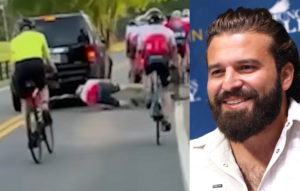
The collision took place on Braaid Road in St Mark’s on 25 September 2024 just before noon. The cyclist was riding in the correct road position when Mason attempted to pass her at speed, but an oncoming van forced him to abort the manoeuvre, clipping the rider and causing her to be thrown from her bike.
A retired police officer driving in the opposite direction gave evidence that Mason’s BMW was “travelling at high speed”. He said he “had to take evasive action” and initially expected a head-on crash before he saw the cyclist “cartwheeling into the air.”
The victim sustained fractures to her spine as well as abrasions to her abdomen, knees, chest and back. She was taken to a hospital and treated for serious injuries.
Mason was interviewed by police and said he had turned onto Braaid Road and was initially driving at 40mph. He said he accelerated to between 50 and 60mph, then “seen the bend, but had not seen the cyclist.”
He claimed that after coming out of the bend, he spotted the bike rider and began to overtake. “The oncoming vehicle had initially been hidden by the dip,” he told police. He said he applied his brakes and was travelling at “15 to 20mph” when he collided with the cyclist. He said she “fell backwards and hit his windscreen,” which broke on impact.
Mason told officers that the vehicle’s rear tyres had recently been replaced and that he “had not been warned about the defective front tyres.”
He admitted that he was “potentially going too quickly for the corner” and acknowledged that “the onus had been on him to ensure it was safe to overtake.”
Defence advocate Louise Cooil told the court the crash was the result of a “lapse of concentration” and said that Mason “had accepted he was going too fast, driving at around 60mph.”
She added that “speed, and perhaps a familiarity with the road leading to a lack of concentration, had contributed” to the incident.
Cooil said Mason had not driven since the crash, intended to sell his car, and was now seeking employment off the island.
Magistrates sentenced him to 20 weeks in custody, suspended for two years, and placed him under supervision for the same period. He was also ordered to pay £5,000 in compensation to the cyclist, £125 in prosecution costs, and must take an extended test at the end of his four-year ban. He will repay the compensation at a rate of £250 per month.
In a statement issued the day of the collision, the Isle of Man Constabulary had said: “The cyclist sustained injuries in the collision and is currently receiving medical treatment. The driver of the car is assisting police as part of an ongoing investigation to determine the circumstances surrounding the incident.”








28 thoughts on “Speeding driver who broke cyclist’s back while trying to overtake handed suspended sentence and four-year driving ban”
She added that “speed, and
She added that “speed, and perhaps a familiarity with the road leading to a lack of concentration, had contributed” to the incident.
Was it also a lack of concentration that caused him no tax, no insurance and tow defective tyres?
That’s a rhetorical question, but the answer is no.
It beggars the imagination the excuses made in these cases, time after time.
It surely should have been causing serious injury by dangerous driving (over the speed limit should make it a slam-dunk!) and had a jail sentence to match the seriousness of the crime. (Or whatever the Isle of Man equivalent of that is.)
Disgraceful, disgraceful, disgraceful.
Simon Withers wrote:
It’s a ridiculous sentence and a miserly £5000 in compensation to the cyclist – how does that compensate for a broken back?
Presumably the expletive
Presumably the expletive deleted can only afford £250 a month, or at least that’s what he’s persuaded the court to believe. So the correct reaction from the bench, if there was any justice, would be to say okay, well given that the physical and mental trauma you have inflicted on this lady will doubtless continue for the rest of her life, you can pay her £250 a month for life, adjusted for inflation each year. Not going to happen of course, hopefully she will be able to claim greater compensation from the Motor Insurers’ Bureau uninsured driver scheme, even though of course that means that the rest of us are paying for this idiot’s crimes.
Rendel Harris wrote:
The court could have at least mandated that he sell his BMW – it’s not like he can use it for the next four years anyway.
Rendel Harris wrote:
And the outcome of that should be a significanlty longer ban, else they drive with impunity.
Thye cannot be trusted to comply with the laws. Law abiding society has bailed them out, they should be required to pay back that sum before they can drive again.
It’s punative damages. The
It’s punative damages. The cyclist should be able to claim from the Motor Insurer Bureau https://www.mib.org.uk/downloadable-content/
Ah, but “it was an accident”
Ah, but “it was an accident” (which I think we now understand means “the specific outcome was unintended” – but certainly not unforeseeable here; indeed sounds like this driver causing problems was entirely foreseeable).
Ah, but they’re so young – we must leave open the possibility of rehabilitation, they’re only 33 so perhaps it’s not surprising in their youthful folly they haven’t yet seen the point in driving per the terms of their licence e.g. obeying speed limits. Or doing boring admin like getting MOTs or tax or insurance … And further they’re so sorry they’re planning to sell the car!
I had a nice argument with
I had a nice argument with someone on reddit about this. They were fully of the view that unless you intend to hurt or kill someone with your driving then its an accident and should be treated as such. No such thing as dangerous driving really because they didn’t mean it therefore it was an accident and not so serious.
This is at the core of our treatment of drivers. We don’t expect them to drive safely. We expect and endorse the idea that you can’t be expected to drive to conditions or behave sensibly if you are given a choice to save a few seconds by rolling a dice. I have it many times on almost every ride. Someone overtakes on a blind corner, over a hill or pulls out in front of you without looking. 99.9% of the time you get away with these things. That 1:1000 time though, you seriously hurt someone and the police and courts brush it off as an accident.
Obviously you are safe driver because you haven’t had loads of crashes. Obviously this is the first time you did something really stupid because everyone knows that poor drivers are always punished for their dangerous behaviour. Obviously you are of good character despite you believing that someones life, health and that of their family and friends aren’t worth as much as a few seconds of your time.
Obviously non-cusodial sentences send the strongest message to drivers that driving dangerously and hurting people isn’t that bad.
And such folk don’t realise
And such folk don’t realise that they have escaped incident because other road users who are more capable have seen a hazard developing and have mitigated the risk.
Hirsute wrote:
Yes. Things which we do which don’t give us negative feedback we’re likely to learn (or unlearn not to do). But if adopted they can put us into a category of higher risk to others. So what was “one of these lifetimes” becomes “one of these years” becomes “one of these days”.
The level of risk isn’t constant per person either. It seems “because humans” people who are in general pretty good at keeping the risk they pose to others low will occasionally give themselves a pass. (They were very tired and “under pressure”, or there were some “emotional events” happening in their life etc. – or it was simply “a one-off”).
Operating a motor vehicle in public space is never zero risk *. And choosing to drive rather than walk / cycle / take the train means that the risk of killing or seriously injuring others is a lot higher.
* Because these are environments which have vehicles and vulnerable road users passing close to each other at speeds where if something unexpected happens sometimes control cannot be regained in time to prevent a crash. There are of course much worse or better designs of infra and rules… and then even “careful and considerate” humans are still human e.g. very occasionally make unfathomable choices, plus are subject to the odd genuinely unforeseen e.g. “medical episodes”.
Its amazing how many drivers
Its amazing how many drivers don’t realise this. Every time I drive I would be in a few dozen crashes if I didn’t compensate for others crap driving. Same for most people. On the motorway I reckon it would be a crash every few miles.
It should be considered good luck that bad/dangerous drivers haven’t crashed before and it should be assumed that if you drive stupidly and get into an accident that you do that regularly. I won’t be in an accident overtaking on a blind corner because I won’t do it. I’ve never felt the overwhelming urge to “just do it once” either like so many people in front of judges across the land.
But of course it’s very, very
But of course it’s very, very rarely a one-off – there’s generally a pattern of behaviour leading to that life-changing moment for a cyclist.
I mean, thats a given which
I mean, thats a given which is why its so laughable when drivers complain about being caught by one of the three speed cameras in the country. What are the chances eh. You just happened to be speeding for the first time at the exact spot a speed camera happened to be. What are the chances. Well, slim to none. The chances of you getting caught aren’t quite so low when your default is to speed though…
mctrials23 wrote:
Personally I still think we should replace dangerous vs careless with intent vs incompetence offences.
Currently we seem to end up with the worst of both – juries reluctant to convict of dangerous when “it wasn’t intentional”, while lawyers will happily switch to “intent doesn’t matter for offence” when the driving is intentional…
Deal with dangerous vs careless via sentencing bands rather than definition of offence.
Then intent needs to be clearly defined – intentionally reducing control by using a mobile phone = intent; minor speeding = not intent; doing 100+ on a residential road = intent; Fleeing police = intent; trying to ‘scare’ a cyclist = intent.
The driver who clipped me (fortunately at low speed) because they didn’t look properly in low sun should IMHO receive a significantly lesser penalty than the driver who intentionally close passed me while screaming threats at me for daring to be on the road on a bicycle, despite outcome being worse from competency issue… The first, having realised how their driving had degraded through complacency had an immediate improvement in driving standard, while the second as a bare minimum needs a significant fine and probably needs threat of jail…
This also gives a better split on offences that can be dealt with via retraining (and/or ongoing monitoring of driving standard) vs offences that need significant jail penalties.
I would hope that the cyclist
I would hope that the cyclist’s insurers take the driver to the cleaners.
Surreyrider wrote:
I don’t know what good that would do as the driver claimed to only be able to afford £250 a month. Even if the cyclist sues the driver for a billion pounds and wins, they’re unlikely to be able to collect the money
hawkinspeter wrote:
Perhaps the prospect of lifelong debt might be a workable deterrent, when people realise that a moment of poor decision making will be a financial mill stone for the rest of thier life thier ownership and sense of responsibility might change.
BikingBud wrote:
Unfortunately, people don’t really consider that they’ll cause a crash and be caught, so it’s unlikely to act as much of a deterrent (same with excessively long prison sentences). Also, putting people into lifelong debt will tend to push them towards crime as they won’t be able to earn money normally, so I don’t think we really want to do that.
In this instance, the obvious answer would be to put him in prison for a period of time (months?) and give him a lifetime driving ban. Any further occurrence of him driving should then be automatic prison time.
There’s perhaps some kind of
There’s perhaps some kind of drugs / state support analogy here?
I think it all starts from driving being more than just transport – it’s about personal status / feelings of agency and “freedom”. And indeed without one it can be harder to “do what I need to do” e.g. get a job (to pay off fines …)
Now we have humans. We hope we can make most people behave better, but if we make using powerful tools possible some people will refuse to use them in a responsible manner (even at risk to themselves) *.
I think there is a tension between “harm minimisation” and “feedback for improper – especially dangerous – use” **. What we have made safe tends to be taken more lightly ***.
Finally – we now have some people who society has taught that a car is important, and indeed feel it’s a “right” and who don’t see everyone else consistently treating operating these tools with (what most might consider…) sufficient caution. So if something bad happens it’s not their fault. Then they don’t understand why they’re being punished – so that’s just something to kick off about and it doesn’t educate them. (They already know that apart from that one time they didn’t have major problems with car use). Society in general then has to pick up the tab for the legal costs and perhaps costs supporting them as they cause further issues out of spite / “fail to thrive” (e.g. can’t pay fines).
Way out? Some people may always fail here? I guess if society was less fixated on the motor vehicle… there’s a slight chance we would be a bit more disapproving of the actual bad actions (reckless motoring) than the resulting status (not having a car / being poor)?
* There are always a small number of such people – hence a fair bit of crime. But I think the perceived “fairness” aspect is harder to deal with given that society gives a massive pass to motor vehicle operation in so many ways.
** There are ways to do this better however – see sustainable safety for a slightly different perspective on making things safer and nicer for all while avoiding unintentionally making carelessness more likely / consequential.
*** Simply reversing that principle doesn’t always help e.g. nervous / stressed humans aren’t necessarily safer humans. See the idea of driving / walking “shared space”, which is – without some very specific design and restrictions – a recipe for generally more dangerous confused drivers, “might is right” and much increased danger to specific groups.
Whilst we all agree the
Whilst we all agree the outcome of the case is too lenient, it would be interesting to know what affect it had on the driver’s future motor insurance premiums.
Assuming it tried to get quotes…
And assuming it would be too expensive, would the driver get behind the wheel whilst uninsured AGAIN (possible given lessons “learnt” from the lenient outcome here) and if caught what would the police/courts do…?
mitsky wrote:
You know the answer – they would sternly tell them not to do it again, again, with the threat of being told not to do it again, again, again.
Slightly longer ban, I bet
Slightly longer ban, I bet they are quaking in their boots…
mitsky wrote:
Given the compensation scheme (US the people who pay more to cover uninsured drivers liabilities) might have bailed the driver out, I feel an appropriate next premium is for that debt to be repaid before any further insurance can be provided.
Quote:
What does that even mean? They weren’t doing puppy paws or sitting on the top tube?
mdavidford wrote:
What does that even mean? They weren’t doing puppy paws or sitting on the top tube?
I took that to mean that the cyclist was on the correct side of the road
hawkinspeter wrote:
I have a sneaking suspicion that what they actually meant was ‘they were over in the gutter where they belong’.
mdavidford wrote:
What does that even mean? They weren’t doing puppy paws or sitting on the top tube?
I had to google that
So what did the cyclist have
So what did the cyclist have to say about this sentence? If she’s fine with it, I’m fine with it. If not, well, maybe the courts should allow her the chance to pursue Mr. Mason with an MV on a road somewhere with her choice as to whether she wants to simply run him into a ditch to give him some idea of what it feels like to be a cyclist or go for the full monte.