


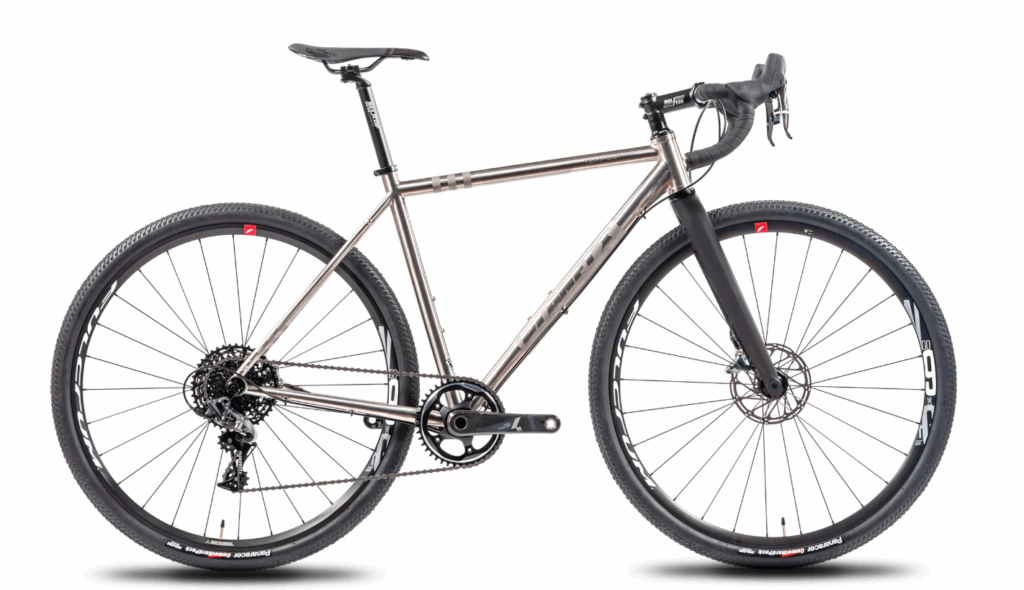

A cyclist paralysed in a crash caused by a Planet X gravel bike’s carbon fork shearing in two on a grass slope has secured a £4.5m settlement against the manufacturer’s insurers. Lawyers say the case highlights the need for “closer attention” to gravel bikes’ regulation, testing and manufacturing so “they are safe for the adventurous use that is shown in their advertising and expected by purchasers”.
Dr Daniel Gordon sustained a life-changing spinal cord injury in August 2020, the NHS doctor paralysed in a crash when the carbon fork of his titanium Planet X Tempest SRAM Force 1 sheared in two on a grass slope in Inverness. Dr Gordon was left with no neurological function in his legs or trunk and will be dependent on a wheelchair for the rest of his life.
Lawyers from UK firm Stewarts confirmed a £4.5m settlement had been secured ahead of a five-day trial that was due to commence at the High Court yesterday. Following Planet X’s financial woes in 2023, a claim for £10m was pursued against the bike brand’s insurers Arch Insurance Limited and Chubb European Group SE.
Testing showed the carbon forks on Dr Gordon’s bike were materially thinner and weaker than two exemplar forks provided by the manufacturer, Huizhou FlyBike Sports Equipment Co Ltd.
Ahead of this week’s hearing it was confirmed a settlement had been agreed, Dr Gordon to receive £4.5m. He will also be able to return to court to seek further damages in the event of a rare but serious and untreatable deterioration caused by a spinal cyst.
“The lack of uniformity as to how gravel bikes are tested, categorised and advertised in the UK”
Stewarts’ lawyers say the case highlights the need for uniformity and clarity in how gravel bikes are categorised, tested and advertised in the UK. Dr Gordon’s £2,300 gravel bike was described by Planet X as a “go-anywhere” model that is “lively on the road but confident enough to play MTB on the trails” and “the only thing Tempest doesn’t have is limits”.
Pictures on Planet X’s website showed the bike being ridden in rocky mountainous terrain, however during legal proceedings the defendants reportedly suggested such advertisement was “marketing puff” that should not be relied upon.
Stewarts also highlighted how, during proceedings, the case was defended partly on the basis that an American standard of classification for bikes (ASTM) applied to Dr Gordon’s bike. This ASTM categorisation, as applied to gravel bikes by other manufacturers, suggested a model should not be ridden over jumps or drops greater than 15cm. However, lawyers reported Planet X’s website made no mention of the ASTM categorisation, nor did any manuals or instructions for the Tempest bike sold to Dr Gordon impose any restrictions on use.
Making a wider point about the advertisement of gravel bikes, Stewarts’ lawyers suggested it is notable that “even when manufacturers and sellers apply ASTM categorisation, this information is rarely prominently displayed and is probably not spotted by most purchasers”.
The law firm said: “The growing popularity of gravel bikes has not yet translated into clear international testing standards, in contrast to the long-standing BS ISO 4210 testing standards for road and mountain bikes and forks. Even BS ISO 4210 testing does not include a test for compressive forces, nor is there any express requirement for manufacturers to conduct any form of field testing of real world cycling before a bike is deemed fit for sale.”
Law firm partner Julian Chamberlayne added: “This case has highlighted that the regulation, testing and manufacture of gravel bikes warrants closer attention, to ensure they are safe for the adventurous use that is shown in their advertising and expected by purchasers.”
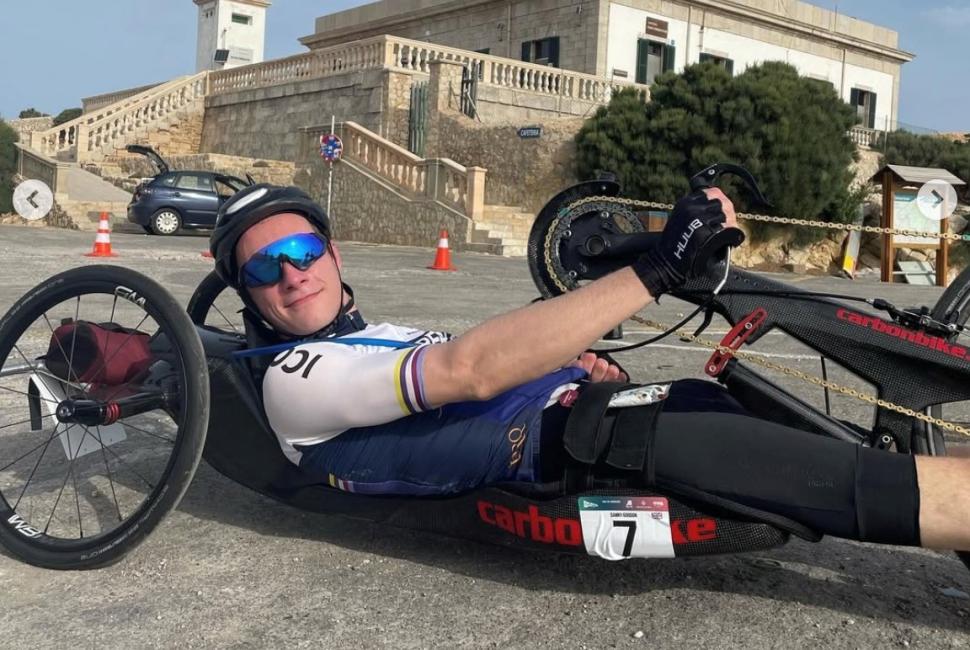
Impressively, Dr Gordon has managed to return to his medical career with NHS Scotland and he currently works four days a week as a specialist respiratory registrar. He has also since taken up hand cycling and completed a cycling tour of Mallorca and this year’s London Marathon.
“Despite a catastrophic and life-changing injury, I’ve been fortunate enough to be supported by Stewarts in pursuing a claim against Planet X’s insurers, the result of which means my future care and accommodation needs can be met,” Dr Gordon said. “Stewarts have been exceptionally proficient, compassionate and offered me clear guidance through an incredibly difficult, complex and personally challenging time.

“I also have to thank Ewan Stirling, a friend and coach who first noticed the unusual way in which the fork sheared, without whom I would likely not have taken any action. I hope now to be able to move forwards and show that despite this injury, life can still be rewarding and fulfilling.”











20 thoughts on “Doctor left paralysed after Planet X carbon fork failure secures £4.5m payout, as lawyers argue case highlights “the testing and manufacture of gravel bikes warrants closer attention””
Dr Gordon sounds a very
Dr Gordon sounds a very inspiring man and I wish him well.
Terrifying how much faith we put in structurally critical carbon components when moving along at speed. Could be any of us.
A 15cm drop is a high kerb…
A 15cm drop is a high kerb…
ktache wrote:
Exactly. I take drops like that on my Brompton.
Indeed, but it’s also true
Indeed, but it’s also true that Steel and Aluminium Alloy components can fail if poorly designed, constructed, or mishandled, carbon isn’t necessarily the outlier in this regard. I wonder if any of this will materially change the way bikes are designed or marketed in the near future, is there a dose of expectation management coming? Or a document supplied that describes what qualifies as gravel?
Indeed, an inspiring
Indeed, an inspiring individual. I doubt if I was unfortunate enough to face similar challenges, that I could bounce back like this!
I think it would be good to have specific performance and use case limitations for cycling equipment made clear. In this case though, the point is made in the article that the fork that broke was materially thinner-walled than the “exemplar” forks from the same manufacturer. This would suggest that the Planet X bike was designed for gravel riding (whatever that is supposed to be) and the marketing of the bike suggesting the Dr’s use of it (as briefly described in the article) was within the advertised use case. The fork was manufactured out of specification of the “exemplar” and this is the implied reason for failure.
I think that standards need to be applied that mandate appropriate QC tests and verification of these tests being passed before safety critical items like bicycle forks are allowed to be sold. The last bike I built had a bunch of QC stickers on the fork steerer, but without knowing what they actually mean, they are worthless.
I have taken this warning
I have taken this warning seriously, and examined the carbon forks on my Vitus gravel bike, my Merlin titanium ‘racer’ and my (even more) aged friend’s Boardman. They all look and feel perfect, and I’ve had the Merlin for 23 years
The article says it was
The article says it was ‘thinner’. I wonder if there is any inspection you could do that would enable you to be able to tell if your forks were thinner or not. Also I would like to know how much they mean when they say thinner, 1mm?
No, all I can do is recall
No, all I can do is recall that the Vitus forks have taken a lot of hammer since 2019 and observe that there is no cracking or defect at all.
There are non-destructive
There are non-destructive testing ways that can revel the thickness and whether there are voids or other internal defects, otherwise invisible. “Carbon” repair places will have such scanners and offer this kind of testing.
Why would a British retailer
Why would a British retailer be expected to reference “ASTM” by a British court. It’s not BSTM or ESTM…
thrawed wrote:
Because they introduced it as a defence. When the manufacturer’s representative states ‘well we only classified it as ASTM2‘ as a justification for its lack of strength, the question ‘did you tell anyone that?‘ is obviously going to be asked in response. What else would you expect?
I have the Planet X Hurricane
I have the Planet X Hurricane bought in 2019 and suffered fork failure whilst road riding about 10 months after purchase . The leg on the disc side crumpled like cardboard around the top disc mounting bolt . I believe it’s the same fork as the Tempest , Hurricane models were both specced with the same Selcof ” gravel ” fork . I had bought spare wheels and 35mm gravel tyres and use it on white roads and bridleways . I contacted PX at the time and after they had suggested I had used incorrect mounting bolts agreed to take it back for inspection. I had no feed back from them for some time and had actually ordered a new fork when on the same day I received notification that a parcel was on its way from PX . It was an identical replacement , with no further explanation or information. New replacement fork promptly cancelled . Needless to say my confidence was severely dented but I’m using it now as I used to with no issues , a Friday afternoon fork ? Incidentally , I have a genuine Selcof carbon Road fork from 25 years earlier, 1″ steerer tube , that looks and feels rock solid on my Ti Raleigh road bike , probably from the original company as I guess Selcof is just a brand name PX purchased and outsourced to China ? I do have a PX Spitfire Ti bought as as frame set like my Hurricane as it was a ” killer ” deal , this too has a Selcof road fork similar in appearance but not shape to that of the Hurricane and not like the old Selcof on the Raleigh .
I thought at the time of the fork failure that I was luck it happened on Bedfordshire’s rolling pot holed roads rather than descending the Col de Galibier !
I have the Planet X Hurricane
I have the Planet X Hurricane bought in 2019 and suffered fork failure whilst road riding about 10 months after purchase . The leg on the disc side crumpled like cardboard around the top disc mounting bolt . I believe it’s the same fork as the Tempest , Hurricane models were both specced with the same Selcof ” gravel ” fork . I had bought spare wheels and 35mm gravel tyres and use it on white roads and bridleways . I contacted PX at the time and after they had suggested I had used incorrect mounting bolts agreed to take it back for inspection. I had no feed back from them for some time and had actually ordered a new fork when on the same day I received notification that a parcel was on its way from PX . It was an identical replacement , with no further explanation or information. New replacement fork promptly cancelled . Needless to say my confidence was severely dented but I’m using it now as I used to with no issues , a Friday afternoon fork ? Incidentally , I have a genuine Selcof carbon Road fork from 25 years earlier, 1″ steerer tube , that looks and feels rock solid on my Ti Raleigh road bike , probably from the original company as I guess Selcof is just a brand name PX purchased and outsourced to China ? I do have a PX Spitfire Ti bought as as frame set like my Hurricane as it was a ” killer ” deal , this too has a Selcof road fork similar in appearance but not shape to that of the Hurricane and not like the old Selcof on the Raleigh .
I thought at the time of the fork failure that I was luck it happened on Bedfordshire’s rolling pot holed roads rather than descending the Col de Galibier !
I wish Dr Gordon all the best
I wish Dr Gordon all the best for his future, but remember any material can fail not just carbon.
I had a Motobecane touring bike a number of years ago that had steel forks. On the day of the failure, I descended a steep hill at speeds approaching 60mph on my daily commute.
I noticed the front end feeling a bit ‘strange’ when I arrived at work, so I picked up the front wheel to have a closer look.
One side of the fork leg just fell off onto the ground! There was a crack going all the way around the leg of the fork about half way down, so I assume a flaw of some kind in the steel, as it was nowhere near the brazed crown.
Close escape for me after the fast descent.
I’m glad the insurers
I’m glad the insurers eventually paid out too – apart from anything it’s nice to know that ‘oh but we went bankrupt’ doesn’t get a company out of paying damages.
But I do also agree with your point that the quality assurance on bikes is the issue here, not necessarily the ‘carbon fibre’ as such. Abrupt failure can happen in any poorly manufactured component. I wonder how many bike companies review the quality of welding in metal frames?
A pox and a curse on Planet X
A pox and a curse on Planet X for fighting this case, glad they lost
It was PX insurers who lost
It was PX insurers who lost the case.
Scarily, there are no
Scarily, there are no universally adopted quality and testing protocols controls for most components across the main bike brands. For example, testing torque forces applied to steerer tubes to determine factors of safety, or overloading structural parts of the frame and forks to determine just how much they will take before they routinely fail. Some do test more thoroughly than others, and examples can be found of most brands where there has been a design or manufacturing issue.
However, this approach to testing (hopefully ) every frame and fork before it is built into a bike could be adopted.
https://www.qualitymag.com/articles/95703-industrial-ct-raises-the-bar-for-canyon-bicycles
My partner has been happily
My partner has been happily riding round on her Planet X Cx bike for years, which I check regularly, but I’m now worried about Planet X😐, although they are very popular numbers wise even though they have the more broad scale appeal of their larger competitors.
Terrible accident, we must
Terrible accident, we must not forget, 99% of carbon bikes are made in china( or taiwan) i saw a s-works sl8 snap in two after a minor colision on the rear wheel. What are the chances to be paralyzed after a bad tumble . I deeply respect the way the dr picked up the pieces and does the hand biking !