



Cycling campaigners in London have called for “immediate and decisive action to address the safety of cyclists” after a woman was killed by a ‘racing’ moped rider while cycling in one of the city’s bike lanes.
Police investigating the death of the female cyclist, who was in her 50s, have confirmed this week that arrests have been made following the fatal hit-and-run collision, with reports suggesting that the moped rider may have been involved in a feud with other scooter users and had entered the bike lane to cut through traffic.
The cyclist was riding in the semi-protected cycle lane on King Street in Hammersmith, known as Cycleway 9, when she was hit by the moped rider, who fled the scene on foot, at around 5.40pm on Friday 22 August.
She suffered critical injuries in the crash and, despite the best efforts of paramedics and members of London’s Air Ambulance, died at the scene at Lyric Square.
The cyclist, whose name has not been made public, is the sixth person to die while cycling in London in 2025. Her family are currently being supported by specially trained officers, the Metropolitan Police has said.
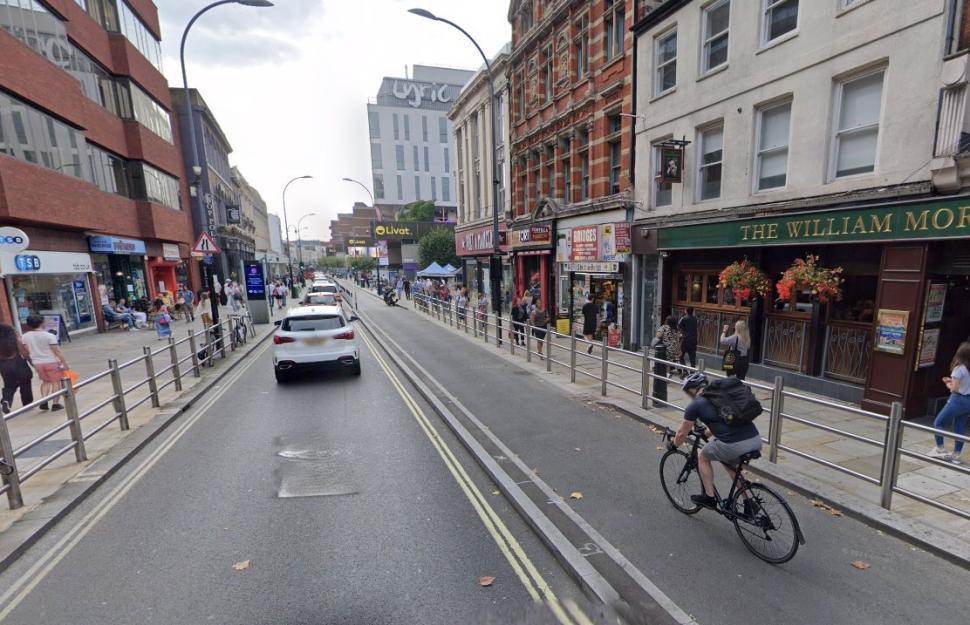
According to a report in the Standard, moments before the fatal collision, a number of moped riders had entered the cycle lane – which at that point is only protected by plastic bollards – seemingly in a bid to cut through traffic.
Reports have also suggested that the moped riders were racing and were possibly involved in a “feud”.
The cyclist had no connection to the moped or scooter riders, and was simply “in the wrong place at the wrong time”, sources have said.
In a statement issued this week, the Met has confirmed that, following efforts to trace down those involved in the fatal crash, arrests have been made.
“Around 17:40hrs on Friday, 22 August, officers attended King Street, Hammersmith, following reports of a collision between a moped and a bicycle in the cycle lane,” a police spokesperson said.
“The cyclist, a woman in her 50s, was found with critical injuries. Despite the efforts of paramedics, she was pronounced dead at the scene. Her next-of-kin are being supported by specially trained officers.
“Arrests have been made, and the investigation is ongoing. Anybody who witnessed the incident, or who has information, should call 101, quoting CAD 5782/22AUG.”

Following the latest tragic incident involving a cyclist in the capital, the London Cycling Campaign has called on the city’s authorities to address concerns that Cycleway 9 is constantly being used by motorbike, moped, and scooter riders.
The two-way cycle lane forms part of Transport for London’s cycling network and runs for around a mile along King Street, from its junction with Goldhawk Road at the boundary with Hounslow in the west, to Hammersmith Broadway in the east.
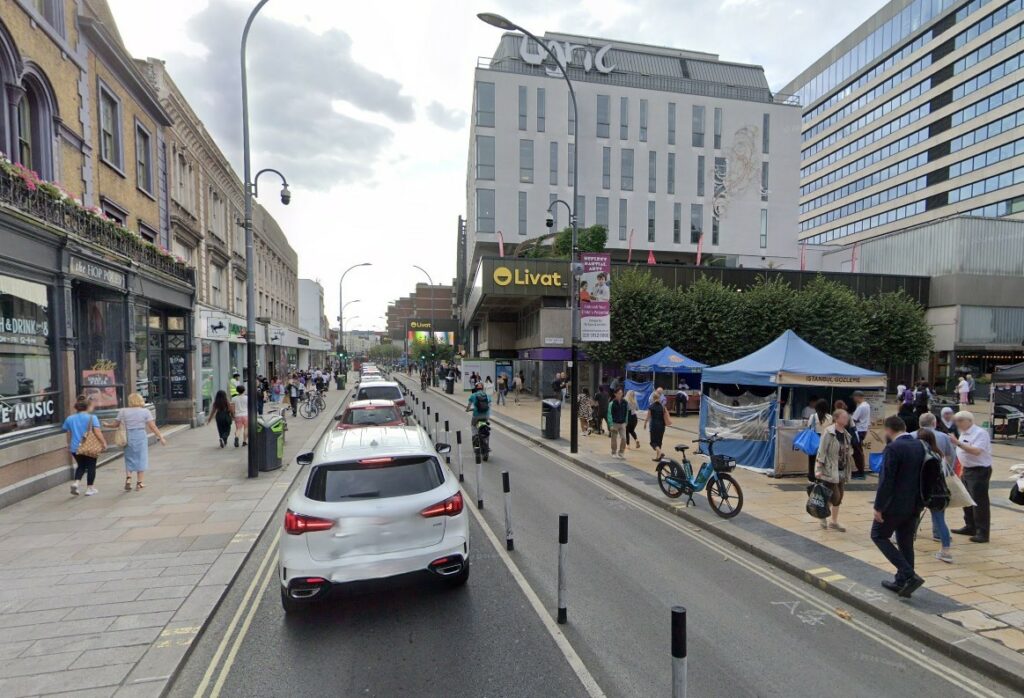
However, the level of protection provided by Cycleway 9 varies in different locations, with the lane’s concrete kerb giving way to plastic bollards at Lyric Square (as seen in this story’s main image), the scene of last month’s fatal collision.
The London Cycling Campaign has previously voiced its concerns that the “downgrading” of the bike lane’s protection from a raised kerb to bollards has made it easier for moped users, including delivery riders on illegal electric motorbikes, to access the cycleway (though it is understood that the rider involved in the fatal crash was not a delivery rider).
Nevertheless, the London Cycling Campaign’s chief executive Tom Fyans, in a letter to Hammersmith and Fulham council, described the tragic incident as a “stark reminder of the critical need for immediate and decisive action to address the safety of cyclists” using Cycleway 9.
“It is a concerning trend that motorbike and moped riders frequently use the cycle lane on King Street to circumvent traffic or make deliveries,” he said.
“This includes some riding across Lyric Square. These practices endanger those cycling as well as walking and wheeling and undermine the very purpose of active travel initiatives.”
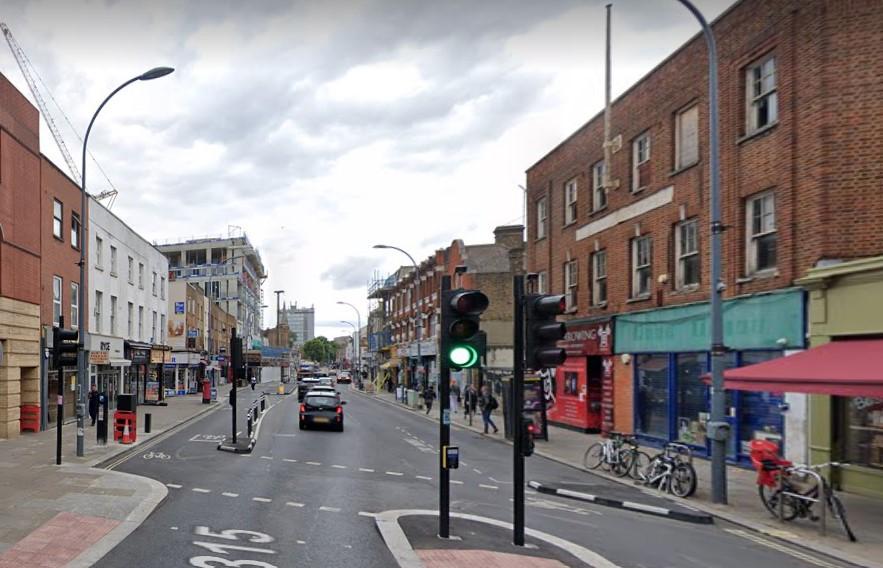
This isn’t the first time that concerns have been raised concerning safety issues on King Street’s cycle lane, which was the subject of several complaints from motorists and politicians before it was installed, including an unsuccessful legal challenge from anti-cycling group OneChiswick in 2020 and 2021.
In 2023, broadcaster and cycling advocate Jeremy Vine criticised the Telegraph for claiming that there had been a “surge” in the number of injuries along the route since the protected infrastructure was installed.
Citing Transport for London (TfL) data, the Telegraph claimed that from January to August 2022, three people were seriously injured while riding bikes on the segregated cycleway – two in collisions involving motor vehicles at junctions, and one in a crash involving three bikes.
That compares to one cyclist being seriously injured on the same stretch of road during the three years from 2019 to 2021, while the news outlet also highlighted that during that same period, 10 cyclists had been slightly hurt in road traffic collisions, which it said was twice as high as the number in 2019, before the lane was built.
However, Vine – who branded the story “garbage” – hit back by pointing out that there was a “crucial fact” missing in the Telegraph’s article, namely, “how many people are using the lane now, compared to the number who used it before?”
“Without this, these ‘stats’ mean nothing,” the radio and TV presenter said. “No-one was cycling in this area before, because it was so dangerous – that’s why fewer cyclists were hurt.”



















16 thoughts on ““A stark reminder”: Cyclist killed by ‘racing’ moped rider cutting through traffic in bike lane, as cycling campaigners call for “immediate and decisive action””
This isn’t a new thing.
This isn’t a new thing.
It’s been going on for ages and the police have done sod all about it – the cycle lanes are used by many hundreds of illegal motorbikes on that section in Hammersmith every day – mostly Deliveroo and Justeat “riders”.
I’ve been buzzed several times by motorbikes doing well over 60mph in the bike lane in the same spot the poor lady was struck and killed.
The problem is london wide though. If the police wanted to solve it all they would need to to is wait outside KFC and McDonalds etc and wait for the “riders” to turn up and collect their next orders.
Don’t let the facts get in
Don’t let the facts of this case prevent you using it to making your case.
The police report doesn’t say
The police report doesn’t say either way. It just refers to “moped driver” and “scooter users”.
Almost all of the mopeds in Hammersmith are rented scooters used for food delivery / drug delivery work*
Either way it doesn’t matter – this poor lady lost her life to vehicles being raced through a bike lane.
* according to local police who have advised local businesses of the same and highlighted the use of Deliveroo / Justeats coats and moped boxes etc by drug dealers.
open_roads wrote:
If it was just road.cc saying that, you might have a point, but they’ve basically just lifted it from the Standard, who it’s probably reasonable to assume have done something approaching actual journalism and have sources other than just the police for it.
Usual suspects, no licence,
Usual suspects, no licence, no insurance, no tax, no visa, no clue. Happens all the time, so fatigued by it all 🙁 as usual nothing happens. Mayor too busy counting his Range Rovers.
Often working illegally on
Often working illegally on “rented” Deliveroo / just eats rider accounts and paying a weekly fee to use someone’s bank account to receive the proceeds. And of those, all are uninsured and few if any have done a driving test.
I think they’re counted as
I think they’re counted as victims of modern day slavery.
London’s mayor has to have
London’s mayor has to have police protection because of all the racist right wingers who threaten him on a daily basis. He is a keen cyclist but rarely gets to ride due to the numerous threats to his life.
Could you elaborate on your comment about ‘the usual suspects’? This is often used as a code phrase meaning something else.
alexuk wrote:
You have no idea whether any or all of those conditions you mention apply. By “usual suspects” one assumes you are implying people of colour or immigrants? Again, no evidence whatsoever.
The mayor of London is, firstly, not responsible for the inadequacies of the cycle lane which allowed the moped riders to enter it, that’s on Hammersmith and Fulham council. On a wider point, Sadiq Khan is the mayor of a city of nine million souls covering more than 1500 km², what is he supposed to do, be present at every junction at all times? If a bunch of morons decide to race their mopeds in the cycle lane, that’s on them, not on him.
Khan used to cycle a fair bit and definitely got the tube to work, I’ve seen him on there more than once. The reason he has frequently to have recourse to an armoured Range Rover these days is because he is advised to by his Metropolitan Police close protection team. This is due to the number of death threats he receives from knuckle dragging mouth breathers who can’t stand the fact that not only is a brown Muslim the mayor of our capital city but also has been re-elected twice. The ire of these Neanderthals is of course greatly increased by the general atmosphere created by idiots trying to make every single incident in London his fault and spewing their nonsense everywhere, including cycling websites, sadly.
Your attempt to weaponise the death of this poor woman in order to attack the mayor of London is frankly disgusting, although of a piece with all your other alt-right comments on this website. RIP to her, and shame on you.
Hey – less of this speciesism
Hey – less of this speciesism against Neanderthals! They appear to have been quite social, egalitarian art-lovers – nothing like the people you’re referring to.
It’s quite a jump to go
It’s quite a jump to go accusing the OP of being racist when referring to the “usual suspects”.
Personally I’d interpret “usual suspects” to mean the huge number of scroats using illegal bikes / motorbikes and unrestricted mopeds on the streets of london. Most of them wearing balaclavas / face coverings and almost all of them ignoring all aspects of the Road Traffic Act e.g. speed, obeying lanes, not overtaking in zig zags, observing pedestrian crossings etc.
And the Mayor does have accountability in this. Via the Mayor’s office / MOPAC he is responsible for oversight of the Met Police and as such has a role in agreeing its strategic objectives – which surely should include tackling the huge number of illegal vehicles now being used on London’s streets (and cycle lanes).
So how would you go about that? Lots more patrols, lots more car/motorbike officers to catch them? Great, now how are you going to achieve that given that the previous Tory governments have slashed the Met budget by £850 million since 2010? Khan has done his best to make up some of the shortfall from other areas but the truth is there simply aren’t enough officers because there simply isn’t enough money and that’s on the previous governments, not him. Unless you want to blame him for the undoubtedly true fact that said governments deliberately cut the funding for the Met out of spite in order to make his job more difficult.
open_roads wrote:
It’s not a jump: the OP included ‘no visa’ in the list of sins. OK, I don’t have a visa, but it would be unusual to for someone point that out unless they thought I needed one.
Thank you, exactly! “No visa”
Thank you, exactly! “No visa” can’t mean anything other than “must be illegal immigrants”, despite the fact that there is no evidence that the perpetrators were any of the things he claims.
slc wrote:
No probs mate we take Mastercard, PayPal, Bitcoin…
This is great cycle lane (and
This is great cycle lane (and great project in general) which is spoiled by people like these. And also by people thinking out of their arses, suggesting this has something to do with their race of visa status.
While stupid youngsters doing what usually stupid youngsters doing in the streets (racing, littering, swearing, etc), more adult ones are swearing, and littering in the comments. Go join the police forces, if you feel like we don’t have enough of them.