



road.cc Podcast episode 113: Is China ready to take over the cycling industry? We chat to Chinese bike brand Yoeleo about challenging the old guard, changing Western perceptions, and “pushing the limits”

“Teammates would joke about body fat”: Anonymous rider shares letter describing weight loss struggles, revealing that “disordered eating was normalised” and training camps became a competition for “who could lose the most weight”

“A burger wasn’t just food, it was failure.” That’s how an anonymous male WorldTour rider has described the way cycling’s weight culture took over his life, in a revealing letter published by Domestique.
“I grew up with cycling in my blood,” he begins, recalling watching the Tour de France as a child and dreaming of joining the peloton. But once inside the men’s WorldTour, he quickly learned that “you had to be as light as possible.”
“I started tracking and weighing all my food, cutting out anything that wasn’t considered ‘pure fuel.’ A burger, for example, wasn’t just food, it was failure, and not something I could eat unless there was a good reason or it was the off-season.”
At altitude camps and in team environments, he says, the pressure was constant: “It almost felt like a competition: who could lose the most weight. Teammates would joke about body fat, staff would reinforce the pressure, and the culture normalised disordered eating as discipline.”
What began as something staff called dedication soon spiralled into obsession. “I couldn’t live without my scale, and going out for dinner felt impossible because it would ruin all my progress.”

The consequences were devastating: “I reached a point of being under-fuelled for so long that I couldn’t train properly. My body felt broken. I couldn’t train or recover, I was constantly sick or injured, and mentally I was crumbling.”
He points out that unlike in women’s cycling, where loss of menstruation is often recognised as a red flag, for men, “low testosterone, depression, and a kind of constant fragility become the quiet reality. But in the peloton, that’s just seen as weakness, not a medical issue.”
“Over several years, I worked, often in secret, to rebuild my relationship with food and with my body. It wasn’t easy. Gaining weight in an environment that celebrates thinness is incredibly difficult, and I had to learn to tune out the comments and the doubts.
“For the first time in my career, I completed a season without missing races due to illness, injury, or burnout. Fueling properly hasn’t made me weaker, it has made me reliable, resilient, and happier, both on and off the bike.”
He closes by urging the sport to confront the issue openly: “I believe RED-S and disordered eating in men’s cycling need to be spoken about more openly. Right now, it is often swept under the rug, as though it’s just ‘part of the sport.’
“But we’re losing talented riders, shortening careers, and damaging mental health because of a culture that glorifies under-fuelling. If we want cycling to be sustainable for the next generation, we have to challenge that.”
.jpg)
This is the latest in a conversation that’s been running all summer, but until now, most of it has been centred on the women’s peloton. Last month, former Olympic cyclist Emma Pooley told the BBC that “at the elite level, the idea that thinner is faster is wrong” and reflected on her own diet struggles during her racing career, stressing that “enjoyment is a really big part of healthiness” and “it’s not about restriction, it’s about healthy fuel.”
Then, just two weeks ago, Pauline Ferrand-Prévot responded to scrutiny of her own weight loss before winning the Tour de France Femmes, saying it had been “controlled and intelligent” with the support of a nutritionist, chef, and coach: “It wasn’t an illness. There was a lot of fuss about it, but I don’t take that personally.”
Cyclist flips the tables and asks ‘Why don’t drivers pull over to allow faster traffic to pass’… but gets accused of overtaking queue of cars on solid white line
A rider in Ireland has stirred up debate with a clip showing them stuck behind a long queue of cars before filtering down the left, overtaking on broken white lines… and, more controversially, slipping past on stretches marked with a continuous white.
Shared by the account CyclingForMind, the video is captioned with a sarcastic twist on a familiar complaint: “Why don’t cyclists pull over to allow faster traffic to pass?” — flipping the usual gripe back onto drivers who were nose-to-tail and blocking the road.
“Why don’t cyclists pull over to allow faster traffic to pass?” pic.twitter.com/cGsydr8TJV
— Cycling For Mind (@CyclingForMind) August 27, 2025
But many online responses homed in not on the irony, but on the Highway Code angle. One commenter insisted: “A solid white line means no overtaking.” The rider shot back: “Amazingly it never applies when drivers are overtaking cyclists.”
Others challenged more directly. “Good that you filtered past on the left when it was safe & the gap,” wrote one user, “but it’s a shame you crossed the solid white line to overtake. The no-overtaking applies to ALL road users, not just motor vehicles.”
The cyclist replied with a clipped “Incorrect,” posting the Irish regulation on continuous white lines, which specifies drivers must stay to the left of them — making the point that, legally, things aren’t quite as commenters assumed.
The exchanges kept spiralling. One critic sneered: “Nice overtake on a solid white line and then undertaking.” The cyclist shot back: “Why were they in the middle of the lane?” — before resurfacing a tweet from the same user complaining about cyclists taking the lane and “making it more difficult for drivers to overtake safely.”
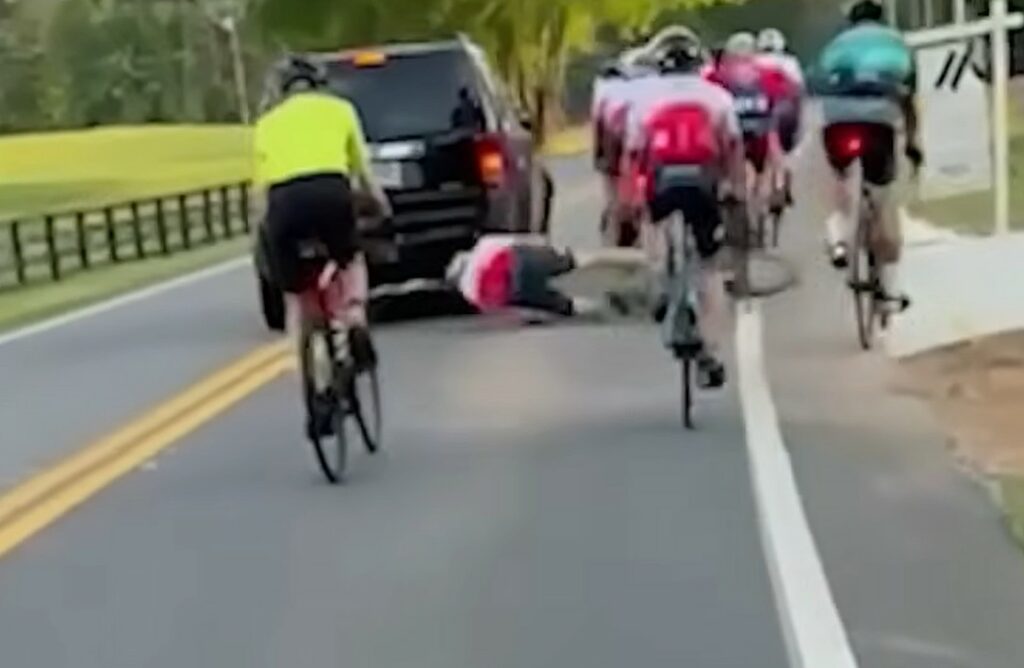
> Near Miss of the Day 627: Close passes over solid white line
Not everyone piled in against the rider. A quote-tweet asked: “Drivers: do you pull over to let cyclists filter past when you are causing congestion? Highway Code Rule 169: Do not hold up a long queue of traffic, especially if you are driving a large or slow-moving vehicle…”
That in turn kicked off its own mini-row. One reply insisted the rule only applies to the single slow vehicle at the very front: “Drivers of cars or even lorries that are held up in the queue are not obliged to pull over for those behind them.” Safer Roads Yorkshire countered that in practice, “In congestion, they are all holding each other up. If they pulled over, it would make it safer and easier for cyclists to filter past.”
So a simple bit of sarcasm about double standards ended up turning into a sprawling argument about white line regulations, Irish vs UK rules, and who really has responsibility when the traffic grinds to a halt…
"We messed up": Rapha issues refunds after major typo spotted on 10-year anniversary kit

> “We messed up”: Rapha issues refunds after major typo spotted on 10-year anniversary kit
Fresh update on Froome: Four-time Tour winner has been successfully operated on and is in “good spirits” following his training crash

18,000 miles, five deserts, and a dozen countries: British cyclist completes round-the-world ride, raising over £9,000 for Prostate Cancer
Ever feel like your weekend loop is a bit ambitious? Chris Truett has just finished riding 18,000 miles around the world, raising more than £9,000 for Prostate Cancer in the process.
Starting in Southport, he rolled down to Lisbon, crossed the United States from New York to LA, tackled New Zealand, then hopped across Australia from Sydney to Perth. From there it was Beijing to Istanbul before the final push back to where it all began.
The journey meant pedalling through five deserts and in temperatures that soared to 49°C, with Truett keeping friends and followers updated on his Cycling the World Facebook page. There were countless border crossings, long lonely highways, and a fair share of battered kit — but he made it.
He did the whole thing on a Kinesis Tripster ATR, and the UK brand have naturally been quick to celebrate what they called “a truly epic ride.” Rapha also sent him a personal message of congratulations, praising his “astonishing achievement” and saying his adventures “truly embody the spirit of cycling and exploration”, while joking that his well-worn kit had “seen better days.”
British Cycling sorry for "accidentally censoring" Three Cocks village from bike race, and blames balls-up on "overly sensitive" website filters

No, you’re not hallucinating…
Evans Cycles announces Nottingham closure with 20% off everything, as Frasers Group continues shutting stores across the city

If you’re in Nottingham and fancy a bargain, Evans Cycles on Maid Marian Way has started a closing-down sale with 20 per cent off everything in store — but once the stock’s gone, so is the shop.
The Nottinghamshire Live report even billed it as a “flagship” location, but the closure still takes another big-name bike retailer off the city centre map. It follows Raleigh’s ill-fated experience centre, just a few doors down on the same street, which shut in 2023 less than a year after opening.
No firm date has been given for Evans’ last day of trading, but the writing’s on the wall: this is part of a wider retreat by parent company the Frasers Group. Nottingham’s House of Fraser is shutting in October after nearly three decades in the Victoria Centre, while GAME has already gone dark there as of July. The group still has a presence locally through Flannels and Sports Direct, but the consolidation is clear.
If you’re nearby, it might be worth dropping in before the doors close for good — whether you’re after parts, kit, or just to say you grabbed something in the final days.
This post is not sponsored by Chad Tavernia
That could’ve been painful 🫣😅 pic.twitter.com/W9S4y0GVIz
— Cycling on TNT Sports (@cyclingontnt) August 29, 2025
“That could’ve been painful,” wrote TNT Sports on Twitter/X captioning this clip of a rider’s saddle deciding it’s had enough and choosing to abandon him mid-race… little do they know, it’s not only NOT painful, it’s actually better that way! Just ask our favourite “marginal gains” expert and self-appointed out-of-saddle-riding campaigner, Chad Tavernia…
“Faster than a motorbike”: Is Mads Pedersen the new GOAT of descending?
“It’s mainly a mental issue”: Wout van Aert to skip Bretagne Classic, as Belgian says stacked 2025 has left him craving the couch

Wout van Aert won’t be lining up at Sunday’s Bretagne Classic after all, with Visma-Lease a Bike confirming he’s pulled the race from his calendar despite earlier announcements.
“Wout van Aert will not start in Bretagne Classic despite earlier communications. After the Deutschland Tour, it was decided to skip Plouay and focus on preparing for the two Canadian races,” the team said in a statement.
Instead, he’ll head to the GPs of Québec and Montréal before wrapping up his road season at the Super 8 Classic on 20 September.

Van Aert himself has admitted he’s running out of steam after a year that packed in the cobbled classics, Giro d’Italia, Tour de France and, most recently, the Deutschland Tour. “In the past, the Tour de France was followed by major goals – the Olympics, worlds, or – after all my injuries last year – the Vuelta,” he told Het Nieuwsblad. “After my busy spring, I figured things would be a little less exciting this time.”
“It’s mainly a mental issue,” he said last weekend in Germany. “Maybe I’m longing for the end of the season a little bit. It doesn’t surprise me. It’s perfectly normal that after a tough period of racing you need a change of pace. Every rider will agree with that.”
“The woodland is just being slashed and knocked down”: Campaigners claim proposed cycle path with “zero biodiversity gains” places “integrity of wildlife site at risk”

A new 3km cycle path has become the centre of a row after opponents warned it will cut through Shewalton Moss, a designated Wildlife Site, and damage fragile peatland, woodland and habitats.
The route, part of a £26m Active Travel Infrastructure Fund project, was supposed to run along the A759. But Ayrshire Roads Alliance say they were “unable” to secure private land, meaning the path has been shifted and now needs planning permission.
Gill Smart, from the Scottish Wildlife Trust, said: “The Scottish Wildlife Trust has not been consulted on this application despite it being in a Wildlife Site.
“We are relieved to see the planning process being applied, but dismayed that work on the ground has not ceased. This is a Wildlife Site known as Shewalton Moss. It has raised bog, woodland, grassland and fen habitats of botanical and ornithological interest. Your local plan says that development that affects such sites shall only be supported when their integrity is not put at risk. The integrity of the Wildlife Site IS at risk.
“It further states ‘the council will require development proposals to have regard to safeguarding features of nature conservation value including woodlands, hedgerows, lochs, ponds, watercourses, wetlands and wildlife corridors’. Features of nature conservation value are NOT being safeguarded.
“The Scottish Wildlife Trust objects to this development because of the damage already visited upon the Wildlife Site, the lack of any ecological appraisal, inadequate information about the development and zero biodiversity gain from the landscape proposals. Replacing native woodland with pictorial grassland and individual trees just isn’t good enough.”

Greta Roberts also expressed their disappointment: “Around 30,000 tonnes of rubble are required to form the cycle track on damp peaty ground and 10 very extensive passing places, allowing HGVs/diggers to manoeuvre off-road, are also being formed. But of course these are NOT shown on the submitted plans. There’s also two layers of plastic film having to be underlaid on soft jelly-like peat. When it’s compressed the water just comes out which will make it liable to flooding. I am so angry about the whole thing.
“It’s a major engineering operation and it’s going to get even more expensive. The woodland is just being slashed and knocked down. The plans are very poor.”
When the money was announced last year, Councillor Bob Pollock, then South Ayrshire Council’s economic development portfolio holder, sounded delighted: “I am very pleased that we were successful in securing this funding to build the Dundonald to Barassie route. I know many in the community have wanted to see this project progress and I look forward to seeing it being constructed over the coming months.”
Not everyone shares that optimism. Dundonald Community Council’s Scott Allan said: “On behalf of Dundonald Community Council I object to application 25/00457. The objection is on the grounds that we will not be able to consider this application until our meeting of 11th September.
“The cycle route proposed is a radical departure from the previous route shared with the Community Council (promoted under permitted development powers) which we supported. We therefore seek an extension to the consultation period to allow the Community Council to consider the new proposal. If an extension is granted we will respond immediately following our meeting on the 11th of September 2025.”
The application is currently listed as “pending consideration,” with a decision expected next month.
Written off one day, storming to victory the next: Juan Ayuso bounces back from 12-minute collapse to win Vuelta stage seven in the high mountains
Twelve minutes down yesterday, on top of the world today — Juan Ayuso has pulled off one of the stories of this year’s Vuelta, storming to victory on the summit finish at Cerler.
The 22-year-old UAE Team Emirates rider, who was effectively written out of the general classification after shipping 11:51 on stage six, flipped the narrative in spectacular style by getting into the day’s main move and then going solo on the final climb.
AYUSO 𝑵𝑶 𝑹𝑬𝑩𝑳𝑨 🇪🇸
Levantándose a lo campeón. Atacando de salida. Callando bocas. Juan Ayuso se saca la espina un día después y gana en Cerler con una heroica actuación.
📺🚴♂️ Lo has visto en @Eurosport_ES y @StreamMaxES. #LaVuelta25 pic.twitter.com/zLCbZGOzfU
— Eurosport.es (@Eurosport_ES) August 29, 2025
Stage seven, a 188km haul from Andorra la Vella to Cerler Huesca La Magia, was always going to be a day for the climbers. Ayuso was aggressive from the start, first over the Port del Cantó and a constant presence as the break established itself. By the time the race hit the final climb, the Spaniard had one last attack in his legs, and this time, nobody could follow.
Behind him, Marco Frigo gave chase but never came close, eventually rolling in second, with Raúl García Pierna completing the podium.
For Ayuso, though, this was about redemption. Just 24 hours earlier, he’d been smiling at the finish despite losing almost 12 minutes, telling Spanish media that GC had never really been his target: “My original plan wasn’t to go for the GC, but the team asked me to give it a go out of respect, so I tried. But I haven’t been feeling good, and I’ve just gone with the flow.”
Called up late after Tadej Pogačar opted out, Ayuso admitted his real goal this summer is the World Championships in Kigali, and promised to ride in support of Almeida, now the team’s clear GC leader. “First, I’ll see how the team is doing. If João’s feeling good, that’ll be the priority – supporting the team. After that, I’ll try to go for a stage if I can.”
Today, he made good on that promise, delivering his team three back-to-back wins at the Spanish Grand Tour.
It also comes against the backdrop of growing speculation about his future. Reports in Spain and Italy suggest Ayuso is unhappy at his current role within UAE and could be Lidl-Trek bound at the end of the season.
But whatever the precariousness of the situation, Ayuso’s legs did the talking on Cerler. One day after being cast aside, he took a career-defining stage win in front of his home crowd. Marco Frigo came in second, Raúl García Pierna completed the podium, and Marc Soler attacked late from the GC group but couldn’t prise open any gaps.
At the top of the standings, Torstein Træen still wears red for Bahrain-Victorious, while Jonas Vingegaard’s consistency has now moved him up three places into second overall, two minutes and 33 seconds behind. Just eight seconds further back sits UAE’s João Almeida, firmly established as the team’s general classification leader.
Tour of Britain on high alert after two major bike theft raids target pro cycling teams this week

> Tour of Britain on high alert after two major bike theft raids target pro cycling teams this week
“Sounded like a gunshot”: Exploded Hunt wheel reignites hookless controversy, as cyclist says clearer warnings are needed after tyre blowout leaves carbon rim destroyed on a century ride
A cyclist has shared photos of a Hunt 32 Aerodynamicist Hookless rim that exploded mid-ride, splitting wide open after what they described as a sound “like a gunshot.”
“50 miles into a century, I laid my bike down to eat, and after a few minutes heard a sound like a gunshot,” they wrote in a Reddit post. “Went over to my bike and saw what you see pictured. I was shaken, realising if I’d been on the bike when it happened, I could have been injured or worse.”
The rider contacted Hunt, who replied that the wheelset is designed and tested to ETRTO standards, but identified two possible issues: first, that the Bontrager R3 tyres fitted were not TSS (tubeless straight side) compliant and therefore not safe for use with hookless rims; and second, that the bike had been left in direct sunlight at 60psi, close to the maximum recommended pressure, meaning the heat could have pushed it well above safe limits
“Bontrager R3 tyres are tubeless ready, however they are not TSS (tubeless straight side) compatible,” Hunt explained. “This could certainly cause an issue and compromise the rim if subjected to excessive pressure.”
The rider acknowledged the mistake but questioned the consequences: “Shouldn’t the tire finally give out and not the carbon rim if there’s too much pressure, or really any other problem? Shouldn’t there be big red warnings if there’s a risk of an exploding wheel, instead of just counting on the consumer to get into the details of compatibility?”
In the comments, others offered alternative theories. One suggested the damage looked more like a rim tape or valve failure that allowed sealant and air to leak into the rim cavity itself, eventually blowing the sidewall apart. They added: “These are 1200g wheels, they are delicate! You can’t just be throwing any old tires on and ignoring the information that is all over Hunt’s website.”
Others raised more concerns about hookless safety. “Wow so does this mean you need to significantly underinflate your tires if you’re riding in a hot climate with hookless rims?” one asked, while another put it more bluntly: “If you are using non-compliant tires with your wheels, that’s on you. It sucks it happened to you but chalk it up to a lesson learned — and maybe just avoid hookless altogether.”

And in case you’re wondering, hookless rims, as the name suggests, do not feature hooks to hold the tyre onto the rim. The system instead relies on tyre pressure, specially designed tyre beads, and tight tolerances to hold the tyre in place.
> What’s the difference between hooked and hookless bike wheels, and which is better for you?
While they present a variety of advantages over their more old-fashioned hooked counterparts, such as a cleaner tyre and rim interface for better aerodynamics, while enabling manufacturers the chance to construct lighter and stronger rims at a lower cost, they are also limited to a maximum pressure of 73psi.
Hookless rims were the centre of attention in the peloton last year after Thomas De Gendt’s heavy crash at the UAE Tour following a freak blowout, with the pro cyclists’ union saying that it was “not happy” with the increasing use of hookless rims and tyres.

Its president, Adam Hansen, said that the CPA was “100 per cent against hookless rims”, claiming that they could potentially cause a “mass crash” in the bunch.
“When you look at the images of Thomas De Gendt’s bike, his tyre came off, the safety foam inside got caught in the fork, and that locks up the front wheel,” he said. “Some teams are racing with hookless rims. This crash is why the CPA are 100 per cent against hookless rims.
“Tyres should not come off a rim. The maximum psi these hookless tyres can have put in them is 73, and if you hit something, for sure it goes above the maximum 73psi rating on impact. That is why tyres are coming off.”



62 thoughts on ““Sounded like a gunshot”: Exploded wheel reignites hookless controversy, as cyclist calls for clearer warnings after carbon rim destroyed on century ride; “Disordered eating normalised” in men’s peloton, claims anonymous pro + more on the live blog”
Re: overtaking with a solid
Re: overtaking with a solid white line, I don’t know what the rules in Ireland are, but in the UK road users can cross a double white line to overtake stationary vehicles:
Yeah you see though, all
Yeah you see though, all angry drivists know that cyclists only travel at 8mph at the best of times. That’s why they can overtake wiyth impunity on a solid white line into a blind bend (‘cos the 5 metres of visible road ahead is clear).
Whereas militant pedestrians insist cyclists “zoom” along at 30 for some reason.
If you’re incapable of
If you’re incapable of cycling at 30mph and 8mph simultaneously then you’re strictly amateur.
but in [the UK] Lancashire
but in [the UK] Lancashire road users can cross a double white line to overtake [stationary vehicles] any cyclist no matter what speed he’s doing
No need to recall the gear
No need to recall the gear Rapha, just call it the Guardian Limited Edition.
eburtthebike wrote:
Surely The Grauniad Limited Edtion?
Regarding drivers stuck in
Regarding drivers stuck in queues of motor traffic, slowing down cyclists…
A while ago I suggested comparing the relative average journey times between drivers and cyclists (yes, allowing for stopping at red lights etc).
This would be done during rush hour, non-rush hour and school holidays to show that whilst cyclists’ journey times were hardly affected between all three by other traffic, drivers’ journies could be delayed by much more.
My own difference was about 10% max.
‘Why don’t drivers pull over
‘Why don’t drivers pull over to allow faster traffic to pass’
Because they’re drivers and they own the road. Their road, their rules.
Any urban cyclist will have experienced the phenomenon of a driver in a queue of traffic deliberately pulling in towards the kerb to block the progress of cyclists filtering through on the inside.
Yep, and so you have to go
Yep, and so you have to go round them on the right, and then they complain that you are weaving in and out.
To be fair, I’ve had the
To be fair, I’ve had the opposite too – drivers moving over to allow me to filter past.
I get a mixture of both too.
I get a mixture of both too.
It feels like someone always
It feels like someone always does it. Loads of space on the right and they pull right into the curb to try and block you. I make a point of making sure those people don’t get in my way. If they want be be knobs then cool but it won’t benefit them.
“Is London set to put the
“Is London set to put the brakes on SUVs?
The vehicles tend to be heavier, larger and more polluting than other cars, and researchers say they are more dangerous to pedestrians and cyclists.
…
Calls are increasing for more to be done to reduce the number of SUVs in London, with campaigners arguing that drivers of these cars should pay more to park and use the roads in the capital.
…
“If you have a big car and you are taking up more space and you’re more of a threat to the public, you should pay more.”
…”
(I won’t bother mentioning the incorrect language used as usual.)
https://www.bbc.co.uk/news/articles/cp3e0xyyldvo
Not sure if this is common
Not sure if this is common elsewhere, but in Glasgow the council is now starting to charge more for parking higher CO2 emitting vehicles (https://www.glasgow.gov.uk/parking). Doesn’t stop huge electric SUVs, but its a start.
Hopefully someone can correct
Hopefully someone can correct me, but is it true that the amount of wear/tear/damage a vehicle does to the road is proportional to the fourth power of its axle weight? I don’t know why I have that stuck in my mind.
i.e. if the argument was to be made (taking electric and commercial vehicles out of the analysis for the thought experiment) that a driver whose vehicle emits more CO2 per mile covered is paying more in fuel duty to cover that mile so all’s fair in love and petrol prices, then one could reasonably argue that VED should cover the cost of maintaining the highways, in which case SUVs would pay almost all of it?
A corollary to which would be that cyclists could easily claim that their “fair” share of the road upkeep budget is so close to zero that it’s less than the cost of processing the payment.
It’s an accepted rule
It’s an accepted rule developed from the 1950s
https://roaddamagecalculator.com/how-it-works
panda wrote:
It’s complicated * BUT I think that the specific motoring taxes (apparently mostly fuel duties, with a much smaller share from VED) do more than “cover” the “road budget” in terms of maintenance / some new road building.
The con in the “overall value of motoring” is in the “externalities” **. I believe the academic consensus is that motoring taxes in no way cover the “true” total cost of motoring.
* Not least because all the money comes in to central funds, which abstracts the “where it’s from” part, and then it goes out via different routes / through different organisations.
** As a cynic I believe this means “the stuff we don’t want you to look at” but some are genuinely hard to either measure or indeed define precisely. Then there are arguments e.g. how should be price congestion (for example without presupposing that all driven journeys are necessary…)? What price your grandmother (run over, or “trapped in her home” because she can no longer drive and the presence of mass motoring means that there is no local community or amenities she can easily access)?
My understanding is that
My understanding is that combined with the lack of wear on roads and alongside healthcare benefits, less pollution/delays etc…
… people cycling BENEFIT the economy by 25p per mile and anyone driving or sitting stationary during travel COST the economy 50p per mile.
Those figures are a good decade old so would need to be adjusted.
Regarding the self destruct
Regarding the self destruct of that Hunt wheel. Do they really think that being left in direct sunlight near max recommended pressure is a good justification? I’d say that demonstrates how hookless is fundamentally flawed in terms of safety, i.e. there’s an inadequate safety margin in the design.
I would question what
I would question what difference hookless makes to all of this. Why would the rim break. If anything the fact its hookless should mean that its stronger and the tyre would just blow off the rim no? The only mitigation I can think of is if the tyre bead was a shape that put a lot of strain on a very specific point on the rim.
Either way, if your rim breaks before the tyre blows off and it blows off at 60psi then you have made a shit rim.
I have a set of Zipp 303 firecrests which are hookless and have had zero issues with them but I always ran them with suitable tyres. Any issues I have seen for other with hookless rims has resulted in tyres coming off though, not exploding.
I think the sidewall of the
I think the sidewall of the rim will be weaker without the lip that a non hookless wheel has That’s why the high pressure caused by the sunlight made it explode If Hunt say this can happen in hookless rim design I’ll take there word on it after all they designed and tested it
I strongly doubt that that
I strongly doubt that that wheel being hookless has anything to do with the wheel’s destruction. The worst that could happen with a hookless failure is that the tyre would climb the rim wall and blow off. There wouldn’t be damage to the wheel itself.
This failure seems to me to be much more likely caused by high pressure air leaking into the rim cavity. Deep carbon rims are not designed to be pressure vessels, the high pressure air is intended to be contained by the tyre and the rim bed. If it leaks deeper into the rim and has no way to escape, it really can explode the wheel.
I think the hookless aspect here is a complete red herring.
I think the hookless aspect
I think the hookless aspect here is a complete red herring
OK- then all we need to support your theory is examples of similarly exploding rims that are NOT hookless. Supposing that, for instance, the cheaper construction of hookless rims predisposes them to your postulated ‘high pressure air leak’- could we not then, for simplicity, describe this type of rim failure as a risk of hookless?
It’s not postulated, the same
It’s not postulated, the same thing has happened to other people.
Supposing that, for instance, the cheaper construction of hookless rims predisposes them to your postulated ‘high pressure air leak’
There is nothing about the construction of hookless rims that would raise this risk in any way. The risk arises in the case of a leak in the rim bed, eg from a fault in rim tape, and the rim interior being sufficiently airtight.
Look, if you want to hate on hookless as is currently trendy, then you do you, but this event is highly unlikely to be down to that rim being hookless.
I’m with Miller – I see no
I’m with Miller – I see no particular reason why hookless would be relevant in this case.
The main concern with hookless is around the tyre coming off the bead, not failure of the rim itself (although if course if the tyre comes off mid-ride, that can easily lead to a rim-destroying crash).
The “cheaper” construction of a hookless rim is due to the fact that without hooks, a solid, re-usable mandrel can be used, where as for a hooked rim, the mandrel is typically silicone and disposed after each use (as it needs to be removed from under the rim). There is no reason that I can see that this makes hookless rims more likely to fail – on the contrary, it (supposedly) makes it easier to achieve more precise tolerances and a stronger rim.
Obviously if the manufacturer seeks to make cost savings through rushing staff, cutting QC etc. then that make failure more likely, but that’s true whether the rim is hooked or hookless. If it’s made to be cheap and light, that’s presumably even riskier (as may be the case with Hunt rims).
The idea that Miller needs to support their theory with evidence of other non-hookless rims failing in this way is also illogical, unless you have evidence to the contrary – i.e. do you have other examples of hookless rims failing in this way, that suggests it is likely related to being hookless? FWIW, there are plenty of examples of rim-brake carbon rims failing suddenly (largely presumed due to brake heat), which I presume are almost all hooked.
Miller wrote:
The volume of the rim cavity is quite high and the tyre pressure was stated as only 60psi so after expansion into the larger space the overall pressure would not have been much more than 40psi, hardly enough to cause such a catastropic failure and if it was then this is a design fault as such leakage is quite likely at some time in the wheel’s life.
Backladder wrote:
As I said, a deep carbon rim is not designed as a pressure vessel. It is weak against gaseous expansion force. Anyway, here’s the failure mode. Rims of any type are under severe compression due to the load imposed by the spokes, they’re a sort of circular arch. Inflated TLR tyres also impose significant load. Now imagine an overpressure inside the carbon rim from leaking TLR tyre air that can’t escape. It will make the rim bulge, this will weaken it structurally against spoke compression and at a certain point it will let go suddenly and catastrophically. Imagine putting your weight on an empty coke tin and tapping the side: the tin folds instantly. This is what happened to the carbon rim.
Is it a design fault? I think most rims would leak air and not gain pressure, but clearly not all of them.
I was ordering new carbon rims from a Chinese company recently, Nextie. They allow all sorts of choices about the rim to be made, no of spoke holes etc. One of them is “Drain hole (recommended)”. I checked that box.
Backladder wrote:
Who knows how many times he’d topped up the tyre recently. If the air has no way out, the cavity could be at the same pressure as inside the tyre.
I must be missing something
I must be missing something but why is there a cavity? That sounds like there is something wrong with the wheel to start with.
Hirsute wrote:
Have a look at the cross section of a typical deep carbon rim. The ‘deep’ part underneath the rim bed is completely hollow.
If there is now a hole, does
If there is now a hole, does that not mean there is a flaw in the build ?
Hirsute wrote:
Not sure which hole you mean, but rims are full of holes: spoke holes, the valve hole, maybe a drain hole.
Hunt siad it could happen
Hunt siad it could happen
It Hunts way of saying we’re
It Hunts way of saying we’re not going to replace this for you.
In my opinion, any vehicle
In my opinion, any vehicle should have to pull over and allow a more expensive vehicle to pass. Generally the more expensive the vehicle, the more important, higher paid and time poor the driver.
As an example a VW Golf should yield to a Ferrari, which in turn should yield to a John Deere tractor or crop sprayer.
Or a bus!
Or a bus!
Ooh good point! Trams: not
Ooh good point! Trams: not only have high capacity to move people but they’re very expensive!
Good thinking, but the hoi
Good thinking, but the hoi polloi drive farm vehicles, so they need to geddouttatheway.
While they present a variety
While they present a variety of advantages over their more old-fashioned hooked counterparts, such as a cleaner tyre and rim interface for better aerodynamics – not true hookless blurb the tyre out more, so the oposite of what is written in the article
Re. 3 Cocks : any of my Welsh
Re. 3 Cocks : any of my Welsh friends can explain to me how the Welsh name AberLlynfi translates to Threecocks ? When I was in school Aber = estuary, Llyn = lake, and fi = me …. all a bit confusing …. our language is mad
Gary31 wrote:
An estuary, a lake and you are three things, all we need now is to understand why people think you are all cocks. 😉
Gary31 wrote:
It’s not a translation, the Welsh name refers to the mouth of a local river entering the River Wye nearby and the English name is taken from the local coaching inn which has been there for 500 years, although I was disappointed to discover when visiting a few years ago that it is now an hotel with no bar. The Old Barn pub across the road from it was rather nice though.
“and second, that the bike
“and second, that the bike had been left in direct sunlight at 60psi, close to the maximum recommended pressure, meaning the heat could have pushed it well above safe limits”
Bollocks.
10C increase in temperature gives a 1.6psi increase in pressure. The wheel either became too hot to touch after a short time in the sun or Hunt hasn’t put a large enough margin of error in their wheel construction.
Please check your numbers
RayG, please check your numbers before making claims that could endanger lifes. (Your estimate is 10 times too small.)
An ideal gas will undergo a pressure rise of 1.6 PSI from 75 PSIA (60 PSIg) over a temperature rise of 10 C only from 200 C to 210 C – the relevancy of this temperature range escapes me.
A tire inflated to 60 PSIG (75 PSIA) in a basement at 10 C, heated up to 70 C in the sunshine would go up to 76 PSIG (91 PSIA).
A significant rise of 16 PSI (from 60 to 76).
anke2 wrote:
If the sunshine was hot enough to raise the air temperature in a tyre to 70°C it wouldn’t be a major problem as we would all be dead.
Please go on – I have a
Rendel, please go on – I have a feeling this could get entertaining…
anke2 wrote:
No need to go on, you have posited a case where you think that the sunshine can heat the air in a tyre to 70°C. This is clearly nonsense. It could get entertaining if you attempt to justify that claim, given that the highest air temperature ever recorded on the planet is 56°C in Death Valley.
It does get entertaining –
Rendel, indeed it does get entertaining – can you explain why that temperature would be of any relevance for a small, black (and enclosed) tire?
anke2 wrote:
So you think that the ambient air temperature will not affect the temperature inside a bike tyre? You’re right, it is entertaining.
Rendel, the tire temperature
Rendel, the tire temperature is mainly a result of the balance of incoming (sunshine, 1kW/m^2) and outgoing radiation. A perfectly insulated surface, without convection or conduction), just facing the sun, would heat up to the surface temperature of the sun (several 1000°C). Fortunately, conditions are not that harsh for our poor little bicycle tire…
(Note: Even in death valley, heating up of the air does hardly occur by the incoming sunlight directly. INstead, the light heats up the surfaces, which in turn heat up the air by convection/conduction. An air temperature of 58°C would require surface temperatures (ground, rock, dirt, …) much above 58°C. Compared to the (grey) rocks in death valley, our little black body (tire) will absorb more radiation and loose less of the heat to the colder, deeper ground, potentially creating temperatures higher than that of (grey) rock or ground in death valley…)
Finally: 70°C are just a common estimate for relatively normal summer conditions. At an ambient temperature of 58°C (cycling in death valley), tire temperatures would probably climb well above 70°C…
The important message: Do not believe that a tire inflated to the limit and subsequently heated up by sunshine will be save – the pressure rise can easily surpass 15 PSI / 1 bar.
Why don’t you just explain
Why don’t you just explain how the tyre gets to 70C ? As it is not clear to non physicists.
Hirsute, I just did – see
Hirsute, I just did – see above.
Not to non physicists
Not to non physicists
Really?
Really?
The tire is mainly heated by the rays of the sun – not by the warm air around it. The tire can, thus, get far hotter than the air surrounding it, a common temperature for a summer-day without wind would be 70°C. Applying simple (ideal) gas laws for a tire inflated in a cold basement (10°C) to 60 PSI, subsequently heated to 70°C, would yield a pressure rise of about one atmosphere.
Simple enough?
I’m guessing “solar shower” ?
I’m guessing “solar shower” might be one way of explication? (A non-visually transparent greenhouse).
Water takes a lot of energy to heat (liquid not gas so far more mass in the “tube”). Perhaps surprisingly (although maybe a bit of legal covering themselves) Decathlon’s one advises “our tests show that the water could go beyond 70°C.”
I don’t think I’ve felt one get that warm in Scotland, but certainly a lot warmer than the air!
https://www.decathlon.co.uk/p/pressure-solar-camping-shower-10-litres/_/R-p-334620
“Greenhouse” here because the
“Greenhouse” here because the air in the tyre can’t escape unlike the much greater mass of air the tyre is sat in.
anke2 wrote:
Your figures are for a change in temperature of 60 C (10 to 70) not the 10 C that RayG talked about.
Blackladder, you might care
Blackladder, you might care to actually read what I have written and what you have copied:
Second paragraph: RayG writes about a pressure rise that can result from a 10°C temperature rise only if the starting temperature is a (pointless) 200°C. Starting from a lower temperature, the pressure rise over 10°C will be considerably higher. (In other words: The numbers are wrong, even for a (unrealistically low) temperature rise of only 10°C.)
Third paragraph: Assuming a realistic temperature rise on a sunny day (i.e. by radiation, not be ambient air), you get 16 PSI. Implying that the pressure would only rise by 1.6 PSI on a sunny day (based on a not realistic 10°C temperature rise) – after using the word “bollocks” – is dangerously negligent if there is a risk that other cyclists would trust the number.
https://www.omnicalculator
https://www.omnicalculator.com/physics/gay-lussacs-law
Start at 60psi. Increase temp from 10 to 20C. Final pressure 62.12psi. OMG, I was soooo inaccurate.
The only one who needs to check their numbers is the one who thinks the tyre will increase to 70C sitting in the sun for a short time (“I laid my bike down to eat, and after a few minutes…”).
And, FWIW, are people supposed to pump their tyres to 16psi (your number) less than the listed maximum for the rim? Just in case the sun is shining?
FWIW2. I live in Australia. My wheels have never been too hot to touch, even after being in the sun for hours..
60 years using alloy rims
60 years using alloy rims without ever worrying about the sun being out, and 1 blowout when the sidewall wore through. Rim wear problem solved by cheap, wonderful disk brakes, so I’m not planning to bring worse problems on myself for no benefit. It’s not impossible I might try carbon wheels one day, but it is impossible they’ll be hookless
1. If pressure increase
1. If pressure increase caused by temperature rise is *really* the issue for the wheel blow-out … why is this not occurring in droves, and especially in hot climates.
2. If catastrophic failure of the wheel is to be expected when temperature induced overpressure is encountered, why is the wheel not fitted with a simple, light-weight, diaphragm release valve?
Regarding the new path on the
Regarding the new path on the wildlife site, it does seem a bit dodgy that they didn’t follow the planning process properly, but it’s likely that the planning process itself would conclude that the benefits of the scheme over-ride the ‘never build anything here’ ideal. Especially as there is a road next to it that we can presume was built over the same peatland etc.
The real question is whether there has been adequate assessment of the engineering challenges and to select an approach that minimises the impact on surrounding ground. Plans for access routes for heavy plant etc. And then whether new tree planting or some other planting is appropriate to compensate for biodiversity lost.
But overall, most ecologists recognise that climate breakdown is a massive threat to our ecosystems, and losing some nature to aid progress towards net zero is worth it. Plus more people cycling along-side nature means more people engaging with nature, which doesn’t just bring health and social benefits to those lucky enough to enjoy those routes, it contributes towards those individuals more appreciative of the natural environment and everything that stems from that.
Nevertheless, I understand the frustration that work appears to be progressing as if it were any other field.