



The BBC has this morning edited a headline which claimed a cyclist suffered devastating facial injuries in an “accident”, that despite the rider’s injuries being caused by a drink driver who was using their phone at the time of the collision.
The story, originally published by BBC Bristol but later also shared by BBC News, originally featured the headline ‘Cyclist gets 3D printed face after bike accident’ but was later edited to ‘Cyclist gets 3D printed face after bike crash’ — that after the public service broadcaster faced criticism online for the wording and we raised the article with the BBC press office.
It also previously referred to the incident as “his accident” in the article copy, something which has since been removed.
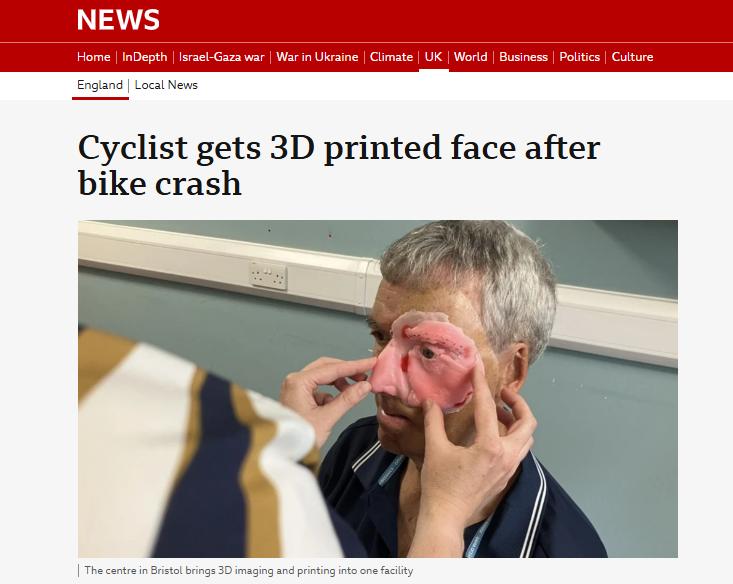
Dave Richards, from Devon, suffered severe burns down one side of his body and face and suffered crush injuries when he and two friends were hit by a drink driver back in July 2021. The driver was also on his phone when he hit the group of cyclists.
The BBC story was about the work of the Bristol 3D Medical Centre, who are treating Mr Richards with a 3D-printed face, making him one of the first patients to benefit from the unique NHS body parts printing centre.
Recalling the collision, Mr Richards said: “He [the driver] came up behind us and was on his phone. My two friends were knocked clear but suffered multiple fractures. I, unfortunately, got trapped underneath the vehicle so I got severe burns down one side of my body and face and suffered crush injuries, ribs on my right hand side.”
He underwent multiple reconstructive operations at Southmead Hospital and the Bristol 3D Medical Centre, which opened in April, is now assisting with facial prosthetics, something Mr Richards reported is helping him “feel a lot more comfortable in myself”.
A large orbital prosthesis and neck scar splints have been made and the centre uses 3D scans to capture a patient’s face digitally to develop a replica and then design the moulds for prosthesis.
“Most times people don’t notice,” he explained. “I have had to live with this for four years. Most of this is in my head. A lot of the time people don’t notice or don’t say anything or accept the way I am.”
Much of the initial reaction to the story was disbelief at the BBC describing an incident where a drink driver on their phone had seriously injured a cyclist as an “accident”.
One reader commented: “A cyclist knocked of his bike by a drunk driver needed part of his face prosthetic to be 3D printed. Let’s play guess the BBC headline: Cyclist gets 3D printed face after bike accident. That’s right! Just an accident! Unbelievable.”
Another said: “A poor headline – being hit by a drunk driver is not an accident.”
We’ve contacted the BBC for comment, but had not received a reply at the time of publication.
Collision or crash NEVER accident https://t.co/2Hk9Pjengi
— ex999 🇬🇧 🏴 (@maurice_1960) June 17, 2025
In 2021, the Road Collision Reporting Guidelines were launched, encouraging journalists and broadcasters to use language that better reflects the reality of incidents on the roads. For example, the press were told to avoid using the word ‘accident’ as it implies that incidents are unavoidable, and reporting should instead refer to such incidents as a ‘collision’ or ‘crash’.
Likewise, when referring to the parties involved, journalists were told to refer to people rather than vehicles; so it would be ‘driver’, not ‘car’. While not mandatory, organisations such as the police and National Highways have announced they will no longer refer to collisions as accidents.
The use of ‘accident’ is still frustratingly common across many publications. In September the BBC apologised for its use of the word ‘accident’ in a headline and story concerning the deaths of US ice hockey star Johnny Gaudreau and his brother Matthew, killed while cycling by a suspected drink driver who allegedly told police at the scene that he had consumed “five to six beers” before the fatal crash.














37 thoughts on “BBC edits headline after backlash over claim cyclist knocked off bike by drink driver using phone was an “accident””
“Cyclist gets 3D printed face
“Cyclist gets 3D printed face after bike crash” also doesn’t seem to quite carry to important role the driver of the car player in it. I can have a crash due to my own actions and it’s entirely my fault but I can be doing everything correctly and still be hit by a drunk driver. Shouldn’t this be reflected in the article! People need to understand the responbility that should come with driving a car.
Prevention is unsexy at the
Prevention is unsexy at the best of times. While everyone bills and coos about what the surgeons are able to do these days, the little voice saying “how about this doesn’t happen in the first place?” is drowned out that little bit more.
Prevention is unsexy at the
Duplicate post on choppy old RCC
It’s a tiny improvement.
It’s a tiny improvement. But still a vastly misleading headline.
This was not a “bike crash”. This was a cyclist injured by a *car crash*. The car crashed. The bike did not – it was crashed into.
There are circumstances in which both vehicles can be said to have crashed, but this is 100% not one of them. The driver rammed the car into the back of a group of cyclists.
The updated headline still makes it sound like the injuries were the result of the cyclists actions when they absolutely were not
Yep.
Yep.
“Cyclist gets 3D printed face after car accident” or “car crash” solves the problem.
IMHO the issue here isn’t accident vs crash (though clearly should be crash given drunk). Its the complete failure to achnowledge a car was involved…
Despite the usual trolling
Despite the usual trolling from the usual moron(s), this is a simple distinction: it wasn’t an accident and it wasn’t even a ‘crash or collision’. The cyclists were hit from behind by a highly culpable drunk motor vehicle driver ‘on the phone’ at the time.
Can I ask for GBH or assault
Can I ask for GBH or assault charges to be brought please?
I’ve recently passed the
I’ve recently passed the driving test and have cycled all my life, cyclist thru & thru and now I’ still think, bloody drivers lol, but seriously, I cannot understand the disregard and way drivers just don’t care…
There is no value in engaging
There is no value in engaging with a PBU and troll.
The site is going to be ruined if people keep responding.
I know, but it’s really
I know, but it’s really difficult; I’ve been really trying.
(Rendel seems to practically revel in it, though…).
I can see the point of people
I can see the point of people saying don’t feed the troll but I personally believe that when someone starts spouting such ridiculous spite and falsehoods they need to be challenged and in fact letting them carry on unchallenged is what will ruin the site. We all know from previous experience of the current troll that it doesn’t matter to him whether he’s challenged or ignored, he will carry on regardless, so I say challenge his lies and foul opinions at every point. I accept that not everyone agrees with this. I will be writing shortly to the editorial team to point out that someone whom they have previously banned multiple times is back so perhaps some action will be taken in that respect.
I get that some things need a
I get that some things need a response but it feels like every point gets a response by multiple people.
Perhaps restricting replies to the more outlandish comments could be a compromise?
Rendel Harris wrote:
I think initially challenging is right. But there comes a point where it just encourages them to post more rubbish, and long chains of (on their part) disingenuous comments spoil the website more than the risk you highlight.
I couldn’t resist, but I’m
I couldn’t resist, but I’m trying to restrict myself to the dumpster fire that is the other thread.
Hirsute wrote:
Well at least the squirrel infestation seems to have cleared up a bit. Perhaps they just stay up in the trees in summer? Or are on their holidays on the Isle of Wight?
chrisonabike wrote:
Well at least the squirrel infestation seems to have cleared up a bit.— Hirsute
Which is odd – I thought they were attracted to nuts?
mdavidford wrote:
Maybe they’ve all gone to Guernsey?
https://www.bbc.co.uk/news/articles/c70nl98zrglo
I think they’re a useful
I think they’re a useful device for addressing any misconceptions people new to the site might have.
But I would say to keep it simple: let one person explain why they’re wrong and leave it be.
They’re never going to admit they were wrong or trolling (accidentally spreading mistaken truths perhaps?) so don’t expect them to: they’re not the person you’re trying to convince anyway.
Car Delenda Est wrote:
Agenda item for the next Evil Cyclists Lobby – decide who the designated troll respondent is.
Presumably a section would be
Presumably a section would be added to threads entitled “from our own troll respondent“?
chrisonabike wrote:
We could have a hotline for people to report when Nigel pops up, just call this troll-free number…
Rendel Harris wrote:
I don’t object
If you call collect
(we just used to talk about bands we’d seen/ heard on John Peel.)
We need some kind of random
We need some kind of random selector to decide who’s going to respond each time – a trolly wheel, if you will.
It will be quite wobbly…
It will be quite wobbly…
quiff wrote:
Agenda item for the next Evil Cyclists Lobby – decide who the designated troll respondent is. — Car Delenda Est
I prefer the scorched earth approach. When the troll makes an appearance on a thread, everyone just stop making any comments at all on that thread. This way, it provides an incentive for Road.cc to get rid of them as there’ll be less engagement whenever the troll appears.
hawkinspeter wrote:
Or dummy articles for them to post on – the mods exerting con-troll?
chrisonabike wrote:
Or dummy articles for them to post on – the mods exerting con-troll?— hawkinspeter
You mean, like a trolly park?
Someone just needs to put
Someone just needs to put “troll alert” and then everyone just leaves them to it.
Three points
Three points
(a) don’t feed the troll
(b) at least the body of the article says “when they were hit by a drunk driver” rather than hit by a car.
(c) regardless of all that, the surgery looks incredible.
As usual the commenters waste
As usual the commenters waste time discussing technical details while missing the wider picture. The headline, whether in line with guidlines or not, still shows a very strong pro motonormality anti-cyclist bias and reinforces negative stereotypes.
In case no one noticed yet, in last few years the insitution has changed a lot.
Complaining about bike
Complaining about bike-shedding on a cycling site?
eburtthebike no doubt has some thoughts on whether the BBC has really changed much.
chrisonabike wrote:
I do: they haven’t. This headline proves it.
On radio 4 news at 1815 they
On radio 4 news at 1815 they went with accident as the headline. When they got to the story about 10 minutes later, they did actually manage to start with knocked off their bike by a drunk driver.
Still not impressed with their presentation.
The BBC is institutionally
The BBC is institutionally anti-cyclist and have been for at least forty years. It would appear that they might be getting worse, describing being hit by a drunk driver on their phone as a ‘bike accident’. If anything is going to put people off riding, it’s headlines like that, and it’s hard not to think that it was deliberate.
If it had been a pedestrian hit by a drunk driver using their phone, would the BBC have called it a ‘walking accident’?*
*Spoiler alert. No.
The proper headline would
The proper headline would simply state the facts: Cyclist run down by driver gets 3D printed face. “Accident” is just wrong, given human error caused the collision. And “crash,” with its suggestion the cyclist was the only one involved in what happened, is only marginally better. It might even be worse.
They may have changed the on
They may have changed the on-line headline, but they still used “accident” on Radio 4 6 o’clock news last night.
Today, BBC R4, about 0730
Today, BBC R4, about 0730 “Ministers are being urged to close a legal loophole for delivery drivers to cut down the number of ebikes on our streets.” They were talking about illegal electric motorbikes. The whole article is at 0752, and they’ve just repeated that they are ebikes. https://www.bbc.co.uk/sounds/play/m002dlgr
It finished at 0757 with only an MP, Ian Duncan-Smith, who admitted that he had had long conversations with Matt Briggs, interviewed who was in favour of the new dangerous cycling law, nobody from any cycling organisation. Definitely balanced: like every other BBC article about cycling.
EDIT: This prompted me to track down what happened to my Ofcom complaint about the ‘Panorama – Ebikes: the battle for our streets’ travesty, so I found the email from them, copied the reference number and went to their website. Spent ten minutes trying to find anything, but couldn’t find a way to search for the reference number, the programme title or any other identifying feature. So I rang their contact number and asked if there was a way to find it using the reference number: there isn’t. I asked why they gave complaints a unique number and gave that number to the complainant if there was nothing they could do with it: it was for internal use only. So why give it to the public?
I then gave them the number and after a few minutes, they were able to direct me to the relevant bulletin, but there was no more information than that they had decided not to pursue the complaint. No report, no evidence, no explanation.
This is the surreal bit. I was asked if I wanted to make a complaint about the reference number being a complete waste of time, so I said yes. My details were recorded, then I was given a reference number. I couldn’t help laughing.
2nd EDIT: Called Ofcom back to get the text of my last complaint, and was cut off after two minutes, twice!