



Cyclists in New Zealand have claimed that “anti-bike rhetoric” is behind a recent surge in vandalism on a number of popular mountain biking trails, where ‘traps’ have been appearing in recent weeks amid a long-running conflict between riders and walkers.
Earlier this week, Wellington’s local authority reported that logs, stumps, and makeshift barriers have been placed on several mountain bike priority trails around New Zealand’s capital city, in an apparent attempt, the council says, to “cause serious injury” to cyclists.
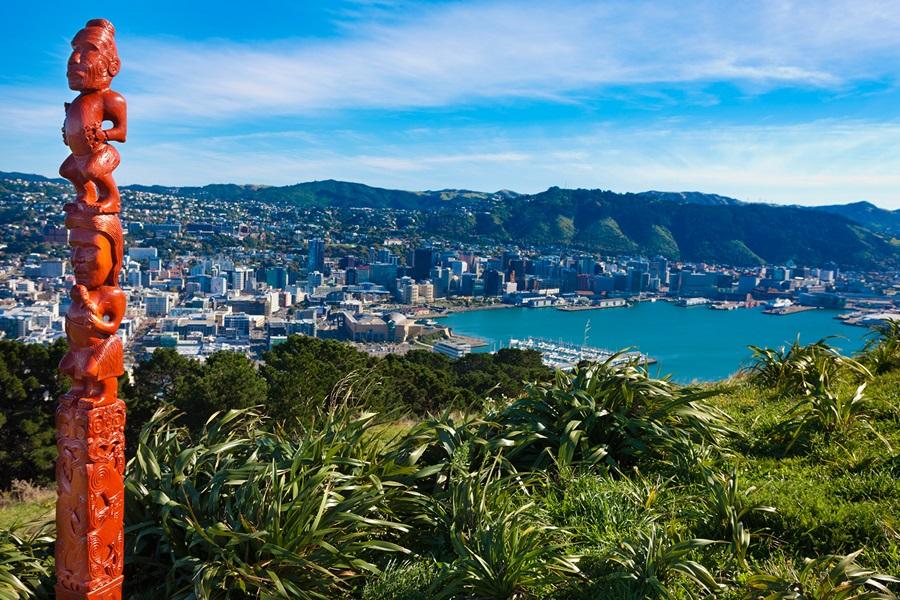
The traps have been placed on different trails along the Mount Victoria/Matairangi section of Wellington’s Town Belt, a 520-hectare stretch of tree-filled green space open to the public and close to the centre of the city. Mountain bikers have been flocking to the Mount Victoria trails since the early 1990s, with the hill hosting a round of the MTB World Cup in 1997.
The city council’s parks manager Bradley Schroder said this week that stumps have been scattered along trails, frequented by downhill mountain bikers riding at speed, and pieces of timber attached to trees and stretching across the path, seemingly with the aim of forcing cyclists to stop or potentially crash. Fencing and signage has also been removed on some tracks.
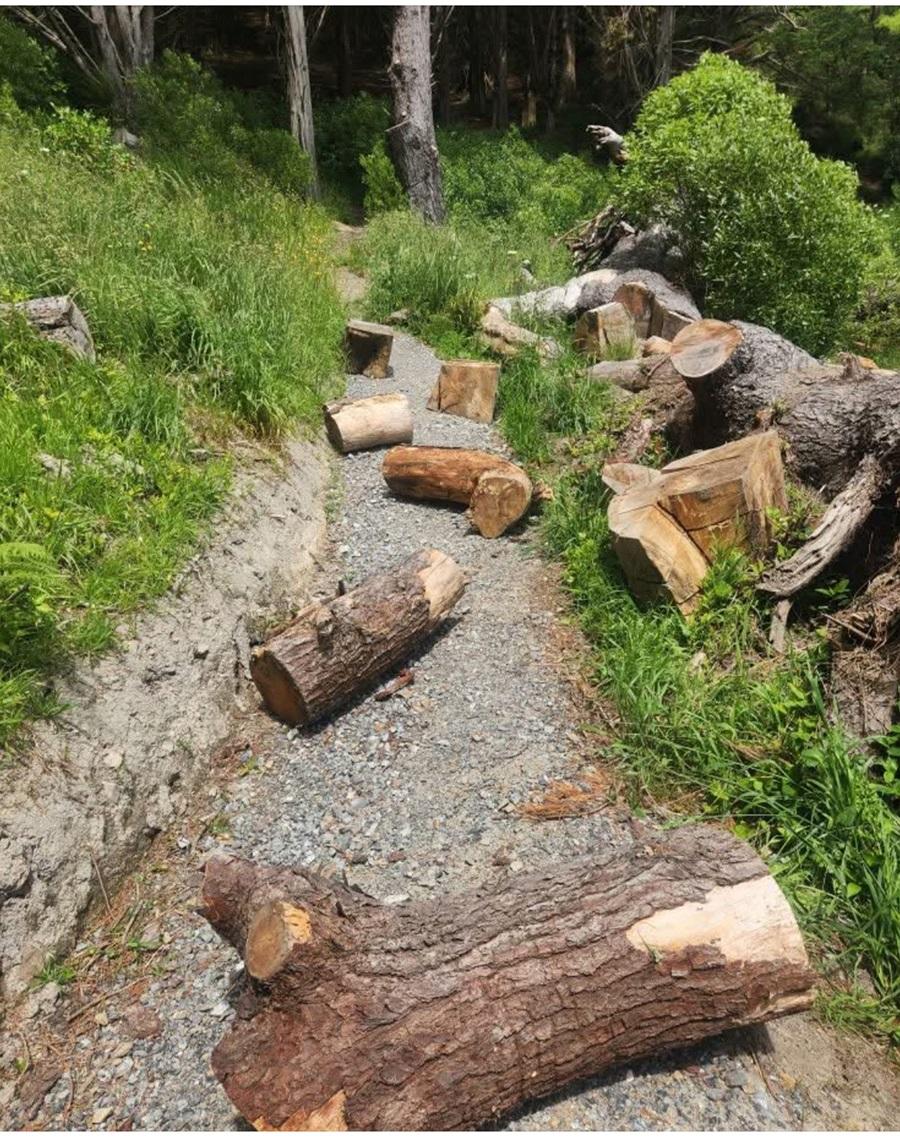
Schroder confirmed that police have been notified of the vandalism and that cameras will be installed along the bike priority trails to identify the culprits, with the parks manager adding that it cannot be taken for granted that other trails have escaped this recent outbreak.
Local cyclists have said the apparent acts of sabotage are the latest “aggressive” instalment in a long-running conflict between mountain bikers, pedestrians, and runners on the mostly shared-use trails.
However, a Wellington residents’ group representative, who has called for dedicated walkers-only tracks, has appeared to suggest that the vandalism is a response to riders “causing harm” to others in the Town Belt.
Speaking to New Zealand-based website Stuff, cyclist Julian Morton, a Mt Matairangi Trail Builders volunteer, said the decision to screw a makeshift barrier to two trees on either side of the path showed a certain “level of intent” on the part of the protesters.
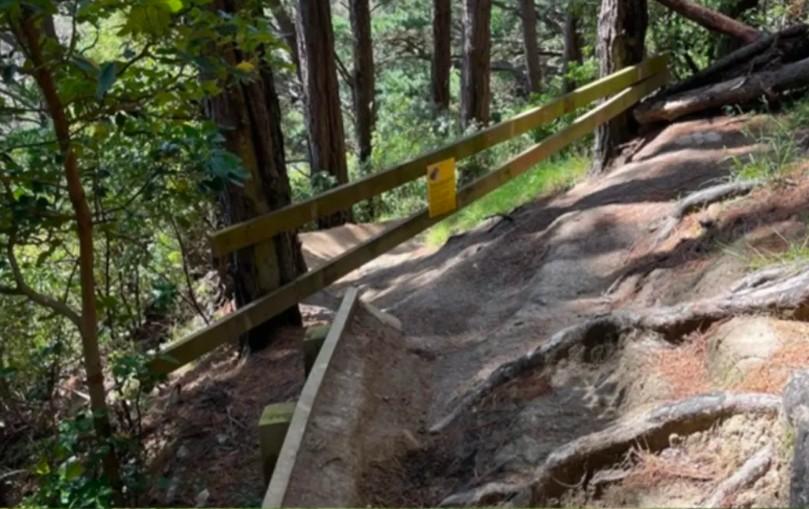
“They would have had to have carried a drill with them… it’s aggressive, anti-social behaviour,” Morton said.
Morton noted that obstacles had appeared “here and there” over the years along the trails, but the frequency of their appearances had ramped up over the last month, becoming an almost daily occurrence – and causing at least one crash.
“We were really getting concerned, not just for riders’ safety – I know there has been at least one person reported to have crashed from an obstacle – but also for people interacting with this individual: it could get violent,” Morton said.
The cyclist stressed that the trail builders work hard to be “socially and environmentally responsible”, and that the trails had been built with the endorsement of the council.
“We look after the trails, we plant 2,500 trees a year and we’re really supportive of the conservation efforts of other groups: we want to share the Town Belt,” he said.
Admitting that he was saddened by the “anti-bike rhetoric” surrounding the trails, Morton added: “At the end of the day we’re all just people who want to enjoy the outdoors or enjoy getting around Wellington.”
Meanwhile, mountain biker Rob Bardsley also pointed out that, due to the placement of some of the obstacles, cyclists using the trail would not be able to spot them until it was too late.
“You can go over the handlebars, [there’s a] good chance of a broken collarbone or arms, worst case a broken neck,” he said, warning that the vandalism was putting children who use the trails at risk.
“Who are you punishing? An 11-year-old out with his mum? They’re the ones who don’t have the ability to stop and haven’t developed the reflexes to avoid [obstacles].
“Putting these up creates fear and anger. Nothing good will come of it other than regret, injury, and legal implications.”
This fear was echoed by Lachie Ross, an U21 New Zealand national enduro mountain bike champion, who rides the Mt Victoria trails around four times a week.
Ross told RNZ that he is “disgusted” about the attempts to put cyclists in danger on what he says are the best trails for children around Wellington.
“If you go any weekday, any weekend, there will be hundreds and hundreds of kids up there,” he said.
“The amount of work that the council has put in to put these barriers in place and separate the mountain bikers and walkers is very fair,” he said.
While noting that most of Wellington’s mountain biking community was respectful, Bardsley did admit that “one or two stuff it up for everyone else”, creating conflict between walkers and runners and mountain bikers “pushing the limits”.
“When they like to ride like that, that can cause some issues,” he acknowledged.
Bardsley also said the local cycling community had its suspicions about the identity of the “vigilantes” behind the recent vandalism and that a description of a suspect was circulating.
“These traps are massive. If it’s the work of one person it’s a very strong person,” he said.
Meanwhile, Mt Victoria Residents’ Association president Ellen Blake told Stuff that she did not know who was behind the vandalism – but insisted “what has happened has been something to do with how people are feeling about it”.
Blake has been a long-standing campaigner for dedicated pedestrian spaces in the Town Belt, and says the conflict dates back to the early 2000s, when the mountain bike trails were first established.
“There has been a lot of issues with people on foot, runners… people have been frightened by mountain bikes using the trails, some people have been injured,” she says.
Blake said that while there are currently 12 mountain bike-only tracks, no tracks are dedicated to people on foot, saying her campaign’s “solution is to make some tracks, like the [10.6km] Southern Walkway so that you can go all the way along it without coming across a mountain biker.”
When asked if she was concerned that the obstacles could injure cyclists, she instead claimed that mountain bikers “had caused others harm”.
“We are always concerned people would be hurt up there, that’s been happening for some of the others,” she said. “If council addresses some issues as a result of this, that would be a good outcome.”
However, in response to these complaints, Wellington council’s media manager Richard Maclean advised that Town Belt users should “exercise common sense”, with walkers sticking to “obvious pedestrian paths” and avoiding trails “clearly designed for bikes”.
“Some people don’t agree that mountain bikes should be on the Town Belt. We think otherwise. It’s a large place, there’s heaps of room for everyone,” he said.
In a statement, parks manager Schroder added that the mountain bike priority trails on Mt Victoria are “designed and heavily signposted to minimise the risk of riders and other Town Belt users from coming into conflict”.
“We are extremely concerned about what’s going on – we’re in touch with the mountain biking community and we’re warning riders to take extra care while using trails on Matairangi/Mt Victoria,” he said.
“We know some people in the community don’t like that the Town Belt is a shared space for walkers, runners, riders, and other track users but we won’t tolerate people doing things to put other people in harm’s way.”
> Police issue warning after cyclist finds wire tied across forest trail
Unfortunately, acts of sabotage on cycling routes – with potentially catastrophic consequences – aren’t just confined to New Zealand.
In March, we reported that a popular traffic-free cycle path on the Isle of Wight was the subject of two apparent anti-cycling sabotage attempts in the space of a month, after piles of logs were left strewn across the trail – and immediately replaced after being moved by cyclists – and hooded, cider-drinking men were spotted allegedly shouting threats and insults at people on bikes.
Last December, a group of mountain bikers, whose decade-long campaign to open up Guernsey cliff paths to people on bikes was recently successful, saw their first trial ride halted when a wooden stake with nails was found laid across the route, believed to be in an act of protest.
And the previous month, cyclists in Sheffield were also warned to “be vigilant” after a dog walker reported finding “a length of wire-filled electric fencing mesh” strung tight and at head height near a popular beauty spot, the homemade trap “clearly intended to do harm”.














14 thoughts on ““Who are you punishing? An 11-year-old out with his mum?” Cyclists say “anti-bike rhetoric” behind sabotage on popular New Zealand trails, putting hundreds of children at risk – but residents claim riders are “causing others harm””
They dont want cyclists on
They dont want cyclists on the road, they dont want cyclists off road. Countries need to start treating this anti-cycling sentiment like a hate crime.
Where do they expect people to go?
Problem is that cars and
Problem is that cars and bikes don’t mix, neither do hikers and bikes, they need their own spaces. Agreed these trails are bike priority, but I wonder how riders would behave on walker priority trails. Oh, wait, I already know.
The problem isn’t bikes, cars or walkers, it’s people…
You mean they are the same
You mean they are the same selfish wankers who dont understand how to share?
StevenCrook wrote:
And some of those problem people are
.. those who know that people are people, but fail to design spaces with that knowledge. Or perhaps: fail to tell the truth about what they’ve made (“it’s for everyone”, or – especially with roads – fail to state “this space is for motorists; any bits not directly used by them are just to keep any other fools out of the way”).
And the most problematic people are those who sold and continue to sell us to motor vehicles…
StevenCrook wrote:
Oh yes they do. Come to the Forest of Dean, where pedestrians and cyclists co-exist with very little friction.
Minor tweak – they *can*, but
Minor tweak – they *can*, but generally if there are more than a few of each mode how well the space is designed becomes important.
Then on top of that we have cultural norms: in the UK where “space for walking” has often been sacrificed to motor traffic *. People can be very protective of the scraps that remain, and see cyclists as unwelcome competition or even a threat.
The majority of the time I’ve seen little drama, but I’ve seen conflict on (signed!) shared use paths and of course canal paths (because popular and often narrow).
* Especially in England where there’s little “wild country” and no “right to roam”.
“Problem is cars and bikes
“Problem is cars and bikes dont mix…” What an absolute crock. They should and do, successfully all over the world. The concept of seperate space for all only results in more concrete pouring with the environmental, financial and human penalties that this brings.
Samtheeagle wrote:
Tons more concrete and asphalt isn’t good as far as I’m concerned – but you’ll want to have a word with humanity (see population growth, housing etc.)!
That statement needs qualification. Do nothing – get continued growth of motoring. Throw motor vehicles, cyclists and people together and … get a road safety record like India or indeed the UK back in time when the rate of death on the roads was shocking. After that comes … everyone driving.
Ignoring motor vehicles, mixing pedestrians and cyclists in *particular* conditions works eg. when there are few of either. Where one mode dominates the other isn’t likely to find it convenient and those people will go elsewhere and/or complain!
In places where you see pedestrians and cyclists interacting happily while going places (like NL) the infra (and network design) is doing quite a lot of work. BUT in the positive side they have taken a lot of that space back from motor infra and some places have actually got greener.
Disappointing that even a
Disappointing that even a sensible place like NZ has anti-cycling nutjobs.
Militant walkers – is this the UK’s “Ramblers’ Society” on holiday?
Disappointing that even a
Disappointing that even a sensible place like NZ has anti-cycling nutjobs
Who is to blame? Do we have any NZ experts (one comes to mind, but his experience may not be recent) who can name the NZ equivalents of the Mail and Torygraph?
These are my local trails,
These are my local trails, the really sad thing is that there’s not a huge anti cycling community in wellington and most of it is very ammicable.
if you look at the portion of land people are arguing about it’s a steep hillside 5 minutes from the city centre with trails criss crossing each other regularly but with a trail network that would rival almost anything in the uk. It has super steep tech dh, jump lines and some flow trails.
the mountain bike trail builders have put a huge amount of effort into minimising conflict with redesing trail exits to improve sight lines and allow slowing prior to being spat out on to share paths.
I think the both sides that you’ve shown is disingenuous and the voice of we want our protected spaces should be asked to go and make them then (as the mountain bike community has). The downhill only trails which are mountain bike only are universally technical, fast and have blind corners which are both unpleasant to walk (from experience chasing a 6 year old on her bike or scoping features I can’t do blind) and would be unsafe for walkers and cyclists to share.
The idiot or idiots who are trying to destroy one of the things that makes wellington such a special place should have the whole force of the law thrown at them and charged with appropriate crimes such as “setting traps” which carries a 5 year prison term and I wish the police would come out and say they’d charge them as it might act as disincentive for those doing or inspired by it.
Quote:
I wouldn’t like to run into the person that can ‘scatter’ those! ?
A fast bowler?
A fast bowler?
chrisonabike wrote:
Generally splatterers rather than scatterers.