



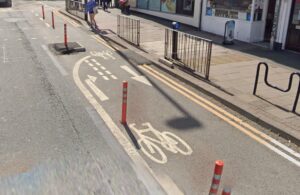
A poll commissioned by Sustrans Cymru has found that the lack of safe routes is the single biggest deterrent to people in Wales cycling, highlighting a need the Welsh Assembly Government’s Active Travel Bill aims to meet.
The proposed legislation, formally unveiled last month, will compel local authorities in Wales to develop and maintain an integrated network of walking and cycling routes, if passed in its current form.
The survey, carried out on behalf of Sustrans by research firm YouGov, found that two in three people in Wales do not cycle at all, but half of those claim they would do if measures were implemented that encouraged cycling were introduced.
The findings have been published on the website WalesOnline.co.uk in an column written by Matt Hemsley, policy advisor at Sustrans Cymru, who points out that currently, just 2 per cent of journeys in Wales are made by bicycle, and just 1 per cent of trips to work.
One in four non-cyclists said that the creation of safe cycle routes would be the single most important measure that would encourage them to take to two wheels, and the survey also found that what Sustrans describes as a “staggering” nine in ten of all respondents would welcome more investment in cycling.
Nearly half of respondents – 45 per cent – were in favour of more money being spent on cycle lanes, even if that forced local authorities to make cutbacks in other areas of their budgets, against 36 per cent who disagreed.
Sustrans pointed out that since it is impractical for all routes to be kept away or segregated from motor traffic, speed of vehicles deterred many from cycling, and its survey found strong public support, at six in ten respondents, for 20mph to be made the default speed limit in residential areas.
Younger people are especially likely to highlight motorists taking more care as being the biggest factor that would encourage them to cycle, one in four of them agreeing, leading Sustrans to pose the question, “As the numbers of young people taking the driving test continues to fall, perhaps they are looking more closely at the behaviour of those behind the wheel?”
The survey asked existing cyclists why they used their bikes, with fitness emerging as the leading response, which the charity highlighted as evidence of a need to do more to make cycling a regular, everyday activity.
It also examined the role of cycling as a political issue, asking respondents whether or not they would have a more favourable opinion of a candidate whose manifesto incorporated proposals favouring cycling, such as safe cycle routes or an increase in 20mph zones.
Three in ten respondents said that they would back such a candidate, against 9 per cent who said it would make them view the candidate less favourably, but among those who stated they were Liberal Democrat or Plaid Cymru voters, the proportion in favour rose to four in ten.
Hemsley concluded his column with the observation that “this, in many ways, is just the beginning.
“In London cycling groups were energised by the election process, campaigning politically like never before [in the run-up to last year’s mayoral elections].
“As the Active Travel Bill passes through the Assembly, expect more people in Wales to take an active interest in how politicians are talking about cycling, and which politicians and parties are offering the funding to back the aims of the Bill.
“At the next elections politicians should take note, cycling is now on the table as an issue that could decide the winner.”














5 thoughts on “Fear of roads biggest barrier to getting people in Wales cycling says Sustrans survey”
“Fear of roads”? Is that
“Fear of roads”? Is that euphemistic phrase written by a car driver?
Hmmm, yet in a recent meeting
Hmmm, yet in a recent meeting with Clrs in Cardiff they were insistant that 10% of journeys in the capital were taken by bike!! Im a cycle courier and quite often cycle for hours (or miles) without seeing another cyclist.
bigbluebike wrote:Hmmm, yet
The Census (2011) had 2.3 per cent of commutes in Cardiff undertaken by bike so, yes, that 10 per cent sounds very high.
2.3 per cent of Cardiff
2.3 per cent of Cardiff residents reported in the census that they commute by bicycle. However, I reckon many commuters will come into Cardiff by motor car from outside Cardiff, and it may well be that the 2.3 per cent figure overestimates the bicycle commute element of all commuting journeys into Cardiff.
I have a feeling that the
I have a feeling that the first thing to occur to non-cyclists or infrequent cyclists surveyed about cycling is that encounters with other road users might be scary or dangerous. A “fear of roads” in the more literal sense or of other cycle facilities that are not fit for purpose tends to manifest once people have atually started cycling in all weathers and all seasons.
I fell into a huge muddy puddle on a cycleway on Monday (2 metres wide, four metres long, four inches deep, major money-spinning tourist route). I thought my wheels would get some purchase on whatever was under the slime on the five-star, award-winning cycleway, but it was a deep layer of slime, and I thought wrong. I’ve also been thrown over the handlebars after sliding out on wet, mossy cobblestones while trying to swerve around a helpfully-positioned bollard, and I’ve had my issues with gravel and poorly-positioned kerbs on cycleways.
I think it’s important to ask people who don’t cycle about what would get them to start, but it’s also terribly important to ask people who do cycle about how their cycling environment could be improved. The trick isn’t just to get people to start – it’s to make sure that they won’t discover fresh problems they hadn’t envisaged beforehand when they do.