


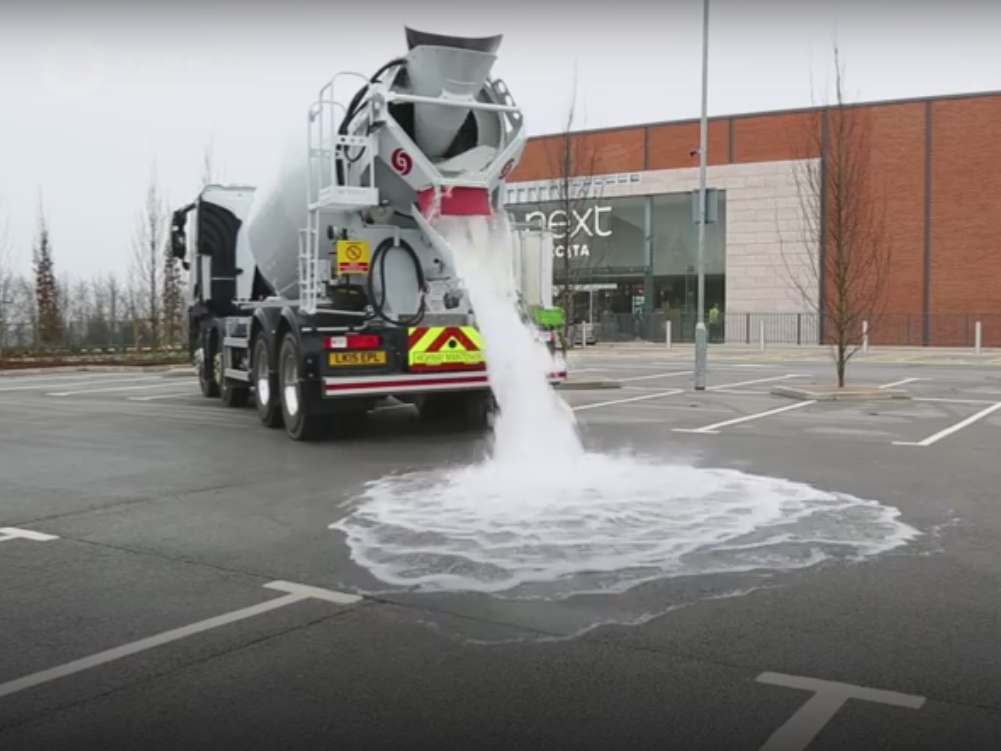

We all know one or two roads that are prone to flooding, but could Tarmac’s Topmix Permeable be the answer? The firm has released a video demonstrating just how much water its new form of concrete can cope with. It’s a lot.
Tarmac says it has already installed the Topmix Permeable concrete in a handful of places including in a car park in High Wycombe and on Worksop Golf Course. You can see how effective it is in the video below. The company claims that the demonstration saw 4,000 litres of water drained in just one minute.
Tarmac says that permeable concrete allows surface water to drain through the surface to the underlying ground. It will also act as a reservoir during periods of high downfall – a characteristic that is said to delay the discharge of surface water into drains, reducing the risk of flash flooding. The firm says that on top of this, storage of water within the system can create a cooling effect that reduces the ‘heat island’ phenomenon that is often seen in urban areas.
So are there any down sides? Well, there’s maintenance. Tarmac recommends a cleaning schedule that involves hydro-pressure with suction cleaning. But set against this, the firm believes that where it is used to combat flooding in urban areas, it will minimise damage and therefore resultant costs. Overall, they say it will minimise the cost and long-term maintenance for local authorities
















25 thoughts on “No more cycling through puddles – permeable road surface sucks up water (+ video)”
But when it freezes and
But when it freezes and expands and cracks it, that is when you have to worry.
That’s what does in normal
That’s what does in normal tarmac, but if this drains as shown there should be no water in it or on it to cause the cracking damage.
forcrz6 wrote:But when it
There’s a very informative link from ch in this thread, which has this amongst other interesting snippets
..worth a read.
Wait did I just read that
Wait did I just read that right? “cycling is a major cause of pavement breakdown”
forcrz6 wrote:Wait did I just
If you’re not joking, no you didn’t read it right.
forcrz6 wrote:Wait did I just
Ride on the road then!
I do that is why I do not
I do that is why I do not understand the statement.
Freeze/thaw cycling is a
We always get the blame….. 8}
PaulBox wrote:
cycling is a
I’m from the Daily Mail and this revelation will make an excellent two page article
kitkat wrote:PaulBox
Lol, I can see the comments section now.
“road tax”
“bloody cyclists”
“get off the road”
“road tax…”
But when it freezes and
But when it freezes and expands and cracks it, that is when you have to worry.
Would it also be permeable
Would it also be permeable coming back the other way? For example, would warmer ground vapour be able to percolate up and then freeze on the surface or even cause vapour / fog to collect above the road surface reducing visibility of road markings and edges?
Interesting.
Interesting.
It’s gravel and glue
It’s gravel and glue basically?
I have this stuff in my city;
I have this stuff in my city; some of New Orleans has it post Hurricane Katrina rebuild, too. It has been around for at least 10 years (maybe not same name brand, but same principal design…the best analogy I can give is that it’s like a giant concrete Rice Krispie Treat),and there are some good and bad points about it. Really the two bad things about it is one, the surface is very abrasive. You’d eat up tires quickly using it for extended periods. It’s mostly for sidewalks or parking lots. The other is that it can clog up after several years and just becomes useless in really heavy rain. Dirt, debris, sand, etc, can clog it, as it just settles inside and has no place to go.
Under floor heating for the
Under floor heating for the winter and we’re sorted.
In true flooding and the
In true flooding and the added bonus of silt etc, this would be useless
http://water.epa.gov/polwaste
http://water.epa.gov/polwaste/npdes/swbmp/Porous-Asphalt-Pavement.cfm
A pragmatic approach from
A pragmatic approach from local authorities would be to ensure that drains, ditches, galleys and culverts are kept clear and in good working order. These features are the primary means of preventing excess water build up on the roads but all to often these days are neglected and left to block up and contribute to more and more example of local floods.
Our roads are barely
Our roads are barely maintained as it is, never mind cleaned. This one for the distant future, Id have thought.
Why don’t we just have more
Why don’t we just have more regulations on concreting over gardens, etc.. Then we wouldn’t have this flooding problem.
.
.
Personally, I’d rather they
Personally, I’d rather they did the fucking roads properly. You know? With a proper camber and a smooth surface.
Like the Romans did.
I believe that they have been
I believe that they have been using this (or a material with the properties) in the Netherlands for years. Someone was telling me about it on a work trip there about 7 years ago. He said the advantage is that it prevents frost damage to the road during freezing periods. However the Netherlands has a lot of water in the ground and they have good drainage which they keep well maintained. I’m not convinced it would work in the UK where we don’t take such care.
I would imagine this is the
I would imagine this is the same draining tarmac that the Italian Autostrade have been paved with for the past decade or so.