


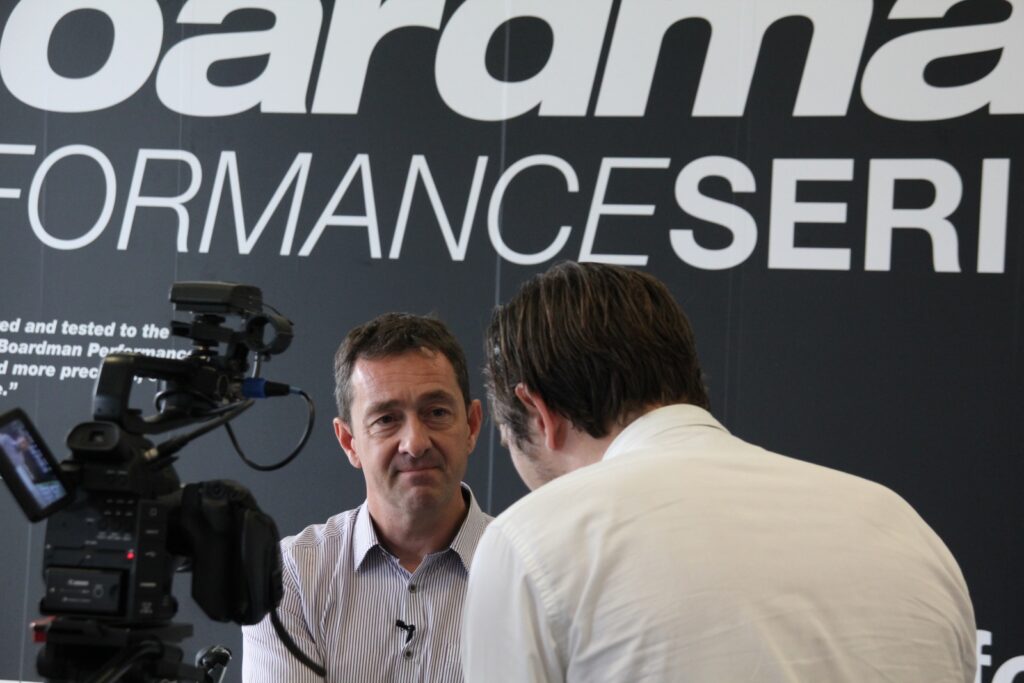

Chris Boardman’s appearance on BBC Breakfast this morning has provoked a flurry of complaints about his not wearing a cycle helmet – even though the segment began with him explaining why he chose not to do so. In a detailed explanation this afternoon, Boardman says that while the reaction was "understandable," it is also "unfortunate because it obscures what I believe are the real issues."
The early morning TV show is featuring a report on cycling each day this week. It is broadcast from Salford, close to the Manchester headquarters of British Cycling, where former Olympic champion Boardman is policy advisor.
Prior to going on a bike ride with him, presenter Louise Minchin asked Boardman, “Viewers will notice I will be wearing a helmet but you won’t. Why not?”
He replied: “It’s a very long answer and more time than we’ve got here," before summarising his position briefly.
“It discourages people from riding a bike, you’re as safe riding a bike as you are walking, statistically, you’re much safer than you are going in your own bathroom and you don’t wear a helmet there," he explained.
“There’s absolutely nothing wrong with helmets, but it’s not in the top ten things that you can do to keep safe.
“We’re going to look at all of those things, but for me, I want bikes to be for normal people in normal clothes.
“About 0.5 per cent of people wear one in the Netherlands, yet it’s the safest country in the world,” he added.
“There’s a reason for that.”
Despite his explanation, the backlash on social media was predictable, many pointing out that the Netherlands already has the type of infrastructure that Boardman and others are campaigning for in the UK.
One Facebook user, John Stimpson, said: “Chris Boardman wearing no helmet and riding in black jacket and jeans. For an item on cycling safety you can't get more stupid.”
Another, Toni Smith, said: “How can you show a piece about cycling safety when the ex-champion is not wearing any safety gear? This is not acceptable! Please in the future choose an ambassador who practices what they preach!”
Many others leapt to his defence, however, with Morgan Lewis saying: “For all those people expressing outrage, I wonder if you have spent the same amount of time looking at the evidence about helmets over the years as Chris Boardman has. His view is not idly held. There is a lot of knee-jerking in these comments.”
Jonathan Richards pointed out: “About two thirds of fatalities WITHIN cars are caused by head injuries – why not a call for compulsory helmets for those travelling in cars? And as for pedestrians ….”
Meanwhile, Chris Myrie couldn’t resist asking: “Does this mean his £80 endorsed helmets from Halfords are useless?”
There was a similar division in reaction to his comments on Twitter, where Boardman himself tweeted this morning after the show: “Hi All, rather than try to address the helmet debate (again) I'm going to pen something for people to read and point you to it this PM.”
That response has now been published on the British Cycling website. Boardman acknowledged the BBC Breakfast piece had “got a lot of people fired up,” and that “my riding a bicycle in normal clothing, looking like a normal person was greeted by some with cries of horror. It’s both understandable and unfortunate because it obscures what I believe are the real issues.”
Foremost among those issues is why some cyclists in the UK believe they should have to wear a helmet while cycling in the first place, he said.
“People wear helmets and high vis as they feel it’s all they can do to keep themselves safe. It shows just how far away Britain is from embracing cycling as a normal and convenient form of transport,” he added.
Pointing to the example of Utrecht in the Netherlands and providing a link to a video of people cycling there he went on: “I’m willing to bet that even those that swear by helmets and high vis would feel comfortable discarding their body armour in such an environment. And that’s the point; in Utrecht they have addressed the real dangers to cyclists.”
While he admitted that the situation in the UK is vastly different, he said helmet compulsion was not the answer, citing drops of between 30 and 50 per cent in countries such as Australia and New Zealand that had introduced such legislation.
“If cycling looks and feels normal, more people will cycle,” he said. The more people cycle, the safer they are – the safety in numbers effect. The more people cycle, the more lives will be saved from amongst the 37,000 that die each year from obesity-related illnesses. Never mind the more than 27,000 that die annually from pollution-related illnesses.”
Boardman said he understands “exactly why people feel so passionately about helmets or high vis,” and “why people wish to use them,” but said he would not promote helmets or hi-vis nor be drawn into a debate on a topic that he considers “isn’t even in the top 10 things that will really keep people who want to cycle safe.”
He added: “I want cycling in the UK to be like it is in Utrecht or Copenhagen and more recently New York City – an everyday thing that people can do in everyday clothes whether you are eight or 80 years old. I want cycling to be a normal thing that normal people do in normal clothes. Is that wrong?”
In the BBC Breakfast report itself, Boardman outlined his top tips for cycling safely including planning your route, how to negotiate junctions and roundabouts safely, road position, stopping at red lights and giving large vehicles plenty of space and not going up the left-hand side of them.










287 thoughts on “Complaints over bare-headed Chris Boardman’s helmetless BBC Breakfast bike ride”
With the bright sunlight we
With the bright sunlight we had in Manchester this morning, dark clothing may well have been safer than dayglo yellow
Working on the
Working on the technical/equipment aspects of British Cycling’s programme, Boardman has been notable for worrying about what works and doesn’t when things are tested, not the pre-existing prejudices or practices of the cycle racing community.
It’s good to see him working on the basis of facts in this debate, too.
Please, Road.CC denizens,
Please, Road.CC denizens, let’s not replicate the canned idiocy and quasi-religious bullshit that filled the Facebook and Twitter all day.
If you don’t get what Boardman is saying, better to remain silent and think him an idiot than open mouth and be proved one yourself.
“Please in the future choose
“Please in the future choose an ambassador who practices what they preach!”
HE IS PRACTICISING WHAT HE’S PREACHING YOU IDIOT.
And breathe.
I think Boardman’s position
I think Boardman’s position is spot on here. Refusing to be drawn on the personal choices he might make – and respecting and understanding the choices of others.
He is far more concerned about the bigger picture of cycling in the UK and so for his cause, the pro/ anti helmet debate is an unnecessary distraction
Having just spent two months
Having just spent two months in NZ and two weeks in Sydney I can attest to the fact that cycling numbers are incredibly low and the general feeling is that cycling is too dangerous. Sydney is doing ok though and a good number of people are flouting the helmet law, myself included… With the cops seemingly having better things to do, even the two horse cops I rode past the other morning not even batting an eyelid as I sauntered past with *shock*horror! No helmet.
Having just spent two months
Having just spent two months in NZ and two weeks in Sydney I can attest to the fact that cycling numbers are incredibly low and the general feeling is that cycling is too dangerous. Sydney is doing ok though and a good number of people are flouting the helmet law, myself included… With the cops seemingly having better things to do, even the two horse cops I rode past the other morning not even batting an eyelid as I sauntered past with *shock*horror! No helmet.
Chris Boardman wrote:an
Yes!
Where a helmet if you want I
Where a helmet if you want I do. I also wear gloves for the same reason. It/they may stop some cuts and bruises but expect nothing more.
As for hi-vis, 2 deaths on Hampshire roads, because of sun in drivers eyes the inference was it made the wearer near invisible.
Ride safe folks but keep riding
DuncanMc wrote:
As for
In one case the driver was acquitted thanks in part to the jury falling for his hard luck sob story 🙁
[Back on topic]
Sweet Jesus
[Back on topic]
Sweet Jesus not this again.
You can see why CB sees this as a distraction!
I once saw some-one washing
I once saw some-one washing up without wearing washing up gloves once. Totally irresponsible. Washer Uppers should do all they can to protect themselves. What sort of message do you think it sends to their kids? It’s shocking. This is why I have no respect for Washer Uppers. They bring it on themselves really.
I caught a brief glimpse of
I caught a brief glimpse of Boardman in his jeans and bomber jacket this morning and he made the BBC idiot in pointless tickbox plastic hat and yellow top next to him look completely daft and over the top when side by side with him.
It was a breath of fresh air to see someone on TV on a bike, and not in a period drama, being shown riding a bike as a normal day to day thing and not needing more safety gear than an assault on the north face of the eiger
I don’t agree with his reaction to the frothing at the mouth of the health and safety magic plastic hat brigade as ‘understandable’ though – it puzzles me why what other people wear on their head seems to get some folks in such a lather. Is it that they can’t bear to see their view that something is terribly dangerous exposed as the load of rubbish that it is or just some kind of deep down need to dictate to others? who knows…
Northernbike wrote:I caught a
It sounds to me like you’re one of the ones getting in a lather, just on the other side of the debate.
Best to just let people make their choices and respect that. Getting out and riding is the main thing, regardless of how you look or what you wear. Showing the public that cyclists come in all shapes, sizes and outfits (whether ‘normal’ or not) is a good thing.
Northernbike wrote:I caught a
I think it’s mainly a vague desire to shift responsibility away from yourself and onto a group of people you don’t identify with.
Driving a car in an urban space – or in any space really – puts you in responsibility of a rather large amount of… stuff. I think many people feel uncomfortable about actually accepting that responsibility, and so try and spread it around – inevitably onto the more vulnerable members of the road system.
A large number of complaints about ‘cyclists’ are found to be so useful, because they shift responsibility so well. They ‘don’t pay road tax’ (i.e. have no right to impede my rightful progress). They don’t wear enough hi-vis (i.e. I shouldn’t have to look for them). They don’t wear enough helmets (i.e. any injury I cause in not my fault but theirs). They look strange [often because of hi-viz and helmets] (i.e. they are second-class citizens). It’s largely a childish reaction against something you don’t want to do. That is, actually think about other people. Because that’s exhausting.
I wear a helmet but respect
I wear a helmet but respect it is an individual choice. Boardmans argument is spot on, compulsory helmet wear would have a negative effect. Maybe a few lives could be saved if the rider was wearing a helmet, but the thousands saved by making cycling more appealing for everybody far outweighs that. Also, I don’t really buy into Hi viz in the day. Reflective strips at night, yes, but I struggle to believe that dressing head to toe in fluorescent yellow is any more visible to other road users. Black isn’t invisible, unless you have your eyes closed.
A lot of fuss about nothing,
A lot of fuss about nothing, so Chris didnt wear helmet & hi-viz. What about it? Normal cycling for a change & not trying to enforce others to wear same. Choice is your own, if you feel happier in helmet & hi-viz on our roads then do so, but think why you feel better that way? Its not cycling that making it so, its the crap infra offered to us.
I tried the hi-viz & found I still got the same lame brain excuse of SMIDSY, so thrown them out. I wear a helmet but know if will do sweet FA for my head or the rest of me when under a tonne or so of metal. I wear it to carry my helmet cam & nothing more. I do have reflectives on my jacket, bike & wheel spokes to go with good lights to help improve in getting me noticed at night when drivers can be bothered to look.
As far as I am concerned, Chris Boardman is doing a grand job for normal everyday cycling & focusing in where we really need to focus on. I so would love to thank him personally as no doubt my tweets to him is being drowned out by the ill-informed moans…
I would say that 60% of
I would say that 60% of safety is WHERE you ride, 30% is HOW you ride, and 10% is WHAT you ride IN.
Still, some days I want that extra 10%.
I know the helmet evangelists
I know the helmet evangelists mean well but I do wish they would just fuck off.
Also, did anyone else notice
Also, did anyone else notice how Boardman wasn’t using stabilisers? Disgraceful.
Why don’t people drive hi-viz
Why don’t people drive hi-viz cars ?
dreamlx10 wrote:Why don’t
They do. The reason why new cars are sold with LED daytime running lights is to make them more visible to other road users.
parksey wrote:dreamlx10
Lights are not hi-viz =))
dreamlx10 wrote:Why don’t
Hehe, that made me chuckle, but then I realised that’s exactly what daylight running lights are for…
DaveE128 wrote:dreamlx10
Quite.
I can’t even turn the damn things off on my Volvo!
And even on road.cc, the
And even on road.cc, the helmet frothing relegates the point of the report (cycling tips) to a paragraph at the bottom and doesn’t mention a key part (rebuild bad roads, including challenging the cycling minister) 🙁
If you want to wear a helmet,
If you want to wear a helmet, wear a helmet. If you don’t – don’t. If you crack your head open not wearing one, then that’s your problem. I personally will keep wearing one, having been saved by one once already.
willdolby wrote:If you want
Sweet Jesus.
willdolby wrote:If you want
Must not rise
Must not rise
Must not rise
Oh for f***s sake,
Go away crash in exactly the same way without wearing a helmet, if you don’t come back i will accept the helmet saved you, if however you come back, which i am almost certain you will…. Helmets will save you from a few cuts and bruises, but don’t expect much more.
As an aside you do know that helmets are less safe than they were 10-15 years ago?
Anyone genuinely interested
Anyone genuinely interested in the evidence on the effects of helmet wearing can look at http://www.cyclehelmets.org and helmet posts on http://www.rdrf.org.uk , starting off with http://rdrf.org.uk/2013/12/17/the-effects-of-new-zealands-cycle-helmet-law/ and
http://rdrf.org.uk/2013/12/27/the-effects-of-new-zealands-cycle-helmet-law-the-evidence-and-what-it-means/.
I mowed my front lawn once in
I mowed my front lawn once in flip flops…. 8}
Boardman =D>
Boardman puts common sense
Boardman puts common sense first, but, the politicians put money first and because they can’t get round his arguments for cycling safety they join the helmet brigade and shout, ‘but he isn’t wearing a helmet’. Proof again politicians have no sense.
If the argument was of
If the argument was of ensuring safety then cars would be coated in a layer of foam and be covered in hi-viz strips.
Personally I couldn’t care
Personally I couldn’t care less whether other riders choose to wear helmets or not, sometimes I do & sometimes I don’t but it’s my choice & mine alone. It’s not something that should be foisted on my by anybody in my normal cycling time, obviously there are some times where helmets are required such as organised events if the rules require me to wear a helmet I will, that’s just part of life. The BBC as a public body should be producing politically neutral reports and promoting cycling as a health benefit rather than producing click bait rubbish on their programs and website, just look at how they support Clarkson & the the piece of televisual junk that is Top Gear which now panders purely to 18 year old boy racers and their intellectual equivalents. This whole issue makes me seethe and the fact that I have to pay a TV License to support this without being given a voice makes it worse.
Sorry for the rant but I just want to go out on my bike without some prick in a car telling me I need to wear “safety gear” to protect myself from him because he can’t be arsed to take responsibilty for his own actions. X( X( X( X( X( X(
I wear a helmet because I
I wear a helmet because I want to protect my head. Regardless of so called statstics, there is always a chance that I might come off the bike, whether by accident or through someone else’s actions. I’ve seen the results of someone’s (helmetless) head hitting a solid surface. Ride round without one if you wish, it’s your head. I wear bright clothing as well just so that others can see me coming. We don’t need more laws, just common sense out on the roads.
Reggie Plate wrote:I wear a
QFT.
Other than that, what CB does is his own business. He hasn’t got a debate started, just a little web forum fulmination.
The world will continue to turn.
I always thought that every
I always thought that every road user had a responsibility for their own actions.
In most of the cycling
In most of the cycling debates shown on TV or discussed on the radio, Chris Boardman is the only one really that talks sense. I find most people have very little knowledge and experience to base their opinion from.
GET THE MESSAGE HELMETS DO NOT MAKE US SAFE
However, cycling with consideration for the rules of the road and other road users, and other road users doing likewise, make our roads safer. Education has got to be the answer to narrow the void between cyclists and vehicle users attitudes towards each other, surely or is that like too much common sense for people who are in a position to influence such changes…. 🙂
Don’t forget “It’s NICE to be NICE!
thecyclingbear wrote:
GET THE
Maybe not, but helmets CAN and DO save lives and prevent head injuries every day.
😉
i already posted this in
i already posted this in another news item but I’ll post it again here because I think it’s relevant for different reasons. And because I think it should be shared far and wide.
a) it’s the voice of reason.
b) refreshingly many of the cyclists are not wearing helmets (it’s filmed in Cambridge as far as I can see.
Blaine Walsh of Driving-instructor.tv and Michael Frearson of The Association of Bikeability Schemes share their thoughts why cyclists sometimes ride in the middle of the road, on how “right of way” doesn’t exist, and how driving instructors have a vital role to play in teaching the next generation of drivers that everybody has a right to use roads, not just motorists.
I have great respect for CB
I have great respect for CB but I always remember him saying that his helmet saved his life when this happened:
http://news.bbc.co.uk/1/hi/special_report/1998/07/98/tour_de_france/131943.stm
And whatever “normal” might be, I don’t want to be it thank you.
Storm in a teacup though imo.
😕
michophull wrote:I have great
There’s quite a difference between hurtling down winding roads 30+mph in a packed peloton and doing… well, something more like this (www.youtube.com/watch?v=n-AbPav5E5M&noredirect=).
While I’m generally quite ignorant on the issue, I’m pretty sure I support compulsory helmet legislation in the upper echelons of cyclesport. Confusing sport with transport though, is folly.
Riding a bike needn’t be dangerous, so helmet use needn’t be compulsory in all situations. It CAN be (and for that reason I’m glad I own one) – just as being a pedestrian can be dangerous dangerous if that pedestrian has jumped out of an airborne helicopter without a working parachute – but it needn’t be. And I’m awfully glad I don’t have to carry a parachute for my normal daily activities.
High viz does stand out on
High viz does stand out on country lanes. I today saw a woman cycling all in black except for a few white stripes, she was on a main A road and I could see traffic making late braking and swerving around her. Where I cycle there are number of riders who wear fluorescent yellow tops and stand out a mile against the background. Add a smattering of reflective strips and you would be a complete knob not to see them in virtually any scenario
Where I cycle there are
Where I cycle there are number of riders who wear fluorescent yellow tops and stand out a mile against the background. Add a smattering of reflective strips and you would be a complete knob not to see them in virtually any scenario
The world of drivers is clearly full of knobs.
I wear bright stuff, lights even in the day, and a helmet, not because I think it makes much of a difference, but because I don’t want someone who hits me to have any excuse.
CXR94Di2 wrote:High viz does
A TRL study wrt hi-viz for motorcyclists would seem to indicate that it’s the clothing/background contrast that is the issue – which could even be white or black clothing. To paraphrase part of the conclusion – not likely to be a one-size fits-all solution and that motorcyclists need to be aware of its limitations.
An Oz study into hi-vis/reflectives found that a disproportionally higher proportion of incidents were during low light levels, and that reflectives were more effective in those conditions.
So rather – it depends, and don’t blindly rely on them.
CXR94Di2 wrote:High viz does
So if they had accelerated early and drove straight through her that would have been proof she had been seen?
wearing a helmet is not safe
wearing a helmet is not safe – it improves safety but does not make cycling safe
we all know that being taken out from the back or not being seen at on coming junctions are the things that will kill us
and until we have a system of perceived liability then nothing will change
i cycle without a helmet all the time – i also use them when am out for long all day cycles
cyclists biggest problem is the car lobby
…
…
Hey, Look. Chris Boardman got
Hey, Look. Chris Boardman got loads of people talking about cycling again. Nice one!
I’m (un)lucky enough to
I’m (un)lucky enough to almost be as old as Chris Boardman and therefore started cycling when no-one wore a helmet, yes, that’s right, no-one. Even the pro’s fought against them being made compulsory when racing. I feel this has given me a very different attitude towards wearing helmets to people who’ve started cycling since then.
I don’t have a fear of being safe on the road and I’ve had a number of accidents like most cyclists. I don’t wear a helmet all the time or hi-viz. I’ve only worn a helmet when it’s been required by an event I’m taking part in and feel no safer with one on, just the opposite, I find other road users treat me differently and give me less space, but that’s just my own opinion and my own choice for me.
If you choose to wear a helmet and hi-viz because you’ve weighed up the pro’s and con’s and feel that’s right for you, chapeau.
Having said all that, when they bring in the airbag suits like MotoGP I’m having one and saving my collarbone B-)
Note that the daytime running
Note that the daytime running lights on cars can make other road users, with less bright lights or no lights, less visible.
Good to see we have the “A helmet saved my life” brigade in attendance. Note: If you consistently wear a helmet walking, in the bath or shower, or when you go out drinking, you will end up with the same tale in time.
So don’t be a hypocrite now: Always wear your walking helmet. Always wear your bathing helmet. Always your drinking helmet!
I’m feeling this pro / anti
I’m feeling this pro / anti helmet debate will never end!! I’m also loving how defensive and personal each side of he debate get towards the other side! Why does it bother so many what others do (who I’m guessing are complete strangers to you?)
I personally choose to wear one. I don’t expect to be judged by others for doing so…however, having read the above it would appear people do.
If on the other hand this discussion was about cyclist who cycle in the dark on the public highway with no lights, then that would be a different matter. This really annoys me as you are not only putting your own safety at risk but also the safety of others you might run into (pedestrians) and also risk ruining someones else’s life if they knock you off and kill you. I mention this as the ‘no-light’ brigade are out in force again due to the clocks changing.
Tinternet_tim wrote
“If on
Tinternet_tim wrote
“If on the other hand this discussion was about cyclist who cycle in the dark on the public highway with no lights, then that would be a different matter. This really annoys me as you are not only putting your own safety at risk but also the safety of others you might run into (pedestrians) and also risk ruining someones else’s life if they knock you off and kill you. I mention this as the ‘no-light’ brigade are out in force again due to the clocks changing.”
Now that is something I agree with, we bang on about how great Copenhagen, Holland etc are but forget these places legislate that bikes must have lights fitted at point of sale, it’s only road bikes & MTB’s that don’t have them fitted as standard by manufacturers, both of Mrs G’s town bikes have lights fitted as standard but there again one is a Dutch steel town bike and the other is a Belgian town bike that she bought especially in Belgium because you can’t get it in the UK. Maybe the Government can actually do some positive legislating for once & require bike manufacturers to fit lights as standard, it’s not a massive cost and might actually keep someone alive plus think of the fun you could have speccing your lights as part of your bike choice. B-)
Gus T wrote:Tinternet_tim
The other side of that though, at least for Germany, is that the regulations specify lights that are utterly and completely inadequate for rural riding, and probably not enough to waken the average half-asleep texting nobber (aka the normal car driver). The main motivation is ‘we must not dazzle the poor motorist’, with the implied threat that if they are dazzled most of them are too thick to stop, and indeed so lacking in control they’ll drive straight into the source.
oldstrath wrote:
The other
I prefer my Philips Saferide 80 to my Lezyne Mega Drive. So am selling the latter. Much better lighting overall.
oldstrath wrote:The other
I’ve clearly dreamt that my German-spec lights are suitable for rural riding, then. I can see fine, but I didn’t buy the bog standard which probably aren’t unsuitable, but then a £3 blinky wouldn’t be suitable either. My old British Standard lights were far worse.
Not dazzling the motorist – or indeed, other cyclists – is a fine motivation. Many of them do seem to be too thick to stop, but anyway, dazzling lights are illegal and I hope you get fined for inadequate lights if you use them.
oldstrath wrote:Gus T
The other side of that though, at least for Germany, is that the regulations specify lights that are utterly and completely inadequate for rural riding, and probably not enough to waken the average half-asleep texting nobber (aka the normal car driver). The main motivation is ‘we must not dazzle the poor motorist’, with the implied threat that if they are dazzled most of them are too thick to stop, and indeed so lacking in control they’ll drive straight into the source.— Gus T
Ah, but in my experience, admittedly on French motorways, every German driver is convinced they are Michael Schumaker and drive as if the are participating in a F1 GP.
Tinternet_tim: It bothers
Tinternet_tim: It bothers some of us, because the other side often lobbies to have laws passed to make helmets compulsory to wear. Successfully in places.
Once that type of idiocy got going, the other side had no choice but to get very vocal.
I no longer wear a helmet,
I no longer wear a helmet, instead I wear a St Patricks Day Guinness hat.
And I don’t wear hi viz. I wear a full Mapei team kit.
So far I have not been knocked off my bike.
Agree with Chris entirely.
Agree with Chris entirely. The sole reason for protective gear is to try and minimise damage caused by, principally with rare exception, idiots in steel cages propelled by increasingly fast engines.
To ridicule and berate Chris for his choice of no helmet (bearing in mind a camera car was obviously present no doubt invoking the ‘look at my safe driving, aren’t I a little cherub’ response seen whenever a police car is in view is the same as criticising a rape victim for not wearing a metal chastity belt.
If we sort the aggressor out there will be little need for helmets and body armour. Seems this concept is wasted on many MPs who find it very inconvenient.
Pity the man whose pleasure
Pity the man whose pleasure depends upon the wearing of a helmet
Many commentators focus on
Many commentators focus on the fear that wearing a helmet when riding abike will be made compulsory. They are totally right. Once such law passes, it will be extremely diffcult to repel it. Therefore the usage of bikes as a means of transportation for “normal” people in “normal” clothes must be accelerated in order to create enough momentum to relegate the wearing of helmets to realm of personal choice.
I suspect that the helmet regulation lobby is disingenuous, trying to smother the “bike as means of transport movement” at birth, lest it encroaches on the disproportionate privileges of the motoring industry at large. Which of course it will, if succesful.
But again, can helmet regulators not look over their shoulder at Germany and the NL, countries with an almost pathetic affection for the car, but which nevertheless have made cycling mainstream, without clothing regulations?
Wearing hi-vis gillet, a
Wearing hi-vis gillet, a helmet and having lights on at 4.30 last Saturday afternoon did absolutely nothing to stop me getting taken out by a car side on and spending 6 hours with emergency services.
Nor did carrying a hi-vis rucksac and wearing a helmet stop me getting turned left on and left in the middle of the road 4 weeks previously
On each occasion, the driver professed not to have seen me. The driver in the first instance has been charged with driving without due care and attention, the driver in the second instance just drove off after checking I wasn’t dead.
It’s not about us or what we wear, it’s about drivers who do not actively look out for cyclists and other vulnerable road users when they get in the car and turn the key. Get learner drivers out on bikes in traffic when learning – help them to understand what it is to be a cyclist.
Armouring ourselves does not address the real problems.
Boardman, the helmet debate
Boardman, the helmet debate has been raised yet again as a direct result of the fact that you refuse to wear one. You harp on about getting to the real issues but surely by virtue of the fact we are sat here discussing it now and of all of the criticism you have had this makes it a real issue.
Chris Boardman, JUST WEAR A HELMET AND STOP BANGING YOUR OWN LITTLE DRUM! and then you could actually move on to discuss those ‘real’ issues.
You’d make a s**t politician!
~X(
Storck Rider wrote:Boardman,
He probably would make a shit politician, as he’d be too busy doing what is right rather than pandering to the spoon fed, milksops like yourself who are seemingly incapable of generating their own thoughts that seem to make up a large hysterically screaming proportion of people nowadays.
Storck Rider wrote:Boardman,
Bingo – you win the ‘Totally and deliberately missing the point’ award this year.
…in case you didn’t notice, thousands of people who understand the nuanced, intertwined issues support Boardman’s stance. Noting it’s not even *his* stance – I have thought this for decades, as have many others. The only ‘little drum’ being banged here is your own.
Storck Rider wrote:Boardman,
He’s trying to sell cycling as an everyday, low cost, low effort means of transportation.
If he does that in helmet and hi-vis, he instantly ‘others’ cycling and turns people off it, shooting himself in the foot.
And while I might be heartily sick of the helmet debate, it’s hardly mainstream. Putting on a piece of protective gear does seem like a ‘common sense’ solution to danger, until you actually look at the larger picture of issues and stats. If we have to go through this all again so that some of those people who don’t currently cycle start to understand why those who do are resistant to it, then good.
Boring…….. in other news.
Boring…….. in other news.
Meanwhile, Nick Clegg and a
Meanwhile, Nick Clegg and a chubby bloke were offering this essential safety advice for cyclists.
I do hope he checked where it was made this time. 👿
Aside from the pro/anti
Aside from the pro/anti helmet debate, isn’t this also the “what you must be seen to be wearing whether you agree with it or not” uniform-on-television debate? You don’t see many presenters on the telly at the moment without a poppy…
If he had showed up on a DH
If he had showed up on a DH bike with a full face helmet and goggles I bet they would have asked him to take it off.
1,713 people died and 21,657
1,713 people died and 21,657 were seriously injured on Britain’s roads in 2013. 46% of the deaths were car occupants, 23% were pedestrians and 19% motorcyclists. But that’s just, what… bad luck?
Yet there are howls of indignation because a normal person rides a bicycle without a piece of vented polystyrene on his head while on the telly.
What a screwed-up set of priorities!
@ Storck Rider all you’ve done a fine job of demonstrating how ignorant you are. Your mum really shouldn’t let you play on the internet unattended.
You guys are special!
I can
You guys are special!
I can see very well what his end game is and why he makes his points BUT, AGAIN, the fact we are here debating this takes away from what he is trying to achieve.
I’ll stop wearing a helmet when somebody can prove to me they haven’t saved a single life!
Storck Rider wrote:
I’ll stop
Will you be applying that thinking to walking and driving, or do you save it for cycling?
felixcat wrote:Storck Rider
Will you be applying that thinking to walking and driving, or do you save it for cycling?— Storck Rider
Most people walk at around 3-4 mph at a steady pace. I tend to cycle at speeds between 10-35 mph on my commute
So you’re not comparing like with like. A helmet may offer protection from a fall at cycling speeds. They’re fairly redundant when walking.
so a bike helmet may be use to you if you come of your bike, whether through your own fault or that of other road users. They’re particularly useful when mountain biking, as the chances of an ‘off’ are probably higher.
If you are unlucky enough to suffer a direct head injury from two tonnes of vehicle, then the helmet is unlikely to help you, whether walking, cycling, or in a vehicle itself
700c wrote:felixcat
Will you be applying that thinking to walking and driving, or do you save it for cycling?— felixcat
Most people walk at around 3-4 mph at a steady pace. I tend to cycle at speeds between 10-35 mph on my commute
So you’re not comparing like with like. A helmet may offer protection from a fall at cycling speeds. They’re fairly redundant when walking.
so a bike helmet may be use to you if you come of your bike, whether through your own fault or that of other road users. They’re particularly useful when mountain biking, as the chances of an ‘off’ are probably higher.
If you are unlucky enough to suffer a direct head injury from two tonnes of vehicle, then the helmet is unlikely to help you, whether walking, cycling, or in a vehicle itself— Storck RiderA lot injuries are in fact attributed to low speed falls when hardly moving. You tend to bounce at speed, dead falls from stationary seem to result in more head injuries.
MKultra wrote:700c
Will you be applying that thinking to walking and driving, or do you save it for cycling?— 700c
Most people walk at around 3-4 mph at a steady pace. I tend to cycle at speeds between 10-35 mph on my commute
So you’re not comparing like with like. A helmet may offer protection from a fall at cycling speeds. They’re fairly redundant when walking.
so a bike helmet may be use to you if you come of your bike, whether through your own fault or that of other road users. They’re particularly useful when mountain biking, as the chances of an ‘off’ are probably higher.
If you are unlucky enough to suffer a direct head injury from two tonnes of vehicle, then the helmet is unlikely to help you, whether walking, cycling, or in a vehicle itself— felixcatA lot injuries are in fact attributed to low speed falls when hardly moving. You tend to bounce at speed, dead falls from stationary seem to result in more head injuries.— Storck Rider
That’s interesting, and of course there are all kinds of reasons why someone might fall from stationary without protecting their head (serious and sudden illness, loss of consciousness etc), many of which are unpredictable and unexpected. You judge the risk and and choose your ‘PPE’ equipment based on the likelihood of injury occurring, how serious it may be and the type of injury that might occur.
So before embarking on a bike ride, you will have different expectations of risk and reach different conclusions about taking precautions than before going for a walk.
I still maintain that likely speed of travel and impact is a factor that could determine ones choice of head ‘protection’ as well as likely gravity of the injury, when that impact happens.
It is everyone’s individual choice to evaluate those risks and take action accordingly (thankfully helmets are not mandatory and I agree with CB’s argument here) but there’s room for some common sense
Sensible debate should respect individual choice rather than characterising the other side’s position or arguments, which unfortunately happens a lot when talking about helmets
700c wrote:
That’s
EXACTLY! THANK YOU! This issue is not whether it will save one life, but whether it is a reasonable response to the level and nature of the danger.
We, correctly in my view, assess that the disadvantages of wearing a helmet while going about our daily lives, even if it only amounts to inconvenience, outweigh the potential benefits that it might prevent some damage in the event of an accident, if that accident involves damage to the head, and that something else worse doesn’t happen at the same time to nullify the benefit.
Cycling is something I do every day. My boyfriend does it. My housemate does it. Most of my friends do it. Many of my acquaintances and colleagues do it. It is a normal, everyday activity to get from A to B.
I might respect your choice to wear a helmet while walking down the street, but I’ll probably assume you’re on your lunchbreak from a building site, or you’re a bit strange.
Wearing a helmet while doing everyday low-risk activities is a bit strange. The reason we don’t think the same thing when it comes to cycling is that for decades we’ve been working on making cycling at all a bit strange.
Helmet and hi-vis is cultural anathema to wide-spread cycle use. You don’t get it in the Netherlands and Denmark. There’s a lot less helmets and hi-vis in Cambridge, where cycling is something the majority of the adult population do. Tackling the helmet question absolutely is a part of the battle for normalising cycling as everyday transport.
That said, feel free to wear a helmet. But don’t tell me I should do the same, or that I’m stupid for not doing it, because you are feeding into the culture that makes what we do strange, and undeserving of national recognition and funding.
HKCambridge wrote:Helmet and
I have no idea if this is true or not, but could it be that in areas where there are larger cycling populations that drivers and pedestrians are more aware of the cyclists presence? And inversely, in areas where less cyclists are present, drivers are less aware and wearing these things might be more beneficial?
LinusLarrabee
To be honest, I’d be surprised if it was a rational response to weighing up the pros and cons of the situation, in the same way that people don’t actually take time to weigh up the pros and cons of wearing a helmet while walking. It’s just normal.
This was the point that Chris
This was the point that Chris was trying to make. If he wore dark clothes and no helmet in Holland or Denmark no one would think it odd, because the infrastructure is designed for cyclists to arrive at their destination safely Wearing a helmet or fluoro clothes in the UK do not make you safe but they do, theoretically, reduce your risk of being injured. There is a big difference in designing a cycling infrastructure that enables people to ride in safety from one where you ride along a blue strip of paint in bright clothing, with lights and a helmet in hope that you are reducing your risk factors to make it in one piece to the end of your journey
Trackal wrote:Wearing a
As Yogi Berri said, in theory, practice and theory are the same but in practice they’re different. And so it is that research at Nottingham and Bath shows that visibility aids do not reduce the risk but may increase it while research from Plymouth and Cambridge show that helmets in the UK at least give no safety benefit. C’est la vie
HKCambridge wrote:Wearing a
This. 1000 times this.
HKCambridge wrote:
Wearing a
This is spot on.
I don’t think many people here are claiming that riding your bike will never lead to a situation where you’d be better off wearing a helmet than not. But this situation is basically no more likely to arise than it is doing any number of other things.
So it’s frustrating when the helmet debate dominates any discussion of cycling when it doesn’t dominate any discussion of those other things (e.g. head injuries in cars) which isn’t rational- and a strategy to increase the number of cycling journeys needs to be rational and not based on pandering to public perception.
It also reinforces the idea that safety on the roads is all about what the potential victims do, not what the people with the potential to do all the damage do. This is pretty much the opposite of the way we would treat any other situation where there’s the potential for people to get hurt, and I think the reason cycling is a special case in this respect is largely for the reasons HKCambridge mentions.
700c wrote:
Most people walk
Is this meant to be an argument for wearing bike helmets but not car helmets or walking helmets?
The figures show that the head injury rates for all three modes are roughly the same. The rates are certainly not different enough to make a distinction in risk levels.
The question remains: is cycling so much more dangerous that a helmet is needed? Or is there something about being on a bike that makes a helmet so much more effective?
Boardman was not riding off road, or talking about riding off road. (and no one posting above mentioned mountain biking) He is being attacked for going lidless on the highway.
Cycling on the road is not so uniquely dangerous that it needs a helmet, and all the fuss about lids only makes it seem to be something that the average citizen should avoid.
felixcat wrote:The question
Shocking. #o
The question, if a person is deciding to wear a helmet, should be: are there any instances where wearing a helmet is beneficial to safety and are there any instances where doing so is detrimental to safety. After weighing up this question you then decide if you have a net benefit or a net detriment. It doesn’t matter how small the overall benefit is, or how far down the list of safety considerations it appears to be (outside Boardman’s top 10 clearly), if wearing one is beneficial then it is better to wear one than not. Neutral instances, i.e. instances where wearing a helmet is ineffectual, are completely irrelevant to determining if one should be used. It’s as simple as that. The same considerations apply to wearing hi-vis clothing or any other action a person can take to make cycling safer.
It is a different question entirely if you are asking if people should be forced to wear one. This seems to be where people lose their minds – so much so that even the mere mention of helmets sends them off into bizarre irrational rants. Personally, I don’t think they should be compulsory.
LinusLarrabee wrote:felixcat
There were 700 stair deaths in 2010. It seems to me that wearing a helmet on stairs is not detrimental to safety but may well benefit you. Ergo we should all wear helmets on stairs.
LinusLarrabee wrote:
The
Don’t you think a helmet might occasionally help a car user or pedestrian? If you think like this surely you wear a helmet in the car or walking?
felixcat wrote:Don’t you
As a purely logical exercise, then yes, it would be beneficial to wear a helmet in these circumstances. But, as I clearly wrote above, determining if something is beneficial is completely different from determining if something should be compulsory. But those amongst us who are cerebrally challenged seem incapable of understanding that difference – which is probably why you are making the irrational argument that helmets are not beneficial when what you really want to say is you just don’t want to be forced to use them or you are just feeling silly when you arguments don’t hold water.
That would be fine by me, except for your complete misrepresentation of what I’ve said so far. But even then, given how you have irrationally extrapolated that everything I say is irrelevant based on a specific answer to a direct comment to me taken out of context, it is clear that your opinion is of no value at all.
Guys, I can go all day – I’ve got all the time in the world. I’m happy to sit here making you look stupid and quite frankly I’m having fun doing it. So bring it on.
LinusLarrabee wrote:
Guys, I
You are deluded on this as well. Your arguments have been exploded.
felixcat wrote:700c
Is this meant to be an argument for wearing bike helmets but not car helmets or walking helmets?
The figures show that the head injury rates for all three modes are roughly the same. The rates are certainly not different enough to make a distinction in risk levels.
The question remains: is cycling so much more dangerous that a helmet is needed? Or is there something about being on a bike that makes a helmet so much more effective?
Boardman was not riding off road, or talking about riding off road. (and no one posting above mentioned mountain biking) He is being attacked for going lidless on the highway.
Cycling on the road is not so uniquely dangerous that it needs a helmet, and all the fuss about lids only makes it seem to be something that the average citizen should avoid.— 700c
See above post, where I think I’ve addressed most of the points, but it’s an argument about applying common sense more than anything I think!
I think if someone wants to wear a helmet, or chooses not to, for any given activity it is based on their evaluation and perception of risk. I don’t think using statistics, which can of course be misleading or lead to erroneous conclusions, is going to persuade anyone either way, since it is a personal choice
I certainly agree that mandating the use of helmets or special clothing would be detrimental to cycling take up, if that’s the point you’re making? Cyclists come in all shapes sizes and outfits, and I wouldn’t enforce helmets any more than i would ban them, I think ‘normal’ cycling should encompass everything from lycra pro style to jeans/ hipster / suit /casual whatever.
Freedom of choice will encourage the most amount of people to cycle, rather than expecting them to confirm to a certain type.
Certainly some non cycling drivers are guilty of this by expecting hi viz and helmets, riding in the gutter etc, but hopefully most of us are more enlightened on here?
700c wrote:
See above post,
We obviously agree on many points, but I cannot share your willingness to dismiss statistics.
If common sense or personal impressions were a good guide to the truth we would not need science. Science uses statistics to validate theories, (or otherwise). Medicine assesses the effectiveness of drugs with studies which are statistically evaluated. I expect you take the drugs prescribed by your doctor. For all I know you may believe in homeopathy, but I don’t. I believe what the science (statistics) tells me.
When we add up the numbers we find that sitting in a car or walking the streets leads to head injuries at much the same rate as cycling.
Cycling really is not so much more dangerous than other everyday activities that it needs a helmet.
The Netherlands has a much lower rate of cycling injury per mile ridden not because of helmet wearing, but because of different road conditions.
Oz and NZ kill cyclists at several times our rate in spite of near universal helmet wearing.
So expanded polystyrene is also irrelevant.
700c wrote:felixcat
Is this meant to be an argument for wearing bike helmets but not car helmets or walking helmets?
The figures show that the head injury rates for all three modes are roughly the same. The rates are certainly not different enough to make a distinction in risk levels.
The question remains: is cycling so much more dangerous that a helmet is needed? Or is there something about being on a bike that makes a helmet so much more effective?
Boardman was not riding off road, or talking about riding off road. (and no one posting above mentioned mountain biking) He is being attacked for going lidless on the highway.
Cycling on the road is not so uniquely dangerous that it needs a helmet, and all the fuss about lids only makes it seem to be something that the average citizen should avoid.— felixcat
See above post, where I think I’ve addressed most of the points, but it’s an argument about applying common sense more than anything I think!
I think if someone wants to wear a helmet, or chooses not to, for any given activity it is based on their evaluation and perception of risk. I don’t think using statistics, which can of course be misleading or lead to erroneous conclusions, is going to persuade anyone either way, since it is a personal choice
I certainly agree that mandating the use of helmets or special clothing would be detrimental to cycling take up, if that’s the point you’re making? Cyclists come in all shapes sizes and outfits, and I wouldn’t enforce helmets any more than i would ban them, I think ‘normal’ cycling should encompass everything from lycra pro style to jeans/ hipster / suit /casual whatever.
Freedom of choice will encourage the most amount of people to cycle, rather than expecting them to confirm to a certain type.
Certainly some non cycling drivers are guilty of this by expecting hi viz and helmets, riding in the gutter etc, but hopefully most of us are more enlightened on here?— 700c
I agree. The phenomena about helmet wearing reducing the take up of cycling and thereby making cycling in general less safe has a proper category of dicursive thought.
It’s an aggregation paradox. An individual cyclist may see wearing a helmet as a logical and benign way to improve even very marginally their own safety. But if lots of cyclists adopt that attitude they may unwittingly contribute to the idea that cycling is not essentially safe. The idea that cycling is not safe may reduce the number of people cycling. That there are fewer cyclists on the road increases the risk for all cyclists including them. The latter point arises from the fact that other road users are better at dealing with and are safer around cyclists when they are used to and are expecting them to be there.
That’s the paradox. It also arises is the scare about MMR vaccines for example. A significant but small number of parents assessed the risk to their child from the MMR jab as high. They therefore did not get their child vaccinated. In so doing they reduced the overall level of vaccination for the three diseases. And that in some places has lead to increased risk for all children including theirs.
If you’re just cycling for transport do the right thing. Leave the helmet at home and help contribute to a safer cycling environment.
Yes and that’s why I wear a
Yes and that’s why I wear a seat belt when in a car! How about you??
Storck Rider wrote:Yes and
Don’t you use a flameproof suit and full face helmet?
Storck Rider wrote:Yes and
Seatbelt? Judging by your nonsensical posts I think the best safety feature you should be using is someone running in front of your car waving a flag.
Storck Rider wrote:You guys
I’ll stop wearing a lucky rabbits foot when somebody can prove to me they haven’t saved a single life!
No-one is telling you not to wear a helmet, the problem is the possibility of compulsion, why do people keep insisting cyclists wear helmets but not pedestrians and vehicle occupants? This promotes the perception that cycling is inherently dangerous and puts people off of cycling.
I’d really like to shut up about helmets, but I can’t and won’t until the ignorant people who keep telling others how to lives their lives off of the basis of their helmet religion.
We should enforce stabilisers
We should enforce stabilisers too. Most incidents occur when people fall off their bikes. Stabilisers make it harder to fall off bicycles, and so reduce risk of injury. I don’t see why people don’t use them. If enforcing them saves one life, it’s worth it.
I once had to turn a corner on my bike. When I turned it, I felt the stabilisers come to my rescue and stop me tipping dangerously far over. I’m sure I would have fallen off, and died, if the stabilisers hadn’t caught me. Stabilisers saved my life, and they might save yours too.
I see many adults not riding with stabilisers every day, and sometimes even children!!! It’s really riles me up! Irresponsible!!! We cyclists should do everything we can for our own safety, and that includes using proper safety equipment while riding so we can stay stable. You never know when you might have to turn a corner, just like I did. Just remember folks, ‘Stay Safe – Stay Stable’. Simple enough, right!?
Today I wore a helmet,
Today I wore a helmet, yesterday I didn’t, on Sunday I wore during a race, on Saturday I didn’t when I was checking my maintenance out. Go figure.
The only people who cared were my wife and someone in our post room who felt compelled to berate me at length about something to do with Eamonn Holmes that I couldn’t work out.
My favourite comment,
My favourite comment, recently, was when I overheard…..
“I saw this cyclist this morning, and he didn’t have any high vis on.”
Not only a great bike rider a
Not only a great bike rider a clever manipulator of the media ……. That Chris Boardman knows how to achieve his goals. We should all support him even if he does from time to time move in mysterious ways……..Chris Boardman I mean not god.
Will someone please think of
Will someone please think of the children!
Sadly, these comments provide
Sadly, these comments provide yet more examples of how stupid and irrational people can be.
Boardman goes on national TV to make his case about cycling safety and completely drops the ball. All anybody is talking about is his lack of helmet. Way to go you idiot! Any fool could have predicted this is how it would turn out. What a complete lack of judgement. He has appeared on TV plenty of times and worn a helmet whilst doing so. It would not have hurt him to do so this time so that his message about cycling safety wasn’t lost in all the uproar about his lack of helmet. It’s no wonder he isn’t taken seriously.
LinusLarrabee wrote:Sadly,
It’s best not to insult those who disagree with you. It does not make your case more convincing.
felixcat wrote:LinusLarrabee
I don’t need to make a convincing case. I’m quite happy laughing at mugs like you.
LinusLarrabee wrote:
I don’t
I can see I have touched a nerve. You do seem to need to tell us your views (and your claimed amusement!) Why don’t you just refrain from posting?
LinusLarrabee wrote:I don’t
Then I can safely ignore every single comment you make, as you are obviously not interested in the facts.
None of the small seemingly pro-helmet minority have produced any evidence to back up their wild claims. I’d be genuinely interested in a pro-helmet post if that person could explain their reasoning (and not just slag off the opposition).
Perhaps there is a correlation between the most irrational, personal, nasty (and pointless) comments and a complete lack of interest in reality. Do these people have a fear of anything that challenges their point of view or do they just like to bicker and throw stones?
I wear an helmet, do have hi
I wear an helmet, do have hi viz stuff but dont tend to care so much about that as it in my view doesnt aid drivers seeing you.
We do need to be careful, a minority easily start to dictate how we should all live.
Why should school kids be banned from cycling to school and forced to wear hi-viz kacket in a walking train when the path/road to school is a lighly lite, wide and speed restricted road? Why because the driving standards are so poor aroudn the school! The logic is flawed. Find a sticking plaster over fixing the problem. Same applies here.
Helmet debates always end in
Helmet debates always end in tears. Perhaps more to the point, did he have to wear completely black clothing? Was he in stealth mode?
wildnorthlands wrote:Helmet
Was he cycling at night? Silly to wear black whilst cycling on roads at night, but it could well make you more visible during daytime.
Did the cab behind him have
Did the cab behind him have to be painted black? Was it in stealth mode?
Chris Boardman is a very good
Chris Boardman is a very good spokesman and he is right to to stand his ground on helmet use.
Like he says it’s not even in the top 10 of things to make cycling safer.
On a previous programme he has likened the attitude to helmets as similar to the attitude that if children were being shot on their way to school then the answer would be compulsory body armour. Obviously the thing to stop is people being shot and in this case run over.
Apart from the fact that body armour does actually work and helmets don’t help one iota if you are struck by a car, it’s a good argument.
I have been riding on the road in a club since 1973 and only worn a helmet for racing and back in the day they were even more useless. I recently showed my son a picture of a cyclo cross race in the New Forest in 1975 I think. No one wearing a helmet. he asked if there were a lot of head injuries back then and I have to say that in 41 years of active cycling I have never seen any cyclist suffer an injury that a helmet would have prevented. I accept that theoretically there would have to be some somewhere but mostly it’s hands wrist arms hips knees and ankles.
Wear one if you like. A friend of mine likes to mount lights and a head cam on his and says that’s the only reason he wears one. But it’s pretty much like installing a 5 point seat belt in your family saloon for the drive to work. Pretty unnecessary but hey if you’re a nervous rider or need a platform for your joystick or head cam then feel free. (only that 5 point belts actually work).
oozaveared wrote:A friend of
I wear one in the winter commuting for this very reason. I have a front and rear light attached and find it very useful for sitting up and looking across lines of traffic & junctions and letting drivers know you are there before they commit an unadulterated dick move.
Attaching lights to a casquette is hassle I can’t be hooped with.
That there is a debate may
That there is a debate may indicate that public perception of road safety isn’t quite where it should be in a developed country in the 21st century. On the other hand it could be the result of rightwing propaganda like the debate on immigration, a nice way of diverting the media away from the elephant in the room or in this case the lorries on the road.
this website seems to still
this website seems to still be on British Summer Time judging by the timestamps of the most recent posts
To those comparing walking
To those comparing walking with cycling as similarly low risk activities, which merit the same choice of PPE, my points have clearly fallen on deaf ears – If I fall or hit an object when i walk, I’m likely to avoid head injury. If I fall over or hit something when cycling I’m likely to avoid head injury. HOWEVER I cannot walk at up to 35mph, but I do cycle at this speed on my commute to work. The impact on my head onto tarmac or other stationary object is going to be worse at higher speed.
I appreciate statistically the risk of head injury when cycling is small. I also appreciate there’s a small window of ‘usefulness’ where a helmet is efficacious (limited object mass, low speeds, etc). I still choose to wear one when cycling but not when walking, following my evaluation of the risk including potential severity. See above. i also choose to wear reflective clothing in winter months. Anyone who comes to a different conclusion is fine by me.
I applaud CB’s efforts to normalise cycling by wearing regular clothing. That he respects and understands my choice to wear other clothing/ equipment is also good to hear.
700c wrote:To those comparing
Your points have NOT fallen on deaf ears. You, with reason, say that the extra speed of cycling is likely to cause injury in the event of something going wrong. I counter that nevertheless the figures show that the RATE of head injury to cyclists and pedestrians is pretty similar. The risk is more or less the same.
I guess that this is because the four wheeled elephant in the room does not discriminate. It even runs down pedestrians on the pavement, never mind crossing the road.
Long may it remain your choice, but I see little reason to wear a helmet cycling, walking or driving.
felixcat wrote:
The four
I don’t wear a helmet to protect myself from the direct impact of a car, as I’ve previously said.
Rate of injury among peds & cyclists may be similar (not sure), that doesn’t mean the severity of the injury will be similar, and in fact I would be surprised if it was, given likely speed differentials of the mode of transport.
Anyway, I’ve made my peace with the helmet debate; i do respect individual views but obviously want to ensure my rationale and argument is properly understood and not misquoted, hence my posting here. I’ve been on here long enough to realise I’m not going to change others views though!
felixcat wrote:
The four
I don’t wear a helmet to protect myself from the direct impact of a car, as I’ve previously said.
Rate of injury among peds & cyclists may be similar (not sure), that doesn’t mean the severity of the injury will be similar, and in fact I would be surprised if it was, given likely speed differentials of the mode of transport.
Anyway, I’ve made my peace with the helmet debate; i do respect individual views but obviously want to ensure my rationale and argument is properly understood and not misquoted, hence my posting here. I’ve been on here long enough to realise I’m not going to change others views though!
700c wrote:To those comparing
35mph Occasionally. It’s not like you’re doing that all the time. That’s a fast downhill bit even for most regular cyclists. And you’re rather missing the point. We’re talking about cycling for transport, The people that ride bikes who aren’t “cyclists”. They’ll have the brakes on going down that hill. 35mph would scare the bejeezus out of a lot of commuters.
OK so mostly on here we’re all experienced cyclists and a lot of us do or used to race. We’re probably confident about our bike and controlling it and confident in traffic. But Boardman is taliking about getting people like my wife to regard cycling as normal and to not be scared and tales of derring do at 35mph on your way to work make it seem like another planet and extremely alarming. Bikes are still very useful at 10mph you know. That 5 mile car drive some of it sitting in traffic that takes 15 mins by the time you’ve parked or the 20 mins bus journey because of the walk to the bus stop and the wait and then the bus going the less direct route is now a cheap predictable half hour ride away. No special safety equipment or clothing required.
That’s what we want to get people to buy into,
@Oozaveared, it’s interesting
@Oozaveared, it’s interesting how different things appear depending on where you sit.
Many will have flat commutes get to work, many won’t. Regardless, the bike is still useful mode of transport. I will encounter gradients over 10%, I could pretty much top 30 without pedalling. I also crawl up hills at 10. But the point is, an ‘off’ will be at higher speed when cycling than when I walk.
and Warwickshire’s not even that hilly compared to some places
Hence my discrimination about PPE for these two activities.
I think if you had a flat commute and cycled at a constant10mph, it would still be a useful mode of transport, as you say. cycling according to those conditions, I daresay I wouldn’t wear a helmet either.
In the context of what CB was doing, I understand his attire completely.
Here’s a novel idea: Do you
Here’s a novel idea: Do you enjoy riding your bike? Yes? Good. Do you want to wear a helmet? No? Ok, enjoy your ride. Yes? Ok, enjoy your ride.
I wear a seatbelt in a car
I wear a seatbelt in a car because a) it’s a legal requirement, and b) there is evidence to suggest that they actually have some impact on safety. Neither of which could be argued about cycle helmets.
andyp wrote:I wear a seatbelt
The other point to make about seatbelts is that if their compulsory use put people off driving that would be a good thing. Mandating (or even just encouraging) helmet use has been shown to put people off cycling, and that’s a bad thing for everyone.
@Farrell, give it a break
@Farrell, give it a break buster! I was just replying to a post earlier relating to the possibility of wearing a hemet whilst driving or walking…… UTTER BOLLOCKS!
My point is was that all CB has done here is re-ignited the helmet debate rather than saying, Look we as cyclists or even just people riding a bike doing all we can to reduce our chance of injury. Now, government, do your part.
Surely there is some level of shared responsibility to improve safety?
Storck Rider wrote:
My point
So you agree that all women who wear short skirts are “asking for it” ??
The duty of cyclists is simply to stick to the rules, exactly the same for drivers.
Its a bit like going back to
Its a bit like going back to the Middle Ages. “You’re not carrying a posy. Are you mad, you’ll die of the bubonic plague?” or “I have friends who carried a pocket full of posies and the doctors say it saved their lives” or “He got a fever but they bleed him and covered him in leeches and poultices and it saved his life”
So many members of the public pitching in with zero knowledge but their own favourite folk remedy for saving cyclists’ lives. No need for evidence. Off to the stake with Chris for heretically suggesting its a load of codswallop and posies and bleeding, poultices and leeches actually give no benefit at all. Can’t deny the baying mob though can you?
YAWN!
We live in a free
YAWN!
We live in a free society, I wear a helmet to train in but if I am riding to the shop I don’t, I would rather my daughter rides a bike with no helmet than sits in her room on a computer.
I agree with Chris lets look at the real issues around rider safety, a helmets worth Jack S**t when you get hit up the arse by a car at 60mph.
Would a helmet have saved Pete Longbottom, NO.
For the newbies out there Pete was a top rider in the 90’s and an old Team mate of Chris’s. Got chucked into the path of an oncoming car by another car which ‘didn’t see him’
Nick Gritton.
And on the same day as he
And on the same day as he posted that load of utter cr4p he also posted that he wouldn’t let his 10 year old ride not only on roads but also on an approved cycle path! Hypocritical tw4t!!
kevinmorice wrote:And on the
The hypocracy is? CB is aware that helmets are next to useless when hit by a car so doesn’t want to risk his kids being killed.
and i suggest you read the statement because you have completely misread it, and got the age wrong.
http://www.cyclingweekly.co.uk/news/latest-news/chris-boardman-says-wouldnt-let-eight-year-old-daughter-ride-british-roads-142528
How about not having
How about not having compulsory wearing of helmets with the proviso that a cyclist with head injuries who does not wear a helmet is kept alive only long enough to harvest the organs?
truffy wrote:How about not
What about if they impale them selves on a post? Same line as they were not wearing body armour?
truffy wrote:How about not
Of course we’ll also withhold care for people who play rugby at the weekend as well without protective headgear, right? Or drive their cars without helmets? After all, it’s common knowledge you can get head injuries from doing those things so if they don’t wear helmets, well…
How about not having
Yes, that’s fine as long as the same rules apply to pedestrians, car drivers, drunks, people slipping the shower, people falling off ladders, and all the other frequent and avoidable causes of head injury.
Is that okay?
I have been thinking about
I have been thinking about this….
I have been riding a bike since 1977, I have been racing since 1978 and had full seasons till 1992, and have raced at least once every year since then, I have been involved in the cycle trade for 38 years.
My point? I can’t name a person who was killed by a head injury.
I wear one as I said before when training, because if it saves me from concussion that’s a result, but if it stops one person riding a bike as they feel intimidated that they should wear one its a bad day.
Ps been a long time but there is nothing better than 60 mph down an alpine pass with no lid on!
Surely the baseline questions
Surely the baseline questions that should be asked are:
1. Can head injuries be caused through the pursuit of cycling?
2. If yes, can the impact of any of those head injuries be mitigated through the use of a helmet?
These days it seems that Boardman is more interested in grandstanding in his attempts to show himself not using a helmet whenever he can deliberately causing confrontation and provocation.
Rather interestingly and inconsistently on his part he always wears a helmet when he does his TdF or this year’s Tour of Britain pieces for TV. I would also wager that none of his kids go out on their bikes helmetless.
All rather small minded by a decorated cyclist and if the best contributions to cycling safety he can offer are piffling suggestions like “work out where you want to go” or “give space to lorries” really it’s time to return to the day job/backroom designing aero frames.
RTB wrote:Surely the baseline
I think Boardman has put in a bit more effort looking into the question of helmets than you have. You haven’t even bothered to read the discussion above.
I have altered your questions to try to make it clear to you that things are not quite as simple as you think.
Reply to: posted by felixcat
Reply to: posted by felixcat [272 posts]
4th November 2014 – 19:10
The original questions posed:
” 1. Can head injuries be caused through the pursuit of cycling?
2. If yes, can the impact of any of those head injuries be mitigated through the use of a helmet? ”
ARE valid and it is inescapable that the answers are “yes” and “yes”. It is illogical to argue otherwise or as you did alter to other things that are not the subject.
I most certainly did read the board (look before you leap cat!) as it is precisely the reason why I posted given the amount of muddled and mixed objective thinking. In regards to expertise I rather think the Snell Foundation has vastly more substance and experience to offer on the subject than Chris “try to avoid lorries” Boardman.
RTB wrote:Reply to: posted by
The Snell Foundation started out in motorsport. It’s standards for motorsport helmets are no doubt worthy. It does have standards for cycle helmets because it’s a logical extension of that work. But cycle helmets and motorcycle helmets and particularly motorsport certified helmets are completely different things. The Snell foundation would tell you that. Cycle helmets are not scaled down motorcycle helmets. They are made and function completely differently. The protection rating for a cycle helmet wheth BSI EC or ASI is 50 joules of impact protection.
ipso facto they are not designed to provide any level of protection in a collision with a vehicle. None. They will fail by splitting. That’s not them working and saving your head. They work up to 50j by compressing the polstyrene foam. It’s a one use effect. Once it’s compressed already or old it doesn’t even protect that much. If it splits it’s because the impact was to gtreat for the styrofoam to compress. It has failed.
50j is the sort of impact a small child might suffer at very low speed. The calculation is the standard one for impact that you learned at schools ie half mass times velocity squared over two.
A 6 year old weighing an average 22Kg and travelling at say 5mph (2.3 m/s) let’s do that calc
11 (ie 22/2) x (3.1squared) 9.61 = /2 = 52.85
So if you are six and you promise not to go faster than your parent can jog alongside you then a helmet could be of some use.
Just for fun though let’s say you’re me. 70kg and commuting your 20miles to work at an average 15mph and you come off and hit your head.
Let’s do that calc
35 x (6.7 squared) 45 = 1575 / 2 = 787 Joules. And that’s just me falling off and impacting my head at that speed. helmet overmatched 15 times.
But hey you’re worried about cars right?
You’re tootling along at 15mph and you’re hit from by a vehicle travelling at 30mph.
relative speed of impact 15mph (6.7m/s) Let’s make that very small car so you can’t say i fixed the figures to prove a point. Let’s make it a smart car. That has a kerb weight of 750kg.
let’s do the calc
375 x (6.7 squared) 45 = 16875 / 2 = 8437.5 joules of impact. or an overmatch for your helmet by 168 times. That’s a very small car at quite low speed.
Cycle helmets may stop you getting a scuff or a bruise but they do not protect you against serious impact. As a road safety measure they are worthless. For protecting yourself from falling off doing MTB and the like ie low speed non-direct impact then fine. Being on the deck in a bunch sprint fine (stops a pedal wound).
But for everyday ordinary cycling they have no value. Just as well wear a St Christopher or keep a rabbits foot in your saddlebag. Cycling is safe and they don’t do any harm or any good either but they nmake some superstitious sorts feel safe.
Oh and the organisation for cycle helmets is not Snell (that’s motorsport) it’s Bicycle Helmet Research Foundation http://www.cyclehelmets.org/
oozaveared wrote: If it
Oh god not this again – yes it has structurally failed, no you can’t say whether it had any benefit unless you examine the foam structure near the rupture and even then it’s not that simple.
That’s for total conversion of kinetic energy to impact energy…. you know that. Collisions with cars, yep – almost certainly bloody useless. Stand-alone accidents (such as the fall you talked about at 15mph) may or may not impart more energy – but you don’t know because you don’t know the strike details – but the helmet may (or not) absorb a significant amount of the potential impact energy anyway and/or may have reduced the deceleration of the head.
Reply to: posted by
Reply to: posted by oozaveared [677 posts]
5th November 2014 – 12:45
I have a degree in engineering and your calculations are wrong. Far too simplistic for a start (you cannot simply use F=ma =>/2 = E (in joules) to work out the force and energy imparted to the head in an impact) and your implicit assumptions are so incorrect to make it fundamentally flawed.
Kinetic energy in this case, as measured in joules, is applied to (and dissipated across) the whole object, i.e. not just the head (primary assumption that you made incorrectly). In order to correctly calculate it you would probably need to do a FEA using a range of scenarios around that – as the professionals do.
Of course a helmet will do you no good in an impact with a car – an air filled Michelin suit wouldn’t help you either. Why would you argue the obvious? Not once did I argue or suggest they would.
Snell standards do cover cycling btw if you care to visit their site. A simple look inside your cycle helmet, if you have one 🙂 will confirm that to you.
RTB wrote:Snell standards do
Not if you bought it recently, it probably won’t! Most helmet producers now prefer to pass only the minimum CPSC or EN standards and not the tougher Snell tests. The biggest difference is that Snell simulate falling onto a large rock – an idealised smooth rock, but still better than no rock.
a.jumper wrote:
Not if you
I think, that Specialized are the only mainstream brand still using Snell and they use an old snell standard rather than the newer harder one.
RTB wrote:Reply to: posted by
Of course it’s a simplistic formula. I pointed you at the website with the full research findings and references. Oh you didn’t look at that? Thought you’d get the “I’m an engineer” card out. Look we can make it as complicated as you like but it doesn’t change the fact that the helmet is only rated for 50 J and please tell the boys and girls in as complex way as you like whether that’s quite a lot of impact protection or sweet FA: ie more like the amount to protect a small child in a relatively low speed crash. or the sort of amount that might benefit an adult in a much faster crash?
and I mention that it won’t protect you in a crash with a vehicle because that’s the reason why people, generally non cyclists, advocate their use on the road. Yes incredible as it seems a lot of people advocate compulsory helmet use because they think it protects cyclists when they are hit by vehicles. Look at the news reports. Cyclist killed by left turning lorry. Not wearing a helmet. Cyclist killed in dual carriageway hit at 60mph by a lorry – not wearing a helmet. The implication being that you can survive being hit by a 38 tonne lorry at 60mph generating an impact force of nearly 7,000,000 joules if only you were wearing a styrofoam helmet rated for 50.
Now Mr “this is ever so complicated I’m an engineer you know” are you telling us dunces that a helmet will make a blind bit of difference if you get hit by a vehicle.
Use complicated words if you like but what’s the answer?
oozaveared wrote:RTB
Of course it’s a simplistic formula. I pointed you at the website with the full research findings and references. Oh you didn’t look at that? Thought you’d get the “I’m an engineer” card out. Look we can make it as complicated as you like but it doesn’t change the fact that the helmet is only rated for 50 J and please tell the boys and girls in as complex way as you like whether that’s quite a lot of impact protection or sweet FA: ie more like the amount to protect a small child in a relatively low speed crash. or the sort of amount that might benefit an adult in a much faster crash?
and I mention that it won’t protect you in a crash with a vehicle because that’s the reason why people, generally non cyclists, advocate their use on the road. Yes incredible as it seems a lot of people advocate compulsory helmet use because they think it protects cyclists when they are hit by vehicles. Look at the news reports. Cyclist killed by left turning lorry. Not wearing a helmet. Cyclist killed in dual carriageway hit at 60mph by a lorry – not wearing a helmet. The implication being that you can survive being hit by a 38 tonne lorry at 60mph generating an impact force of nearly 7,000,000 joules if only you were wearing a styrofoam helmet rated for 50.
Now Mr “this is ever so complicated I’m an engineer you know” are you telling us dunces that a helmet will make a blind bit of difference if you get hit by a vehicle.
Use complicated words if you like but what’s the answer?— RTB
WTF?! I was just correcting your bad physics, sorry if you put yourself out of your depth, you did that to yourself. :))
RTB wrote:Reply to: posted by
It appears I failed to make myself clear. Sorry.
The answers to your questions are indeed inescapapable. The point I tried to make was that your questions can just as fairly be asked of using a car or walking. They would be just as valid and the answers the same. I assumed that you would see that this means car and walking helmets are just as reasonable. You did not show that cycling is significantly more dangerous (which would be difficult, since it is not).
My argument is that cycling is not so uniquely dangerous that helmets are justified, if they are not justified for other means of road transport, and indeed for many other everyday activities for which helmets are unthought of.
If you think walking, driving , stair climbing, going out drinking helmets should be worn I shall have to admit I was wrong about my understanding of your position.
This point, that cycling is not unusually dangerous, had already been made in the discussion thread, by me and others, and since you neglected to address it I wrongly assumed you had not read the thread.
The Snell Foundation concerns itself with testing helmets in laboratories. It assumes, like many other helmet proponents, that this is a good proxy for helmet performance in the real world. This assumption underlies the many huge overestimates of the utilty of helmet wearing and helmet laws. As the various “experiments” in compulsion show, the mechanical analysis of helmet effectiveness is utterly mistaken. Nowhere in the world has compulsion been followed by a reduction in the rate of head injury. The Snell Foundation does not concern itself with this. As far as they are concerned, if a helmet has the correct mechanical properties that is enough. The real world does not bear this out, but the SF has nothing to say about this. It just goes on with the same testing regime, without enquiring into why helmets don’t work on the roads.
Boardman is probably well aware of this failure.
Felix how can you write
Felix how can you write “helmets don’t work on the roads” at the end whilst at the beginning write “The answers to your questions (about helmets mitigating potential head trauma caused through cycling) are indeed inescapapable”.
It is a contradiction!
A better comparison for cycling, seeing as you want to peddle that line, is skiing. Speeds are similar (non-propelled common mass (weight) object acting under the forces of gravity) and even though the incidents of crashes, actually and statistically, are higher for skiing than cycling the impacts of head traumas are not dissimilar. Very few, if any, of the posts, have referenced medical expert data for head trauma.
It is inconceivable for me to cycle without a helmet and most of the races/events or groups I cycle with will not allow riders to participate without using helmets.
I wish I had applied the same criteria to my skiing when several years ago I hit an ice block in poor light and endured a high speed crash (flipped in the air) without a helmet bouncing my skull heavily on the downslope. I was lucky that I escaped with only mild concussion but it hurt like **** with headaches for weeks. The two medics that I saw in the aftermath left me in little doubt that I had acted negligently by not wearing a suitable helmet. They should know, they see the outcomes every day.
RTB wrote:A better comparison
You say yourself that the likelihood of crashing while skiing is higher. Therefore the risk of a head injury is higher, so the use of the use of helmets is more justified. For the most part people who take part in skiing are doing it as a sporting activity, so a fairer comparison would be with sport cycling, as opposed to utility cycling which is the main focus of what CB is talking about. There will always be exceptions (as there are with skiers) but I’d say the majority of people cycling as a sport use a helmet regularly. A better comparison for utility cycling might be cross country skiing. How many people do you see cross country skiing with a helmet on? Very few, because the risks are much smaller. Yes – there is a chance that you could fall and hit your head while cross country skiing, just as there is a chance (as has been pointed out several times above) that you could sustain a head injury walking along the street, climbing the stairs, driving a car. If you go down the road of any risk of head injury, however small, being justification for wearing a helmet, then we’d all put one on when we got out of bed in the morning and not take it off until we go to bed at night.
graham_f wrote:RTB wrote:A
You say yourself that the likelihood of crashing while skiing is higher. Therefore the risk of a head injury is higher, so the use of the use of helmets is more justified. For the most part people who take part in skiing are doing it as a sporting activity, so a fairer comparison would be with sport cycling, as opposed to utility cycling which is the main focus of what CB is talking about. There will always be exceptions (as there are with skiers) but I’d say the majority of people cycling as a sport use a helmet regularly. A better comparison for utility cycling might be cross country skiing. How many people do you see cross country skiing with a helmet on? Very few, because the risks are much smaller. Yes – there is a chance that you could fall and hit your head while cross country skiing, just as there is a chance (as has been pointed out several times above) that you could sustain a head injury walking along the street, climbing the stairs, driving a car. If you go down the road of any risk of head injury, however small, being justification for wearing a helmet, then we’d all put one on when we got out of bed in the morning and not take it off until we go to bed at night.— RTB
Good point on the analogy with nordic/alpine skiing but where it breaks down is that most nordic skiers I have seen are highly competent (skilled) and I do not see anywhere near the same level of competence with occasional cyclists, quite a few of whom look decidedly unstable and not in total control of their bikes.
I had such an incident last week in the Great Park where I was riding steadily at over 40kmh and a lady cycling with family group wandered (wobbled) from their side of the road (flat section btw) right across the road. I always stay alert for such situations and called out from a good distance away whereupon she unnecessarily jerked the bike back the other way nearly coming a cropper with her own group. She was at relatively low speed and without a helmet (just the kids had them interestingly). It was all safe in the end and I thanked them as I passed by but she could have been another statistic without even coming into contact with me.
RTB wrote:graham_f wrote:RTB
You say yourself that the likelihood of crashing while skiing is higher. Therefore the risk of a head injury is higher, so the use of the use of helmets is more justified. For the most part people who take part in skiing are doing it as a sporting activity, so a fairer comparison would be with sport cycling, as opposed to utility cycling which is the main focus of what CB is talking about. There will always be exceptions (as there are with skiers) but I’d say the majority of people cycling as a sport use a helmet regularly. A better comparison for utility cycling might be cross country skiing. How many people do you see cross country skiing with a helmet on? Very few, because the risks are much smaller. Yes – there is a chance that you could fall and hit your head while cross country skiing, just as there is a chance (as has been pointed out several times above) that you could sustain a head injury walking along the street, climbing the stairs, driving a car. If you go down the road of any risk of head injury, however small, being justification for wearing a helmet, then we’d all put one on when we got out of bed in the morning and not take it off until we go to bed at night.— graham_f
Good point on the analogy with nordic/alpine skiing but where it breaks down is that most nordic skiers I have seen are highly competent (skilled) and I do not see anywhere near the same level of competence with occasional cyclists, quite a few of whom look decidedly unstable and not in total control of their bikes.— RTB
and it further breaks down because Ski helmets are very substantially more protective than cycle helmets. they are designed and constructed differently and they work differently.
Of course if you want to wear a ski helmet or a motorcycle helmet tell me how that works for you cycling. I suspect the enthusiasm would soon wear off. But you don’t mind wearing a cycle helmet because it’s light and comfortable almost designed as if lightness and comfort were the main criteria and not protection…..oh wait a minute.
Then of course there’s the fact that you were high speed skiing in the dark. So again we have this idea that cycling is an extreme sport practiced by very fit people travelling quite fast. Further missing the whole point of what Chris Boardman is saying ie that if cycling were like it was in NL then it would be a heck of a lot of people travelling quite sedately as a form of completely benign transport. Why don’t you mention the fact that whole hoards of people from young to old go skiing and are quite content to ski nicely down a slope without pushing the limits. You know just travelling along nicely.
But every time we have to come back to people that want to push the sporting line that because they ride fast or ski difficult slopes in the dark that Mrs Jones popping to the shop for some chops for dinner has to be kitted out like she’s on an adventure.
Some of you guys aren’t getting this are you?
oozaveared wrote:RTB
You say yourself that the likelihood of crashing while skiing is higher. Therefore the risk of a head injury is higher, so the use of the use of helmets is more justified. For the most part people who take part in skiing are doing it as a sporting activity, so a fairer comparison would be with sport cycling, as opposed to utility cycling which is the main focus of what CB is talking about. There will always be exceptions (as there are with skiers) but I’d say the majority of people cycling as a sport use a helmet regularly. A better comparison for utility cycling might be cross country skiing. How many people do you see cross country skiing with a helmet on? Very few, because the risks are much smaller. Yes – there is a chance that you could fall and hit your head while cross country skiing, just as there is a chance (as has been pointed out several times above) that you could sustain a head injury walking along the street, climbing the stairs, driving a car. If you go down the road of any risk of head injury, however small, being justification for wearing a helmet, then we’d all put one on when we got out of bed in the morning and not take it off until we go to bed at night.— RTB
Good point on the analogy with nordic/alpine skiing but where it breaks down is that most nordic skiers I have seen are highly competent (skilled) and I do not see anywhere near the same level of competence with occasional cyclists, quite a few of whom look decidedly unstable and not in total control of their bikes.— graham_f
and it further breaks down because Ski helmets are very substantially more protective than cycle helmets. they are designed and constructed differently and they work differently.
Of course if you want to wear a ski helmet or a motorcycle helmet tell me how that works for you cycling. I suspect the enthusiasm would soon wear off. But you don’t mind wearing a cycle helmet because it’s light and comfortable almost designed as if lightness and comfort were the main criteria and not protection…..oh wait a minute.
Then of course there’s the fact that you were high speed skiing in the dark. So again we have this idea that cycling is an extreme sport practiced by very fit people travelling quite fast. Further missing the whole point of what Chris Boardman is saying ie that if cycling were like it was in NL then it would be a heck of a lot of people travelling quite sedately as a form of completely benign transport. Why don’t you mention the fact that whole hoards of people from young to old go skiing and are quite content to ski nicely down a slope without pushing the limits. You know just travelling along nicely.
But every time we have to come back to people that want to push the sporting line that because they ride fast or ski difficult slopes in the dark that Mrs Jones popping to the shop for some chops for dinner has to be kitted out like she’s on an adventure.
Some of you guys aren’t getting this are you?— RTB
Oh dear oozaveared did I touch a nerve when I degaussed your physics lesson? It was you afterall who went into that space not me and it did cry out to be addressed given how incorrect it was.
Sorry to hijack your monicker (Cycling is like a church – many attend, but few understand) ‘Physics’ is like a church – many attend, but few understand… Btw FWIW I don’t understand physics properly either but it is nice to go back to church once in a while 🙂
RTB wrote:oozaveared
You say yourself that the likelihood of crashing while skiing is higher. Therefore the risk of a head injury is higher, so the use of the use of helmets is more justified. For the most part people who take part in skiing are doing it as a sporting activity, so a fairer comparison would be with sport cycling, as opposed to utility cycling which is the main focus of what CB is talking about. There will always be exceptions (as there are with skiers) but I’d say the majority of people cycling as a sport use a helmet regularly. A better comparison for utility cycling might be cross country skiing. How many people do you see cross country skiing with a helmet on? Very few, because the risks are much smaller. Yes – there is a chance that you could fall and hit your head while cross country skiing, just as there is a chance (as has been pointed out several times above) that you could sustain a head injury walking along the street, climbing the stairs, driving a car. If you go down the road of any risk of head injury, however small, being justification for wearing a helmet, then we’d all put one on when we got out of bed in the morning and not take it off until we go to bed at night.— oozaveared
Good point on the analogy with nordic/alpine skiing but where it breaks down is that most nordic skiers I have seen are highly competent (skilled) and I do not see anywhere near the same level of competence with occasional cyclists, quite a few of whom look decidedly unstable and not in total control of their bikes.— RTB
and it further breaks down because Ski helmets are very substantially more protective than cycle helmets. they are designed and constructed differently and they work differently.
Of course if you want to wear a ski helmet or a motorcycle helmet tell me how that works for you cycling. I suspect the enthusiasm would soon wear off. But you don’t mind wearing a cycle helmet because it’s light and comfortable almost designed as if lightness and comfort were the main criteria and not protection…..oh wait a minute.
Then of course there’s the fact that you were high speed skiing in the dark. So again we have this idea that cycling is an extreme sport practiced by very fit people travelling quite fast. Further missing the whole point of what Chris Boardman is saying ie that if cycling were like it was in NL then it would be a heck of a lot of people travelling quite sedately as a form of completely benign transport. Why don’t you mention the fact that whole hoards of people from young to old go skiing and are quite content to ski nicely down a slope without pushing the limits. You know just travelling along nicely.
But every time we have to come back to people that want to push the sporting line that because they ride fast or ski difficult slopes in the dark that Mrs Jones popping to the shop for some chops for dinner has to be kitted out like she’s on an adventure.
Some of you guys aren’t getting this are you?— graham_f
Oh dear oozaveared did I touch a nerve when I degaussed your physics lesson? It was you afterall who went into that space not me and it did cry out to be addressed given how incorrect it was.
Sorry to hijack your monicker (Cycling is like a church – many attend, but few understand) ‘Physics’ is like a church – many attend, but few understand… Btw FWIW I don’t understand physics properly either but it is nice to go back to church once in a while 🙂— RTB
I think you’re just suffering from analysis paralysis. The desire to overly complicate matters so as to avoid reaching a conclusion. You can always add complaxity but it very rarely changes the actualite. Same here. Whatever way you add complexity to the anlysis you will always have to conclude that cycle helmets aren’t much use. You can demonstrate quite easily as I did that the forces involved in collisions vastly out match the force protection offered by the helmet. But you can keep adding layers of different types of and angles of and directions of force and make it direct and indirect. and it doesn’t change the basic fact that they aren’t very useful.
Analysis Paralysis
The phrase describes a situation where the opportunity cost of decision analysis exceeds the benefits that could be gained by enacting some decision, or an informal or non-deterministic situation where the sheer quantity of analysis overwhelms the decision-making process itself, thus preventing a decision. The phrase applies to any situation where analysis may be applied to help make a decision but in which the volume of data and analysis creates a dysfunction in the ability to make a decision.
oozaveared wrote:RTB
You say yourself that the likelihood of crashing while skiing is higher. Therefore the risk of a head injury is higher, so the use of the use of helmets is more justified. For the most part people who take part in skiing are doing it as a sporting activity, so a fairer comparison would be with sport cycling, as opposed to utility cycling which is the main focus of what CB is talking about. There will always be exceptions (as there are with skiers) but I’d say the majority of people cycling as a sport use a helmet regularly. A better comparison for utility cycling might be cross country skiing. How many people do you see cross country skiing with a helmet on? Very few, because the risks are much smaller. Yes – there is a chance that you could fall and hit your head while cross country skiing, just as there is a chance (as has been pointed out several times above) that you could sustain a head injury walking along the street, climbing the stairs, driving a car. If you go down the road of any risk of head injury, however small, being justification for wearing a helmet, then we’d all put one on when we got out of bed in the morning and not take it off until we go to bed at night.— RTB
Good point on the analogy with nordic/alpine skiing but where it breaks down is that most nordic skiers I have seen are highly competent (skilled) and I do not see anywhere near the same level of competence with occasional cyclists, quite a few of whom look decidedly unstable and not in total control of their bikes.— oozaveared
and it further breaks down because Ski helmets are very substantially more protective than cycle helmets. they are designed and constructed differently and they work differently.
Of course if you want to wear a ski helmet or a motorcycle helmet tell me how that works for you cycling. I suspect the enthusiasm would soon wear off. But you don’t mind wearing a cycle helmet because it’s light and comfortable almost designed as if lightness and comfort were the main criteria and not protection…..oh wait a minute.
Then of course there’s the fact that you were high speed skiing in the dark. So again we have this idea that cycling is an extreme sport practiced by very fit people travelling quite fast. Further missing the whole point of what Chris Boardman is saying ie that if cycling were like it was in NL then it would be a heck of a lot of people travelling quite sedately as a form of completely benign transport. Why don’t you mention the fact that whole hoards of people from young to old go skiing and are quite content to ski nicely down a slope without pushing the limits. You know just travelling along nicely.
But every time we have to come back to people that want to push the sporting line that because they ride fast or ski difficult slopes in the dark that Mrs Jones popping to the shop for some chops for dinner has to be kitted out like she’s on an adventure.
Some of you guys aren’t getting this are you?— RTB
Oh dear oozaveared did I touch a nerve when I degaussed your physics lesson? It was you afterall who went into that space not me and it did cry out to be addressed given how incorrect it was.
Sorry to hijack your monicker (Cycling is like a church – many attend, but few understand) ‘Physics’ is like a church – many attend, but few understand… Btw FWIW I don’t understand physics properly either but it is nice to go back to church once in a while 🙂— graham_f
I think you’re just suffering from analysis paralysis. The desire to overly complicate matters so as to avoid reaching a conclusion. You can always add complaxity but it very rarely changes the actualite. Same here. Whatever way you add complexity to the anlysis you will always have to conclude that cycle helmets aren’t much use. You can demonstrate quite easily as I did that the forces involved in collisions vastly out match the force protection offered by the helmet. But you can keep adding layers of different types of and angles of and directions of force and make it direct and indirect. and it doesn’t change the basic fact that they aren’t very useful.
Analysis Paralysis
The phrase describes a situation where the opportunity cost of decision analysis exceeds the benefits that could be gained by enacting some decision, or an informal or non-deterministic situation where the sheer quantity of analysis overwhelms the decision-making process itself, thus preventing a decision. The phrase applies to any situation where analysis may be applied to help make a decision but in which the volume of data and analysis creates a dysfunction in the ability to make a decision.— RTB
“and it doesn’t change the basic fact that they (helmets) aren’t very useful”
Ergo but more useful than ‘no helmet’ and isn’t this the basic point?
And please don’t drag it down on that specious and tenuous argument that more people will die from obesity related diseases by not getting on a bike (which is true) because they were put off by the perception of having to wear a helmet (which is false/unproven). It is a fallacy.
RTB wrote:
“and it doesn’t
That is still unproven and you may actually have a greater chance of injury even if the helmet makes you marginally safer when you get into an accident. For instance, if cars make closer passes, your chance to get an accident increases. If you ride more dangerously due to the feeling of safety that the helmet provides, you will get more accidents and more serious ones.
Both of these downsides can easily overwhelm the advantages of wearing a helmet. The fact that no solid scientific proof can be found in real life that helmet use makes people safer, shows that the net effect is so minimal that it cannot be proven either way.
But clearly you are wedded to the idea that helmets must work. Probably due to the classic human tendency to want to control our faith. When confronted by a risk, people want to feel that they are in control, which explains the prevalence of superstitious behavior which allows people to feel that can control what happens. Cyclists have only limited control over whether they get into an accident or not and helmets allow people to delude themselves into thinking they substantially improve their survival chance in those situations. It’s pretty much the same as wearing a lucky charm, although it seems much less irrational because it is common sense that a helmet ought to work. Unfortunately reality doesn’t always do what it ought to do and common sense is regularly wrong.
RTB wrote:Felix how can you
It is impossible to be sure that helmets could not mitigate some injuries, just as it is impossible to be sure that they do not exacerbate others. All we can be sure is that in the countrywide experiments in helmet compulsion no net benefit can be shown, only a small possible disbenefit. Why this is is debatable. My own belief is that risk compensation plays a large part, as well helmets making very little difference in the event of a crash.
As to skiing, I would want to see much better statistics before making any conclusions. I suspect skiers, like cyclists and indeed any sentient being absorb safety benefits as performance benefits. That is, they do things with helmets that they would not do without.
Your medics may see many injuries but they are trained in repair, not in avoidance of injury. I would no more take a doctor’s views on injury prevention than a panel beater’s, especially since a doctor may have an inflated idea about his omniscience.
RTB wrote:Surely the baseline
How about these as baseline questions
1. should we be discouraging laziness and inactivity in general life?
2. would compulsory helmets discourage cycling?
mrmo wrote:RTB wrote:Surely
How about these as baseline questions
1. should we be discouraging laziness and inactivity in general life?
[RTB] Entirely different subject to whether helmets should be worn or not and as is often the case with you here and others you focus on the symptom of the problem not the root cause. Of course obesity and lack of exercise is at epidemic proportions but what the hell has that got to do with wearing helmets for cycling or not?
2. would compulsory helmets discourage cycling?— RTB
[RTB] Irrelevant for reasons previously stated.
RTB wrote:mrmo wrote:
1.
— mrmo
No it is a totally relevant question. Are roads dangerous? Are roads dangerous because of how some use them?
If you mandate helmets and reduce number of cyclists, as studies show it is what happens, journeys will still be made, but by car, more cars will make the roads MORE dangerous for those that remain cycling and for pedestrians.
There is nothing black and white in this argument, helmets might help IF you crash, will do precious little if a car hits you, mandating helmets will reduce cycling numbers. Will make a declaration that cycling is dangerous and not something that “normal” people should do.
mrmo wrote:RTB wrote:mrmo
— RTB
No it is a totally relevant question. Are roads dangerous? Are roads dangerous because of how some use them?
If you mandate helmets and reduce number of cyclists, as studies show it is what happens, journeys will still be made, but by car, more cars will make the roads MORE dangerous for those that remain cycling and for pedestrians.
There is nothing black and white in this argument, helmets might help IF you crash, will do precious little if a car hits you, mandating helmets will reduce cycling numbers. Will make a declaration that cycling is dangerous and not something that “normal” people should do.— mrmo
Where did I say “mandate helmets” or where have I said/suggested a helmet will protect you when hit by a car? If you believe I said either of these you either misread or misunderstood.
RTB wrote:
Where did I say
Re-read your points, you are suggesting at every point that everyone should wear a helmet that there are no down sides.
Most people here are arguing that helmets are bad for UTILITY cycling, As far as sport cycling goes the UCI set the rules, which means helmets, even if the standards are crap.
mrmo wrote:RTB wrote:
Where
Nope didn’t say that either. As I did say I believe in free choice including whether to wear a helmet or not. I would always wear a helmet and support the case that wearing a helmet is a good thing irrespective of cycling type.
Why would you possibly say “helmets are bad for UTILITY cycling”. How could they be bad (other than some tenuous argument that they put people off cycling)?
Further why would you say “UCI set the rules, which means helmets, even if the standards are crap”?
RTB wrote: I would always
See, you are saying wear a helmet, everyone else is saying it isn’t clear cut.
There is precious little evidence that helmets really work. There is plenty of evidence that helmets are detrimental to people cycling.
RTB wrote:
Why would you
Not tenuous at all. Helmet laws have been followed by a reduction in cycling everywhere they have been enacted.
Laws have a date of enactment so it is easier to show the effect on cycling when compared with helmet promotion, but there is evidence that promotion affects cycling rates.
Do you remember BeHIT’s poster for schools, showing a skull in a helmet?
felixcat wrote:RTB wrote:
Why
Not tenuous at all. Helmet laws have been followed by a reduction in cycling everywhere they have been enacted.
Laws have a date of enactment so it is easier to show the effect on cycling when compared with helmet promotion, but there is evidence that promotion affects cycling rates.
Do you remember BeHIT’s poster for schools, showing a skull in a helmet?— RTB
Yeah but (other than cycling rates) how are they “bad” and why are the UCI rules on helmets “crap”?
RTB wrote:Yeah but (other
Isn’t the point of promoting cycling to increase rates of cycling? Isn’t it enough that they’re bad for cycling rates?!
graham_f wrote:RTB wrote:Yeah
I don’t accept the premise of the argument and I have not seen a single killer point from anyone that lands it, not even close. Either people want to cycle or they don’t and the suggestion that a major obstacle is the perceived peer pressure to wear a helmet is poorly conceived; it’s a specious argument. There are far more fundamental reasons than that and if anyone offers it up it’s an excuse not a reason.
RTB wrote:Either people want
Or, they want to cycle but are put off by being lead to believe it’s more dangerous than it actually is. I believe that’s the conclusion surveys that have been done point to. I not sure anyone’s mentioned the obstacle being perceived peer pressure. The obstacle is perceived danger.
graham_f wrote:RTB
Like I said in another post “danger” is a mostly a personal perception/threshold and people will make their own judgements and conclusions on that for themselves. You cannot control that one nor why would you want to.
RTB wrote:
Yeah but (other
I took “bad for utility cycling” to mean “diminish the amount of utility cycling”. I thought this was pretty clear from what I and others wrote. What is your quibble here?
You are (understandably) confused about the UCI. It was not I who mentioned them.
felixcat wrote:RTB
“You are (understandably) confused”
Come on Felix that’s condescending and unwarranted.
RTB wrote:
“You are
I assure you it was not meant to be. What I was referring to was the number of different conversations with different people you are engaged on. I was in fact trying to soften what I said. Don’t be so touchy.
felixcat wrote:RTB
I assure you it was not meant to be. What I was referring to was the number of different conversations with different people you are engaged on. I was in fact trying to soften what I said. Don’t be so touchy.— RTB
Fair enough makes sense now. Btw I’m not the touchy type (ex rugger-bugger so all my touchy-feely stuff got pulverised long ago)
RTB wrote:I don’t accept the
You are missing the point completely. This isn’t about the people who want to cycle and those who don’t, it’s about the people who want to and do and those who want to and don’t. For this latter group, safety and convenience are major obstacles. Both are strongly influenced by the helmet debate, as it:
– Makes cycling look much more unsafe than it is
– Makes the media, politicians and ordinary citizens ignore actual pro-cycling measures (which increase both safety and convenience) to instead bash cyclists for not making themselves safe (even though helmets do not achieve this)
– Makes utility cycling very inconvenient when you have to carry around a helmet, get your hairdo ruined, etc.
– Gives cycling an uncool image, which pushes people who care about their looks/image towards cars.
Fact is that countries that focus on helmets fail. Those who don’t care about that and focus on good infrastructure succeed. If you want to argue the benefit of helmets, you basically have to argue that the big advantage of helmets was completely negated by other factors in those countries, which immediatly undermines the point that helmets are important. After all, then those other factors are much more important for safety and cycling rates.
I think he was agreeing with you, in that he did not see how the UCI is a major factor when it comes to helmet use in utility cycling. I didn’t read it as condescension.
Aapje wrote:RTB wrote:I don’t
You are missing the point completely. This isn’t about the people who want to cycle and those who don’t, it’s about the people who want to and do and those who want to and don’t. For this latter group, safety and convenience are major obstacles. Both are strongly influenced by the helmet debate, as it:
– Makes cycling look much more unsafe than it is
– Makes the media, politicians and ordinary citizens ignore actual pro-cycling measures (which increase both safety and convenience) to instead bash cyclists for not making themselves safe (even though helmets do not achieve this)
– Makes utility cycling very inconvenient when you have to carry around a helmet, get your hairdo ruined, etc.
– Gives cycling an uncool image, which pushes people who care about their looks/image towards cars.
Fact is that countries that focus on helmets fail. Those who don’t care about that and focus on good infrastructure succeed. If you want to argue the benefit of helmets, you basically have to argue that the big advantage of helmets was completely negated by other factors in those countries, which immediatly undermines the point that helmets are important. After all, then those other factors are much more important for safety and cycling rates.
I think he was agreeing with you, in that he did not see how the UCI is a major factor when it comes to helmet use in utility cycling. I didn’t read it as condescension.— RTB
I get the point alright, it has been repeated enough times. I happen to disagree with premise and the claims, especially those around scientific based data being cherry picked and spun to support pre-desired outcomes. The supposition of the premise is not proven as you and others appear to claim.
The facts of the matter could not be clearer (and I think I can safely say we will agree on many):
1. Growing obesity related diseases are a ticking timebomb in terms of cost, suffering, lifespan, public health, load on services etc.
2. People need to eat less, especially processed foods and red meat (which btw are massive factors in so called greenhouse gas increases) and exercise more.
3. Cycling is one of many ways in which people can address the exercise part of the equation.
4. Promotion and growth of cycling is desirable. There are many ways to achieve this as there are many possible factors to inhibit it.
5. Infrastructure for and safety in cycling is equally if not more desirable.
6. Some degree of danger exists at all levels of cycling in which many contributory factors are involved.
7. Wearing a helmet for cycling will give you more protection than wearing no helmet.
8. Wearing a helmet for cycling does not give absolute protection.
RTB wrote:
Yeah but (other
Project a image that cycling is dangerous when it is not, are we arguing drivers should wear helmets where strong evidence exists to suggest there would be a benefit. Put the onus on the victim that they are to blame in the event of a crash. Give drivers less reason to overtake properly. Increase the differentiation between “us” and “them”
UCI rules are based on helmet standards that are inadequate, a drop test from 1-2m does not equate to the real world by any stretch of the imagination. The UCI are playing politics and giving lip service rather than trying to improve safety.
RTB wrote:Why would you
Because they unnecessarily reinforce the view that cycling is a dangerous activity, and that puts people off cycling. It’s not tenuous.
“work out where you want to
“work out where you want to go” or “give space to lorries”
What’s wrong with those suggestions?
You have to remember that most people are morons.
When cycling as a sport, I
When cycling as a sport, I wear a helmet.
When pootling around town, I don’t.
I guess that I agree with Chris Boardman on the normal clothes and ease of cycling thing.
Quote:We should enforce
Unfortunately I have a different story involving stabilisers. While driving through town I got caught behind a young cyclist with stabilisers. In my need to get to the tail of the queue that was up ahead, I just had to get past this cyclist. I made the judgment call that I could get past safely even if it was a bit of a squeeze. I caught the stabiliser and broke it with my front wheel, the modern 4×4 is indeed a heavy old beast, this in turn threw the youngster under my rear wheels and caused an explosion in which we all died.
How safe are your stabilisers now?
The youngster wasn’t wearing a helmet either.
don simon wrote:Quote:We
Unfortunately I have a different story involving stabilisers. While driving through town I got caught behind a young cyclist with stabilisers. In my need to get to the tail of the queue that was up ahead, I just had to get past this cyclist. I made the judgment call that I could get past safely even if it was a bit of a squeeze. I caught the stabiliser and broke it with my front wheel, the modern 4×4 is indeed a heavy old beast, this in turn threw the youngster under my rear wheels and caused an explosion in which we all died.
How safe are your stabilisers now?
The youngster wasn’t wearing a helmet either.
That’s dreadful! Especially the bit where you died! We must ban stabilisers at once before more of these terrible instances occur!
Quince wrote:don simon
Unfortunately I have a different story involving stabilisers. While driving through town I got caught behind a young cyclist with stabilisers. In my need to get to the tail of the queue that was up ahead, I just had to get past this cyclist. I made the judgment call that I could get past safely even if it was a bit of a squeeze. I caught the stabiliser and broke it with my front wheel, the modern 4×4 is indeed a heavy old beast, this in turn threw the youngster under my rear wheels and caused an explosion in which we all died.
How safe are your stabilisers now?
The youngster wasn’t wearing a helmet either.— don simon
That’s dreadful! Especially the bit where you died! We must ban stabilisers at once before more of these terrible instances occur!
It was a tad inconvenient to say the least.
It really is eye-opening how
It really is eye-opening how retarded some of you people are.
As far as I can tell, nobody in these comments has called for compulsary helmet wearing.
However, a lot of people have made irrational, nonsensical arguments against helmets – often employing irrelevant personal experiences or completely stupid analogies.
I’d have more respect for you idiots if you simply said you don’t want to wear a helmet out of personal choice and shut the f#%k up, rather than trying to make logical arguments your pea sized brains are not equiped to make.
LinusLarrabee wrote:It really
Well, maybe you should think about it, and try and find out why some other people believe that helmets are useless and irrelvant.
cyclehelmets.org would be a start to your education.
Here is a quotation from the New York Times
“A Bicycling Mystery: Head Injuries Piling Up
By JULIAN E. BARNES
Published: July 29, 2001
“Millions of parents take it as an article of faith that putting a bicycle helmet on their children, or themselves, will help keep them out of harm’s way.
But new data on bicycle accidents raises questions about that. The number of head injuries has increased 10 percent since 1991, even as bicycle helmet use has risen sharply, according to figures compiled by the Consumer Product Safety Commission. But given that ridership has declined over the same period, the rate of head injuries per active cyclist has increased 51 percent just as bicycle helmets have become widespread.
What is going on here? No one is very sure, but safety experts stress that while helmets do not prevent accidents from happening, they are extremely effective at reducing the severity of head injuries when they do occur. Almost no one suggests that riders should stop wearing helmets, which researchers have found can reduce the severity of brain injuries by as much as 88 percent.
Still, with fewer people riding bicycles, experts are mystified as to why injuries are on the rise. ”It’s puzzling to me that we can’t find the benefit of bike helmets here,” said Ronald L. Medford, the assistant executive director of the safety commission’s hazard identification office.”
You have a very black and white view of the world. Real life does not always fit your limited understanding. I will have to accept I don’t have your respect. I think I will live.
Felixcat, any kind of
Felixcat, any kind of rational discussion with you is a futile exercise. You are a moron.
LinusLarrabee wrote:Felixcat,
I am deeply wounded but I may well recover.
LinusLarrabee wrote:It really
“When you have no basis for an argument, abuse the plaintiff.”
Marcus Tullius Cicero
Tony wrote:”When you have no
Having made my argument much earlier today in these comments, and having had nobody actually argue against what I said – only what some morons misconstrued from my comments – your pointless little quote is, well, pointless. I will concede that I was rude and quite happily so – that was the intention. However, I can always stop being rude any time i choose to, but as the great Ron White said, “you can’t fix stupid”, “stupid is forever!” – “there isn’t a pill you can take or a class you can go to”. So you’re pretty much stuck. How about that for a quote that has no meaning to this discussion, but quite aptly sums up the problem people will have dealing with the likes of you and muppets like felixcat?
LinusLarrabee wrote: “you
Oh, the irony.
i would ask a simple question
i would ask a simple question why can’t the UK do as the Dutch did? Are the British really that different that there is no hope for improving the conditions of the towns and cities we live in?
http://www.aviewfromthecyclepath.com/2011/01/stop-child-murder.html
We had a coronial inquiry
We had a coronial inquiry last year here in NZ looking at 13 cycling deaths. About half didn’t involve any interaction with a vehicle. Helmet compliance is about 93% here due to 11,000 infringement notices and $400,000 worth of fines coming from 1% of modal share (pop 4.4 mil).
2 of the deaths were from cyclists going downhill and hitting objects (power pole and rock). The speeds were 32 kph and 40 kph respectively; both riders were wearing helmets.
Hitting your head at 32 kph (19 mph) wearing a helmet kills you. That’s very little additional protection from a helmet considering most vehicle speed limits are at least 50 kph.
The protection helmets provide is vastly oversold and the last thing I think about on my commute with narrow bridges and no shoulders with heavy traffic doing 100 kph is how safe I am because I’m wearing a helmet.
Here is some discussion of
Here is some discussion of NZ’s helmet law.
The evidence is that the law is associated with a reduction in cycling and an increase in casualty rates. The same happened in Australia.
Yes, accidents could be
Yes, accidents could be minimised by much smarter road and cycle path design, competent other users, and limited speed where sensible; however nasty accidents can WTF occur even at low speeds and it is only a matter of time before you injure your head, as I eventually learned the nasty way after years of cycling and only limb graze and bruise crashes, so it is tempting fate not to wearing a helmet.
The killed NZ cyclists were probably either wearing “lid” helmets or suffered other fatal momentum impact injuries e.g. a broken neck.
Most people who wear bicycle helmets wear “lids”. All “lid” bicycle helmets compromise dent resistance and helmet area for lightness and ventilation, for often negligent protection standards; this compromises impact injury protection by limiting the area an impact is cushioned and spread over the skull, so limits protection from head injury, including brain impact on the inside of the skull; they also provide inadequate protection for the front and lower back of the skull, because I know 1st hand that a chin strap will not completely stop a helmet moving on the head during a crash!
Helmets with less ventilation area, a tougher skin, larger head area protection and more padding, can make head injury less likely; the best of these are proper full face MTB downhill helmets. FYI: from personal crash experience, the MET Parachute is a “lid” excuse for a full face MTB helmet (the 2014 model looks little different), so best avoided.
urbane wrote:however nasty
I think your statement tells us more about your proficiency as a cyclist, with your frequent limb grazes and bruise crashes, than about whether helmets make you safer.
There has been no clear statistical evidence that helmets make people safer, unlike car seat belts or motorcycle helmets or separate cycling paths. Actual scientists have actual proof that those work, unlike bicycle helmets. We do know that helmet-laws cause less cycling and more injuries. Cyclists are also often blamed for their injuries when they don’t wear one.
So the unscientific claims about the usefulness of helmets bolster the enemies of cycling. It allows them to pretend to care for cyclists while doing something that doesn’t cost any tax-payer money and just inconveniences cyclists. It’s the classic strategy of doing something that doesn’t work, but seems logical and has solid support by the less-informed among your enemy. So you divide the opposition, to weaken them. At the same time, the even less informed general population gets convinced that plenty has been done, so support for measures that actually work is eroded.
Aapje wrote:urbane
You really should do more research before you make such unsubstantiated (or worse misleading) statements. As a starter check out the Snell Foundation:
http://www.smf.org/helmetfaq#aWhyHelmet
Aapje wrote:urbane
You really should do more research before you make such unsubstantiated (or worse misleading) statements. As a starter check out the Snell Foundation who will provide some enlightenment for you.
You make the same mistake as so many others on here by confusing objectives, i.e. wanting to promote cycling (entirely laudable) with the use of helmets as an inhibitor (different subject entirely).
RTB wrote:You make the same
But the two are inextricably linked! The promotion (or worse, the mandating) of helmets for cycling reinforces the view that cycling is a dangerous activity, which in turn can and does discourage people from cycling, working against the promotion of cycling.
graham_f wrote:RTB wrote:You
No Graham they are not “inextricably linked” they are tenuously (loosely) linked at the most.
So many posters on here seem to be peddling the argument, like Boardman, ‘don’t force people to wear cycling helmets lest you will disincentivise them from taking up cycling’. It is so lame it is naff.
It is big levers like Olympic & TdF success, increased TV exposure, high profile women’s teams and stars like Vicky, Laura, Dani and Joanna that incentivise people (notably women) to take up the sport/pastime not in/out red-herrings like use of helmets which are, as most would acknowledge, an inherently sensible measure.
RTB wrote:graham_f wrote:RTB
“so lame it’s naff”? Isn’t it backed up by the figures from places that have brought in helmet laws?
I suspect that being forced or encouraged to wear a helmet has a stronger influence on people’s desire to start utility cycling than seeing lycra-clad sports men and women competing in the Olympics. The levels of influence are probably different for people taking up cycling as a sport, but what CB is talking about is normal people in normal clothes, cycling to get around. Very different things.
RTB wrote:No Graham they are
Out of interest, which bit would you dispute – that telling people that they should wear a helmet reinforces the view that cycling is dangerous, or that holding the view that cycling is dangerous makes people less likely to cycle?
graham_f wrote:RTB wrote:No
Neither of these paradigms is my point or concern. I have a libertarian perspective: free speech; free choice. There is no law or planned law (that I know of) to compulsorise the use of cycling helmets nor would I push for one – in fact I am very ambivalent about this part of the debate.
RTB wrote:graham_f wrote:Out
But you were disputing the promotion of helmet wearing having a detrimental effect on the promotion of cycling:
My argument is that by promoting helmet use you put people off cycling. That is based on the two premises above – that promoting helmet use reinforces the view that cycling is dangerous, and that thinking cycling is dangerous puts people off doing it. If you disagree with my argument, that suggests that you disagree with one or both of those premises, or the link between them. I’m curious to know which it is.
graham_f wrote:RTB
But you were disputing the promotion of helmet wearing having a detrimental effect on the promotion of cycling:
My argument is that by promoting helmet use you put people off cycling. That is based on the two premises above – that promoting helmet use reinforces the view that cycling is dangerous, and that thinking cycling is dangerous puts people off doing it. If you disagree with my argument, that suggests that you disagree with one or both of those premises, or the link between them. I’m curious to know which it is.— graham_f
“promotion of helmet wearing having a detrimental effect on the promotion of cycling”
Yes I do dispute that; it is a preposterous proposition that people might choose not to cycle because they might feel pressured into having to wear a helmet (which btw they don’t). Either people want to cycle or not and if the suggestion that the only (or major) thing preventing them doing it is having to wear a helmet (or to spend 20, 30 etc quid on one) was the showstopper then I would suggest they were never that serious or motivated in the first place about wanting to cycle.
RTB wrote:
Yes I do dispute
Look at the evidence from NZ, Australia, et al.
Compulsory helmets mean less cycling.
If your racing, helmets are not an issue, if your utility cycling then they are.
mrmo wrote:RTB wrote:
Yes I
Really, was that the conclusion? The only factor? I doubt it very much. Like I said elsewhere helmets are an excuse in the whole piece not a reason.
RTB wrote:
Really, was that
Law passed, helmet use mandated, cycling levels fall, injury levels per cyclist per km remain constant.
i.e. less cyclists and no benefit to the cyclists left.
mrmo wrote:RTB wrote:
Really,
Really? So all those cycles of people who now had to use a helmet are currently rusting away in sheds and garages (assuming none of them would be on anything carbon) and the people are now doing what?
Just not credible at all and you also have to ask in those countries (to reiterate I am ambivalent about helmet wearing being compulsory) why it was introduced as law.
RTB wrote:mrmo wrote:RTB
Really? So all those cycles of people who now had to use a helmet are currently rusting away in sheds and garages (assuming none of them would be on anything carbon) and the people are now doing what?
Just not credible at all and you also have to ask in those countries (to reiterate I am ambivalent about helmet wearing being compulsory) why it was introduced as law.— RTB
But it was measured by respected scientists who concluded that it actually happened. So when you say that it is ‘Just not credible,’ we are getting at the point where your beliefs are not consistent with scientifically established fact.
That is the point where you either change your mind or decide that the things that ‘feel right’ are more important than the actual truth. Your call.
RTB wrote:
Just not credible
Why was it introduced, because car driving politicians can claim they have done something without having to spend money, and the exact argument you are using, surely a helmet is better than no helmet.
It allows politicians to claim they are doing something, but rather than enforce traffic laws, which cost them money, or cycle paths, which cost them money, helmets cost the government nothing, in fact until recently the government charged VAT so made money!
RTB wrote:Yes I do dispute
You’re (I suspect deliberately) missing the point of what I’m writing, but hey-ho, I’ll try again. Being told that you should wear a helmet to take part in an activity reinforces the view that that activity is dangerous. In the case of utility cycling the statistics don’t back that up, and the level of risk isn’t significantly different from other everyday activities like walking and driving. I’m not suggesting people are put of cycling by having to wear a helmet (although some may be) or having to spend £20-30 on one. I’m suggesting that being told they should wear a helmet makes them think it’s dangerous, and the perceived danger puts them off doing it.
graham_f wrote:RTB wrote:Yes
“I’m suggesting that being told they should wear a helmet makes them think it’s dangerous, and the perceived danger puts them off doing it”
I don’t buy that at all and more to the point I have seen nothing empirical to support it. It is all about perception and it is in the eye of the beholder what constitutes danger and at what threshold.
Helmet use in cycling is increasing and will contiue to do so whether legislated or not. The amount of cyclists on the roads, road and MTB, is increasing and most of those (high 90 percentile – anyone disagree?) will be wearing helmets so it is there in full glare every day for people to see for themselves and make their own conclusions and perceptions as to whether cycling is dangerous or not or more pertinently whether it is for them or not. This is why I say this whole debate around helmets is a moot point in your context.
Helmet use in cycling is a forward gear only juggernaut. You cannot stop it or put it in reverse. The genie is out of the bottle and the most disappointing thing about this recent action by Boardman, who I utterly adore in every other facet, is that he is stooping to grandstanding and stunts which just undermines his substance.
RTB wrote:”I’m suggesting
OK, which bit don’t you buy – that being told they should wear a helmet makes people think cycling’s dangerous, or that thinking it’s dangerous puts them off cycling?
RTB wrote:
Helmet use in
No, you’re wrong. The lead in utility cycling is provided by The Netherlands, where helmet use is virtually unknown and yet also has by far the best cycling safety record.
*That’s* what Boardman is trying to demonstrate … but obviously it went straight over your helmeted head.
Cycling without a helmet is not a “stunt”. It’s a perfectly safe and normal thing to do. I’ve been cycling for 50 years and it has never even occurred to me to wear a helmet.
Tonight I’ll be walking to the pub to have a few drinks and then walking back home. Statistically that’s a far more dangerous activity than cycling whilst sober. I’m going to take a chance though and NOT wear a helmet.
Joeinpoole wrote:RTB
No, you’re wrong. The lead in utility cycling is provided by The Netherlands, where helmet use is virtually unknown and yet also has by far the best cycling safety record.
*That’s* what Boardman is trying to demonstrate … but obviously it went straight over your helmeted head.
Cycling without a helmet is not a “stunt”. It’s a perfectly safe and normal thing to do. I’ve been cycling for 50 years and it has never even occurred to me to wear a helmet.
Tonight I’ll be walking to the pub to have a few drinks and then walking back home. Statistically that’s a far more dangerous activity than cycling whilst sober. I’m going to take a chance though and NOT wear a helmet.— RTB
Answer me this then. Why do you almost never see children (including Boardman’s children) cycling without a helmet?
RTB wrote:
Answer me this
I think you know the answer to this really. It is because of the continual barrage of propaganda convincing people that cycling is so dangerous that their children will die if they cycle without a helmet. You have been engaged in denying that there is any propaganda so you don’t want to admit this.
I was a mature cyclist when the first plastic hats appeared from the U.S. In those days we all learned to ride with very few problems on roads that we are told were much more dangerous than todays. We had no idea that we needed a helmet. Nowadays we have been convinced that the roads are too dangerous and a helmet will make them safe!
RTB wrote:
Answer me this
And the nature of children accidents and their height mean they are probably the only group where helmets are more useful than not.
mrmo wrote:RTB wrote:
Answer
On the other hand, I see a huge number of children wearing their helmet incorrectly (too far backwards or forwards). The disadvantages are also more pronounced due to children having a smaller & lighter head, so the weight and size increases impact them far more than adults.
So it’s not clear cut that they benefit more.
RTB wrote:
Answer me this
You’ll have to ask the parents __ I can’t answer for them.
All I know is that I learnt to ride a bike when aged about 6 without wearing a helmet. Instead of helmets we learned to ride on grass first before progressing to pavements when competent.
When I was growing up every kid had a bike, helmets did not exist and personally I never heard of any child incurring a serious head injury whilst cycling.
Life was so much simpler before the Elf & Safety Nazis took charge. Accepting minor risk in daily activities was merely a consequence of being alive.
Joeinpoole wrote:RTB
Me too and each to his own as I have said repeatedly in this thread. I choose helmet you choose not, perfectly fine by me.
Btw you just proved “Godwins Law”.
RTB wrote:
Answer me this
Did you watch Newsnight on BBC2 tonight? Interesting report on mental illness in adolescents (often leading to self-harm/suicide) with one of the expert professors determining a major factor in such events to ‘today’s risk-adverse society’.
Recreational or utility cycling is an incredibly safe activity. You really DON’T need PPE to enjoy it. The more you promote the (utterly useless) need for PPE in cycling the fewer people will adopt or accept it as a ‘normal’ activity.
RTB wrote:Joeinpoole
For the same reason that people don’t let their kids be the only ones that cross the road on their own, or the only ones playing in the park unattended. Because by standing out from the norm on risk perception you’d be labelled the irresponsible uncaring parent.
You really don’t understand how much pressure even sensible parents come under if they don’t follow the herd. Whatever the arguments on helmets and their usefulness the opposite would apply. If all the other kids didn’t wear a helmet then the pressure would reverse, In that case you’d be the overprotective parent that was stunting your kids’ development and sense of adventure.
Luckily I’m an informed adult but arriving at work on bike without helmet I am often asked by people that maybe have never ridden a bike on a road and have been alive several decades less than I have been a road cyclists why I am not wering a helmet. I’m lucky because I’m senior enough to tell most of them to politely and couteously to do one.
Parents are not in a position to do that and there is a small chance that some idiot would start mithering about child protection and neglect and some other risk averse box ticker that wanted to make sure they were seen to be taking child protection seriously might just start looking into it. Now that may not happen but enough parents think it might happen for them to keep their heads down and fall into line.
This my friend is how a risk averse play culture comes about.
Joeinpoole wrote:RTB
No, you’re wrong. The lead in utility cycling is provided by The Netherlands, where helmet use is virtually unknown and yet also has by far the best cycling safety record.
*That’s* what Boardman is trying to demonstrate … but obviously it went straight over your helmeted head.
Cycling without a helmet is not a “stunt”. It’s a perfectly safe and normal thing to do. I’ve been cycling for 50 years and it has never even occurred to me to wear a helmet.
Tonight I’ll be walking to the pub to have a few drinks and then walking back home. Statistically that’s a far more dangerous activity than cycling whilst sober. I’m going to take a chance though and NOT wear a helmet.— RTB
Interesting report (1st paragraph here) from Holland which would appear to show that I am perhaps not as wrong as you would like to portray:
Dutch Foundation Report on Bicycle Helmet Promotion
Stichting Consument en Veiligheid – Netherlands
Consumer and Safety Foundation
Reports: Bicycle helmets for young children: determinants for purchase and use
Establishment Number R265 – Publication date October 2003
Available on the Web only in the original Dutch version
Context
Approximately 18,000 children present to the emergency rooms of hospitals in the Netherlands each year. About one quarter of them have head injuries. Research indicates that wearing a bicycle helmet can reduce the probability of serious head injury by 85 per cent. But only a minority of young children wear helmets while cycling. The literature gives no clear picture of the factors that motivate parents to buy a bicycle helmet, nor of the factors that motivate them to be sure their child wears the helmet once purchased. To find out more about the factors that are important in helmet wearing by four to eight year olds an investigation was conducted by Consument en Veiligheid in conjuction with Stichting Wetenschappelijk Onderzoek Verkeersveiligheid (SWOV), the Verenigde Verkeers Veiligheid Organisaties (3VO) and the University of Maastricht.
RTB wrote:Interesting report
This part already shows that the report is based on false science. The report showing an 85% decrease has been discredited and any report using that figure is clearly biased. If you know the limited working range of helmets, that figure is quite absurd and simply cannot be true. It would mean that bicycle helmets are more effective than seat belts, which were proven to work by huge improvements in accident statistics when they were made mandatory. This in contrast to helmet laws, which had no clear positive impact on accident statistics. This simply doesn’t compute.
In fact, the name of the report shows the bias already. Any report on ‘Bicycle Helmet Promotion’ will of course focus on promotion, not on evaluation.
BTW, there is a newer Dutch report from 2009 on helmets for children and it concludes that cycling helmets only work in one-sided accidents and not for car-bike collisions (first result when you google “Consument en Veiligheid helm” , click translate to read in semi-English). It also never mentions that 85% decrease, but 45%, so they already figured out that their previous claim was too obviously a lie.
RTB wrote:… Research
That 85% figure is BS I’ve seen it bandied about before and I’ve heard that the study that led to it was flawed and biased.
http://www.cyclehelmets.org/1131.html
http://www.nohelmetlaw.org.uk/why-helmet-laws-fail/law-failure-4
The 85% figure was based upon totally faulty logic.
kie7077 wrote:
That 85%
This figure comes from the Thompson, Rivara, Thompson 1989 Seattle study. Quoting the figure is a sign of wilful credulity or a lack of scruple. Even the authors have had to revise their figures down to 69% effectiveness.
It also needs to be asked, if helmets are so effective why can’t we tell in whole population studies, like the “experiments” in NZ and Oz.
The study has the faults that case controlled studies are prone to, unless very carefully controlled.
Basically it compares two groups of cyclist, one helmeted the other not, and their accidents. A useful result depends on the two groups being alike in all other relevant ways except the variable being studied.
The helmeted cyclists tended to be middle class children with health insurance and relatively wealthy and educated parents. The helmetless were less likely to be riding as carefully or in a similar environment.
The figures and method used in the study can be used to show that helmets prevent 72% of non head injuries!
http://www.cyclehelmets.org/1131.html
RTB wrote:Joeinpoole
No, you’re wrong. The lead in utility cycling is provided by The Netherlands, where helmet use is virtually unknown and yet also has by far the best cycling safety record.
*That’s* what Boardman is trying to demonstrate … but obviously it went straight over your helmeted head.
Cycling without a helmet is not a “stunt”. It’s a perfectly safe and normal thing to do. I’ve been cycling for 50 years and it has never even occurred to me to wear a helmet.
Tonight I’ll be walking to the pub to have a few drinks and then walking back home. Statistically that’s a far more dangerous activity than cycling whilst sober. I’m going to take a chance though and NOT wear a helmet.— Joeinpoole
Interesting report (1st paragraph here) from Holland which would appear to show that I am perhaps not as wrong as you would like to portray:
Dutch Foundation Report on Bicycle Helmet Promotion
Stichting Consument en Veiligheid – Netherlands
Consumer and Safety Foundation
Reports: Bicycle helmets for young children: determinants for purchase and use
Establishment Number R265 – Publication date October 2003
Available on the Web only in the original Dutch version
Context
Approximately 18,000 children present to the emergency rooms of hospitals in the Netherlands each year. About one quarter of them have head injuries. Research indicates that wearing a bicycle helmet can reduce the probability of serious head injury by 85 per cent. But only a minority of young children wear helmets while cycling. The literature gives no clear picture of the factors that motivate parents to buy a bicycle helmet, nor of the factors that motivate them to be sure their child wears the helmet once purchased. To find out more about the factors that are important in helmet wearing by four to eight year olds an investigation was conducted by Consument en Veiligheid in conjuction with Stichting Wetenschappelijk Onderzoek Verkeersveiligheid (SWOV), the Verenigde Verkeers Veiligheid Organisaties (3VO) and the University of Maastricht.— RTB
Head injuries is pretty broad as a category. So let’s break this down.
18,000 kids in NL go to A&E
25% of those have a head injury of some sort that’s 4500 head injuries across the spectrum of head injuries.
As you know all head injuries of any serious at all are automatically sent to A&E if they come into the health system.
As a rugby coach I have routinely sent kids to A&E as is the recommended practice for any blow to the head.
So what we know is that in the netherlands where helmet use is far less prevailent only 4500 kids end up in A&E with any kind of head wound at all and that figure is exaggerated particularly at the lower end by the practice of routinely sending kids to A&E even for very minor head injuries. It’s further inflated by the category “children” who are far more likely to suffer minor injuries in play and activity than adults. does the term “look mum no hands” mean anything to you.
Since I started cycling as a child I have suffered a broken collar bone, spokes going through my arm, countless bruises and cuts. Hardly any of those in the 80’s 90’s naughties apart from the odd off on ice and slippery paint. Almost all of them before I was 18. I have never had a head injury through cycling. Not on the road, commuting, racing, not in crits, on the track, through 7 season of CX (without a helmet). Or ten years messing about on an MTB (with a helmet) not in 41 years as a club cyclist and the last 5 commuting all seasons 25 miles a day.
Widespread helmet use is entirely irrelevant to road safety. About as useful as the splash of Holy Water my mum insisted on providing me whenever I went out on my bike or the double splash if I was racing.
Oh hang on a moment maybe it was the holy water that saved me from all those head injuries….? Hmmm Food for thought.
RTB wrote:
Yes I do dispute
I don’t think anyone has said that people are not choosing to cycle because they might feel pressured … This is what is called a straw man.
What people are saying is that helmet promotion necessarily depends on convincing prospective cyclists that cycling is so much more dangerous than other methods of getting to work, the shops or to school, that they need to wear a special helmet.
This helmet is jeered at by many and some women don’t want their hair do flattened. It is a mark of difference in our society and a pain in the bum when off the bike.
Some prospective cyclists may be unsure (not that serious as you put it) and wavering. We need to get them on their bikes too.
RTB wrote:graham_f wrote:RTB
I agree with you on this but only when we are talking about encouraging cycling as a sport/pastime. For sports cyclists a helmet is part of the uniform and in this branch of cycling the helmet debate is a non-issue (does it even exist?). I honestly don’t think there are many who choose not to race or ride sportives because of the helmet compulsion that exists.
However, when we are talking about getting people to cycle to work/school/the shops etc. it doesn’t apply. I don’t believe that the Olympics or the Tours are major drivers for utility cycling. If anything they probably do it a disservice by portraying cycling as something only for the super-fit who are brave enough to descend at 50+mph.
I’d also conceed that there is nothing unsensible about wearing a helmet when cycling. There’s also nothing unsensible about wearing one when walking, driving, running, climbing stairs or binge-drinking. The important point is about net impact of helmet use/compulsion/psudo compulsion on the attidude of the general public towards cycling.
Commuting, I wear a helmet
Commuting, I wear a helmet because people are in a rush including me. On the road bike I wear a helmet because 20mph + wall or telegraph pole = hurt. I wear one on the mountain bike because tree or rock = squashed head. Riding to town on Saturday not in a rush I don’t wear one and I ride on residential roads, separate cycle paths and canal toe path. If my commute was all on segregated paths I wouldn’t wear one but I have several busy junctions and roundabouts to negotiate at rush hour and I don’t trust drivers.
The Dutch argument stands.
There has never been a proper
There has never been a proper study to ascertain the efficacy of cycle helmets. The pros and cons have never been robustly tested which is one reason why the government has not moved to introduce legislation, preferring to leave cyclists to chose to wear a helmet or not.
But there is one irrefutable fact:
promoting the use of cycle helmets does nothing to improve road safety.
And that remains a major concern, because by the far the greatest danger to cyclists comes from others, from motor vehicles generally moving at inappropriately high speed.
No cycle helmet is intended to withstand the force from a vehicle impact, although it may do so.
Prior to the first hard-shell helmets arriving in Britain from an American manufacturer over 20 years ago, cycling here was never considered to be a particularly dangerous activity.
Condor flyer wrote:There has
There have been some “experiments”. Australian laws increased the wearing rate from about 33% to well over 90%. One might expect that if helmets work the effect would be very clear. It was not. The number of cyclists decreased considerably, and the rate of head injuries increased.
This may not be a proper study, but it looks pretty unequivocal to me.
http://www.cyclehelmets.org/
felixcat wrote:Condor flyer
I think the Austrailian studies and similar NZ discussions in the rdrf links are properly equivocal in that they put forward reasoned possible causes for the figures. What they don’t do, and don’t pretend to do, is deal in isolation with the ability of a cycle helmet to prevent certain injuries which is perhaps more what Condor flyer was talking about (apologies if not).
Helmets can arguably help in some cases, e.g. lacerations of the scalp, ‘rebound’ concussion injury and maybe equally arguably make things worse in others, e.g. concussion due to tangential strikes, neck injuries and so on. These studies deal with much broader, and probably more immediately important, issues. Fall off your bike on your tod and a helmet may make a much appreciated difference, get in an argument with a bus or van at any significantly velocity and it will probably make zero difference to the outcome, impose a blanket ban on riding without a helmet and you fuck things up for all manner of non-mechanical reasons.
Hey, that’s my take on it anyway.
@felixcat, some of the
@felixcat, some of the problems may well be risk compensation, i would never dream of riding the MTB without a helmet, but what protection will that helmet actually afford??
To be honest, not a great deal, it might stop me getting a few cuts when i clip a low branch, but if i crash into some rocks it is going to hurt! as the stitches on my face can testify to, my face did a good job of protecting the helmet which suffered no scuffs or marks.
As for mounting a light or camera!!! nice way of creating a stress riser and reducing the efficacy even further!
If it was me who had paid to
If it was me who had paid to license hats with his name on……I would be raging.
Unless of course the helmets are from Stan Boardman.
Flying Scot wrote:If it was
Why? He hasn’t told people not to wear helmets, or not to buy his helmets, or that the helmets with his name on are rubbish. He’s just said that there are more important things to worry about. Which is true.
Helmets are rubbish! If you
Helmets are rubbish! If you really feel that it’s too damn dangerous to get out there without one, then you probably shouldn’t be out there at all. Think about getting a life before a helmet. <:P
Ripper wrote:Helmets are
There is something called Freedom of Choice you fascist.
Airzound wrote:Ripper
8| You have envoked Godwins Law and as such you have lost the argument <:P <:P <:P <:P <:P
Wow, that sounds like an
Wow, that sounds like an attack from a lofty height. Have I touched a nerve? First off, I never denied anybody their freedom of choice. Secondly, what the heck has “fascist” got to do with my statement?
My experience of many years
My experience of many years of cycle commuting in London both wearing and not wearing a cycle helmet tells me that my head was just as uninjured in the spills I didn’t have when I wasn’t wearing a helmet as when I was. I wear a helmet when I’m racing or training because it’s required and also good sense. I also wear a helmet when I’m riding my BMX at the skatepark or riding MTBs offroad. Other than that and for road riding, I don’t bother.
Chris Boardman is of course
Chris Boardman is of course right and very wrong. Wear a helmet may very well not be in the top 10 things to keep you safe cycling but that doesnt mean they are useless and it is sending the wrong message to youngsters. I grew up in an age when the only option was the laughable leather hair net and even then we only wore them road racing as it was compulsory. I have to say even despite my dislike of helmets i dont even go round the corner to the shops on the bike without one. I definitely wouldnt let my five year old go out without one. He doesnt complain, it doesnt put him off because he thinks its normal to wear a helmet.
a helmet wont save you if you get hit by a truck but it could in a wide range of collisions and falls i have seen. At the very least it could prevent some disfiguring cuts and scars.
Boardman is right that there are plenty of other things that cyclists should be focused on for safety. The thing that wasnt mentioned in the report which in my view, alongside situation awareness, is the biggest factor in keeping cyclists safe is bike handling. I see so many cyclists, even club riders who seem woefully incapable of riding in a straight line, who swerve at the last minute to avoid potholes and drains and cant a hand off the bars to signal without veering across the road.
If you ride in a steady predictable manner, observe the road well ahead, make smooth manouvres to avoid hazards you are much less likely to get into trouble or be hit. Add to that an understanding and practice of basic hazard recognition so that you stop potential dangers and yes stupid actions of other road users before they become life threatening and you are a whole lot safer. In the process you will have increased your chances of survival way more than wearing a helmet.
Yes other road users need educating, but lets not forget in a busy road scene a head on cyclist is very narrow and difficult to see. I am not excusing careless driving but we cyclists need to take responsibility for our own safety.
oh ffs, here we go again.
oh ffs, here we go again. Stop having spats and just ride your bloody bikes with or without a lid
(|:
gareth2510 wrote:oh ffs, here
The abuse is all from one side, and from one person.
just think, if the effort
just think, if the effort that was put into the helmet argument was directed towards arguing for improved infrastructure.
mrmo wrote:just think, if the
I think that, more or less, is the point Boardman’s making about the whole helmet debate – it’s just a distraction from the real issues.
I’m relieved that this thread
I’m relieved that this thread is now closed thanks to Godwin’s law.
Well done everyone.
Over and out.
Chris Boardman is clearly an
Chris Boardman is clearly an intelligent man. But now, I think this BBC appearance has showed him to be clever too!
Provoking a debate over this topic will be hugely valuable, especially if it reaches (transport) policy makers in this country. You only have to look at the number of responses on this item (exceeded only by free competitions!) to know how important the words and actions of CB are.
Just think, had he been wearing a helmet & hi-viz gear then this debate – the real debate over making our roads safer for cyclists – would be over….
I agree with Boardman helmets
I agree with Boardman helmets and high visibility clothing are way down on the list of things that are truly important for greater safety on the road for cyclists.
Helmets and high vis are Personal Protective Equipment. In UK industry PPE is seen as last resort for safety, employers are obliged to use safety system’s to ensure employee safety at work. For example you cannot work more than a meter off the ground using a ladder. Scaffolding has to be erected!
It is strange to me that PPE as a first resort is acceptable on our roads but not in the work place.
From a personal point of view I wear a bright yellow reflective helmet when ever I cycle. This is due to the fact that I take warfarin and aspirin to thin the blood due to two different heart conditions, so I am at greater risk of brain haemorrhage in a minor head injury (before anybody asks no I don’t wear it walking in the garden or in the car (that has air bags and seat belts), as I don’t do 20mph on foot, neither am I perched on a cycle so don’t behave like a tit) so a minor head injury for anybody else could be life threatening for me.
So helmets are a personal choice and worn for many reasons.
I also wear a high vis reflective tabard thingy no I don’t feel any safer but it keeps my wife happy and it also means that a magistrate or judge cannot say I didn’t take sufficient precautions to ensure my own safety on the road.
It also gives vehicle drivers a chance to see me if I am wearing dark clothing. Mind you that only helps if they are bothering to look!!
But the most effective thing I do for safety is to cycle mainly in France as I live there and being totally honest I would seriously consider giving up cycling for some other form of exercise if I moved back to the UK as the infrastructure for cycling and driver attitude towards other forms of transport is so negative and aggressive. This opinion is formed from personal experience when cycling on UK roads and observation of other drivers actions when driving in the UK.
Anyway enough witter have fun and be safe out there
[applause for felixcat]
[applause for felixcat]
The only time I wear a helmet
The only time I wear a helmet or hi-vis is when I am waving a chainsaw around; usually up a tree. I have been cycling for fifty four years – including several spells as a ”pushie” in London – I guess I have just been in possession of the most extraordinary good fortune having never suffered the slightest injury.
I did once experience an unplanned free-fall from a very unco-operative Chestnut; the helmet certainly prevented a serious head trauma but the bleddy hi-vis was bleddy useless – five broken ribs!!!! Ouch!!!
I choose to wear a helmet to
I choose to wear a helmet to ride. I saw a friend have an innocuous accident on a cycle path… he landed head first and then onto his arm. His head was fine, his elbow was smashed. My Dad suffered a serious head injury falling backwards from the 5th stair in his house. My point is nothing is predictable and we make our own choices based on our own circumstances and beliefs. I don’t agree with compulsory and I would love to see the day we have a cycling infrastructure the likes of the Netherlands. I may even choose not to wear a helmet.
On the skiing thing, i am
On the skiing thing, i am sure i read recently a study that made the point that helmets are getting more common but there is no change in rates of head injuries. Make of that what you will.
mrmo wrote:On the skiing
This is what you would expect if you looked at cycle helmet wearing. Neither compulsion nor voluntary wearing has had the hoped for effect.
There is a very strong
There is a very strong correlation between helmet wearing, low cycle use and high cycling casualty rates.
The helmet countries, USA, NZ, SA, Oz have low rates of cycling, and high cyclist casualty rates.
The cycling countries, like Denmark and especially the Netherlands have low rates of helmet wearing and of cyclist casualties.
We are somewhere between these groups. I know which way I would like us to change.
“Yes I do dispute that; it is
“Yes I do dispute that; it is a preposterous proposition that people might choose not to cycle because they might feel pressured into having to wear a helmet (which btw they don’t).”
Actually, they do feel pressured into wearing a helmet. When I did my research into helmets, I lost count of the number of times I was told “I only wear it because the wife/girlfriend/boyfriend/mother/father insists.”
Given that you’re wrong about that, I can’t say I have much faith in any of your other statements.
Small kids,moving slowly,
Small kids,moving slowly, don’t weigh much, quite close to the ground, a bit wobbly, I think they work (no science)
Bigger, faster, higher, heavier, or contact with motor vehicles, I feel they’re useless and by making your head bigger may make some accidents worse and cause neck injuries.
I only wear them coz they’re pro…
Re: The Dutch
Re: The Dutch report.
Interestingly of all of you who responded the unanimous focus was on the “85%” number they quoted. Actually that was the least interesting number to me because it was the least empirical. However, you can quite reasonably postulate that it is not 0% either, it is some percent. Take two extreme points and somewhere in between will lie the truth. That gives you enough to conclude therefore that use of helmets in some of those cases would have mitigated head trauma. It is inescapable and the case is made.
What was more interesting was the verifiable (i.e. hard) data that approximately 18,000 Dutch children (0.11% of the population @ average of ~50 per day) went to A&E in that year and ~25% of them had head injuries.
Sort of blows the side out of the purveyed image here and by Boardman that Dutch cycling is the problem free bicycling utopia to which we should all aspire and then illogically linking this, ‘ipso facto’, to the non use of helmets in the manner of cause & effect.
RTB wrote:Re: The Dutch
Nobody claims that the Netherlands is a “problem free cycling utopia”. What it represents in this discussion is a country with a cycling casualty rate a fraction of ours achieved not by wearing helmets. As opposed to certain other countries which have over 90% helmet wearing and casualty rates a multiple of ours. This makes it absolutely clear that helmets are not the answer.
The insistence on helmets is the product of a road culture which proritises driving and resists effective measures which work elsewhere, in favour of measures which work nowhere. This is perverse. The comment from Boardman repeated by several posters in this thread, that helmets are a diversion from relevant and effective policies is very much to the point.
Of course there are accidents in the Netherlands too. Nobody claims otherwise. Its interesting though that helmeted Dutch cyclists have a higher accident rate than the general population of cyclists.
The point about quoting the 85% effectiveness rate is that it shows a lack of regard for the science. Anyone still using it is either ill informed or unscrupulous.
felixcat wrote:RTB wrote:Re:
Nobody claims that the Netherlands is a “problem free cycling utopia”. What it represents in this discussion is a country with a cycling casualty rate a fraction of ours achieved not by wearing helmets. As opposed to certain other countries which have over 90% helmet wearing and casualty rates a multiple of ours. This makes it absolutely clear that helmets are not the answer.
The insistence on helmets is the product of a road culture which proritises driving and resists effective measures which work elsewhere, in favour of measures which work nowhere. This is perverse. The comment from Boardman repeated by several posters in this thread, that helmets are a diversion from relevant and effective policies is very much to the point.
Of course there are accidents in the Netherlands too. Nobody claims otherwise. Its interesting though that helmeted Dutch cyclists have a higher accident rate than the general population of cyclists.
The point about quoting the 85% effectiveness rate is that it shows a lack of regard for the science. Anyone still using it is either ill informed or unscrupulous.— RTB
You have not addressed the central point in this instance that 25% of 18k children suffered head trauma that could have been mitigated down by some percent (both numbers and severity) had they been wearing a helmet.
It is an inescapable conclusion both in Holland and everywhere else. Helmets are not a panacea and not anywhere have I stated that they are. Pure and simple wearing a helmet will reduce risk (some risk not all risk), mitigate some head trauma and in some cases save life. Even if just one life is saved or just one head trauma avoided it is enough to make the case.
RTB wrote:Even if just one
That is absolute fucking nonsense. By that measure we would also ban cars, trains, ferries, aircraft, etc … because “if just one life is saved or just one head trauma avoided it is enough to make the case”.
We should also ban drinking alcohol, stairs, meat-eating, skateboards, skiing, rock climbing, surfing, etc, too … because “if just one life is saved or just one head trauma avoided it is enough to make the case”.
You Sir are an idiotic wanker.
@Joeinpoole
That last line is
@Joeinpoole
That last line is completely unnecessary and detracts from your argument.
kie7077
Its also grammatically incorrect! 😉
kie7077
He had no argument, never did just lots of p*** & wind and a foul mouthed, insulting rant at the end. At least others engaged in rational, reasonable debate putting points and counter points with a modicum of respect. There will always be oiks though wherever you go in life.
One thing we do share common ground on is passion for cycling and a wish to see its growth.
Joeinpoole wrote:RTB
Whoa there big man. Couple of pints and the true bloke emerges eh. Hope the wife/partner avoided a slapping from Mr. Angry.
felixcat wrote:Its
That’s because 90% of the helmeted cyclists in Holland are on racing bikes or MTB’s and take more risks than utility cyclists on Dutch bikes.
I expect newer accident rates to change though, as more people are using electric bikes without helmets. They have more speed and more often go at speeds beyond their control (especially the elderly). They also rarely wear helmets.
But the fact that the accident rates for helmets are mostly determined by the behavior of the group wearing them is a good indicator that their usefulness is not that significant.
PS. Shorthand for The Netherlands is NL, not N (which is Norway)
A number of the posts on here
A number of the posts on here have many of the hallmarks of the lobbying that went on in the motor bike helmet wars. Same types of arguments from the traditionalists.
Like it or not, and most of you don’t it seems, helmet use in cycling is growing, will continue to grow and is a forward gear only juggernaut that ain’t turning around anytime soon. You can carry on arguing against the weather if you like but it’s still going to happen.
RTB wrote:A number of the
Lets not get into arguing about motorbike helmets. That would be too much.
You are convinced GB will go the way of Oz and NZ, not the way of N or DK.
You may be right, but I think this would be a very bad thing. The Antipodes are places where many fewer people cycle at a much greater risk. Helmet wearing is not the way to go, and does not save lives or increase cycling. There is no reason why we cannot go in the Dutch direction, it is quite possible and much preferable.
You mention the weather. Climate change is another good reason to promote cycling.
felixcat wrote:RTB wrote:A
Lets not get into arguing about motorbike helmets. That would be too much.
You are convinced GB will go the way of Oz and NZ, not the way of N or DK.
You may be right, but I think this would be a very bad thing. The Antipodes are places where many fewer people cycle at a much greater risk. Helmet wearing is not the way to go, and does not save lives or increase cycling. There is no reason why we cannot go in the Dutch direction, it is quite possible and much preferable.
You mention the weather. Climate change is another good reason to promote cycling.— RTB
Earth’s climate has been in constant change for 5 Billion years another specious argument so let’s not go there shall we.
No I am not convinced UK will go the way of Oz/NZ and nor do I care one way or the other. As I said way earlier my perspective is free choice.
I am not sure you can make a statement “helmet wearing does not save lives”. James Cracknell for one would not and does not agree with such a statement. In his own words…”I wouldn’t be here today if it wasn’t for a helmet.”
RTB wrote:I am not sure you
For a long time, bleeding was used to treat patients with a fever, since it obviously worked: the temperature of the body went down. Many people swore it saved (their) lives.
Then someone decided to do an experiment, checking the outcomes of patients that were bled and those that weren’t. Bled patients died at an alarmingly higher rate (because as was later learned, a fever is part of how the body fights off infections). The people who claimed that bleeding helped them survive actually would have survived anyway, they just had less chance to do so.
The lesson here is that it is very easy to come to conclusions based on anecdotes and common sense that are completely false. People greatly overestimate how significant their personal experiences are, even though their observations are often flawed. An example is how the belief in global warming goes down during a cold winter, even though most places have far fewer cold winters than ever before. Yet many people overvalue their short-term experiences and fail to see the longer trend.
This is why anecdotal evidence is usually worthless.
RTB wrote:.
I am not sure you
He might not agree with the statement, but he’s completely wrong in his own statement. Nobody, not Crackers, not his doctors, not you or I or the Flying Spaghetti Monster, know if he’d be alive or not had he not been wearing a helmet.
Glad to see the debate
Glad to see the debate rumbled on late in to the night without me! I had to cycle home (helmetless – I survived) and set fireworks off with the kids. RTB – it seems clear that we’re not going to agree so I don’t see any point carrying on the discussion. Then I noticed you’ve brought in climate change denial and James Cracknell, so I’m definitely out of here. I pretty much agree with Joeinpoole’s assessment above, but would be too polite to actually say it, so I’ll leave it as let’s agree to disagree. I’m going to print out a copy of this cartoon from XKCD (http://xkcd.com/386/) and stick it up next to my desk to remind me not to get involved in online debates about bicycle helmets. There are more productive ways to spend my time.
To everybody quoting “facts”
To everybody quoting “facts” and figures, do your figures include the two crashes I had in September – one that sent me flying in to a ditch with the bike landing on top of me and the second (on the very next day) that threw me in to the path of on coming traffic? I only mention it, because I’m wondering how many of these official sounding stats include all the little accidents where people get up and walk away relatively unscathed and don’t report the accident or seek medical assistance? I couldn’t tell you with any degree of certainty if the helmet helped or not – it all happened so quickly and whatnot – but I can tell you I did go over head first and rolled a bit, but I didn’t suffer any head injuries. It is hardly a stretch of the imagination to assume that there are people out there who have had accidents and their helmets have prevented an injury that would have required medical assistance and thus appearing on your figures.
‘It is hardly a stretch of
‘It is hardly a stretch of the imagination to assume that there are people out there who have had accidents and their helmets have prevented an injury that would have required medical assistance and thus appearing on your figures.’
It is hardly a stretch of the imagination to assume that there are likewise plenty of unreported minor crashes involving people not wearing helmets.
LOL this is still
LOL this is still going!!
There’s a fundamental problem with trying to use statistics to prove helmet efficacy or to ‘win the argument’, basically because we’re unable to do tests with humans under controlled conditions which replicate real riding experience and conditions.
This leaves us with data such as head injury rates in general populations and trying to correlate with helmet use, which doesn’t definitively prove a cause and effect. And anecdotal evidence, which, by definition, does not stand up to empirical scrutiny . Neither is ideal, so people make judgements on use of helmets based on perception of activity risk and some assumptions about their efficacy, (as well as their own beliefs, experiences etc)
So basically, nobody is in a position to trash the reasoning of those on the other side of the argument to them, based on their ‘facts’, since there really aren’t any concrete ones.
The argument by Boardman in this article that using a lot of PPE might be putting some people off cycling is persuasive, but I’d wager that even greater factors are the volume of traffic and lack of decent cycling infrastructure, plus number of deaths reported recently, which conspire to make cycling on UK roads seem dangerous.
Oh, and don’t mandate their use as that will have unintended consequences on cycling take up.
700c wrote:So basically,
Agreed. However, data aside, it is certainly acceptable to ‘trash’ another persons poor reasoning skills – especially if they lead somebody to make a decision that could impact their safety in a negative way.
There’s been a lot of posts towards the end of this thread that I haven’t read, but as far as I could tell, NOBODY here was mandating anything. If I’ve missed that post somewhere I apologise. Some people here have pushed logic and reasoning to the most extreme lengths because they seem to be under the impression that anybody who suggests that it’s is beneficial to wear a helmet is automatically advocating for their enforcement – which simply is not the case.
LinusLarrabee wrote:
There’s
If you read some of the comments, some are arguing you are an idiot for not wearing a helmet, which is pretty close.
The issue as i see it, helmets are the wrong topic for discussion. As Boardman has said not even in the top 10 issues. If you want to make the roads safer deal with the problem, cars, and how cyclists interact with them. You don’t begin solving a problem by looking at the victim and blaming them. If after making the roads safer, there is a issue with cyclists and head injuries then maybe have a look at helmets. In any workplace PPE is always the last remedy if no other solution can be found.
LinusLarrabee wrote:
There’s
I have just realised why you keep bringing up compulsion.
Its certainly true that a lot of us are anti compulsion, whether believers in helmet efficacy or not.
But the reason why I mention states which have a helmet law is that their cases make the failure of wearing to achieve casualty reduction much clearer.
In Australia the wearing rate jumped from about a third to over 90% overnight, without any change in casualty rate but with a big reduction in cycling. The sudden change in wearing rates makes these bad effects much plainer, whereas a gradual increase in wearing because of propaganda may fail in the same way, but is more difficult to pick out against other gradual changes.
700c wrote:
The argument by
Not quite, Boardmans argument is stop talking about PPE until we have sorted out the rest of the solution. Deal with traffic, deal with infrastructure, etc. Look at how much time and effort has been wasted in this thread, and countless other ones.
There is no evidence that helmets are a good thing overall, there is plenty of evidence that not being hit by a car is a good thing. However, rather than deal with the elephant in the room, everyone is focusing on the pointless solution that may not work.
Obviously cycle paths cost money, policing costs money, helmets, well the victim is picking up the tab and government takes the credit by being seen to do something.
mrmo wrote:700c wrote:
The
I don’t think we’re in disagreement, mrmo.
Now get back to your safe infrastructure planning and road safety policy implementation and stop posting on this thread! 😉
700c wrote:
Now get back to
There is only so many times you can abuse Worcestershire and Gloucestershire county councils before they take out a restraining order 😉
mrmo wrote:700c wrote:
The
Here here. Let’s get on with the not being run over thing!
‘So basically, nobody is in a
‘So basically, nobody is in a position to trash the reasoning of those on the other side of the argument to them, based on their ‘facts’, since there really aren’t any concrete ones.’
The concrete fact here is that *nobody* can prove that their helmet saved their life. That is indisputable, unless you’re a complete idiot.
andyp wrote:’So basically,
Ha! Love it! That is a concrete fact. That there is no concrete proof to prove they *won’t* save your life is a concrete fact too!
Or are you unwilling to accept that?!
700c wrote:
Ha! Love it! That
There is no evidence that a helmet will save your life, or not save your life, there are certification guidelines which demand performance that is no where near some of the demands being placed on helmets. So whilst a helmet MAY help, the impact in a car crash will be so much more than the helmet can cope with it is simply not possible to say a helmet will help.
Does ask the question, what is the point of certification that is basically not fit for purpose?
700c wrote:andyp wrote:’So
Ha! Love it! That is a concrete fact. That there is no concrete proof to prove they *won’t* save your life is a concrete fact too!
Or are you unwilling to accept that?!— andyp
There are *plenty* of examples of deaths in people wearing helmets, so no, I can’t accept that as it is written. I will however accept that there is a chance that they *might* save your life. And this is why I wear one.
andyp wrote:’So basically,
Ha! Love it! That is a concrete fact. That there is no concrete proof to prove they *won’t* save your life is a concrete fact too!
Or are you unwilling to accept that?!
Quote:So don’t be a hypocrite
I actually know someone who should have worn a drinking helmet. She was drunk, at night, fell down a bank and ended up with concussion and a couple of weeks off work with a bad headache. Back to normal now (oh so perhaps she didn’t need a drinking helmet).
It’s the age old tale.
A
It’s the age old tale.
A minority or simply people deemed as being different or of less worth are being persecuted and singled out for mistreatment simply because arse holes can get away with it.
When brought to task about the issue they quickly engage in victim blaming with various lovely comments such as
“they should try and act less gay in public and they won’t be assaulted”
“you should not go out wearing a short skirt”
“they didn’t have a hi-viz vest or helmet on”
“I pay road tax…”
It’s the same attitude entirely.