


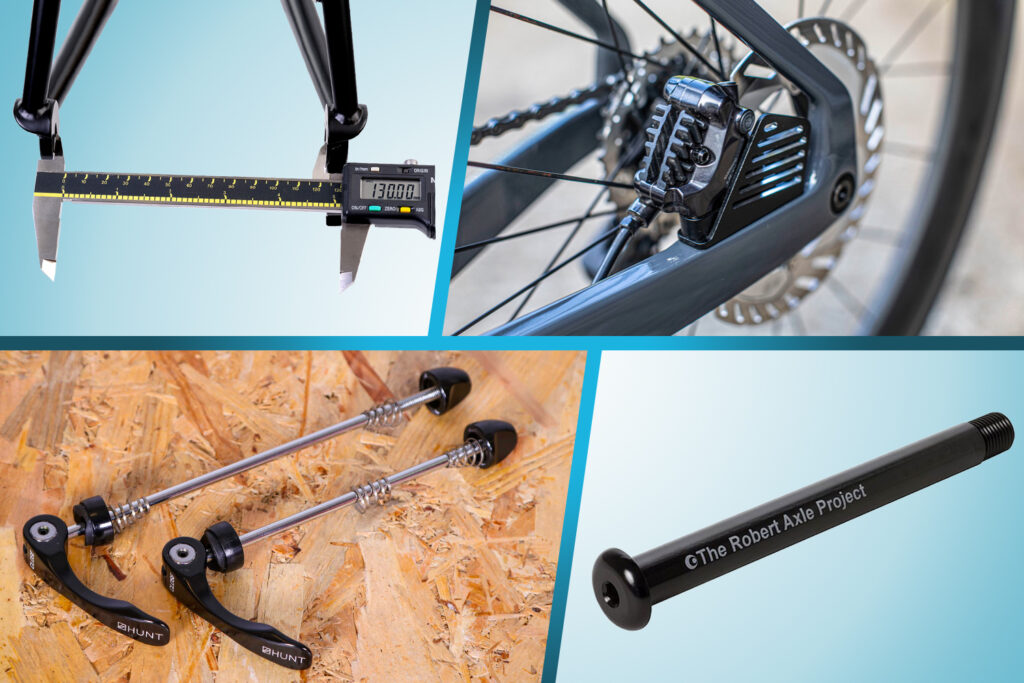

There is a lot of talk about a thru axle (TA) being stiffer than the quick-release (QR) skewer system that preceded it, but the reason for the adoption of thru axles for current era road and gravel bikes has more to do with the accurate and repeatable location for disc brake systems.

The quick-release skewer (above) has been with us for over 90 years now, and we’re all familiar with the design. Invented by Tulio Campagnolo as an improvement over wing nuts, it allows easy removal of a wheel without the need for tools. It features a 5mm diameter rod, which sits inside a hollow axle, and it is tightened by closing the lever. The axle ends protrude beyond the axle nuts and rest in the frames’ open dropouts. The clever part is the cam that is held within the QR lever, which allows the fast tightening of the wheel into the frame.
A thru axle (above) holds the wheel in the frame using closed dropouts. With the hub end caps sitting in recesses in the frame and fork, the system is clamped tight by turning the thru axle. There are two main types: one is tightened using a hex or Torx key, the other uses a lever to turn the thru axle into its thread, and then finally tightening it.
Thru axles were first introduced in the mountain bike world as a way to keep suspension sections more rigid and to resist twisting and bending forces. Open dropouts were struggling to keep up with the forces being put on them, particularly with downhill mountain bikes. You wanted the fork legs just to move up and down, not twist side to side (other than from your steering input). The greater forces found in mountain biking require a larger diameter thru axle to maintain the integrity of a suspension section.
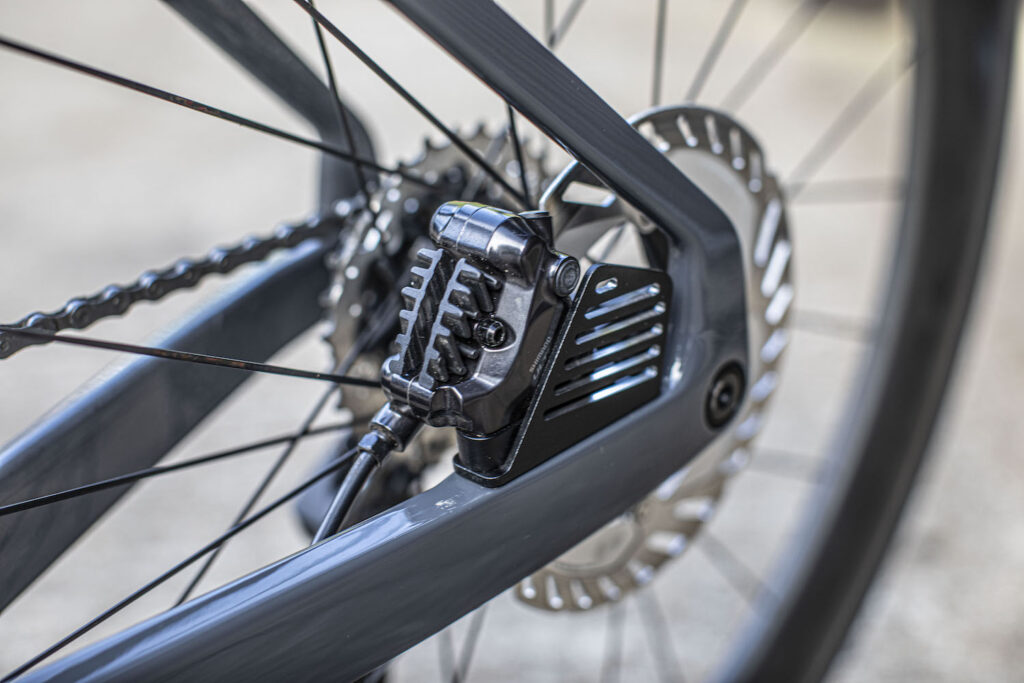
Many issues relating to disc brake alignment and brake rub are also solved by using a thru axle. When you’re not braking, the gap between a bike’s disc rotor and pads is often about 0.2-0.5mm on each side. Compare that with a 1-2mm gap per side on a well-set-up rim brake calliper with a true wheel, and you can see that the tolerances are much tighter for a disc brake.
This is a very small gap for a disc rotor to pass through, and to allow the wheel to spin freely. Rim brakes have more tolerance to wheel misalignment, due to the larger gap between the brake pads and the rim.
With a quick-release axle, the wheel doesn’t always seat in exactly the same place each time. If your bike has disc brakes, just a slight difference in wheel position can be enough to cause the brake pads to rub on the rotor. I’ve certainly had to re-centre the calliper after removing/replacing a wheel to eliminate brake rub once or twice when using a quick-release system.
A big advantage of a thru axle is that the wheel goes back into the same position every time. It’s easier to know that you’ve put it all back together correctly, too.
How do I know if the system will fit my bike?
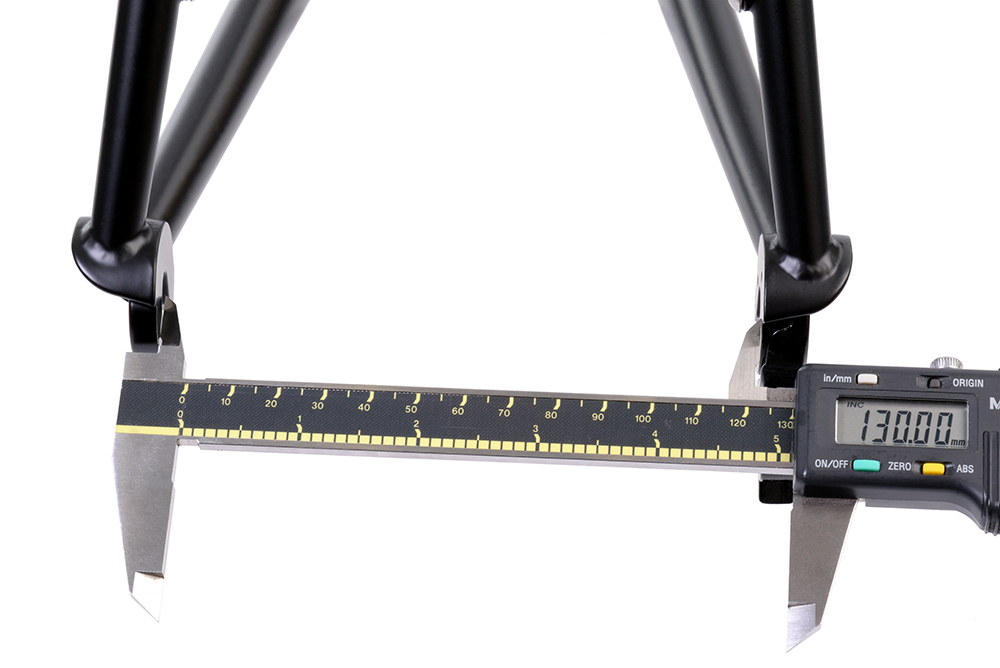
Hubs need to match the frame or fork they are used in. The hub spacing is measured from the outside face of the locknuts, or across the end caps. This is known as the “O.L.D.” (over-locknut dimension). Similarly, the spacing of a frame/fork is measured from the inside surfaces of the dropouts, where they come into contact with the locknuts or end caps of the wheel’s axle. For example, most rim brake road bikes are 9mmx100mm (front) and 10mmx130mm (rear) with a QR axle, and most thru axle disc brake road bikes now are 12x100mm (front) and 12x142mm (rear).
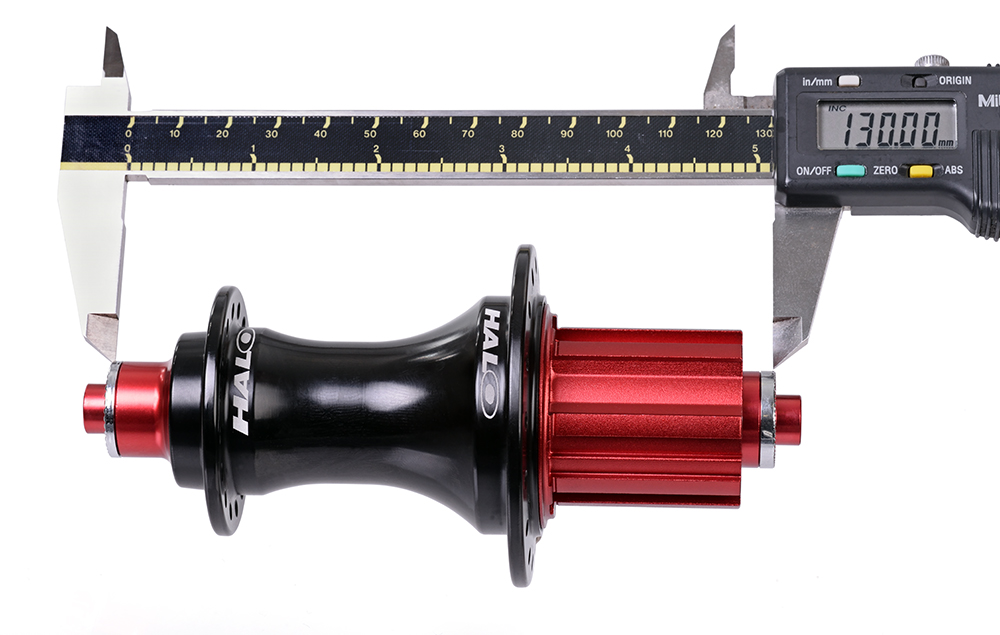
The next thing to know is the axle type that is being used: 9mm or 10mm with a QR, or a 12mm, 15mm or 20mm thru axle. It’s useful to know that sometimes you can use the same wheel with some/all of these standards just by switching the end caps. Hope hubs often have this ability, for example.

A quick-release skewer can broadly be swapped between bikes (length depending) and is often regarded as part of the wheel. The thru axle should be regarded as part of the frame or bike and is not now an easily swappable part between bikes. Although on the face of it, a 12x100mm TA is a 12x100mm TA, this only refers to the fork spacing.
The thru axle itself can have a 1.0, 1.25, 1.5 or 1.75mm thread spacing (or ‘pitch’), there is the length of that thread (maybe 16mm or 18mm, for example), the overall length of the thru axle, and whether it has a flat, tapered or conical shape under the head.
Get any of these variables wrong and you may find that problems occur or, in the worst case, you could damage the frame or fork. The greater the thread spacing (the coarser the thread), the quicker the thru axle can be removed. However, finer threads offer higher tensile strength, a higher clamping force for a given torque, and greater security against loosening caused by vibration.
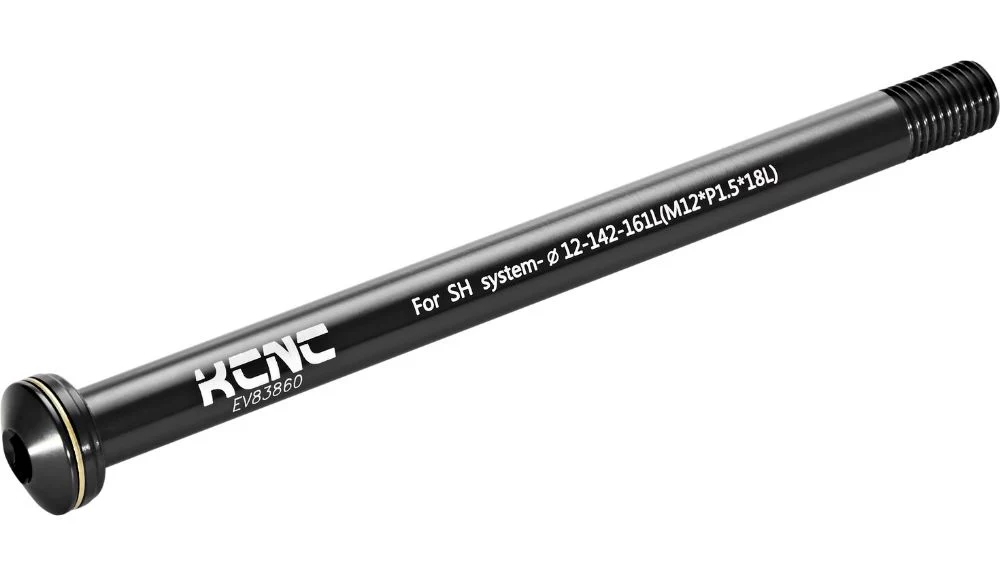
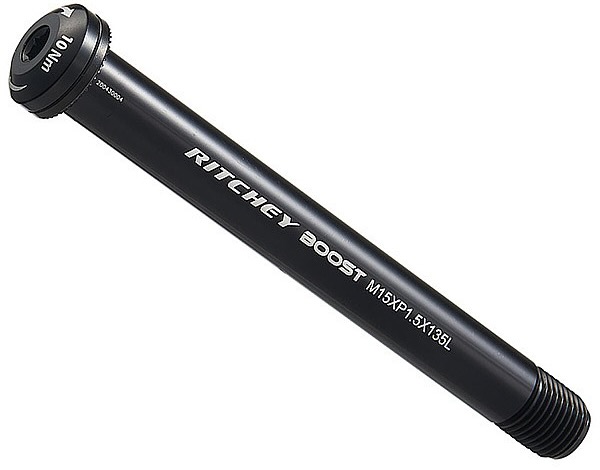
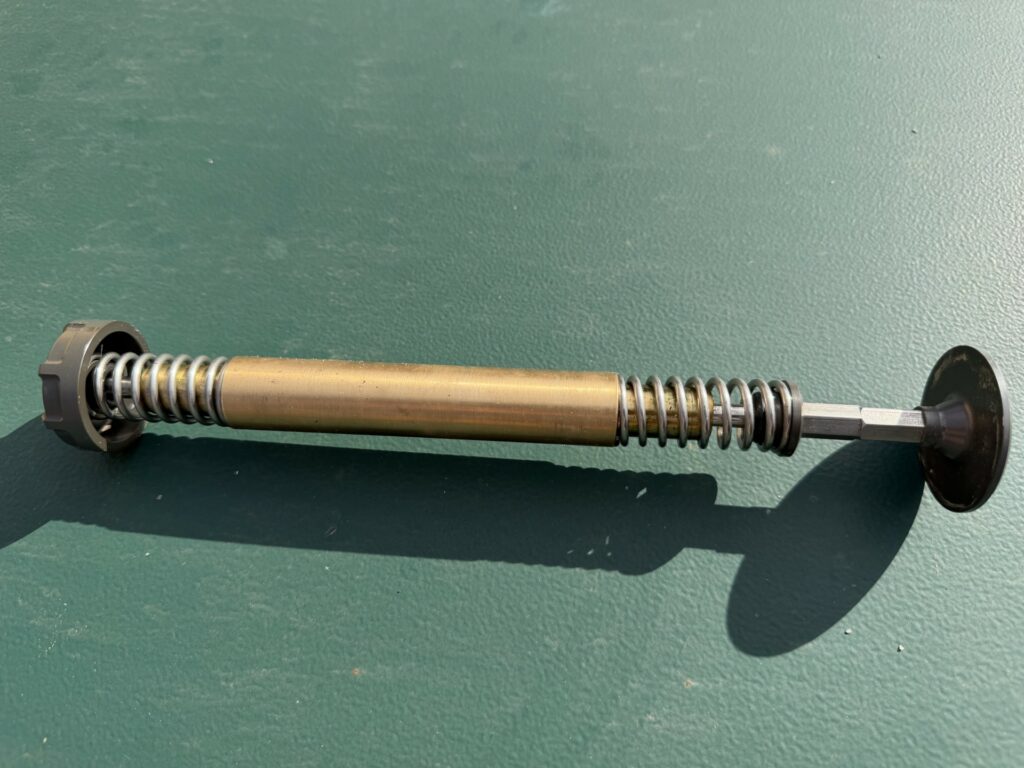
Often, a thru axle has these specification variables etched on it, which is very helpful should you need to change it. Referring to the KCNC axle shown above, we can easily see that the thru axle is an M12 x 142 (12mm nominal diameter, 142mm rear axle spacing), but also that it is 161mm long (measured from the base of the head) and that it has 18mm of threading with a 1.5mm thread spacing.
The most useful thru axles helpfully add the required torque on the outside of the head too, most falling into the 10-15Nm range. Just check first if you’re not sure. As an example, Specialized recommends 15Nm for both thru axles on its Aethos 2 bike. If the thru axle has a lever then you can’t measure the torque and need to use a slightly different technique. Our road.cc guide to fitting thru axle wheels is here.
Another useful resource for identifying which axle is needed for which bike can be found at the Robert Axle Project.
A final thought on thru axles: it is worth putting a light coating of anti-seize grease on the threaded section as well as on the bolt shaft itself when fitting. This should ease wheel removal, and stop corrosion between the bearings and thru axle. You’ll be thankful that you did if you find yourself trying to remove the wheel roadside to fix a puncture.
Certain manufacturers specifically say that you should do this, others don’t mention it. Please check with the frame manufacturer first for their guidance (adding grease can change the torque required to achieve the correct clamping force).
Some useful information:
Common hub widths or O.L.D. (Over-Lock-nut Dimension)
Front wheels:
100mm – Modern front hubs, including quick release and some thru axle types
110mm – Some thru axle front hubs, including 20mm and Boost standards
135mm – Fat Bike
150mm – Fat Bike
Rear wheels:
120mm – Modern track hubs
126mm – Older 5, 6 & 7 speed road bikes
130mm – Non-disc road bikes, generally 8-10 speed compatible
135mm – QR mountain bike, most QR disc road bikes
141mm – QR Boost
142mm – Thru axle rear hubs
148mm – Boost standard thru axle rear hubs
150mm – DH Bikes
157mm – Super Boost standard thru axle rear hubs
170/177/190 and 197mm – Fat bike rear hub sizes
Quick release & thru axle common sizes
Quick-release skewers are 5mm in diameter and are used with either 9mm or 10mm axle diameters. They are different lengths depending on the axle width (front or rear) plus the dropout width.
Thru axles are usually 12mm, 15mm or 20mm in diameter. The length, thread spacing and thread length are determined by the frame requirements. It must be correct for the frame.
Proprietary systems
We’ve focused on the most common types of thru axles in this article, but it’s worth being aware that several other types exist, so just watch out for them. These include:
- R.A.T. (Rapid Axle Technology) thru axles, found on some models of Focus, Merida, Centurion, and Cervelo Bikes.
- Mavic Speed Release systems, found on a variety of bikes.
- Naild thru axles, found on some models of Marin, Polygon, and Argon 18 bikes.
- Surly GnotBoost and MDS Dropout bikes.














26 thoughts on “Thru axles vs quick-release skewers: why modern road bikes made the switch”
Quote:
Its not as simple as that, the disc brake pad will usually be at a radius of about 80mm from the wheel centre wheras the rim brake pad will be at a radius of about 310mm. this means that the difference caused by the wheel being out of alignment will be about 4 times greater at the rim than at the disc so the 0.2-0.5mm would be equivalent to 0.8 to 2.0 mm at the rim. Personally I have not had any problems with brake rub on my QR disk brake bike but I believe the key is to refit the wheel with the bike upright and press down on the saddle or bars when tightening the QR.
The wheel being out of true
The wheel being out of true doesn’t affect the disc at all, since it’s mounted directly on the hub. One of the advantages of disc brakes. The disc itself can go out of true if it gets a knock, but it’s not hard to (very carefully) bend it back into shape.
Agreed about pushing the bike down onto the QR to keep it aligned, makes sure it goes to the end of the dropout. A gentle wiggle of the frame before tightening helps too.
RedJohn wrote:
Sorry if it wasn’t clear but I’m talking about the wheel not being aligned to the frame/forks (not fully bedded in the dropout) rather than being out of true.
Quote:
Nonsense. For an article explaining how axles work it fails to notice that a so called “thru axle” isn’t actually an axle at all, just a threaded rod to hold a wheel hub in the frame. It doesn’t even make contact with the wheel, all it does is squeeze the dropout against the hub and a steel QR skewer does this just as well as a larger diameter hollow aluminium tube will. As for stiffness; a quick release lever will provide a tighter interface than thru axle unless you have about 18″ of allen key to get the same leverage.
Nick T wrote:
An axle or axletree is a central shaft for a rotating wheel or gear. On wheeled vehicles, the axle may be fixed to the wheels, rotating with them, or fixed to the vehicle, with the wheels rotating around the axle.
Sounds pretty much like the latter definition to me.
Agreed. When, in the 70s on a
Agreed. When, in the 70s on a tour of the Massif Centrale, the rod which was threaded at both ends for nuts to fix the rear hub to the dropouts of the Ladies’ Palm Beach tourer (I was riding that and she was on my slightly better bike) decided to break, I definitely thought of it as an axle.
Sounds like it was an
Sounds like it was an axledent waiting to happen.
I anticipate another series
I anticipate another series of posts like the ones debating the true definition of ‘bolt’ and ‘screw’.
I don’t think the topic of
I don’t think the topic of “disc brakes – are they all that, there was nothing wrong with rod brakes” has been debated recently.
Blind hole vs through hole
Blind hole vs through hole init.
Blind hole vs through hole
Blind hole vs through hole init.
Never mind bolts and screws,
Never mind bolts and screws, when are we going to debate the difference between pipes and tubes!!!
That’s where you would be
That’s where you would be mistaken then. A bicycle wheel has an axle, it’s what the bearings are in contact with to allow the hub shell to rotate around it, that’s why a bicycle wheel can spin in your hands without being mounted in the frame. It’s hollow, so that a bolt can pass through it and provide the clamping force to hold the wheel in the dropouts. That bolt can be a 5mm threaded rod or a 15mm threaded tube, but it’s only a bolt, it has no other purpose, it sees no load from the wheel at all.
It’s this sort of confidently wrong misunderstanding that the industry thrives on, people see a bigger “axle” and they’re told it’s stiffer so they happily pay for the “upgrade”, when in reality a wider diameter bolt requires more torque to tighten due to increased friction. Your thru axle wheels are very likely less tightly clamped to the frame than the old qr wheels were unless you’ve adjusted torque accordingly, luckily they’re captive so can’t be pulled out during braking
The things every bike wheel
The things every bike wheel has an axel. It’s not the through axel draw bolt.
The axel is the sleeve of hub that the through axel slides through.
EDIT: what Nick said.
Nick T wrote:
The article doesn’t specifically say a thru axle isn’t an axle, but nor does it say it is. “Thru axle” could equally be understood as an object which simply passes through the axle.
The article repeatedly refers
The article repeatedly refers to a quick release skewer as a “QR axle” which implies that they are both axles, and perpetuates the false understanding that a wider “thru axle” will be inherently stiffer. It’s supposed to be a tech feature, I would expect some degree of technical explanation
Nick T wrote:
Although less repeatedly than it refers to it as a QR skewer.
Inconsistency can lead to
Inconsistency can lead to accuracy at least some of the time
Unlike the stopped clock,
Unlike the stopped clock, this is right more often than it is wrong.
Why, because manufacturers
Why, because manufacturers have sinsisted on change, everyone had quick release, then they decicded, mountain bikes were going to be gravel bikes, so they chucked drop bars on them, so disc brakes came with that, and the through axel, the slowness of removeing, the weigjt, but money for manufacturers, and the lemmings follow
Surely lemmings ride downhill
Surely lemmings ride downhill MTBs?
Tony West wrote:
Wow, how patronising. Calling consumers “lemmings” for adopting new technology.
You know that this isn’t how major manufacturers work, don’t you? They are incredibly risk averse. They don’t “build it, and they will come”, they can’t afford that. They give customers what customers ask for.
Gravel bikes – and mountain bikes before them – evolved from general cyclists using bikes in new or different ways, and then the manufacturers stepped in to fill that demand. So gravel has taken over bits previously occupied by MTBs, and has all but wiped out CX bikes.
And nobody but pros gives a rat’s about the speed of wheel removal, likewise weight is irrelevant. And you conveniently ignore that QR standards shifted from 126mm to 130-135mm. Having previously been 120mm under single speed days, which no doubt you yearn for.
SecretSam wrote:
But we are aren’t we, always clamouring for the latest shiny!
I do care about having a loose component that can be lost or damaged while it is off the bike, the QR stays in place ready to be retightened. QR standards haven’t changed, the OLD standard has changed, driven by an ever increasing number of gears, and QRs have adapted to suit the new standards.
Very disappointing article.
Very disappointing article. It completely ignores the debate about whether thru axles are really needed on road/gravel bikes and whether the extra complications and incompatibility issues that they cause can really justify the (possibly marketing only) benefits. You could at least start with an analysis of clamping forces generated by quick realeases and thru axles. Maybe also take a sample of everyday people’s bikes (or just the people in your office) and see how many of them have their thru axles (or QRs) tightened correctly.
Quick release skewers were
Quick release skewers were invented when racing bikes had horizontal* dropouts like this:
They required a massive clamping force to stop the drive side moving forward under power and causing the tyre to rub against the left chainstay. A regrettable occurence that older cyclists will remember.
As through axles are located in a hole, there’s no possibility of the wheel moving. They don’t need the clamping forces that can be achieved with a QR skewer.
*Fun fact: they’re actually angled, at right angles to the seat stays, so you can lengthen the wheelbase and marginally lower the rear, slackening the steerer angle, by moving the wheel backwards in the dropouts.
matthewn5 wrote:
They need at least as much, to prevent the threads from loosening. The captive bolt will keep you safe, but adequate torque is essential to prevent wear or damage to the wheel and frame, in some hub designs to properly preload the bearings etc. The tiny lever they sell you is far too short to get anywhere near 10nm with