



It sounds obvious that a heavy rider will descend quicker than a light one. After all, gravity is your friend when barrelling downhill… but how much difference does it make? In an attempt to find out, we strapped 8kg to ourselves and set off to do some garage science!
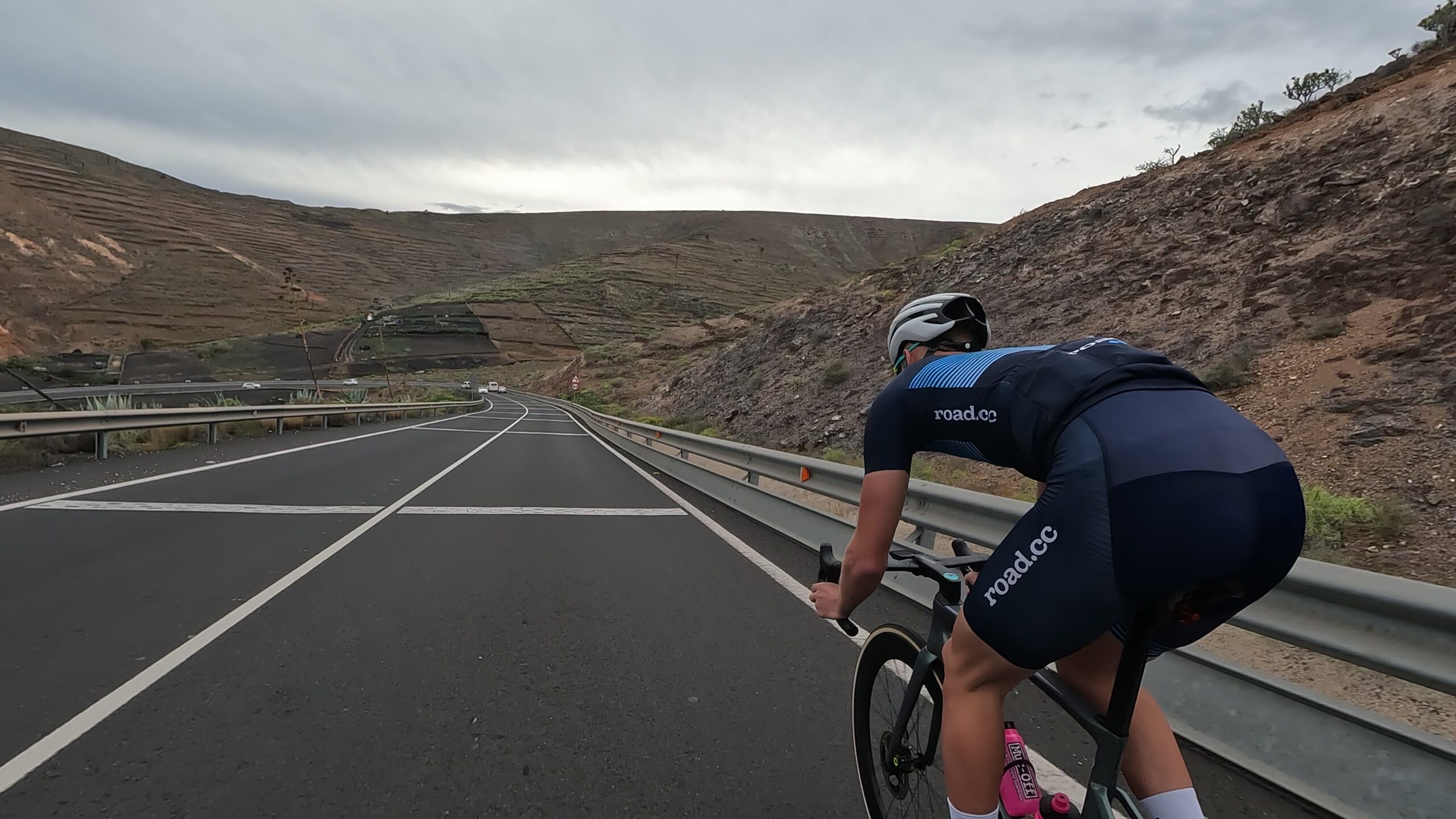
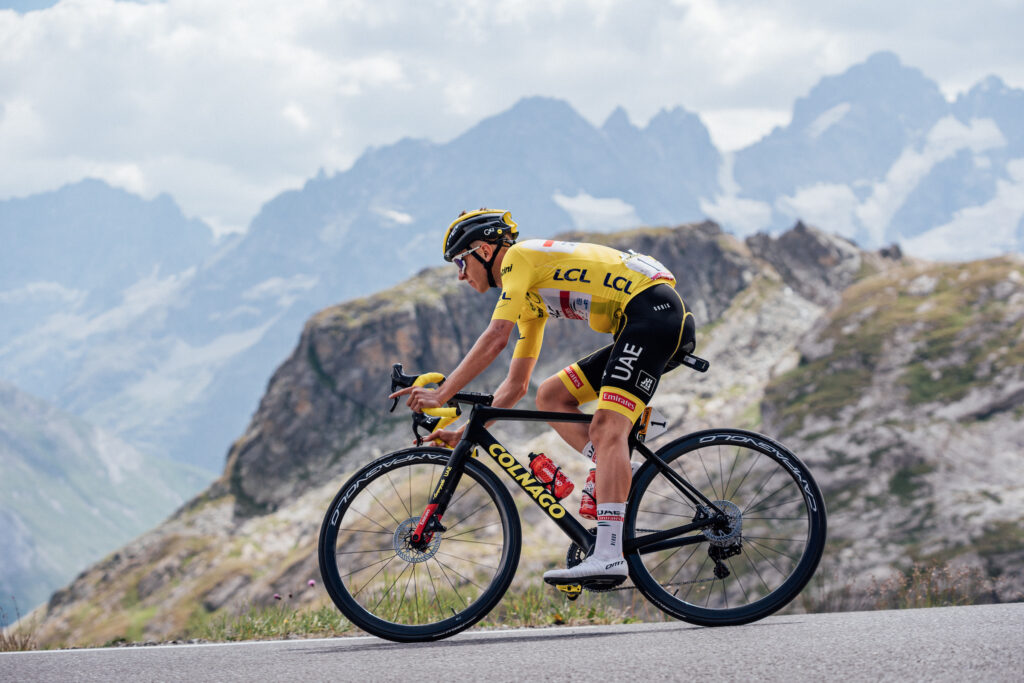
Heavier riders descend quicker right? It’s been ingrained in us since secondary school physics lessons. Well, that’s what we thought, but look at recent descending masterclasses and it’s the light riders often leading the way. Take Tom Pidcock for example, both one of the lightest and fastest descenders in the peloton, and it kind of upsets this theory.
> 14 expert tricks for better descending
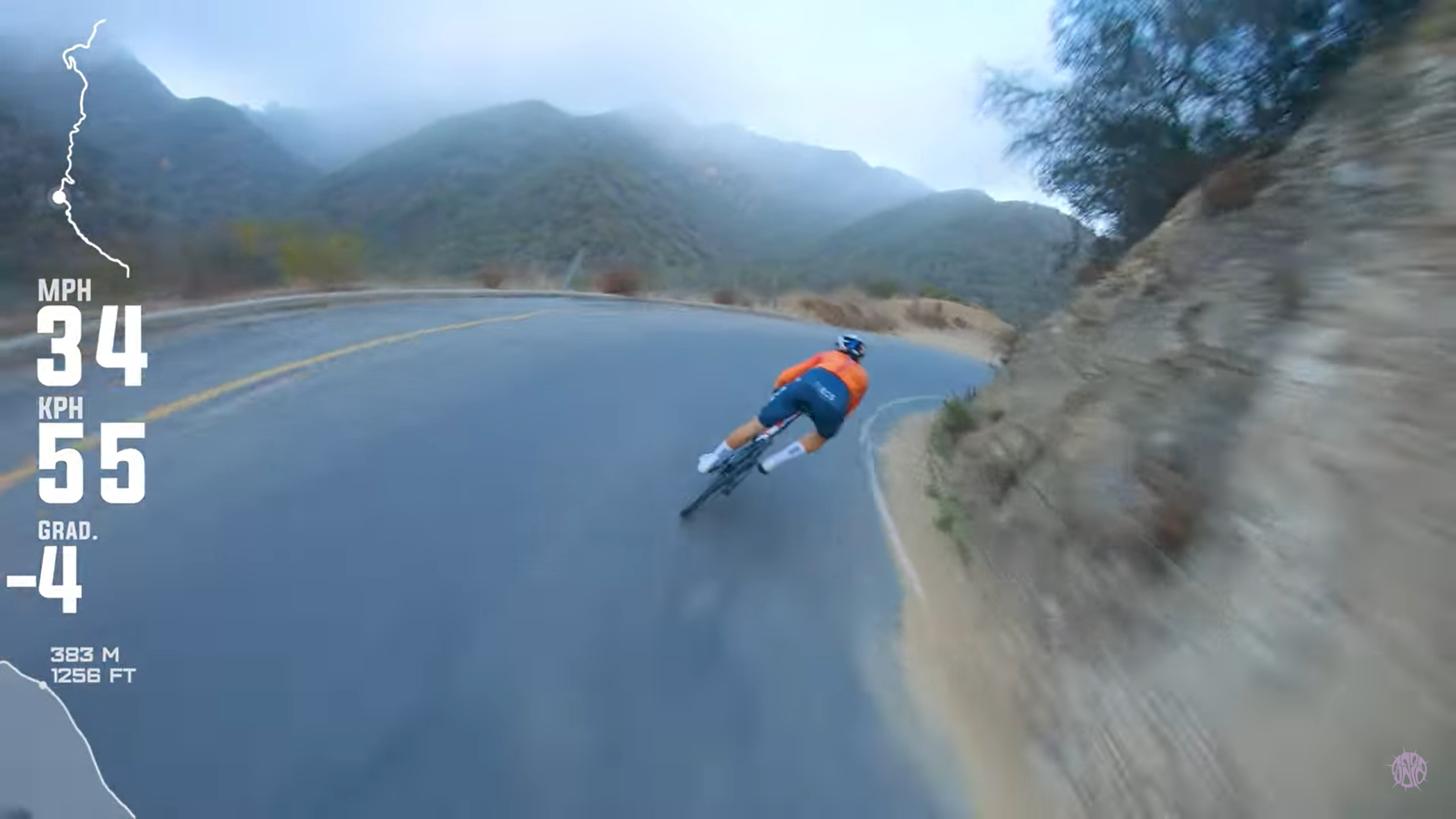
> How Fast!? We take a look at Tom Pidcock’s Alpe d’Huez conquering Strava file
Does this mean that weight has a far smaller impact on descending than we might have previously thought?
The test
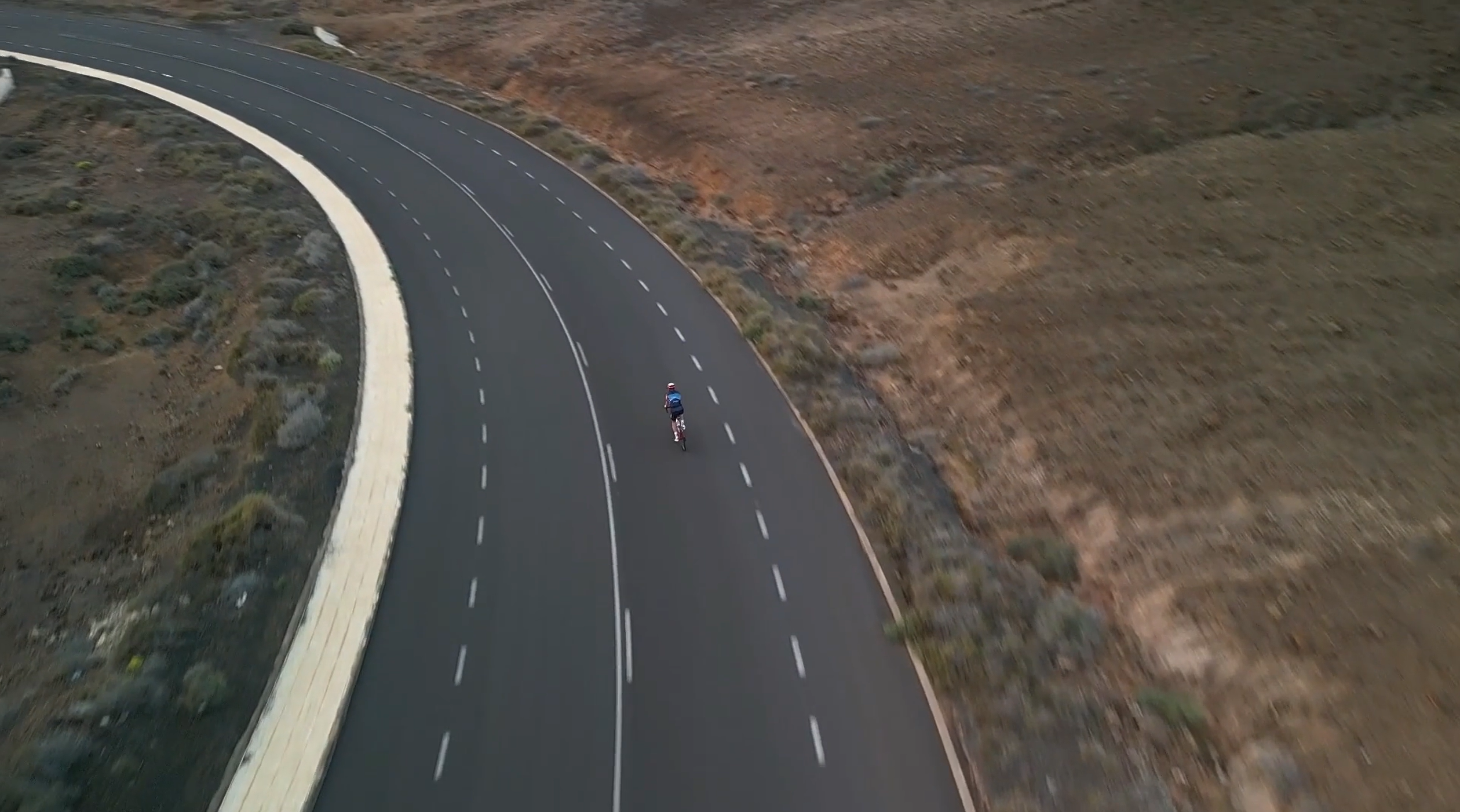
Whilst watching Ed struggle home from the supermarket with 8kg of water, an idea popped into my head. Firstly, I wondered if I could beat him up a hill if he was 8kg heavier, and secondly I wondered if it could make him beat me down one…
To find out once and for all how much difference weight makes when descending, we found a suitable hill and devised a plan for two tests. Test number one would involve timed runs down a steep hill with and without the additional water, and the second included a roll back up the other side of the tip until Ed ground to halt. In the first test the lowest average time would win, and in test two the winner would be the one who travelled the farthest distance.
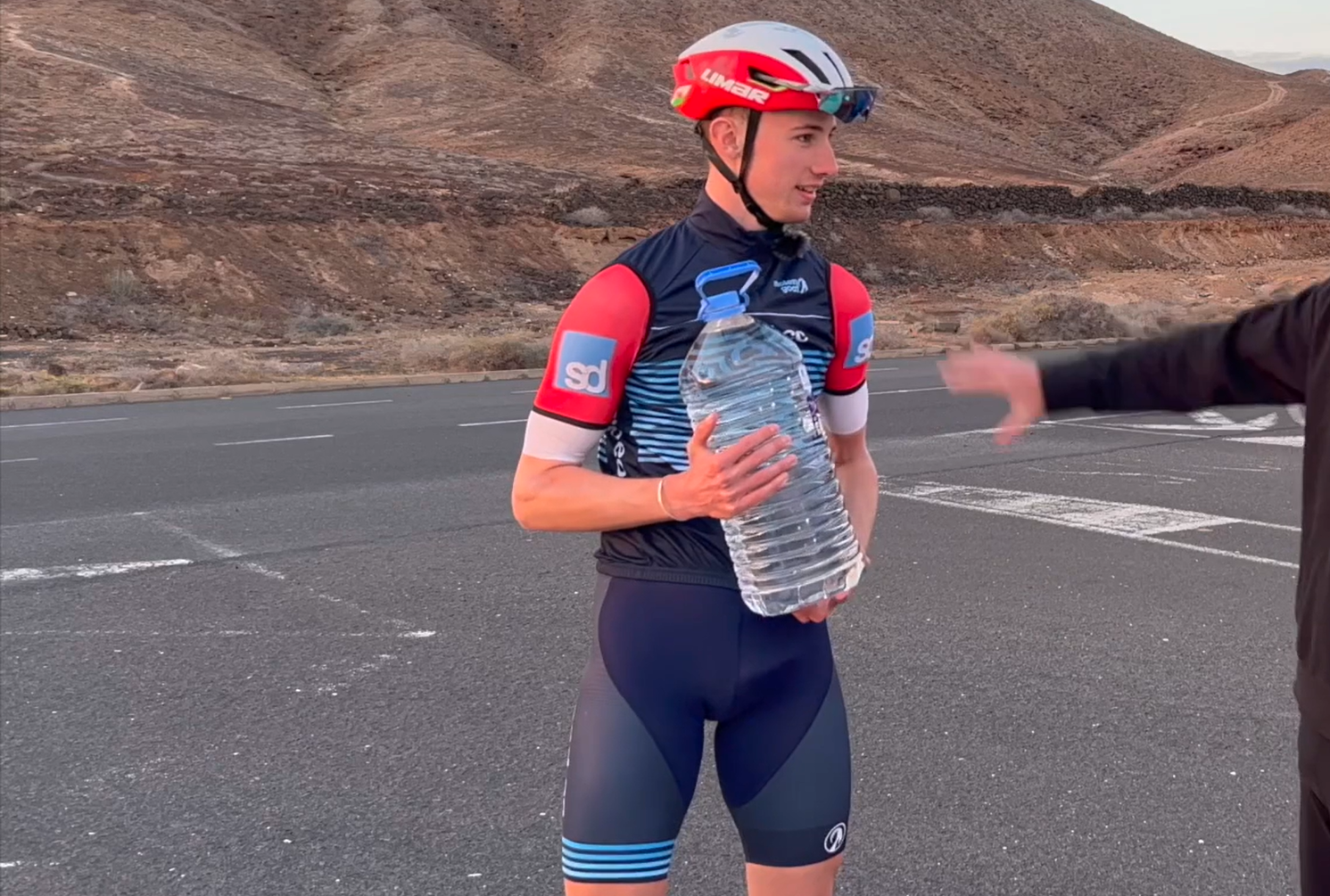
We decided that strapping the weight to Ed’s front would have less of an impact on his aerodynamics than if it was on his back. It also better simulates a larger/heavier rider as this does tend to be where many of us hold that additional weight.
Results, part 1 (the steep descent)
We start off on the timed runs down the steeper of the two descents. According to Strava this had an average gradient of -10% and lasted around 40 seconds.
> Hitting 100kph on a bike — what does it take to break this elusive cycling speed barrier?
To make the results as reliable as possible, Ed wasn’t allowed to pedal at any point during the descents. He got a TT-style start to avoid having to push off the line, and took the same line through the one corner each time. He also tried as hard as possible to maintain the same position throughout the testing, and we did it on the stillest day possible to try and avoid any wind gusts that could throw the results.
For the first test, Ed did a total of eight attempts, each three-quarters of a kilometre long, four with the 8kg of water and four without. Overall he was quicker (drum roll, please)… WITH the additional weight; but not by as much as you might think.
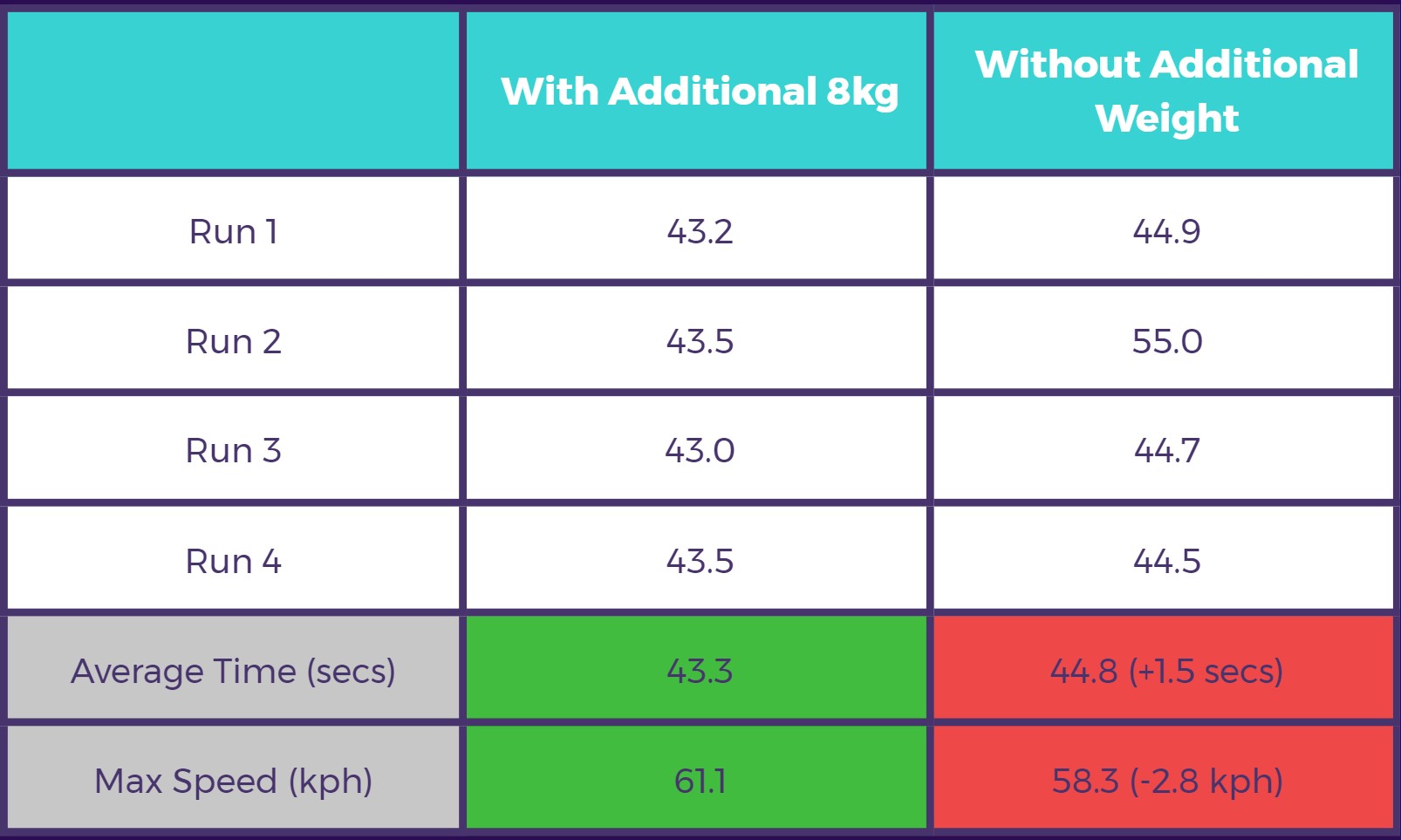
That means that the additional 8kg made Ed on average 1.5 seconds faster on our descent. That might not sound like a lot, but it is over 3% difference.
It is worth noting, however, that the weight would have less of an effect on a shallower descent, or indeed if there were more corners where braking and acceleration were required.
Results, part 2 (rolling to a halt)
> How hard is it to train like a pro cyclist? Spending a week riding like an elite
For the second test, we set Ed off down the same descent, but instead of stopping at the bottom he carried on rolling up the other side of the dip until he ground to a halt. We then measured the distance he reached each time, again four times with the 8kg of additional weight and four without.
To Ed’s surprise, this time he performed better without the water strapped to him, stopping on average two meters further than when bottled up.
Why is this?
There are two main forces acting on a rider and their bike when cycling downhill. As Ed isn’t pedalling, any forward acceleration is due to gravity. As you’ll remember from back in school F=ma where:
Force = mass x acceleration
Therefore, when we make Ed heavier the m in the equation gets bigger, so the force pushing him forwards gets bigger too.
However, the second major force to consider is air resistance, which opposes a rider’s motion. The faster you go or the less aerodynamic you are the bigger this force gets.
As we strapped the water to Ed’s front and given the results, it’s unlikely that we changed Ed’s drag coefficient significantly. This is why on the timed descent, Ed was quicker when carrying the additional weight.
However, when we then threw in the ascent on the other side it’s clear that the weight has more of a negative impact going up the hill than going down it, otherwise he would have travelled further.
Because air resistance has a non-linear relationship with speed, the additional weight has a far bigger impact when travelling at lower speeds, i.e uphill. Unfortunately, for many of us, this is the area we want to improve and is also where many races (both professional and on the club run) get decided.

> Power-to-weight ratio: what is W/kg, and why does it matter?
It’s for this reason that nearly all the successful general classification riders look in such depth at improving their power-to-weight ratios, and are seriously lean for target events.
Conclusion
So, does a heavier rider descend quicker? Well, yes, in a straight line at least. However, as we previously discussed your weight pales into insignificance when compared to aerodynamic drag. Therefore, if you want to get faster at descending, our advice is not to hit the all-you-can-eat buffet but rather work on your position and ditch the flappy clothing.
It’s also worth noting that any advantage on the descents that you do get from being heavier will have far more of a negative impact when the road heads upwards! If you want a better idea of how much weight can slow you down, when climbing then you can check out our analysis of Tadej Pogacar’s fateful climb from last year’s Tour De France below.
> Did disc brakes get Pogacar dropped? How much difference does that extra 300g make?
Let us know what garage science you’d like us to do next time in the comments section below!












88 thoughts on “Does a heavier cyclist descend hills quicker? We strapped weights to ourselves to find out”
8kg isn’t that much of a
8kg isn’t that much of a weight penalty. I remember a time when I overtook a chap probably twice my weight on a hill. On the downhill on the other side he went past me (not pedalling) and I could not catch him regardless of how hard I pedalled. Double the weight and the difference becomes much more pronounced!
“Heavier riders descend
“Heavier riders descend quicker right? It’s been ingrained in us since secondary school physics lessons. ” – Um… no? As a one time physics teacher I seem to remember teaching ‘All objects fall at the same rate in a vacuum, regardless of mass’ -Galileo demonstrated it (without the vacuum) -apocryphally from the Leaning Tower of Pisa. Neil Armstrong did it on the moon, with the vacuum.
This. The question I want
This. The question I want answered is, given knowledge of physics dating back 400 years, why does a heavier person descend faster?
As above. Tl;dr
The riders’ stop getting quicker only when their air resistance exactly opposes their gravity. The heavier rider has more gravity, so they need to be going faster for their air resistance to be equal (and opposite) to their gravity. Only then does their speed level off.
Basemetal wrote:
You would have thought that would have added extra unnecessary weight but I guess he was a neat freak.
It’s necessary – otherwise
It’s necessary – otherwise when you try to dust off the cheese-mites what with the low gravity it’d quickly be like a sandstorm.
NOtotheEU wrote:
smallest vacuum I’ve ever seen
NOtotheEU wrote:
And, I hope you noticed, he wore a helmet.
Basemetal wrote:
I’ve never ridden a bike on the moon. so air resistance is a real factor.
Absolutely -my comment was
Absolutely -my comment was addressing the ‘ingrained since seconfdary school physics’ point. On the terminal velocity question there are (post high school) formulae that are hard to write here along the lines of V =Sqr rt((2m.g.sin theta -mu.k/(rho.A.Cda)) where terms have ther usual meannings (and combining mechanical friction and rolling resistance into mu.k.) One of the fun things is terminal V would be airspeed not ground speed. The (much lower) frictional forces (mu.k) would of course be groundspeed not airspeed related. Upshot is that if all else is equal, terminal velocity is proportional to the square root of mass.
Basemetal wrote:
True … except that it was David Scott on the Apollo 15 mission
Cheers. I’m sure there’s a
oops!
As it’s not April 1st, I’ll
As it’s not April 1st, I’ll bite.
On average you’d expect smaller, lighter riders to descend faster.
F=ma, so acceleration = force divided by mass.
Gravitational force is proportional to mass (double the mass, double the gravitational pull) so acceleration under gravity is a constant for any mass: approx 9.8 meters per second squared near the earth’s surface.
In a vacuum, a feather will fall at the same rate as a 10kg cannon ball, in air the feather, with it’s large surface area incurs a lot of drag, and falls much slower than the cannon ball.
A smaller, lighter rider will, on average, have a smaller frontal area, incurring less drag, and so will accelerate faster (potentially reaching a higher terminal velocity), even though the gravitational force is the same as for larger riders.
I would guess that the strapped-on water container, did affect the drag coefficient of the test rider – it may have been a fairer test if the experimenters had strapped on an empty water container for the control.
No Sweat wrote:
The important point is the aerodynamics of the two. A rider that’s twice as heavy will have twice the force accelerating them, but is unlikely to present twice the aero drag and so will be pushing through the air quicker.
It’s the same principle as terminal velocity and if you compare a 10kg cannon ball with a slightly smaller football, the 10kg cannon ball will have a faster terminal velocity.
I’m was told it’s surface
I was told it’s surface area relative to mass, assuming the same shape, will determine terminal velocity. I think heavier things will fall faster as a lot the inside is kind of protected (I guess slip streaming) from the air resistance.. So a 1kg cannon ball will fall (I assume roll too) faster in an atmosphere, than 1000 1g balls made from the same cannonball.
Indeed, acceleration = force
TL;dr Speed increases until wind resistance equals the force due to gravity, which is greater for the heavier rider.
Acceleration = force/mass.
Force (i.e. weight) is in proportion to mass so both riders experience the same acceleration due to gravity.
So ignoring air (and other) resistances, all riders experience the same acceleration and their speeds remain in lockstep.
But resistances can’t be ignored. A rider will stop accelerating when there is net-zero force, the speed where resistances (a function of speed) equal the force due to gravity, at which point they hold their current speed.
The heavier rider enjoys a greater force due to gravity (i.e. they weigh more), so they must be going faster before resistances balance it out.
That assumes both riders present similar aerodynamic characteristics.
My observation, riding with a heavier person, is that they easily descend faster than me – no contest. They also ascend much faster, but I put that down to them riding an e-bike!
The gravitational force is
The gravitational force is higher for an object with more mass, they also have proportionally greater inertia due to that mass, consequently in a gravitational field in the absence of resisting force they accelerate at the same rate.
Surely weight plays a big
Surely weight plays a big part.
If you really want to descend fast on anything other than closed roads the size of your bollocks and therefore their weight plays a huge part.
I don’t like to brag, but I’m a bit of a demon at the descending malarkey.
I’m surprised anyone’s
I’m surprised anyone’s surprised (that you descend faster if heavier).
My weight has fluctuated between 60kg and 68kg and, riding the same bike up and down the same hill, the extra weight makes me much faster down (let’s not talk about the up).
Now, I just need to find someone to open a pie-shop at the top …
Great article, thank you!
Great article, thank you! This came up in a comment section here recently, and I’ve been thinking about it since.. I know it’s unrealistic, but I want more data! Different size riders, and I’d like to see more variation in the course too to start! I’m also curious how much cornering is effected by weight, I’m assuming lighter would be more nimble, but I think we need a new article please!
So 8kg represents about a 10%
So 8kg represents about a 10% increase in the total of rider, clothes and bike. This gives a 3% increase in speed. Which doesn’t sound out of kilter with diminishing returns in these things.
I read somewhere a long time ago to increase the speed of a ship by 1 knot requires a doubling of horsepower.
It’s not the heavier nor the
It’s not the heavier nor the more aerodynamic rider who descends faster, it’s the braver one with more confidence (or blind faith) in their brakes and what’s around the corner, both in terms of road surface and other road users.
Well Jamie Williams obviously
Well Jamie Williams obviously failed physics in school. Everything dropped accelerates at the same rate which is the acceleration due to gravity. Heavier objects with the same shape as lighter objects will have a higher terminal velocity.
You could also negate the aerodynamic effect of the water bottle by running tests with it full and empty and that 55s is an obvious outlier which should be ignored.
festina wrote:
I think Jamie has a better grasp of the subject than you. Objects do not accelerate at the same rate. That’s true in a vacuum, but in real life there are many types of drag that affect how quickly an object accelerates.
The writer does seem to have
The writer does seem to have reached approximately the right conclusions, but appears to be a little muddled by the underlying physics. Down hill with greater mass but approximately the same air resistance, velocity of the heavier rider will likely be higher, but if you consider the additional gravitational potential energy they possessed at the top of the hill, at the bottom, because of the drag forces being higher at higher velocities and related to the square of the velocity, the proportion of their lost gravitational potential energy converted to kinetic energy by the rider with greater mass will be lower. They go faster, but not fast enough to overcome the burden of the additional mass they are carrying on a subsequent climb. Of course there are also all the complications of control at higher speeds that come with greater mass.
Festina is right, Jamie is
Festina is right, Jamie is wrong. I’m a theoretical physicist. The acceleration is the same and has no dependency on weight as the inertial force of the mass has to be overcome to more the object. These two masses cancel out. So all objects accelerate as the same rate. Yes the rest is due to aerodynamics. That is the effect that makes the times different. Rolling resistance is dependent on mass but that’s the only way mass has an effect on this system. Terminal velocity is reached when the air resistance matches the acceleration due to gravity. Hence it’s all about the shape not the weight.
Rolling down a straight hill,
Rolling down a straight hill, the physics seem reasonably clear cut (some commentors seem a bit confused, but Sriracha’s got the right idea).
But obviously Tom Pidcock et al. aren’t rolling down straight hills. There are corners, there is braking and there is acceleration (actually those are all forms of accerleration). I would be interested to know how weight affects those things. On the one hand a lighter rider should require less force to slow down/corner/speed up, but on the other hand if the limiting factor is tyre grip, a heavier rider may create more friction and therefore be able to apply a greater force.
My old club used to have a
My old club used to have a downhill championship every year: same hill, drivetrain disconnected. It was an easy descent followed by a gentle incline. No one under 90kg ever won it.
No one under 90kg ever won it
No one under 90kg ever won it
I think this experiment is quite strong evidence in the debate. I always overtake my lightweight daughter just rolling downhill, and she’s on a pretty good Whyte which is classier than my worn gravel bike in every respect but is still on 700c. I must have an absolute wind resistance higher than hers, my absolute force of gravity (weight) is considerably greater, but so is my mass. This must all be quite complicated
wtjs wrote:
No, it’s quite simple. You’ll keep getting quicker until the forces cancel each other out (wind resistance versus gravity). That is true regardless of mass. But of course gravity pulls stronger on the more massive object (witness the scales of truth), so wind resistance (hence speed) must be greater before they reach equilibrium.
Yes, but greater in direct proportion. Since acceleration is given by the one divided by the other, and they are in direct proportion, the gravitational acceleration remains the same regardless of mass. Were it not for wind resistance the two of you would match each other’s speed exactly.
Well done, yes this is
Well done, yes this is correct! Inertias mass dependance cancels out gravity’s mass dependance.
What was the starting speed
What was the starting speed for each run as this will have an effect on measured time differences?
If starting from a standing start, then the differences will be smaller, as at lower speeds air resistance would play a smaller part and acceleration would be similar. The differences would only start to mount up once air speed is significant, so for a good chunk of each run, there would be no differences.
I’d be interested to see the results if each run started at say 40kph.
Anecdotely, I’m a fat sprinter and I descend quicker than most. I always tell people I’ve learnt to descend fast as I need to catch back up after being dropped on the hills, however the reality is its just gravity working in my favour.
New just in physics gonna
New just in physics gonna physic.
Anybody who has ever tried to
Anybody who has ever tried to keep up with a tandem on a descent wouldn’t need to do this experiment, but it sounds like you had fun, so well done.
Of course, the problem is that a tandem also has the capability to ascend well assuming you have 2 reasonable riders.
Looking forward to next week
Looking forward to next week’s hard hitting expose on whether ursine faeces can be found in sylvan enviroments
(assume there is a typo and that the slowest run was 45seconds not 55seconds)
This is a worryingly
This is a worryingly incorrect article with extremely bad science. When an object is accelerated by gravity, in order to move the object it must over come the objects inertia. The inertial mass of an object is the same as its gravitational mass hence to two masses cancel out in any of these equations. This was famously discovered by Galileo, running similar experiments as you did here. The difference being that he accounted for all aerodynamic veritables. Putting a ferring over your chest ans stomach is known to have aerodynamic advantages and is banned by the UCI. The only thing you did in your experiment is study aerodynamics. And all those people how go down hill faster than you skinny friends. It’s not your weight that helps you! It’s having more inertia from your rolling start so rolling resistance hass less effect than you might expect and the fact you have an aero gut!! Skinny people are less aero. Simple as. If you don’t believe me watch the vid of astronauts dropped hammers and feathers on the moon. The difference on earth is the air resistance and that only depends on dimensions and shape!!! Also i have a phd in theoretical physics and still work in the field (just here to show I’m not a quack). Edited due to an insightful comment.
A couple of people have pointed out that they are not aware of inertia. If you have heard of it watch this veritasium vid and if you want to go deep look up the equivalence principal.
woodstock555 wrote:
You should turn in your phd if you go around saying things like “skinny people are less aero”.
hawkinspeter wrote:
You should turn in your phd if you go around saying things like “skinny people are less aero”.— woodstock555
I’ve worked with a few people with a PhD in theoretical physics. It seems to require a good knowledge of higher mathematics but no knowledge of the real world. They were all complete useless pillocks.
ShutTheFrontDawes wrote:
What I find suspicious is when people feel the need to advertise their qualifications rather than letting their expertise speak for itself.
I hoped it would help you
I hoped it would help you believe what i said. I also gave all the reasoning. I agree that should have spoken for it’s self. Unfortunately not it seams…
woodstock555 wrote:
Well, it shouldn’t be about belief really.
The issue I have with your analysis is that you claim that their mass has no effect and that it’s purely the aerodynamic differences that make heavier cyclists go quicker down hills. Their mass has a direct effect as their terminal speed is when the aerodynamic force is balanced out by their weight acting on the downhill gradient. That means that if you have two identically shaped riders (i.e. same aerodynamics), then the more massive rider will generate more weight force and thus have a higher terminal speed.
Specifically, your statement “It’s not your weight that helps you!” is incorrect – a simple high-school understanding of physics/mechanics is enough to understand why that is wrong.
Yes if those where the only
Yes if those where the only two forces then you would be right. But you and the author have forgotten about inertia. When you push a heavy car on a flat road its very hard untill it’s up to speed. Then its easier to keep it moving and hard to stop it. Trains are a better example as they have such low rolling resistance. That’s inertia. “An object at rest remains at rest, and an object in motion remains in motion at constant speed and in a straight line unless acted on by an unbalanced force”. It’s inertia that keeps thing moving and makes it hard to accelerate them. So when you right the equation of forces for a bike on a slope, with a standing start the mass cancels out of everything apart from rolling resistance.
woodstock555 wrote:
If you think that a heavier object is easier to push to maintain a given velocity, even on the flat, compared to a lighter object, there is a word for you: idiot.
ShutTheFrontDawes wrote:
To be fair, it should make no difference on a flat surface if the friction is the same and no acceleration is involved. However, there’s usually more friction involved with heavier objects.
Even in that idealised,
Even in that idealised, totally theoretical example it’s still not ‘easier’.
ShutTheFrontDawes wrote:
It’s easier to keep it moving than it was to accelerate it. It is much easier to accelerate a light object. This is inertia.
hawkinspeter wrote:
To be fair, it should make no difference on a flat surface if the friction is the same and no acceleration is involved. However, there’s usually more friction involved with heavier objects.— ShutTheFrontDawes
Yes!!! Absolutely this is how mass gets it equations related to the experiment in the vid! So a heaver object is harder to accelerate than a lighter one this applies when you roll down a hill.
I didn’t say it was easier to
I didn’t say it was easier to put a heavy object on the flat! It has rolling resistance or friction and both of those are dependent on mass. It’s harder to accelerate an object if its heavier. So gravity finds it jarder to accelerate an object if its heavier, hence mass cancels out in that part of the equation of motion!
woodstock555 wrote:
No. The acceleration due to gravity is the same regardless of mass. 9.81ms^-2. Gravity does not “find it harder”. Gravity is gravity.
An object with higher mass has higher potential energy (PE = m g h). When an object rolls down an inclined plane, the potential energy is converted to kinetic energy (KE = 1/2 M V^2). An object with more mass has higher potential energy for the same height and higher kinetic energy for the same speed. In this case, the masses appear to cancel out. But when accounting for resistance (which is not proportional to mass) which converts some of the kinetic energy to heat (i.e. wasted) the heavier rider would have a lower proportion of its energy wasted and therefore have a higher velocity.
ShutTheFrontDawes wrote:
I completely agree with this apart for you calculation of the forces of resistance air resistance has mo mass dependance. Rolling resistance does but should go up with mass… So if people roll down hill faster than others it must be due to aerodynamics??
woodstock555 wrote:
I completely agree with this apart for you calculation of the forces of resistance air resistance has mo mass dependance. Rolling resistance does but should go up with mass… So if people roll down hill faster than others it must be due to aerodynamics??— woodstock555
Where did I say resistance is not dependant on mass? I said it’s not proportional to mass. As someone with a PhD in theoretical physics, I’m sure you know what that means. More likely you have a theoretical PhD in physics (i.e. it doesn’t exist).
You think they may actually
You think they may actually be … an accountant for instance?
chrisonatrike wrote:
I do assume that accountants need to be at least reasonably intelligent, but then when I remember that our former Prime Minister Alexander Boris de Pfeffel Johnson did not know that 0.04 and 4% were the same, it did make me question my philosophies somewhat.
ShutTheFrontDawes wrote:
As long as you can get your chums to rustle up a few hundred thou – or indeed a million, same difference – you probably don’t need to be able to count e.g. how many children you’ve had.
I also realise my philosophies are holding me back. However my “interpersonal capabilities” / chutzpah can’t compete at anywhere near the Boris level. So I guess I’ll just have to keep counting the pennies and being grateful that I can.
woodstock555 wrote:
Inertia does exist, but is irrelevant in this situation.
Think about the forces in a simple inclined plane diagram (high-school physics) and tell me where you draw the line for the inertia and explain why you think mass is irrelevant to the magnitude of the force down the plane (mg sin θ).
Consider that at terminal velocity, the force from the air resistance will be equal to the accelerating force (mg sin θ) and thus increasing the mass or the angle will increase the maximum speed attained.
hawkinspeter wrote:
Inertia does exist, but is irrelevant in this situation.
Think about the forces in a simple inclined plane diagram (high-school physics) and tell me where you draw the line for the inertia and explain why you think mass is irrelevant to the magnitude of the force down the plane (mg sin θ).
Consider that at terminal velocity, the force from the air resistance will be equal to the accelerating force (mg sin θ) and thus increasing the mass or the angle will increase the maximum speed attained.— woodstock555
That’s a static balance of forces. We where talking about things accelerating under gravity. Weight is the name of the force gravity exerts on the object it is directly proportional to the mass and the acceleration due to gravity. So no things have weight. When an object rolling down a hill it accelerates due to its weight. And must overcome it’s inertia, rolling resistance and air resistance. Inertia is also a f=ma equation. If you want to Wikipedia it search for the “equivalence principal”. I’ll find a YouTube vid explaining it for you and edit this.
Vid https://youtu.be/2EkHB_WtKRQ
woodstock555 wrote:
You’re not making much sense. The acceleration is due to the applied forces (due to gravity and air resistance) – do you believe that the forces are somehow different? You seem to be trying to treat inertia as a force when it’s clearly not.
Please provide a simple diagram that backs up what you’re trying to say.
Maybe this person has a
Maybe this person has a different learning style and that’s why communication is not flowing here? If they’re more of a kinesthetic type or just a practical empiricist why not propose the following:
1) Ride up your favourite hill with a massive takeaway / picnic / several litres of beverages and deposit these at the top.
2) Time yourself riding down the hill. Or better, get someone else to time you. Don’t pedal or use the brakes and try to stay in the same position throughout.
3) Ride back up the hill. Or take the chairlift / sticky bottle – it’s only important you’re back at the top again somehow.
4) Consume takeway / beverages. I would not advise alcoholic or – for practical reasons – fizzy. It’s just the mass we’re interested in after all.
5) Ride down hill again and note time. Try to keep the same position / line as previously.
6) Note differences between times.
7) Note that unless you are an experienced competitive eater / swallowed lead this has probably not made any more difference than taking a slightly different line down the hill or adjusting your riding position. However you’ve now had a couple of fun rides down your hill and a good feed / drink, so you probably don’t care so much about the details any more.
hawkinspeter wrote:
You’re not making much sense. The acceleration is due to the applied forces (due to gravity and air resistance) – do you believe that the forces are somehow different? You seem to be trying to treat inertia as a force when it’s clearly not.
Please provide a simple diagram that backs up what you’re trying to say.— woodstock555
Ok this is more in-depth than i would like but here you go.https://youtu.be/2EkHB_WtKRQ
Should have gone straight to veritasium this one is much easier to understand https://youtu.be/_mCC-68LyZM
woodstock555 wrote:
Just seen the first one and I take issue with his statement that inertia resists motion whereas it doesn’t – it resists acceleration. That’s demonstrated by using Newtonian mechanics – an object in motion stays in motion unless acted upon by a force. Inertia does not apply a force and decelerate objects in motion (though air resistance will do that).
I’ll have a watch of Veritasium as I like those videos, but I doubt that anything will back up what you are saying.
hawkinspeter wrote:
Just seen the first one and I take issue with his statement that inertia resists motion whereas it doesn’t – it resists acceleration. That’s demonstrated by using Newtonian mechanics – an object in motion stays in motion unless acted upon by a force. Inertia does not apply a force and decelerate objects in motion (though air resistance will do that).
I’ll have a watch of Veritasium as I like those videos, but I doubt that anything will back up what you are saying.— woodstock555
Thank you yes he should have said change in motion. If you find the veritasium vid contradicts me then i have done a bad jod of explaining this. Though its a short vid with little explanation. The main point he has it the one I’m trying to get across.
woodstock555 wrote:
Okay, I’ve watched the Veritasium vid and it doesn’t address the aerodynamics issue at all – it’s just talking about inertia which is not relevant to this.
I find this discussion with you is getting tedious now.
Thanks for your lovely
Thanks for your lovely comment. You must be a very pleasant person. I work in an applied role and often have to deal with mathematicians and engineers who get the basics of physics wrong and cause them selves massive headaches. They to have a low option of physicists till i help them out.
woodstock555 wrote:
My advice: stick to string theory. Your knowledge of aerodynamics and mechanics is tenuous. And that’s being generous.
ShutTheFrontDawes wrote:
I’m sorry i upset you so much.
woodstock555 wrote:
I’m sorry i upset you so much.— woodstock555
You could try reading Basic Engineering Mechanics Explained (Gregory Pastoll). Let me know if you need any help with the longer words.
ShutTheFrontDawes wrote:
I’m sorry i upset you so much.— ShutTheFrontDawes
You could try reading Basic Engineering Mechanics Explained (Gregory Pastoll). Let me know if you need any help with the longer words.— woodstock555
Watch this please https://youtu.be/_mCC-68LyZM veritasium is very good at explaining things.
ShutTheFrontDawes wrote:
Any credibility as an aerodynamicist disappeared with talk of a “ferring”!
Griff500 wrote:
Any credibility as an aerodynamicist disappeared with talk of a “ferring”!
— woodstock555
A child knows this.
ShutTheFrontDawes wrote:
A child knows this.— woodstock555
Thanks… Did you watch the vid???
Griff500 wrote:
Any credibility as an aerodynamicist disappeared with talk of a “ferring”!
— woodstock555
Dyslexic. Spelling not my strong point, sorry if that makes me less credible to you.
ShutTheFrontDawes wrote:
This might help you https://youtu.be/_mCC-68LyZM
woodstock555 wrote:
This might help you https://youtu.be/_mCC-68LyZM— woodstock555
Yes that video debunks most of what you’ve said.
ShutTheFrontDawes][quote
And you would be viewed as a useless pillock in places in places where they excelled.
BTW a huge amount about knowing how the ‘real world’ works can be explained by physics.
imajez wrote:
Quite – physics is very much an investigation into how the ‘real world’ works
Is a ton of climbers lighter
Is a ton of climbers lighter than a ton of sprinters, though? (Presumably “yes, when the climbers have got ahead and are higher up the mountain”)
chrisonabike wrote:
What about when the climbers are descending and the sprinters are still climbing though?
hawkinspeter wrote:
Good point, I was using way too simple a model. – We should also factor in rates of perspiration and evaporation, differential tyre and brake mass loss, oh, and can anyone reach relativistic speeds on descent?
chrisonabike wrote:
Anyone can reach relativistic speeds on a descent, but it does require a very dense object such as a neutron star or black hole.
So your old skinny steel tube
So your old skinny steel tube bike is more aero than modern chunky aero road bikes???? Wow…
woodstock555 wrote:
That’s mainly due to the profile of the tubes. Skinny steel bikes typically have circular tube profiles whereas modern CF bikes tend towards having a truncated aerofoil shape.
I am surprised that you believe that having a larger frontal cross-section leads to better aerodynamics – you should test that out by cycling with a cardboard box taped to your handlebars and comparing your speed/effort with having the same carboard box flat-packed and held sideways (i.e. thinnest dimension towards the front).
I don’t aerodynamics is hard.
I don’t, aerodynamics is hard. The reason aerofoils are fast has to do with how the air is disturbed. Different people are very different aerodynamically. Skinny people like andy shleck where very un aero compared to leaa skinny people like Fabian. Obs it got more to do with arm length then fat content. I’m telling you that it’s not mass it’s all inertia for a rolling start and aerodynamics that makes some riders go down hill faster.
woodstock555 wrote:
This is a worryingly inaccurate statement for someone claiming to have an O level, let alone a Phd in physics. Firstly it has nothing to do with fat versus thin, it is about heavy versus lighter so you didn’t even read the question.
So take two cyclists of the same shape, therefore having the same drag coefficient (Cd), but differing in height by 10%. 10% height difference given same shape and density translates one being 32% heavier than the other, therefore the force pulling him down the hill is 32% higher. The aerodynamic drag at any given speed (Cd * frontal area) only increases by 21%. Therefore the speed at which the two forces balance out is higher for the heavier rider, and he will reach a higher terminal velocity.
*Note that although Cd is expressed as per unit frontal area it takes into account the 3d shape of an object, and is specifically used for comparing drag of different shapes irrespective of their size, so two riders of the same shape but different size, will indeed have the same drag coefficient.
Griff500 wrote:
This is a worryingly inaccurate statement for someone claiming to have an O level, let alone a Phd in physics. Firstly it has nothing to do with fat versus thin, it is about heavy versus lighter so you didn’t even read the question.
So take two cyclists of the same shape, therefore having the same drag coefficient (Cd), but differing in height by 10%. 10% height difference given same shape and density translates one being 32% heavier than the other, therefore the force pulling him down the hill is 32% higher. The aerodynamic drag at any given speed (Cd * frontal area) only increases by 21%. Therefore the speed at which the two forces balance out is higher for the heavier rider, and he will reach a higher terminal velocity.
*Note that although Cd is expressed as per unit frontal area it takes into account the 3d shape of an object, and is specifically used for comparing drag of different shapes irrespective of their size, so two riders of the same shape but different size, will indeed have the same drag coefficient.— woodstock555
Nope your right I forgot about terminal velocity. The heavier rider has a higher terminal velocity. I got court up with people not thinking about inertia. What i have been saying applies until the one of the two objects (light / heavy) reaches terminal velocity. At that point the lighter one (assuming same Cd) stopped accelerating. So if you start pulling away for your riding buddys at the top of the hill or straight away it’s not your weight just how aero u are. Depends on the slope as well.
woodstock555 wrote:
This is a worryingly inaccurate statement for someone claiming to have an O level, let alone a Phd in physics. Firstly it has nothing to do with fat versus thin, it is about heavy versus lighter so you didn’t even read the question.
So take two cyclists of the same shape, therefore having the same drag coefficient (Cd), but differing in height by 10%. 10% height difference given same shape and density translates one being 32% heavier than the other, therefore the force pulling him down the hill is 32% higher. The aerodynamic drag at any given speed (Cd * frontal area) only increases by 21%. Therefore the speed at which the two forces balance out is higher for the heavier rider, and he will reach a higher terminal velocity.
*Note that although Cd is expressed as per unit frontal area it takes into account the 3d shape of an object, and is specifically used for comparing drag of different shapes irrespective of their size, so two riders of the same shape but different size, will indeed have the same drag coefficient.
— Griff500 Nope your right I forgot about terminal velocity. The heavier rider has a higher terminal velocity. I got court up with people not thinking about inertia. What i have been saying applies until the one of the two objects (light / heavy) reaches terminal velocity. At that point the lighter one (assuming same Cd) stopped accelerating. So if you start pulling away for your riding buddys at the top of the hill or straight away it’s not your weight just how aero u are. Depends on the slope as well.— woodstock555
Nope, more “bad physics”. Aero doesn’t just step in at terminal velocity. Right from the off, the aero drag is resisting the gravitational force, more so on the lighter cyclist (as already explained due to his larger relative frontal area in relation to mass), so the heavier rider accelerates faster, in addition to reaching a higher terminal velocity.
(With regard to your ramblings on inertia, perhaps you should read the article again. I draw your attention to the bit about the route not having much in the way of bends, so braking and acceleration (where intertia comes into play) were not major factors.)
woodstock555 wrote:
Now that we are agreed on that, the polite thing to do would be to apologise to the author.
This experiement could have
This experiement could have been more useful had they only changed one variable. The mass. Here they altered mass and aerodynamics.
Doing the same runs with a full water container and also the same empty water bottle would have reduced the exeriment to the single variable actually being investigated.