



Getting the right tyre pressure is simple, right? Pump your tyres to the range recommended on the sidewall and away you go. Turns out it’s not quite that straightforward.
Your tyres do a lot of things. They grip the road so you can steer and go forward. On a road bike, they provide the only significant suspension, cushioning you from bumps and holes. They have to be tough enough not to puncture too easily, but thin and light enough to roll well. All these things are affected by pressure, as well as the design and construction of the tyre itself.
When you sit on a bike, your tyres compress. If they compress too much, they’ll writhe and squirm on the rims, making the bike harder to control, increasing rolling resistance and putting you at risk of pinch punctures. If they doesn’t compress enough, the ride will be harsh and there will be so little rubber on the road that grip will be reduced.
Somewhere in between those extremes, there must be an ideal compromise. How do you find it?
The happy medium
As well as pressure, how much your tyres compress depends on your weight, so if there’s an optimum pressure it will depend on your weight and the type of riding you do.
Engineer Frank Berto, who investigated this issue for Bicycling magazine back in the late 1980s, came up with a formula based on the weight on each tyre; he reckoned that the happy medium involved a tyre being compressed 15 percent of its height.
As a recreational and touring rider, Berto was probably more interested in comfort than speed, so this idea is controversial, because Berto recommends lower tyre pressures than most of us use.
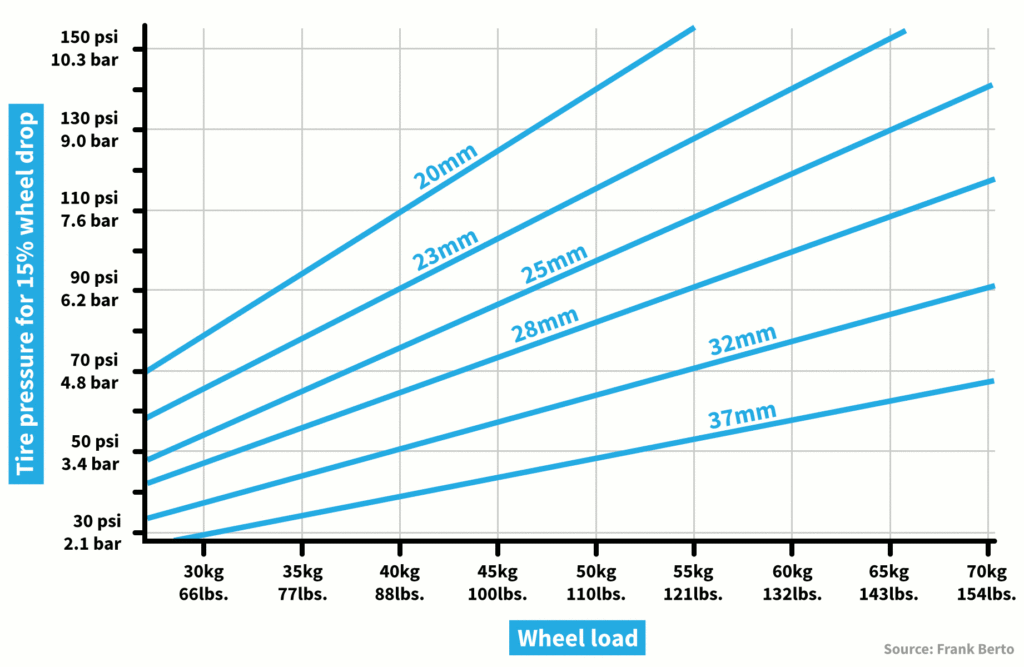
Tyre drop is hard to measure, but Berto did a shedload of measurements, and plotted the pressure needed to give a tyre drop of 15 percent for a range of rider weights and tyre widths. Here’s a graph of his recommendations, showing the relationship between pressure and wheel load for each common road bike tyre size.
Weighty matters
There are two important things to bear in mind here. The first is that the tyre width is measured not claimed. When Berto originally did his work on tyre drop there was a big problem with tyre manufacturers mislabelling their tyres because the easiest way to claim you had the lightest 23mm tyre was to mark a 21mm tyre as a 23mm. That’s improved, but some tyres are still wrongly marked; I recently put calipers on a nominal 28mm tyre that turned out to be just 26mm wide.
The other is that wheel load is per wheel. If you weigh 72kg and your bike weighs 8kg, then your tyres carry a total of 80kg but it’s not evenly distributed. The rear wheel carries more of the load, usually between 55 and 65 percent.
To determine the right pressure, you’ll need to measure the load on each wheel. Put a bathroom scale under one wheel and enough wooden blocks, books or old magazines under the other to level the bike. Lean very lightly against a wall to steady yourself and sit in your normal position on the bike. Get someone else to read the scale for you. Repeat the process with the scale under the other wheel.
If your rear wheel is carrying 44kg and your front 36kg (a 55:45 weight distribution) and you’re running 25mm tyres, then reading from the graph tells you that you want about 90psi in the rear tyre and 70psi in the front.
That’s probably lower than you’re currently running, so think of it as a starting point from which you can tweak the pressure until you get a feel you like.
If the pressure comes out well below the minimum recommended pressure of your tyre, then you can go skinnier; if it’s well above, then use a fatter tyre if your frame will accommodate one.
Controversy
As I mentioned, this approach is controversial. Another engineer, the late Jobst Brandt, author of ‘The Bicycle Wheel’ wrote in a newsgroup posting: “What Berto did not seem to consider is that hard cornering and rough pavement require higher inflation than comfort or other considerations might demand. Banking over to a maximum lateral acceleration of about 1g is not something that works reliably with a comfortably inflated tire, nor is encountering rough pavement with breaks and patches in the surface.”
Brandt was also sceptical about Berto’s notion that front and rear tyre pressures should reflect the loads on them. He wrote: “I run my tires at the upper end of pressure because snake bites are always a threat on mountain roads. When descending with hard braking, the front wheel carries the entire bicycle, with the back wheel at lift-off. The same is true climbing while seated on steep grades where front wheel rise is close at hand.”
More recently, Bicycle Quarterly magazine did some tests that revealed there was no speed advantage in pumping tyres up very hard. It was already known that when measured on a smooth drum rolling resistance didn’t decline much beyond a certain pressure. But as editor Jan Heine discusses here Bicycle Quarterly’s real-world testing indicates that when tyre pressures get too high, there’s no further reduction in rolling resistance. Heine believes that you lose the suspension effect of the tyres and that’s enough to push the rolling resistance back up.
What about tubeless?
With no tube to pinch, tubeless tyres give you the opportunity to run lower pressures with less risk. Jobst Brandt’s concerns about high-speed cornering atill apply, though.
In fact, tyre deformation in low-pressure tubeless set-ups is a major consideration because if you load a tubeless tyre sideways hard enough it can lift off the rim and burp out your air and sealant. On a mountain bike that usually just leads to an embarrassing minor spill, but on a high-speed road descent, it could easily be disastrous.
Even with tubeless tyres, then, you don’t want to go to soft, and you don’t want to go too hard either for the reasons discussed above.
We explored the subject of tubeless tyre pressures in a lot more detail in this article.
Choices
Where does this leave you and me then? I think there are five take-homes:
If you ride in a leisurely manner — a short commute, gentle pootling around the lanes — then you can afford to run quite low pressures for comfort.
At the other extreme, don’t bother over-inflating your tyres for races and time trials. Unless the road surface is glass-smooth you won’t get any advantage, and let’s face it where are you going to find a road like that in the UK?
In between, you should tailor your tyre pressure to your riding style and roads. Ride in flat country and on smooth roads? Go for the lower end of the range between the Berto 15% drop figure and the range marked on your tyres.
In the hills I’d follow Jobst Brandt’s advice for equal pressures front and rear if you like to descend quickly. I love to go downhill fast (it makes up for the fact you need time-lapse photography to observe me climbing) but a front wheel impact puncture at 50mph is high on my list of things I’m not keen to try, along with BASE jumping and being visited in hospital by Boris Johnson.
If you’re not a demon descender, you can run a softer front tyre for comfort.
if you’re running tubeless tyres, you have more leeway to experiment with low pressures, but you should probably still treat the Berto recommendation as a lower bound, or at least experiment carefully with pressures lower than the Berto graph recommends.
For many of these situations, going up in tyre size is also a good idea. Our Mat Brett explored the reasons for fatter tyres in a Trendspotting piece. It’s a convincing case.
Gauges
To set your tyre pressure right you’ll need a pressure gauge. Track pumps usually have one built in, but they’re often not very accurate, especially if the pump is a bit old and has been kicked around the workshop floor.
A standalone gauge, properly looked after, is a better alternative. If you can find a sturdy, metal-bodied analogue gauge, grab it, but digital gauges like these are more convenient.
Topeak D2 Smart Head Digital Pressure Gauge — £29.99
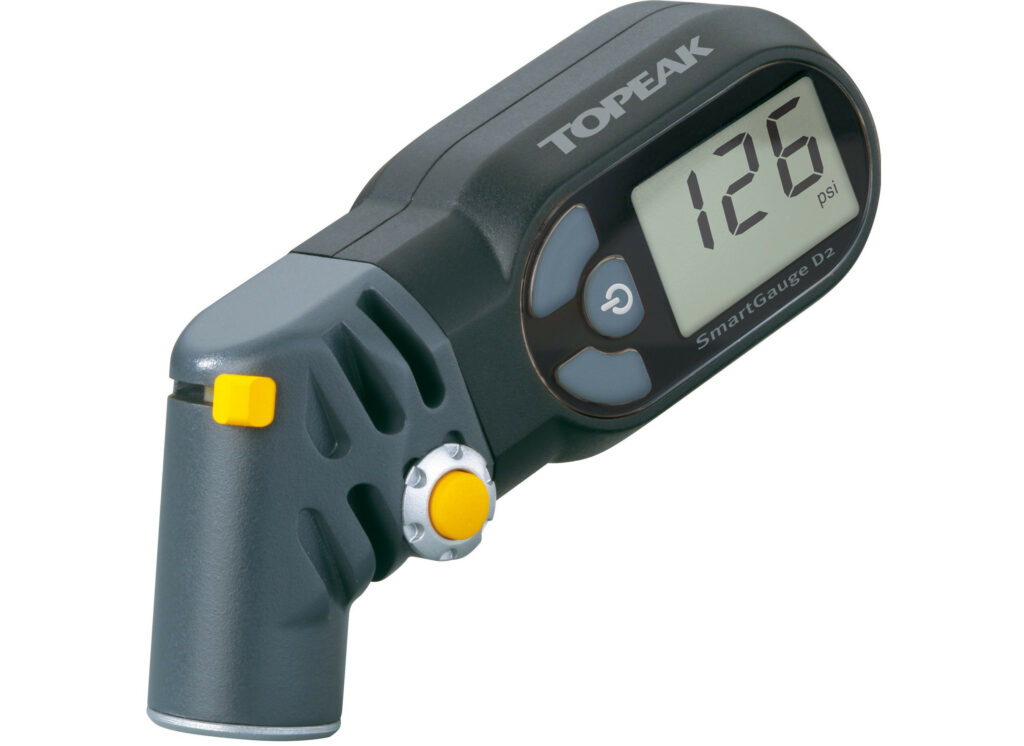
This well-regarded digital gauge measures in 1psi increments and automatically adapts to Schrader and presta valves. It reads up to 250psi so you can even use it on your mountain bike’s shocks too.
SKS Airchecker — £21.99

Accurate enough for workshop duties, yet compact enought to slip into the smallest of seat packs or jersey pockets, the SKS Air Checker is a very tidy digital tyre pressure gauge.









73 thoughts on “How to choose the best bike tyre pressure — balancing speed, comfort and grip”
This is probably the most
This is probably the most important article Road.CC will publish this year.
I’ve been a fan of the Bicycle Quarterly 15% tire drop chart for years. I even have a copy stuck to my workshop wall for quick reference. What I have found over the last few years as tire carcass technology has improved, is that you can go even lower especially if you’re using tubeless. I regularly go 10 to 15 PSI lower than what the chart says and find that my times are just as fast if not faster and I’m a lot more comfortable – Plus the brakes work a hell of a lot better when you’ve got a bigger rounder footprint and more rubber in contact with the road at any given fraction of a second.
Part of this I think is down to the fact that tubeless is a different game to clinch plus inner tube, the other part of it is the advances in material technology that have seen things like Schwalbe’s Microskin and other technologies come into tire construction. These rewrite the rulebook regarding what was considered an appropriate TPI threadcount.
The bottom line is, don’t be afraid to experiment and go lower than you ever thought possible. Your arse and your Strava times may well thank you.
KiwiMike wrote:
Really? I sincerely hope not!
I agree with BBB – you don’t need long-winded sciency guff to establish tyre pressures that suit the individual. If his perfectly concise sentence isn’t enough then try Michelin’s simple chart.
Adjust in 10 psi steps above or below as you see fit (the above is a starting point, not a Rule).
Simon E wrote:
This makes good sense to me, and ties in well with what a friend and former pro triathlete told me a while back – weight in kg divided by 10 gives you the pressure in bar you should run your tyres at (23mm). Has worked well enough for me over the years.
TheSpaniard wrote:
There was an article in a bike magazine I read a couple of years ago that quoted a Specialized team mechanic saying pretty much that – he stated the weight of the rider + bike in kg.
For me, that’s about 110 psi, which concurs with the chart above for 700x23c tyres – which, it turns out, is pretty much what I’d been running them at for years by feel alone, according to the gauge on my pump.
I keep meaning to check them with a proper pressure gauge to see what they’re actually at.
I’ve never felt the ride on my bikes was overly harsh as a result of those pressures – apart from my hack bike, which has a monstrously rigid frame anyway (hi-tensile steel pile of crap – long story!).
Simon E wrote:
Seriously?
Just like we don’t need long-winded sciency guff to explain why the world isn’t flat, the sun doesn’t rotate around us, and the universe wasn’t created in a few days.
Here’s to the people who are curious enough to care about and understand such things, for they are the ones who make the world a better place for the rest of us. Hence medicine, electricity, and a few other things.
So, road.cc, thanks for the article. It’s interesting, useful and I’m pleased you published it.
flobble wrote:
Seriously?— Simon E
Yep.
If you removed those blinkers you would find that I’m not against science or technical articles, quite the reverse. I am more than comfortable with the idea that some people like to have such detailed investigation; I simply pointed out that the vast majority of people can set tyre pressures using a simple rule of thumb and/or chart. It doesn’t have to be complicated.
Why is that such a big problem for you?
Simon E wrote:
this article will prove to be pretty important indeed if it stops people using that guff. I am 80kg, so according to that chart, I should pump my 32mm tyres to 87psi. At that pressure there will be no give at all, every bump in the road will be smashing my wrists, while the chart in the article has 80kg+10kg bike, split 45% to the front tyre, 55% rear gives 65psi front and 75psi rear for my 28mm tyres. Smaller size, lower pressure.
Agree with KiwiMike, how low
Agree with KiwiMike, how low can you go? After several weeks off the bike, l joined last Sunday’s clubrun without inflating the tyres and enjoyed a bash in the Essex lanes, from time to time noticing how pleasantly the bike was floating over the rude surfaces. When I finally got the pump out, I found the tyre pressures were in the mid-40s psi. Oh dear! That’s not supposed to work! (Michelin Optimum Pro 25s on Velocity A23s, measured width around 27 mm)
+1 for lower pressures –
+1 for lower pressures – always find my alloy commuter most comfortable and still fast at 70 front 80 rear – on 23mm tyres!
The advice about pressure
The advice about pressure could be contained in one sentence.
Go as low as you can as long as you don’t suffer rim strikes/pinch flats and handling issuses.
BBB wrote:
Sorry BBB, most people don’t have an endless supply of wheels/tyres/tubes to experiment with. You only know when you’ve gone beyond what is sensible when you puncture / collapse your rim / loose traction and fly off the road / have your tyre roll off.
So suggesting people just keep going lower and lower until ‘something bad happens’ is not good advice.
Whereas measuring your tyre, weighing yourself, then adjusting *slightly* either way is scientific, proven, and is far less likely to see you repairing flats / buying new rims / fishing yourself from a hedge.
KiwiMike wrote:
This is like people who roast, hand-grind and precisely weigh and their coffee stating that anything else isn’t really coffee.
What I think this boils down to is not right or wrong but that you prefer a convoluted, technical looking method because you think it’s terribly important. BBB and I disagree, there’s no need to make it complicated.
I’ve run pressures from 40 to 100 psi in my road tyres and only ever had one pinch flat after riding too fast through a puddle on a disused railway trackbed. It taught me that I should ride more slowly in those conditions.
Simon E wrote:
This is like people who roast, hand-grind and precisely weigh and their coffee stating that anything else isn’t really coffee.— KiwiMike
No, it really isn’t. The ‘measuring’ is trivial and everyday – bathroom scales and side of the tyre (as a first guess of actual inflated size). The comment Mike was replying to mentioned reducing pressure until you got handling issues (amongst other signs) – i’d agree with him that perhaps that’s not the safest way of doing things .
Simon E wrote:
This is like people who roast, hand-grind and precisely weigh and their coffee stating that anything else isn’t really coffee.
What I think this boils down to is not right or wrong but that you prefer a convoluted, technical looking method because you think it’s terribly important. BBB and I disagree, there’s no need to make it complicated.
I’ve run pressures from 40 to 100 psi in my road tyres and only ever had one pinch flat after riding too fast through a puddle on a disused railway trackbed. It taught me that I should ride more slowly in those conditions.— KiwiMike
Tyre inflation is nothing like home roasting of coffee. Firstly, it used to be very common for homes to do their own roasting of coffee (often just using the oven though there were simple hand-cranked roasters as well). It wasn’t until instant coffee (invented late 19th century) became popular (Nescafe – 1938) that people decided that home roasting was too much effort and that decent coffee wasn’t worth the occasional house fire (coffee roasting creates lots of flammable chaff from the outside of the bean).
Secondly, hand grinding is usually cheaper than buying a ‘decent’ electric burr grinder, so will produce better results for people who shirk away from forking out £800 on a decent machine. I used to get a more consistent grind with my handheld Porlex grinder than with the rubbish electric grinder that I used to use (upgraded it to a low-end Baratza).
The problem with inconsistent grinding is that you end up with a big range of particle sizes – from tiny ‘fines’ through to larger ‘boulders’. When brewing, you end up with over-extracting the fines and under-extracting the boulders and thus end up with a less than optimum brew.
Thirdly, how can you ensure the optimum brewing time if you keep varying the amount of coffee that you use? Weighing is the only accurate way to determine the amount of coffee that you want to use. You wouldn’t bake a cake without weighing the ingredients, would you?
Fourthly, unless you live near a decent coffee roaster/shop, the only way to guarantee the freshness of your coffee is to roast it yourself. Green (unroasted) coffee beans will keep fresh for about 18 months or so without any noticeable degradation. Once roasted, the beans will keep fresh for about two weeks – it’s worth giving roasted beans a couple of days to de-gas before brewing so that you don’t get too much CO2 coming off and causing too much bloom in your brewing receptacle. Once you grind the beans, they degrade MUCH faster – maybe an hour later and they’ll start to taste stale.
Fifthly, NEVER use boiling water.
Wait a minute, which forum is this one again?
KiwiMike wrote:
Sorry BBB, most people don’t have an endless supply of wheels/tyres/tubes to experiment with. You only know when you’ve gone beyond what is sensible when you puncture / collapse your rim / loose traction and fly off the road / have your tyre roll off.
So suggesting people just keep going lower and lower until ‘something bad happens’ is not good advice.
Whereas measuring your tyre, weighing yourself, then adjusting *slightly* either way is scientific, proven, and is far less likely to see you repairing flats / buying new rims / fishing yourself from a hedge.
— BBBReducing pressure GRADUALLY say by 5psi every few days in order to see how far you can go isn’t going to destroy you tyres/tubes/rims etc… You’ll know when to back off.
BBB wrote:
Yes. You’ll know. When you suffer a flat / dented rim / loose traction. what you are proposing is using your bike/health in a to-the-point-of-failure (i.e. destructive) test.
What’s next – arguing against torquing brake cable bolts correctly – just keep backing it off until the cable slips under emergency braking, then after you’ve healed up and the insurers have settled, you’ll know to make it *that little bit tighter*?
I acknowledge that some people simply do not like being ‘told how to do something’, but will reject vociferously their leading others down a path of trial-until-damage- or injury-causing error. Just do the very simple weighing / maths, and be confident of the result, FFS.
KiwiMike wrote:
Like I said letting a few psi out between one ride and another is NOT going to dent your rims destroy your bike etc. You seem to be making a big fuss out of nothing.
I agree about the maths and I’m a big fan of the 15% drop method (as a starting point) but experimenting is the key. Every tyre is different. E.g. at the same pressure a Vittoria CX will ride completely differently than say Marathon Plus (which will need much lower pressure due to stiffer casing).
What’s missing in the article
What’s missing in the article is the influence rim width has on the optimum tire pressure. You can install the same 25 mm clincher on an old school 13c rim with 13 mm of width between the hooks and end up with a much higher required pressure than when you install it on a modern rim with 17 to 19 mm inner width. The tire will measure 1 to 1.5 mm wider on the wider rim but the main effect is indeed the much bigger area where the wider rim supports the tire through the trapped air. Expect to be able to lower the tire pressure by 20% when going from a 13 mm rim to another one with 17 mm inner rim width with the same tire.
I assume when Berto tested road tires he was using rims with 13 to 14 mm inner rim width since that was kind of a norm at that time. So nowadays with modern wheels Berto’s values are already the upper limits of what is sensible even for race usage.
Tyre widths for pressure
Tyre widths for pressure calculations are normally quoted as measured,rather than nominal, width IME, so should be good as a first approximation. Agree the figures are high though.
I weigh 75kg and I have a
I weigh 75kg and I have a 13kg bike, and I inflate my 700x32c tyres at 80psi and sometimes I can find tire pressure that has droped down to 50 psi. At 80 psi the ride is very harsh, but on the other hand I have forgoten how to change an inner tube
I’m 6ft 4, 95kg, and have
I’m 6ft 4, 95kg, and have never ridden with the pressure this suggests. For starters I think I would crap myself straining on the track pump. 100-105 psi on 25’s and I’m happy, any more and its a boneshaking ride. Plenty of grip, smooth, few punctures and decent tyre wear. Each to to their own I guess. Probably like the lemond formular, ok as a starting point, then find your own way in life.
Simmo72 wrote:
I agree, the Michelin chart has the top cut off, I’d (do) need to lose 12kg to get on the chart!
whobiggs wrote:
Same here, roughly. But the vertical bit suggests that anything higher than the weight on the top of the chart, just use the same pressure.
However, I think it’s safe to say I’m not going to try 23mm tyres on my tandem 🙂
I’ve found a big difference
I’ve found a big difference in finding a suitable working tire pressure between vulcanised tires (i.e. Conti GP 4000 II in 25c) and high TPI open tubular tires (i.e. Vittoria Corsa G+ in 25c) , and even a slight difference when using a butyl tube and latex tube in the open tubular
anyone else experienced this?
Alot of these charts and
Alot of these charts and opinions about sky high pressures is to do with with the traditional mindset that the only good road bike tyre is a rock hard road bike tyre going back to the days of 21 and 23mm tyres.
When I hired a bike in Lanzarote recently I took my 25mm Conti Grandprix GT tyres and when the bloke (no spring chicken but amazing at fitting tight tyres with no tools!) went to fit them, he went “Right, what’s the max pressure on the side, 120 psi? Right, let’s put 120 psi in them”. I asked him to put 80 psi in them (I’m 67kg), he wouldn’t have a word of it and eventually put 100 psi in as a grudging compromise. Naturally I just let a bit of air out after he’d gone.
Witht the popularity of 25+ mm tyres and the increasing evidence about rolling resistance and comfort, the mindset among cyclists will gradually start to change.
guyrwood wrote:
In Lanzarote that is normal, the roads are really very good and there’s no real need to go lower.
I wigh in at less than 50kg &
I weigh in at less than 50kg & ride around on 25 mil Vredestein Senso all weather tyres at 100 PSI. I’d be frightened they would pinch puncture or roll off at the 70 PSI recommended by Michelin.
Aileen wrote:
I wouldn’t be worried at all in general but it’ll depend on the sort of surfaces you’re riding on, tyre beads, rim profiles and so on. 100 psi on average British roads with 25mm tyres sounds very high, especially at such a small mass, but low if you were on the track permanently. If you’re not riding on very, very smooth surfaces all the time how about a compromise and try 75/80psi front/rear and see how it goes and adjust from there ? I’d hazard a guess that with any half decent tyre and rim combination there’d be no reason to worry about any roll-off (less chance of blow-off too) and a lot to potentially gain for grip, comfort and general rolling efficiency. Worth a punt mate.
I ran mine at 90, never came
I ran mine at 90, never came close to either (80kg)
Seems best just to play about
Seems best just to play about as it really depends on what bike and tire combo you have. My old CAAD8 was always up at about 100psi with 23mm tires and it rode like crap, because i believed everything i was told. Now i ride a Gt Grade with fat schwalbe s-ones at about 50 and its a revelation. Old tech vs new thinking. I arrived at 50psi via no science whatsoever, it just felt right.
I think a lot also depends on
I think a lot also depends on how you ride. I used to do a lot of mountain biking on dry rocky surfaces in the south of France. I slowly dropped my pressures lower and lower, giving me greater comfort but also faster times as the bike rolled over the rough ground better. I learned to “ride light”, that is to balance my weight evenly between my legs and arms over rough ground.
Now that I ride almost exclusively on the road I have found that the same applies. I can run lower pressures than most and I have NEVER had a pinch flat. However I ride with others who run their tyres much harder than me who get pinch flats.
At no time have I been
At no time have I been subject to the vastly differing effects of tire pressure than with my current set of tires – 32 mm Clement Strada LGGs. Their pressure range is 40-80 psi.
In my experience, they really, really dislike high pressure. They roll very well at 70 psi, but just cannot corner with any real grip, and they are caught out by wet patches very easily. The phenomenon persists down to 65 psi too.
After lots of experimentation I got to my Goldilocks pressures: 45 psi front, 50 psi rear. This was a huge surprise, considering my bike and I weigh around 95 kg. So far, no pinch flats, no squirm, just as much grip as these tires are going to give me.
In contrast, my old set of 28 mm Continental UltraSport IIs were a lot more “straightforward.” They were supposedly rated for a 80-105 psi range, so I kept them at 80. There are times when I’d ride tham at 70 or even 65 because of the normal leakage of air through a butyl inner tube, and I didn’t come out any worse for wear.
Useful article but the
Useful article but the comments exploded!
I just ride my dayum bike 🙂
Also, any chart for a non-pro or non-racing cyclist topping out at less than 90 or 100kg excludes must exclude a large proportion of riders.
jackhannaford wrote:
This chart covers riders up to about 140kg though.
“To determine the right
“To determine the right pressure, you’ll need to measure the load on each wheel. Put a bathroom scale under one wheel and enough wooden blocks, books or old magazines under the other to level the bike. Lean very lightly against a wall to steady yourself and sit in your normal position on the bike. Get someone else to read the scale for you. Repeat the process with the scale under the other wheel.“
Not wishing to throw stones from my glasshouse, but jesus, haven’t you all got better things to do (like ride your bike)? On the road, with 25mm tyres, 105-110psi is always the right answer. Except if you are riding tubs, when 125-130psi is probably the right answer. Unless its wet. And your track pump’s gauge has a 5-10% margin or error, so there’s little point in preternding to be accurate.
Just wrong dude!
Just wrong dude!
i have a tyre pressure gauge also, so I am being accurate.
72kg bike and rider 80front 90 rear tyres 26mm measured, nice and comfy, nice and fast
I have 3 set of wheels for my
I have 3 set of wheels for my bikes, 115kg rider+bike
25mm Tubeless for sportives, comfy and quick 95 psi
40mm tubeless 65 psi comfy for training
25mm tubular 125psi for fast riding
This topic has been covered
This topic has been covered in depth on the Fastfitness.tips site, and there is a dynamic tire pressure calculator on there too. Whether it works or not, I don’t know.
I keep it simple. 80-85kg
I keep it simple. 80-85kg depending on how much ive indulged the past months.
23c – Don’t bother.
25c – 95psi rear/90psi front (tyres are generally 26-27mm mounted: Schwalbe One or Vittoria Corsa G+)
28c – 85psi rear/80psi front
I don’t get pinch flats and comfort is great. Can probably drop by 5psi but no point if its working. All the charts I’ve looked at discriminate that I shouldn’t ride a bike at my weight and if I do, my tyres should be at 125-130psi. They’re wrong.
Very simple formula, easy to
Very simple formula, easy to remember. Start eith 120 and divide it by two, then add 60, et voila; you’re ready to go
Have to agree with you
Have to agree with you Check12. I’m 68kg and run 25s at 80psi front and 85psi rear.
im usually lower than these
im usually lower than these charts on tubeless. 75kg/28mm usually 45psi rear 40 front works well. lower = too lower, higher = less cushiony/a lil slower. maybe i should pump em a lil higher. though the streets here are pretty bad.
I believe Bike Snob NYC
I believe Bike Snob NYC called fred on this regurgitated article .
Firstly, everyone is assuming
Firstly, everyone is assuming tyre gauges are accurate. Well they are not and by a big margin. Before you start setting tyre pressures you must know the gauge you are using is accurate and this should be to 1%, not 3% to 15% as most gauges are. Your average gauge is about 10% out, maybe more. Even Silica (who make £200 to £800 gauges) in their small print say their gauges are 3% accurate. Sorry, but that is just not accurate enough.
In the area of motorsport there are some very accurate gauges available but probably don’t go high enough for bicycle tyres. I wonder what gauges Team Sky use?
Biggus-Dickkus wrote:
I brought a digital tyre pressure reader thingy when I switched to tubeless a couple of years ago, turned out my old track pump was consistantly 28psi under…. 28 PSI !!!! I’d been riding for years on 23mm tyres and tubes at what I thought was 95-110 in actual fact it was 70-80psi!!
My replacement track pump has been close enough not to think about.
peted76 wrote:
Yes, but don’t be fooled just because the gauge is digital. They are just as inaccurate as the analogue gauges. The problem is that China makes these gauges in millions and they are dirt cheap. The more precise the gauge needs to be the more expensive it costs to make it, plus even when you have a good accurate gauge these should be selected for tight tolerance to about 1%. Probably 1 in 100 would meet the tolerance so the pump/gauge manufacturers don’t bother to select the best as it costs too much money. Even Silica quote 3% and that is across the range 0-160psi!!!
Biggus-Dickkus wrote:
Within 1%? Aren’t we in danger of spurious accuracy here? Surely variations in air temperature from day to day and hour to hour will change the actual tyre pressure more than this, not mention the tyre heating up from friction whilst actually rolling.
A bit of trial and error until you find what works for you within the tyre’s recommended pressure limits works for me.
I’m 97kg and run 32mm
I’m 97kg and run 32mm tubeless at 45psi. Adjust pressure until the ride feels comfortable but not draggy, it’s a feel you get, something a calculator won’t give you. Sooner be a bit slower and comfortable than a bit faster but aching like f*#k, and not in a sexytime aching way.
People actually use guages?
People actually use guages?
I usually pump my tyres up to a pressure that feels about right by the industry standard ” squeeze the tyre” test. Then as the tyres leak over a long time they get more and more comfortable until finally the sidewalls collapse. At this point I pop in a couple of pumps of the track pump so that the rim stays off the pavement. I appreciate this is a little extreme but I don’t get pinch flats…
I stumbled across a view blog
I stumbled across a view blog articles from Silca about tyres. In the link below there is the first part 6-7 articles were they go in depth on a whole scala of things all relating to your tyre (size, pressure, aerodynamics, comfort etc.) It is a mostly chronological, but I though it was fascinating when I read it over a year ago. (you also get some behind the scenes storys when they were working with pro riders riding roubaix etc 🙂 )
This is not about finding out the perfect tyre pressure for each person or the ongoing discussion that this can be summarized into one graph or sentence. This is purely for the people how like the sciene behind it! I would highly recommend the read:
https://silca.cc/blogs/journal/118397252-tire-size-pressure-aero-comfort-rolling-resistance-and-more-part-1-how-we-got-to-now
as a super light rider (I’m
as a super light rider (I’m 60 kg bike included) with 23 conti gp 4000sII mounted on 31 wide rims with latex tubes. i can low the presure at 55 psi front 65 rear . more confort , more grip , less rolling resistance . Brussels cobblestones feel like track parquet
The charts are not making
The charts are not making scense, in every case they have a heavier rider at the max. I think it’s far more about rider experiance and experimenting. I am 80kg and ride anywhere from 60psi to 90psi on my road bike depending on tire/wheel/comditions.
I’m 70kgs and run 25mm @
I’m 70kgs and run 25mm @ 70psi & my 28mm @ 60-65psi. Both tubeless.
I am very aware of the comfort advantages of lower pressures when I overinflate to 80+!
They feel like rock and feel like i have less grip at the higher value.
But pumping them up hard as
But pumping them up hard as part of the pre ride psych makes you feel like you should be going faster.
Vittoria Corsa G tubs 25mm, f80 / r110psi, 80Kg all up. Which by pure luck seems to be in the ballpark for the above graphs.
There is a Berto Tire
There is a Berto Tire Pressure phone app in which you enter your weight, the bike weight, wheel and tyre sizes, front and rear loads (if any), and it calculates the F/R inflation pressures to give the 15% drop. I use it as a starting point and usually add an extra few psi to the suggested pressures to get to what seems to work for me.
NickJP wrote:
There’s an excel programme that does even more, has front/rear weight distribution for differing bike types incl MTB, so your all out racer is going to have more load on the front than your audax/endurance set up and that changes again if you’re more upright or you carry a load over the rear. You can change the weight loads for several types and have them ready to look at.
I think Jobst also makes some errors in his thinking with regards requiring high pressures for hard cornering/rough surfaces but ATEOTD go with what you feel is right. Unless you have a wattometer and can spend hours and hours on a rolling road that reflects the general conditions you’re going to ride on it’s hard to find extremely accurately what is the optimum and that in itself varies from person to person anyway which is also dictated by you/bike/load weight, the actual tyres, plus bar type (A carbon bar for me means I can handle a slightly higher front tyre pressure compared to an alu bar), frame design/materials and even injuries -for me that’s shoulder injuries which pertains to the bar difference as I find CF bars measurably comfier.
Sometimes you’d rather have performance over comfort and the wider tyres are not giving you a faster ride unless you decide to hoof that pressure up to a point to match the narrower tyre, and then you’re losing pretty much all the supposed comfort benefits which renders putting on wider tyres a bit pointless especially since you’re losing another bit from the aero aspect as well (yes it’s a tiny bit but that tiny bit can offset the aero gains you made elsewhere so why do it when it’s not needed)
You should notice the difference in performance of a new tyre over an old one, the old one has got wider over time even at same pressures as previous yet is subtly slower even when you’re nowhere near the tread thickness limits.
useful old article
useful old article resurection – just tidying up and found some tape, valves and sealant hiding out and put them to good use on some 30mm roadish tubeless that I’d intended to set up and never bothered after the struggle to get on with a tube to soften them up a bit – always been one for pump it up and feels ok but did experiment with the reduce 5 psi and see how goes with my 35mm gravel tyres and was impressed with result – much more comfort
just tried the Berto app (cheapskate free trial) suggests 73psi rear and 47psi front – quite a big front rear difference bigger than I’d expect though I’m still getting my head around different pressure front / rear (took me quite a while to accept different tyres front/rear on mtb) – my guess would have been more like 65 rear 55 front with me weighing in at 72kgs still looks a good starting place
have a digital gauge but really need to buy one that allows you to vent the air as recommended in the article
85kg rider + 7kg CAAD10 on
85kg rider + 7kg CAAD10 on 23mm fr 25mm rr Ultrasport 2s @ 100psi. I’m happy.
Ideally I would be 25mm fr 28mm rr @ 85-90psi but too much aero sacrifice on current rim widths.
17psi fr 19 psi rear on my 2.8″ mountain bike tyres!
I like the aero joke, nice
I like the aero joke, nice work.
Regarding the accuracy of
Regarding the accuracy of pressure gauges, as long as you’re only using one then you should be able to get consistent pressures if not totally accurate ones.
I use the MyMavic app to get a ballpark figure then use my Topeak gauge to set the pressure.
As it happens, the 86/89 psi front/rear split that the app suggests is just a little harsh and I drop it down to 80/85. Whether that is a genuine 80/85 psi doesn’t matter because it gives me a good combination of grip, comfort, pinch resistance and it rolls well.
I think it’s time to update
I think it’s time to update this old article before bumping it up again (very lazy Roadcc, if you cba to update the lame PM joke – David who?? – then at least proofread it), particularly since tyres are getting wider. Also more and more people are hopping on the tubeless bandwagon, which most folks tend to run at considerably lower pressures
What is the correct inflation
What is the correct inflation pressure for my tire?
https://www.schwalbe.com/en/luftdruck.html
HP, good coffee stuff, have
HP, good coffee stuff, have you thought about using different grades of seive, getting rid of the small and big stuff?
ktache wrote:
I’ve got a couple of sieves from Kruve (https://www.kruveinc.com/) when they first did a KickStarter, but I found it a bit too much faff and you end up with some coffee left in the sieves which gets a bit stale (compared to grinding on demand which I usually do). Nice idea in theory, but it’s much better to just use a really good grinder.
Wow, that David Cameron
Wow, that David Cameron reference really dates this article.
David who?
David who?
I read several articles back
I read several articles back in the 80’s that Frank Berto wrote, and I don’t recall comfort being the issue, maybe, but what I remember was he was saying for maximum tire wear, the best handling, braking, and shock absorbtion over imperfect road surfaces was why the 15% came about. And now even a lot of tire manufacturers recommend Berto’s 15% drop research.
Of course some people may want to adjust the psi lower for comfort, or higher if the roads are smooth, or to whatever preference you prefer, but the 15% was about treadwear and handling.
The below web site has the best write up that I could find on this subject:
https://www.renehersecycles.com/wp-content/uploads/2015/03/BQTireDrop.pdf
Saw this on Silca’s blog the
Saw this on Silca’s blog the other day: https://blog.silca.cc/asymmetric-effects-of-tire-pressure-optimization
Pump till you can’t squeeze
Pump till you can’t squeeze the sidewall, job done!
Most people won’t even notice
Most people won’t even notice if they are 30% underinflated. Most people will never go near the limits of their tyres cornering grip.
I wonder why top cyclists don’t seem to have adopted the current Motogp style of moving your mass over in fast bends? Probably not safe to do in a group but given the supposed benefits to reducing lean angle on motorbikes you’d think it would work cycling. I’ve started doing it and it feels safer and I’ve got some half decent downhill times on Strava. I’ll have to put the leathers on one day and see how far I push matters.
How do you move your mass
How do you move your mass over then? Do you mean move your back side off the saddle or something ?
Rick_Rude wrote:
It’s going to matter far less on a bicycle. Motorcyclists are trying to get their suspension closer to vertical so that it can do the suspension thing. Secondarily it stops hard bits like the exhaust and peg touching down on some bikes. Unless you’re starting to roll onto your sidewall, or having trouble steering, it’s probably not going to do much as long as you have your inside pedal up at 12:00.
A few years back, I
A few years back, I implemented Berto’s recommendations in a Google Sheet. Here it is.
https://docs.google.com/spreadsheets/d/15nT3Q2Cnk6-2HbRSpPngFEoR5QnLTQZdlzofzC_mLTY/edit?usp=sharing
Per Jan Heine, Berto’s data was not made with particularly supple sidewalls, so if you’re using something like a René Herse tyre, add a bit of pressure to make up for the lost sidewall stiffness.