



A groupset is a collection of matching components used by a bike manufacturer to turn a frame into a bike. But confusingly, the term doesn’t cover all the parts on a bike, so let’s take a look at what it does cover, and why groupsets exist.
The first groupsets were produced by Italian component maker Campagnolo, and just as today, a groupset was a collection of components that matched visually and in quality and function. The shapes of the various cast, forged and machined parts of a groupset all follow similar lines. There will often be a common colour too, with various shades of grey currently in vogue.
Who makes groupsets?
The big names in bike component manufacturing are Shimano, Campagnolo, and SRAM; these are the brands behind the groupsets you’ll see most frequently fitted to bikes. Japanese company Shimano dominates the market.
You’ll find SRAM groupsets on some mid-priced and high-end bikes, this US-based company focusing on its wireless eTap electronic shifting, and on cyclocross and gravel/adventure bikes with its 1x transmissions that combine a single chainring with a very wide-range sprocket set.
Taiwanese/Italian manufacturer FSA offers groupset components, Rotor – now owned by Chinese OEM WheelTop – has a range too, and Taiwan’s Microshift offers several groupsets covering road, gravel, mountain biking, and utility cycling. Tektro/TRP offers various groupset components – and has recently teamed up with Classified (see below) – and you can also look to Chinese brands like L-Twoo.
There used to be others. Mavic made some strikingly styled groupsets in the 1980s, and we previously wrote about the demise of SunTour of Japan and Zeus of Spain. Sachs, part of the German Mannesman industrial conglomerate, made groupsets in the 1990s before selling its designs and production facilities to SRAM.
A few other brands have appeared on groupsets, but usually some of the parts have been rebranded components from other manufacturers. Italian company Miche, for example, used to offer groupsets with rebranded SunTour derailleurs (and still offers various groupset components), while Galli, also from Italy, made its own brakes and derailleurs but rebranded other companies’ parts for the rest of its groupsets.
Today, each of the big three makes a range of groupsets covering bikes from the entry level up to professional racing. The table at the foot of the page lists them.
What’s in a groupset?

A modern groupset usually comprises brakes, brake/gear levers, chainset, derailleurs, chain and sprockets. That’s changed over time, though. For example, there was a time when a groupset included pedals and hubs. Groupset makers still offer hubs and pedals that are designated as part of a group, but it’s rare to see them on off-the-peg bikes.
Bike makers usually buy complete wheels, sometimes from the groupset manufacturer and sometimes from another company. Bikes often come with very basic pedals, or none at all. The customer is expected to fit their chosen pedal system. Campagnolo and Shimano used to offer seatposts, Shimano made headsets and handlebar stems, Campagnolo has dabbled in saddles and for a while made highly-regarded rims.
What about the other bits?
A groupset brand won’t provide the bike’s bar, stem, saddle or seatpost. There’s no particular reason for this, except that groupset makers tend to have long-standing specialisation in moving parts and leave the less complicated components alone.
But we’re talking about the bike industry so it’s Not That Simple. Some manufacturers of non-groupset components have expanded beyond that original remit, notably FSA and Ritchey with headsets and wheels.
From the other direction, Shimano owns Pro Bike Gear, which makes bars, stems, saddles and seatposts, plus bags and accessories. You’ll need tyres and tubes, but it’s otherwise possible to build a completely Shimano/Pro-equipped bike.
SRAM also owns various other brands, including Zipp – which offers wheels, handlebars, stems, seatposts and other components – and Campagnolo owns the Fulcrum wheel brand. They all have fingers in various pies.
Why have a groupset at all?
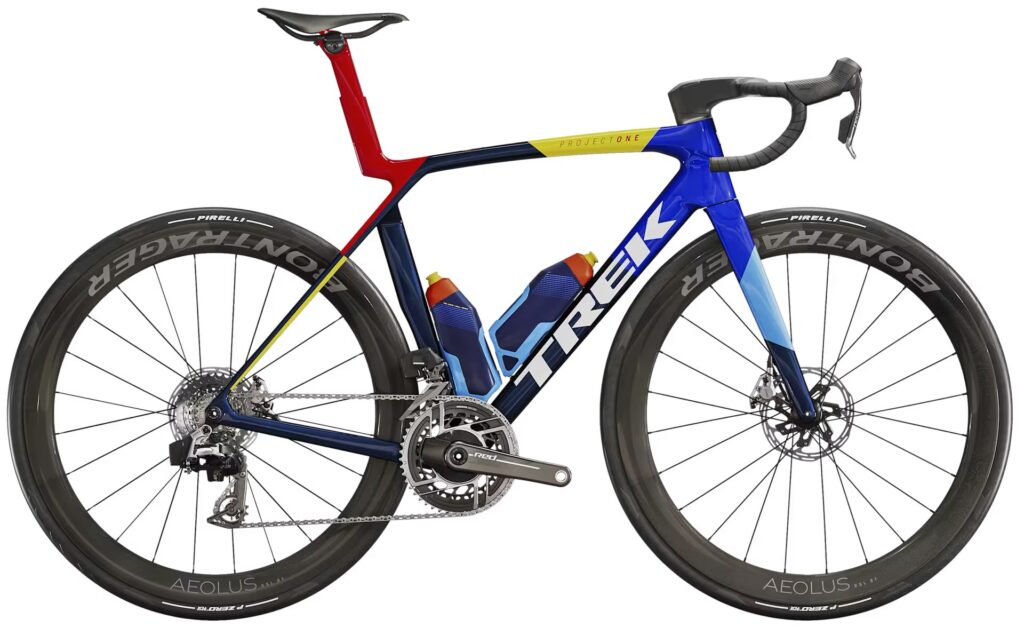
We’ve already touched on two reasons why groupsets exist: matching aesthetics and matching quality. A bike with a complete groupset looks good, because the chainset, brakes, levers and derailleurs will all be the same colour and share other visual features.
Perhaps more importantly, the quality of all the parts will be similar, so you can expect them all to be similarly durable. The metal treatments and high-strength alloys that make pivots and bearings more durable and that also make parts lighter are expensive, so better groupsets are pricier. If you ride 10,000 miles per year, the reliability of an expensive groupset is a decent investment; if you’re a 2,000 mile-a-year weekend warrior, perhaps not so much.
Materials themselves may delineate groupsets. You won’t find any carbon fibre in Campagnolo’s entry-level Centaur groupset, but its top-end Super Record 13 groupset is positively dripping with composites. The use of high-tech materials makes Super Record 13 lightweight… and expensive.
 Another reason is that a bike with a complete groupset almost always works better than one with a mix of parts from different manufacturers. Component makers design their shifters to pull just the right amount of cable for each gear shift or braking action, and their sprockets and chainrings to grab their chains and move them smoothly from one tooth to another. Change almost any component and things won’t work quite as well.
That said, some manufacturers are pretty good at making compatible parts. For example, it’s not unusual to find KMC chains on bikes equipped with any of the big three’s groupsets. In fact, KMC is widely reported to supply chains to Shimano, so you’d expect its chains to work with Shimano gears. Nevertheless, with rare exceptions, if you want your bike to work as well as it possibly can, then fitting a complete groupset is the way to go.
How many gears?
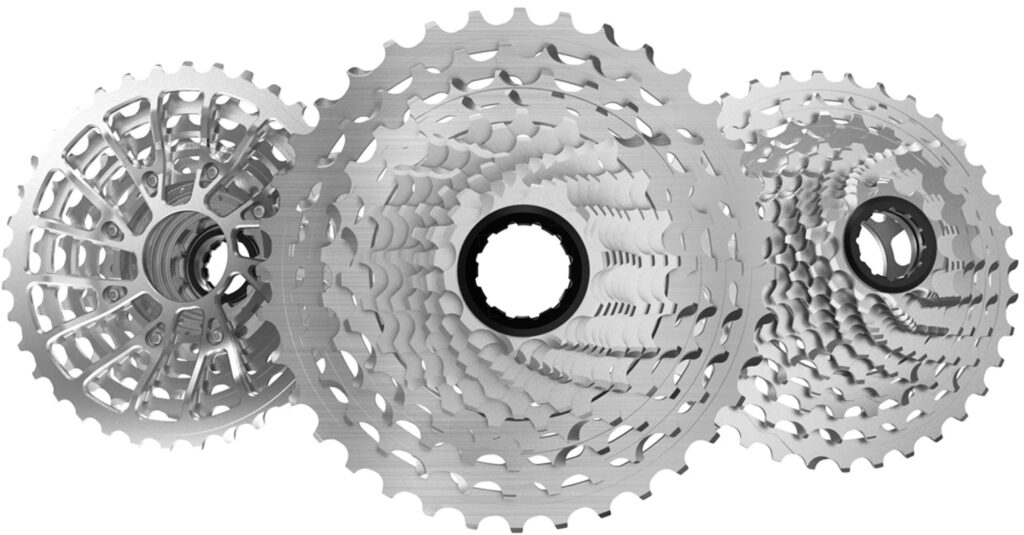
Aside from weight and durability, one of the main differences between cheaper and more expensive groupsets is the number of gears you get. The latest top-end groupsets have 12 or 13 sprockets on the rear hub, giving a wide range of closely-spaced gears. Lower-end groupsets have fewer sprockets.
When it comes to groupsets you’ll find on bikes in the shops, Shimano’s Tiagra, Claris and Sora components are being phased out in favour of Shimano CUES, which comes in nine, 10 and 11-speed options.
What is Shimano CUES?
As mentioned, Shimano CUES (Creating Unique Experiences) is taking over from various groupsets, including Tiagra, Claris and Sora on the road side of things – but it’s a gradual process, so you’ll see a lot of components from those existing line-ups for a while yet.

Shimano explains it like this: “CUES offers all the confidence of a high-end groupset at an affordable price point. The groupset is available for e-city and trekking bikes, MTB, road, gravel, cargo and e-cargo bikes. It is the new standard, no matter your cycling style.”
CUES is available for both flat and drop handlebars, and in nine, 10, and 11-speed options.
Shimano summarises the CUES concept as offering a range of interchangeable components that “standardises compatibility across a wide range of categories”.
A major positive of Shimano CUES is its compatibility across groupsets. It’s designed for cyclists to mix and match components. CUES nine, 10 and 11-speed groupsets are cross-compatible, and shifters, derailleurs, cassettes and chains can be used together across different bike setups.
All CUES groupsets use 11-speed chains with the same front derailleur pull ratios and cog spacings.
This means that you can mix nine, 10 and 11-speed CUES cassettes and derailleurs with different CUES shifters, and all that’ll happen is that you’ll lose one or two gears at the top or bottom (you decide), or hit the travel limit with a few clicks to spare.
What about Classified?
Belgium’s Classified doesn’t fit neatly into the groupset story in that it doesn’t offer its own brakes or derailleurs, but it does provide an interesting alternative to a standard drivetrain.
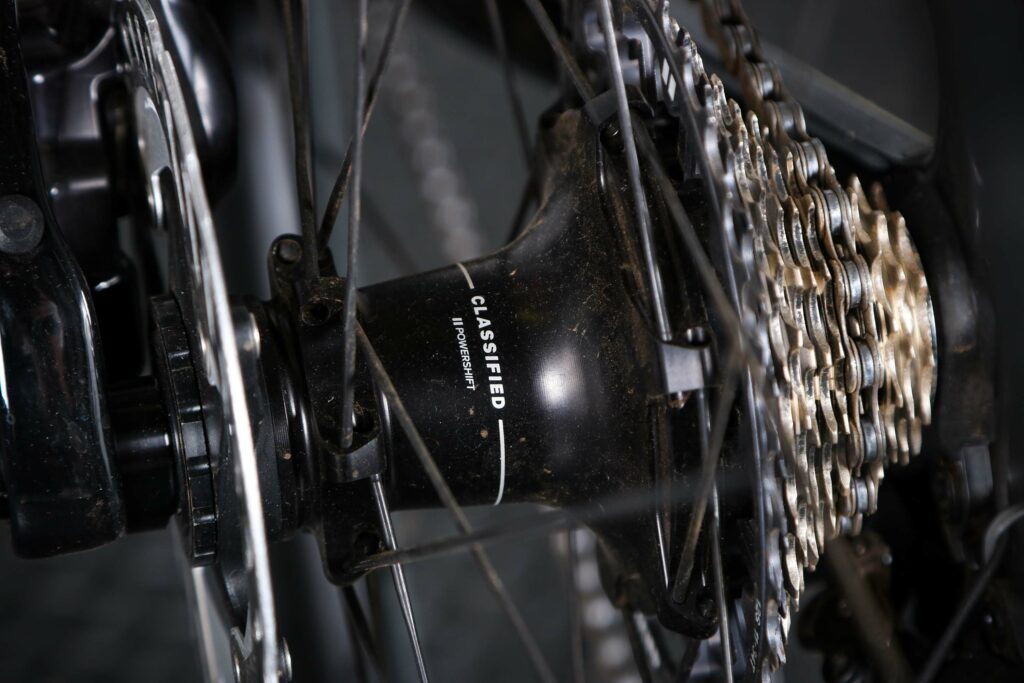
Classified introduced its Powershift technology in 2020 – a two-speed internal geared hub that’s an alternative to a front derailleur. The idea is that you run a standard rear derailleur (from another brand) alongside the Powershift hub, so you get the ratios of a 2x system with the fast-shifting of hub gears and the clean design of a 1x setup. The shifting is electronic and wireless.
> Read our review of the Classified Powershift Kit and Wheelset
 Classified has since joined forces with TRP to provide the Vistar // Powershift groupset, which combines a 12-speed cassette with a single chainring and the Classified Powershift Hub.
Classified doesn’t currently offer a complete groupset of its own components, but who knows what’s to come?
Stopping options

Just a few years ago, there was only one way of slowing down a road bike: with brakes that acted on the wheel rims, operated by cables. Since then, disc brakes have become common, even on some relatively low-cost bikes. At higher price points, they use hydraulics to get braking force from lever to calliper; you’ll find conventional cables used on more affordable bikes.
All the major manufacturers now offer groupsets with disc brakes; Campagnolo was the last to come to the party, and aside from the grizzling of a few retro-grouches they’re now a key part of the bike component universe. While they’re a bit heavier than rim brakes, they offer better control, are less affected by the wet and still work if your rim gets damaged or you break a spoke.
The rise and rise of electronic shifting
Component manufacturers have long been intrigued by the idea of using motors to operate derailleurs instead of having the rider yank a cable to make a gear shift. The idea is that shifting can be made faster, more precise and more reliable if you take clumsy human beings out of the process.
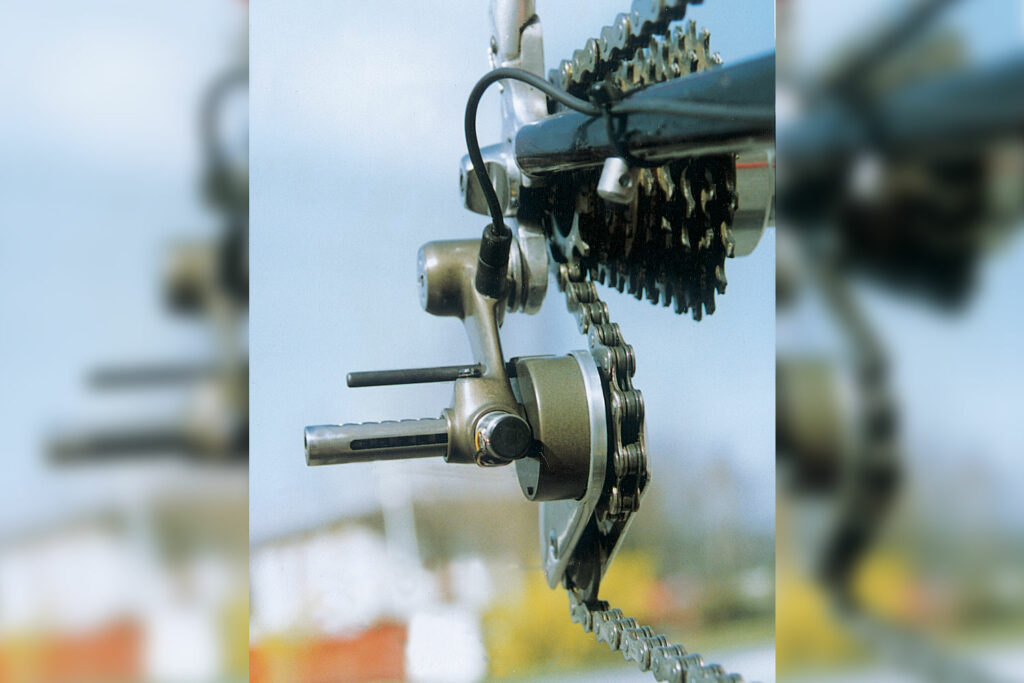
Mavic had a couple of attempts at electronic shifting with the Zap and Mektronic systems in the 1990s, and SunTour had a chainset-based system called BEAST (for Browning Electronic AccuShift Transmission — Browning was the family of inventors behind the design, AccuShift was SunTour’s term for indexed gear systems). All suffered reliability problems. The SunTour/Browning system just didn’t like getting wet and muddy, a serious problem for mountain bike components, while Mavic’s systems were a victim of their own ingenious design. The power needed to make the shift happen in a Mavic system came from the movement of the chain, which meant that the batteries and solenoids could be small and light, but the mechanism to take the motion of the jockey wheel and turn it sideways was quite delicate. BEAST, Zap and Mektronic were discontinued and the idea faded away for a few years.
In the mid-2000s, prototypes of Campagnolo electronic shifting systems began appearing on pro riders’ bikes. Even though these were clearly quite advanced development units — you could see mould marks, indicating that Campagnolo had gone to the expense of making moulds for the composite parts — Campagnolo remained tight-lipped about when they’d actually be on sale.
In 2009, Shimano became the first of the major groupset makers to offer an electronic-shifting system for road bikes with the Dura-Ace Di2 system, though Shimano registered the ‘Di2’ trademark in 2000 and offered electronic Nexave rear mechs for hybrid bikes in the early 2000s.
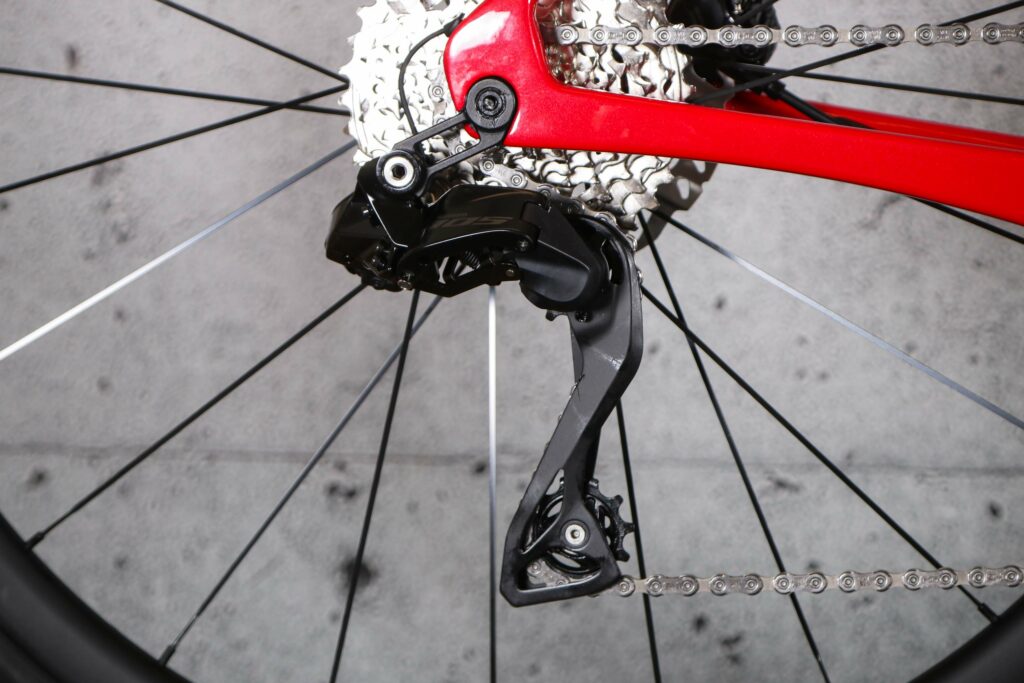
Dura-Ace Di2 was rapidly followed by Ultegra Di2 and eventually by 105 Di2, and Campagnolo finally unveiled EPS (Electronic Power Shift) components in 2011. SRAM responded with eTap, ditching the wires between shifters and derailleurs and making installation incredibly easy at the expense of slightly slower shifts compared with Shimano.
Since then, electronic shifting has gone from strength to strength. It has proven functional and reliable and is clearly here to stay.
What’s the future of groupsets?
The barrier to entering the groupset market is high. Most of the customers are bike manufacturers with well-established relationships with their existing suppliers. You need substantial amounts of heavy machinery for the forging, casting, stamping and moulding processes that convert raw metal to bike parts, and either robots or inexpensive labour to assemble them.
As a result, brands don’t tend to enter the field with a complete groupset. The trick is to get started with a part that’s better than what’s already available, or at least very different from it. SRAM did this with its throttle-style gear shifter GripShift, and expanded by buying other companies like Sachs (derailleurs), Avid (brakes) and Truvativ (chainsets).
FSA hasn’t made the inroads we expected when prototypes of an FSA electronic gear system, dubbed K-Force WE, appeared on the bike of top Italian rider Ivan Basso at the 2016 Tour de France. 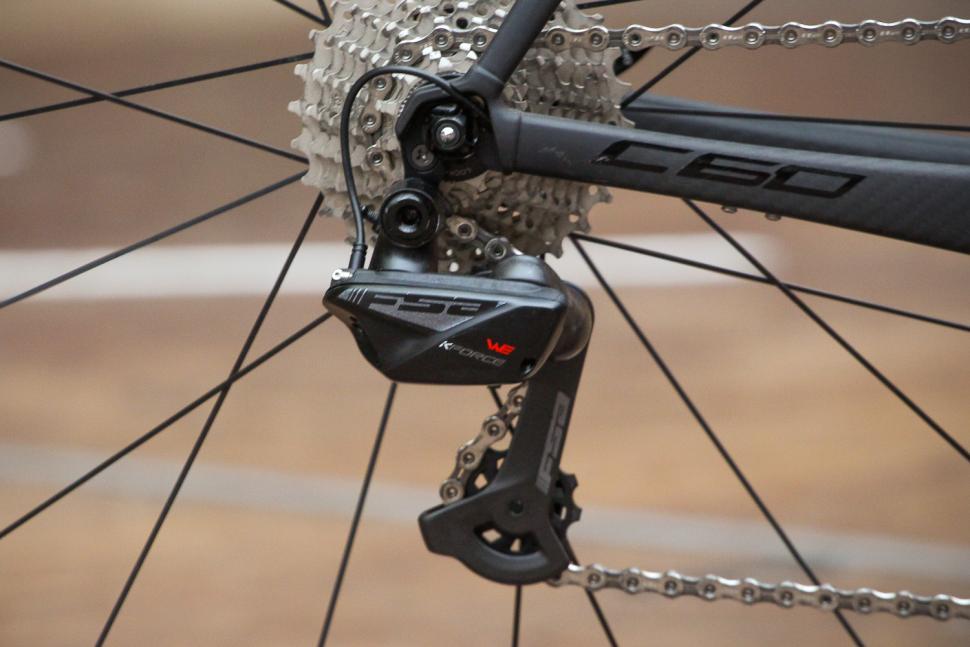 We tested K-Force WE when it finally became available and found it had some way to go to catch up with the electronic groupsets from Shimano, Campagnolo and SRAM. Since then, it looks like FSA has squashed some of the bugs. In August 2019, Angel Madrazo Ruiz of the BH-Burgos team won a stage of the Vuelta a Espana using K-Force WE. The latest version is the 12-speed K-Force WE12S, announced in 2022, but it’s incredibly unusual to find on an off-the-peg bike.
The reason it took so long for FSA to get a groupset out is probably that decent-quality road bikes now all have combined gear and brake levers. There are only so many ways to do this, and they’re covered by patents held by Shimano, SRAM and Campagnolo. Shimano introduced its STI brake/shift levers in 1990, so its patents on that design should now have expired.
The trend over the last few years has been to ever-greater integration between parts, and that will continue. In the days before indexed shifting, you could use a Campagnolo derailleur with Shimano gear levers (though Campagnolo derailleurs of that era shifted so badly it’s a mystery why you’d want to). You can’t do that now and be certain the indexing will work properly, nor should you use Shimano levers with Campagnolo brakes — they have different cable pull requirements. And you definitely can’t use SRAM hydraulic brakes with Shimano levers because they use different, totally incompatible hydraulic fluids.
As for what the future might bring, imagine a system that senses that you’re braking and changes gear for you. That would require a level of integration beyond the current state of the art. Or how about a seatpost that automatically adjusts your saddle height within a range: lower for descending, higher for climbing? Or how about an electronic system that talks to your power meter and keeps you in the necessary gear to put out your target power for a training session?
Some e-bikes feature automatic or semi-automatic shifting, with systems like Bosch eShift and Shimano Auto Shift using sensors to detect your input and road conditions, then shifting gears automatically to maintain a desired cadence or power output.
Shimano has also introduced its Q’Auto system for battery-free automatic shifting on non-electric bikes, meaning that manual shifting is no longer required. Q’Auto independently puts you into the right gear without you needing to think about it – or do anything.
Read more: Is Shimano about to make shifting your bike’s gears a thing of the past?
Shimano says, “Until now, fully automatic shifting was only possible with advanced e-bikes. Shimano’s newest shifting technology takes that concept and turns it on its head, and combines the joy and simplicity of riding a mechanical bike, with electronic shifting. Q’Auto is an innovative technology designed to make cycling more enjoyable and accessible for riders of every skill level.”
What’s to say Q-Auto will work to your preferences and level of fitness, though? Shimano has thought of that.
“Its battery-free design and adaptive learning software allow for an entirely new type of bike that keeps riders in the right gear and adapts to your riding style, allowing the rider to focus solely on the road ahead,” it says.
A shift switch allows you to change to a different gear, and the system will select that gear and remember this setting for similar situations in the future. In short, Q’Auto is designed to remember your individual shifting patterns and learn to behave accordingly.
Will automatic shifting take over? Only time will tell.
> Your complete guide to SRAM road bike groupsets
> Your complete guide to Campagnolo road bike groupsets
> Your complete guide to Shimano road bike groupsets
Know your groupsets
The table below lists the drop-handlebar groupsets currently offered by Shimano, SRAM and Campagnolo, along with the recommended retail price of a complete set of each one. You’ll almost always be able to find them for less than RRP, but the prices give you an index of the relative quality of each groupset. These prices are correct as of October 2025.
When buying a groupset, make sure you know exactly what’s included before stumping up the cash. Different dealers include different components in their groupset packages.
Some groupsets — especially those from Campagnolo — are very uncommon on off-the-peg bikes. It’s also now hard to find high-end bikes equipped with rim brakes these days.
| Groupset RRP | |
|---|---|
| Shimano | |
| Dura-Ace 9250 Di2 rim brake | £3,479.95 |
| Dura-Ace 9270 Di2 disc brake | £3,644.95 |
| Ultegra R8150 Di2 rim brake | £2,039.95 |
| Ultegra R8170 Di2 disc brake | £2,369.95 |
| 105 R7100 disc brake | £924.95 |
| 105 R7150 Di2 disc brake | £1,659.95 |
| Tiagra 4700 rim brake | £579.95 |
| Tiagra 4720 disc brake | £769.95 |
| Sora R3000 rim brake | £539.95 |
| Claris R2000 rim brake | £484.95 |
| CUES U6000 1×11 hydraulic drop bar | £664.99 |
| CUES U6000 2×10 hydraulic drop bar | £679.99 |
| CUES U6000 1×10 hydraulic drop bar | £629.99 |
| CUES U6000 2×10 mechanical drop bar | £654.99 |
| CUES U6000 1×10 mechanical drop bar | £614.99 |
| CUES U4000 2×9 mechanical drop bar | £614.99 |
| CUES U4000 1×9 mechanical drop bar | £564.99 |
| GRX RX825 Di2 2×12 | £2,064.95 |
| GRX RX827 1×12 Wireless | £1,739.95 |
| GRX RX820 2×12 | £1,239.95 |
| GRX RX820 1×12 | £1,239.95 |
| GRX RX610 2×12 | £999.95 |
| GRX RX610 1×12 | £959.95 |
| GRX RX600 2×11 | £944.95 |
| GRX RX600 1×11 | £859.95 |
| GRX RX400 2×10 | £759.95 |
| Campagnolo (excluding BB and rotors) | |
| Super Record 13 2×13 disc brake | £3,850 |
| Super Record S Wireless 2×12 disc brake | £3,430 |
| Super Record Wireless 2×12 disc brake | £4,450 |
| Super Record EPS 2×12 disc brake | £4,675 |
| Super Record 2×12 disc brake | £3,175 |
| Super Record 2×12 rim brake | £2,930 |
| Chorus 2×12 disc brake | £1,745 |
| Chorus 2×12 rim brake | £1,290 |
| Centaur 2×11 rim brake | £635 |
| Ekar 13 | £1,579 |
| Ekar 13 GT | £1,369 |
| SRAM | |
| Red AXS 2×12 (inc Hammerhead Karoo computer) | £4,090 |
| Force AXS 2×12 | £2,168 |
| Rival AXS 2×12 | £1,576 |
| Red XPLR AXS 1×13 | £3,530 |
| Force XPLR AXS 1×13 | £1,917 |
| Rival XPLR AXS 1×13 | £1,392 |
| Apex XPLR AXS 1×12 | £1,227 |
| Apex XPLR mechanical 1×12 | £730 |












9 thoughts on “Which groupset is best for your bike, and how much should you spend?”
I’m now sounding like my
I’m now sounding like my father these days “what you do need x number of gears for?” as I appealed for a bike better than the bombproof SA 3S. The early Shimano indexed BSA Courier bike never functioned properly and eventually I got my first “racer”, a Raleigh Medale 10s.
I got back into cycling about 20 years ago, so I got and have mainly stuck with 10s systems in my little fleet, many running Shimano 600 friction levers that Spa had a batch of a few years ago.for about £15 a pop. My one FD foray into Microshift wasn’t a success.
Overall, I like group sets for all the reasons given, even if my biggest purchase, an Ultegra 6800 fell into the “thanks Shimano” cranks category. A lot of riders will benefit from things like 46-34t systems, so for a road set-up that usually means Stronglight ? square taper. I don’t think there’s ever been a Touring or Audax groupset, e.g. that might have featured long-drop calipers.
Indexing is a pain – if you grew up without indexing, you can happily operate 11s just as well with friction – you’ve got more options when a RD that was shifting fine decides to go loo-lah on a rise. Don’t get me started on battery-reliant systems, as if there weren’t enough complications with charging up cameras and lights.
It’s great and long overdue news about CUES – what will all the cycling fora to do when there’s no more late night “can I run x derailleur with y cassette?” posts?
Sensah worths to be mentioned
Sensah worths to be mentioned too as a groupset manufacturer. Lots of options and sensible prices.
What kind of drunkard did the
What kind of drunkard did the sorting on those groupset price lists?
No article on gears and
No article on gears and groupsets is complete without a plug for https://www.disraeligears.co.uk/site/home.html
(No its not sports washing).
In particular some of the wacky 90’s MTB designs have to be seen to be believed.
The 3 jockey wheel EGS Up-cage.
https://www.disraeligears.co.uk/site/egs_up_cage_derailleur.html
The White Industries LMDS
https://www.disraeligears.co.uk/site/white_industries_lmds_derailleur.html
“Campagnolo (excluding BB [..
“Campagnolo (excluding BB […])”
Tell me, what kind of BB should I be selecting to go with my Ultra-Torque crankset?
Campagnolo Record Outboard
Campagnolo Record Outboard Cups for Ultra-Torque e.g. these.
I have a few sets on hand,
I have a few sets on hand, but that’s just cups. They’re small parts, about £12 a pair, and don’t connect the cranks to each other or contain any bearings. Where is the part that’s missing from the Campag groupsets but included in the others?
I don’t think the statement “
I don’t think the statement “(excluding BB and rotors)” is correct. If I buy Campag Chorus groupset from Condor it contains everything I would need except the band-on FD adaptor for bikes without the braze-on.
Pub bike wrote:
All groupsets I see from Shimano and Campag don’t include the rotors, they’re either left out altogether or a paid-for add-on. On Condor’s website it specifically says rotors are not included with Chorus, maybe you just got lucky and someone included them by mistake! It does include the BB though.