


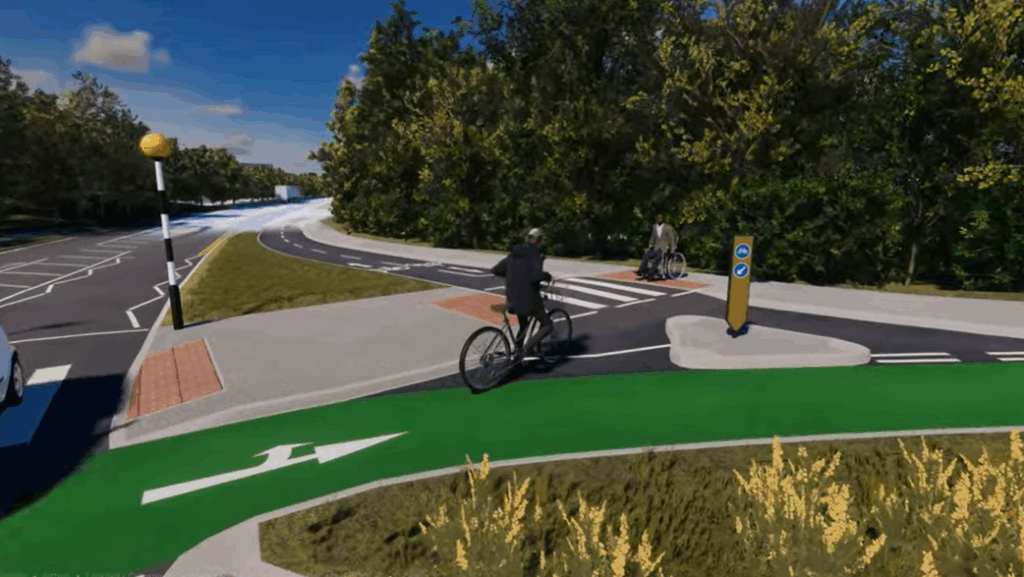

This country is going down the crapper. Everywhere we look we have WOKE nonsense showing how we’re circling the drain and communism is about to take over. How do I know? The media keeps telling me, so it must be true.
I’ve been told that avocados are WOKE, not being racist is WOKE, working from home is WOKE, how an AI tool owned by Elon Musk is WOKE, but most worrying of all… roundabouts. Roundabouts. Are. WOKE!
That’s because according to MyLondon, “Britain’s ‘most woke’ £2m roundabout [is] due to open next week”. Could the last person to vacate this ludicrous country please turn out the lights? Or maybe don’t, because didn’t you know? Saving electricity is WOKE!
MyLondon are not the only site to cover this. The Daily Mail, the Express, and the Telegraph have all written stories about it, and go into great detail about how ridiculous it is that there is a ‘3-minute explainer video’ that people must watch in order to understand how to use this roundabout.
I’m hoping that it will come as a surprise to nobody that this explainer video doesn’t try to explain an incredibly complex system. Mainly because this is not a complex system; it is a Dutch-style roundabout, so it has a cycle lane going around it in the same way that most roundabouts have footpaths around them.
The first 50 seconds of the video – which we’ve embedded above for your viewing pleasure – introduces where the roundabout is, what is does, and why it was built. It then takes 30 seconds to show how a cyclist needs to do ‘complex’ manoeuvres, like stopping at stop lines and not running over pedestrians on zebra crossings. The next 45 seconds explain how cars need to stop at stop lines, not run over pedestrians on zebra crossings, or cyclists in cyclists lanes, and how lorries need to check their blind spots. The last 25 seconds talk about onward active travel routes.
WOKE!! COMPLEX WOKERY!!
The idea that stopping at stop lines and checking your blind spot is somehow woke is absolutely mental, but is unfortunately symptomatic of the right-wing media’s constant need to find thing to make people angry about that don’t run counter to their long- standing narratives.
It means that progressive ideas that would make the UK a better place for people to travel, for people to raise their kids, to clean up pollution, and reduce deaths on the road are labelled as something that people should be angry about. It is desperation from a bunch of people clinging to relevance, and keeps the kind of people who still read their awful papers in a state of constant anger and bewilderment, scared of change but also wholly unsatisfied with their current predicament.
Unfortunately, this means their ire is generally aimed directly in the direction of cyclists and/or people who just want to walk around now, so it seems. This is all because what we choose to spend our time doing and writing about does exactly what they don’t want people to do: be active, happy, and healthy.
Calling roundabouts ‘woke’ is just the latest in a long line of culture war nonsense aimed at cyclists by these titles. Whether it’s the Telegraph claiming that cyclists are running people down at 52mph, or Iain Duncan-Smith trying to persuade the public that cyclists are more deadly than drivers (despite statistics suggesting that his own policies killed more people in five years than cyclists have done in 200), the juggernaut of fact-lite nonsense rolls on and on.
We are in a media landscape where journalists at these bigger titles are forced to write this stuff, I suspect because it is the only way they can get on in journalism. The person who wrote the article is not a frothing idiot. They are almost certainly a recent graduate who has clearly been asked to write a boring article, then an equally downtrodden person knows they must write an attention-grabbing headline to generate page views and engagement. They have done what they were asked to do, but that just reinforces the stereotypes around cyclists, and ultimately adds to the content that makes all of us less safe on the roads.
The problem we have is that it works. Mainstream journalism today is not so much about covering the important news, it’s a rocket-powered race to the bottom… and the culture war-obsessed rags are using cyclists and active travel as fuel.




















33 thoughts on ““Woke roundabouts” is a depressing new low when it comes to how the media attempts to report on cycling and active travel”
Great commentary, George. But
Great commentary, George. But how about using the term “sensible ideas.” For your U.S. readers, “progressive” has some negative connotations. Progressives were a big force in bringing Prohibition to the U.S. It seemed a perfectly sensible idea to them. It turned into a shite show. I’d hate to have anyone thinking about Dutch roundabouts in a similar context, given that they work great.
Wouldn’t worry, there’s
Wouldn’t worry, there’s nothing but shifting sands with words, particularly when they get political (anywhere). People will get the meaning they want to take!
An older example (than “bad” or “woke”) from a well-known US writer:
ORDINARY, adj. Common; customary. In the Southwestern States of the Union this word is pronounced ornery and means ugly—a striking testimony to the prevalence of the disagreeable.
Maybe I’m one of those rude
Maybe I’m one of those rude cyclists who is never happy with the infra… but I don’t much like the look of the tight left turn from the roundabout onto the cycle route in the video. Hope that radius is not as tight in real life.
quiff wrote:
Given that the video is just an AI rendition (along with the rather stilted commentary), I shouldn’t worry. The one introduced near the courts in Sheffield, though much smaller, works just fine for those who bother to use it. Lots of cyclists seem a bit lairy as yet. But, to quote a certain baseball film, now that it’s built, they will come.
Please don’t call the…
Please don’t call the… Things that write these articles, ‘journalists’. They are not. Most of them can neither spell nor master simple grammar. They use online tools to “write” the crap they turn out and an equally useless editor usually fails to spot the errors, due to a high level of stupidity in both.
Or perhaps they’re just cheap.
It’s lazy journalism driven
It’s lazy journalism driven by a need to generate clicks for their websites more than anything. Having said that, the editorial stance of the Mail and Telegraph has long held a degree animosity towards cyclists as a group. Their coverage has worsened in recent years, which, in my view, stems from their London-centric outlook and a lack of broader engagement with cycling culture across the country. It’s also not been helped by “Cycling Twitter”, and how some individuals do create incidents while riding, then posting them on social media.
The irony, somewhat depressing in its own way, is that many staff at these publications cycle into work themselves. Not to mention, the Telegraph employed Boris Johnson, who introduced popular hire bike schemes and has been an advocate for cycling.
As for the word ‘woke’, it’s been rendered nearly meaningless—often used by those who dislike something but struggle to form a coherent or rational argument against it.
It’s called rage bait. Ignore
It’s called rage bait. Ignore it. Those who approve of it will never change their small minds anyway.
It will sort-of change their
It will sort-of change their minds. It will amplify their echo chamber, strengthen their feelings, make their hatred feel righteous, and make them feel that they have the support of wider society. It limits their opportunities to hear counter-opinions and nuance. It will radicalise them further.
So next time you get a motorist hurling abuse at you for no reason, or objects thrown out of a car at you, then this in part can be traced back to ‘woke’ roundabouts.
All very true except for the
All very true except for the bit about journos being forced to write this stuff. As a thought experiment, I asked this to Perplexity (AI LLM) and got back something which I would struggle to spot was machine generated. More, idiot generated.
“write me a 200 word article in the style of the daily mail, showing antagonism towards cyclists and how they inconvenience motorists who should really own the roads”
Got this: (it even has references). Wtf indeed
“Motorists across Britain are once again finding themselves at the mercy of the so-called “lycra louts,” as cyclists swarm our roads with apparent impunity. While drivers pay hefty road taxes and insurance, cyclists glide along, weaving through traffic, jumping red lights, and even mounting pavements—often with a smug sense of entitlement that leaves law-abiding motorists fuming.
The Daily Mail has long highlighted how these two-wheeled eco-warriors, emboldened by town hall bureaucrats and green lobbyists, now believe they “rule the road,” turning every commute into an obstacle course for the real owners of Britain’s highways. Cyclists, cheered on by officials pandering to their every whim, seem to think saving the planet gives them carte blanche to ignore the rules that everyone else must follow.
Meanwhile, motorists are left to navigate a gauntlet of unpredictable cyclists, forced to slow down, swerve, and risk fines or worse if they dare to challenge this new order. It’s high time common sense returned to our streets: roads were built for cars, not for hobbyists in spandex holding up the nation’s business and family life.
”
“
richliv wrote:
Shurely a “no thought experiment”? Although I guess that depends on your philosophical position (RE hard problem of consciousness)?
No thought, indeed. But I
No thought, indeed. But I think there’ll be clear water soon between media who use journalists to produce thoughtful pieces that readers empathise with, and media mostly written by AI where in spite of have the form on the surface, adds no actual value and is pure click bait. Like the *Live.com websites run by Reach Media. It’s a horrible race to the bottom driven by least cost and not recognising value in people’s opinions, only financial.
That’s a fascinating and
That’s a fascinating and frankly disturbing thought experiment, richliv. Your point about AI being able to generate such antagonistic, Daily Mail-esque content so convincingly really underscores the author’s argument about the ease with which these divisive narratives are created.
It certainly makes you wonder how much of what we read is genuinely held journalistic opinion versus content crafted purely for clicks, whether by human or machine. It’s a sobering thought that AI could so easily replicate the kind of rhetoric that actively harms road safety and fosters division.
[Or at least, that’s what Gemini says.]
Same as everything else I
Same as everything else I guess – just add some other things to the list of “made in a factory – used to be low-paid workers making it, now it’s just machines”.
Presumably there will be a small market for overpriced hipster content with a “hand-written” tag. And knock-offs of same…
Not for journalism. If its
Not for journalism. If its impossible to make a living at journalism because, AI, then I doubt people will take the risk individually. Sites like road.cc have a pre- existing brand which quite a few people trust, so likely in a better position for now, but that may erode. Hard to know, tbh. I work with AI professionally (as in, creating systems that use LLMs and more) so I am maybe better informed than most and I have to tell you, it’s coming for all white collar professions in one way or another.
I can believe it. But …
I can believe it. But … there will almost always be a niche. But it’s just how small that is / how close to “the wage of an artist is bread”?
After all we’ve had factory-made loaves for some time but there are still small bakeries (although the profit tends to come more from the pastries rather than the bread…) You can even find hand-made paper!
Although … perhaps the whole notion of making physical marks on a surface or delivering physical gifts will also become incredibly niche?
More a question of whether
More a question of whether the artisanal journalism will be drowned out by the low cost vast wavevof AI generated c**p. My FB feed is already unusable for this reason. Maybe it’ll settle down to a steady state eventually where both forms exist. Maybe print newspapers will return, hard to pollute those with AI generated nonsense, but the Daily Mail journos do a great job of that by themselves anyway 😄
richliv wrote:
I can say from personal experience that it’s already pretty much done for 90% of the freelance writing market. I saw an interview the other day with Geoffrey Hinton, a.k.a. “the Godfather of AI”, who has moved from creating AI to warning of its dangers: when he was asked what sort of employment he would advise people to aim for he said, “It’s going to be a long time before [AI is] as good at physical manipulation as us, so a good bet would be to be a plumber.”
Interesting/terrifying news
Interesting/terrifying news in the Guardian this morning: the number of entry-level jobs advertised has fallen by 32% since Chat GPT launched:
https://www.theguardian.com/business/2025/jun/30/uk-entry-level-jobs-chatgpt-launch-adzuna
Rendel Harris wrote:
Except its almost certainly bollocks. Correlation is not causation. We’ve hardly had the most stable last few years. I’d want something more riguourous than a bunch of chancers who run a recruitment site. We all know recruitment is where failed estate agents go.
Secret_squirrel wrote:
Okay, how about the McKinsey report the estimated that 30% of US jobs could be automated by 2030, the Goldman Sachs report that estimates that 25% of the global labour market could lose their jobs to AI by 2045, JP Morgan’s estimation that by 2030 at least 20% of their workforce will no longer be required due to AI, or the Institute for Public Policy report that found that 60% of administrative tasks currently performed by humans could be undertaken by AI even in its current iteration. I don’t think all the people who wrote those reports can be failed estate agents…
Rendel Harris wrote:
I’m obviously missing something, but if so many people become unemployed because their jobs have been replaced by (definitely not hallucinating, guv!) LLM software, who will the companies that have replaced their workforces actually be selling stuff to?
brooksby wrote:
Interesting question. One depressing model I saw recently suggested that although a substantial percentage of workers might be surplus to requirements, due to the reduced running costs of companies who replace them with AI higher management employees of companies will become substantially richer and so many companies will simply focus on these newly wealthy individuals and their luxury needs; after all if you sell one £15,000 bicycle to a rich person your profits aren’t going to be dissimilar to, or possibly even greater than, selling thirty £500 bicycles to the lower paid. A more utopian solution that some economists believe is inevitable if AI lives up to predictions would be the introduction of a Universal Basic Income, though how that’s going to get past the gatekeepers of global capitalism is another question.
Rendel Harris wrote:
As soon as we see AI in the accounts / the treasury (if we haven’t already…) I’m sure Skynet will immediately conclude that’s a saving to be made. Likewise with the cost of most older folk…
Rendel Harris wrote:
Or the companies could use the increased competition for jobs to reduce the wage bill even further and increase the shareholder value as they already do when possible, they will rely on the government to subsidise them by paying benefits to all the unemployed.
Rendel Harris wrote:
When you have ‘Mericans calling the British healthcare system “communist”, I can’t see the American sphere of influence and vassal states ever taking up UBI…
Rendel Harris wrote:
You’ve missed the most obvious point. All those companies have a vested interest in selling AI, either directly (McKinsey) or because they are riding the bubble themselves (GS) or at best have drunk the AI koolaid (IPP).
These are the same companies that spent a decade trying to flog blockchain, and a dozen other bubbles before that.
Is AI a useful tool? Yes it can be. Much like but much less than say a spreadsheet can be. Think of it as about as useful as a high powered spellchecker and you wont go far wrong. It takes about 10% of the drudgery out of a day job for certain types of role – thats all. Everything else is either Sales Pitch or US CEO bullshit.
I run the ROI analysis for all the AI initiatives in my company. Take it from me AI is the next dot com bubble. The trillion dollar investments dont match the outcomes and it will be a bloodbatch when the valuations of these companies collapse. Will there be some interesting bits and pieces among the rubble together with a couple of new winners yes because thats how bubbles work.
Secret_squirrel wrote:
Interesting example, I have no idea of the figures but one would imagine that a very significant number of staff have lost their jobs since the advent of the personal computer due to the fact that one operative can process figures and produce reports in a fraction of the time that would have taken dozens of employees back in the day.
As for AI being “about as useful as a high-powered spellchecker” that’s simply nonsense. It’s quite capable of producing perfectly literate, if uninspiring, text and a lot of writers have already lost their livelihoods because of it. Ten years ago a travel company wanting, say, 2000 words on the artistic and historical glories of Crete for their website would put that contract out to tender and pay, if it was a decent-sized company, around $500-$1000 for that service. You can now go on ChatGPT or any of the other free services and get that text provided free in a matter of seconds. It might not be as well written or as well researched, in fact it definitely won’t be, but it will certainly be of a quality that will be adequate for 95% of users. Whether or not you think that’s a bad thing is up to you, but claiming that it’s just a “high-powered spellchecker” is ridiculous.
Rendel Harris wrote:
Mechanisation absolutely puts people out of work … but a few new niches may be created. And counteracting that as e.g. it became quicker to produce reports, more reports were produced!
As with AI – I suspect it’ll be far more bullshit (glossy, plausible), faster. Or more politely – instead of a single pamphlet from a copywriter (text) in the same time we’ll expect someone using AI to generate video content and perhaps a measure of managing “interaction” e.g. comment sludge on the SM’s [ which I’m adding to… ] ).
I’d definitely bet this will be significant – just not sure whether it’s “a few of us” or “a substantial fraction” – with the competition for remaining human jobs in those areas becoming even more cut-throat.
It’s certainly true that
It’s certainly true that there is a tech bro gold rush on to sell AI tools, especially agentic AI. That’s the version where it doesn’t just tells you about what trip you might like to take, it can book it all for you on your say-so. All that’s about reducing the friction of eComnerce shopping and checkout to near zero, rather than replacing the human world, though it’ll have some effect on that too. LLMs will remove some category of jobs entirely (social media marketing? Cv writing and filtering?). It will create a lot more. Imagine the positive impact it could have on teaching when overloaded teachers can have virtual assistants to help plan lessons, mark, and children can have personalised virtual assistants to ask questions to help explain concepts and topics. A shift in the way teaching and exams work today will be needed otherwise it’ll be a free for all. But just illustrating how transformative all this could be given the right choices. It depends on politics too so I’m not on the edge of my seat.
Was this written by a not
Was this written by a not-very-good, not-very L LLM that wasn’t fed enough data on Use of English and spelling?
Of course, remember paperless
Of course, remember paperless offices and the massive increase in leisure time we’d all be experiencing…
Often the way with tech
Often the way with tech “solutions”. If they succeed and settle in the early bugs get mostly worked out. But then come the cons of mass adoption / overuse / misuse / issues which only emerge in the longer term – and detract to some degree from the benefits *. And of course what’s not new or rare or terribly limited then becomes background and people find something else to get upset about / worry about / compete over.
Recall nuclear power – “will be too cheap to bill”. Or indeed the heyday of mass motoring…
* I probably lean toward “things are getting better … very slowly”.
I have now watched the video
I have now watched the video about the roundabout. It’s very good, but I await the first announcement from Hertfordshire Constabulary that they will take no action over OpSnap videos showing motor vehicle near-miss attacks on cyclists and pedestrians ‘because the cyclists/ pedestrians should have been looking where they were going’. That’s just the first stage in the process whereby the police forgive motorists for actually hitting said cyclists/ pedestrians, for the same reason and ‘everybody does it’ (charge straight across the pedestrian/ cyclist lanes, that is).