



In October 1974, as a storm gathered over Zaire’s capital Kinshasa, Muhammad Ali shocked the sporting world by knocking out the undefeated heavyweight champion George Foreman.
A 40-1 outsider with some bookies, an ageing Ali knew he had to come up with something special to beat the fancied, powerful Foreman. And he did, employing his now famous ‘rope-a-dope’ strategy, deliberately placing himself on the back foot by leaning against the ropes, inviting Foreman to land blow after heavy blow.
For seven rounds Ali soaked up the pressure, tiring his relentless opponent, goading the future grill salesman after every punch. ‘Is that all you got, George?’ In the eighth, Ali finally came off the ropes and landed a perfect right hander to send Foreman to the canvas. His status as boxing’s greatest was secured, even when – and perhaps because – it all seemed so improbable.
I’m not sure whether Tadej Pogačar has studied Muhammad Ali’s career in any great detail. But if he has, the Rumble in the Jungle would have offered some valuable lessons for the world champion’s spring classics campaign.
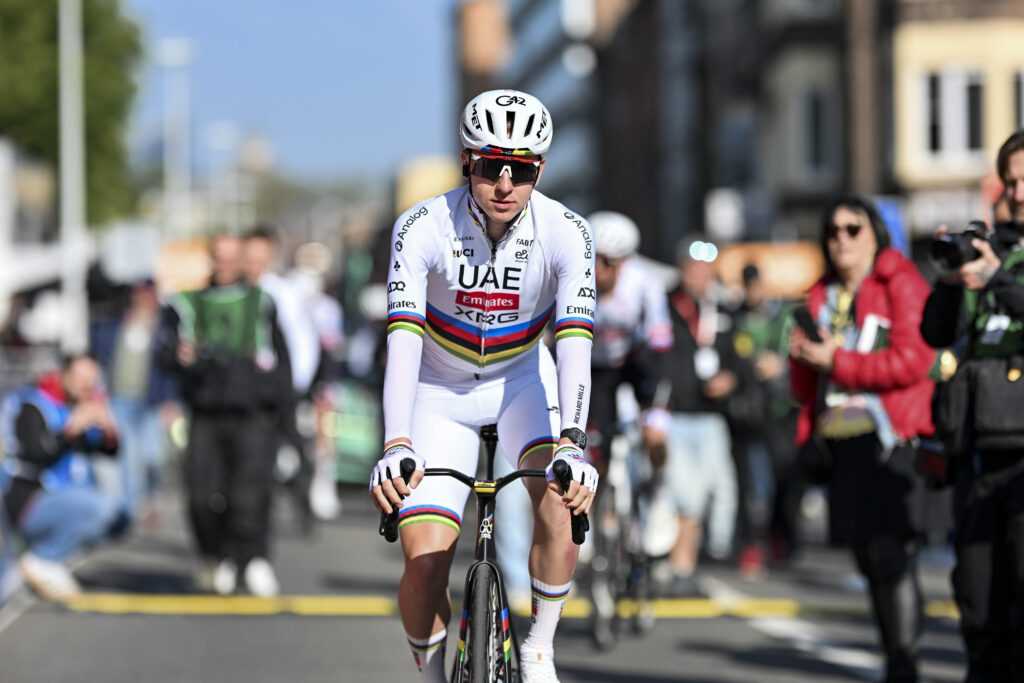
On paper, Pogačar’s 2026 has, so far, been as close to perfect as any bike rider has ever managed. The UAE Team Emirates star has raced just five times, in the five biggest one-day races on the spring calendar: Strade Bianche, Milan-Sanremo, the Tour of Flanders, Paris-Roubaix, and Liège-Bastogne-Liège (these days, Pogi doesn’t interrupt his training schedule for any old Mickey Mouse race).
He won four out of the five. Not a bad hit rate. Roubaix, as I’m sure you know, was the only race that eluded him, that second place at the Hell of the North the one blemish (if you could call it that) on an otherwise faultless spring.
Essentially, men’s pro cycling has reached the stage where Tadej Pogačar turns up and Tadej Pogačar wins.
Of course, on the road it wasn’t that simple. In fact, Pogačar was forced to rope-a-dope quite a bit this spring – more than he would have liked – before throwing that killer punch.
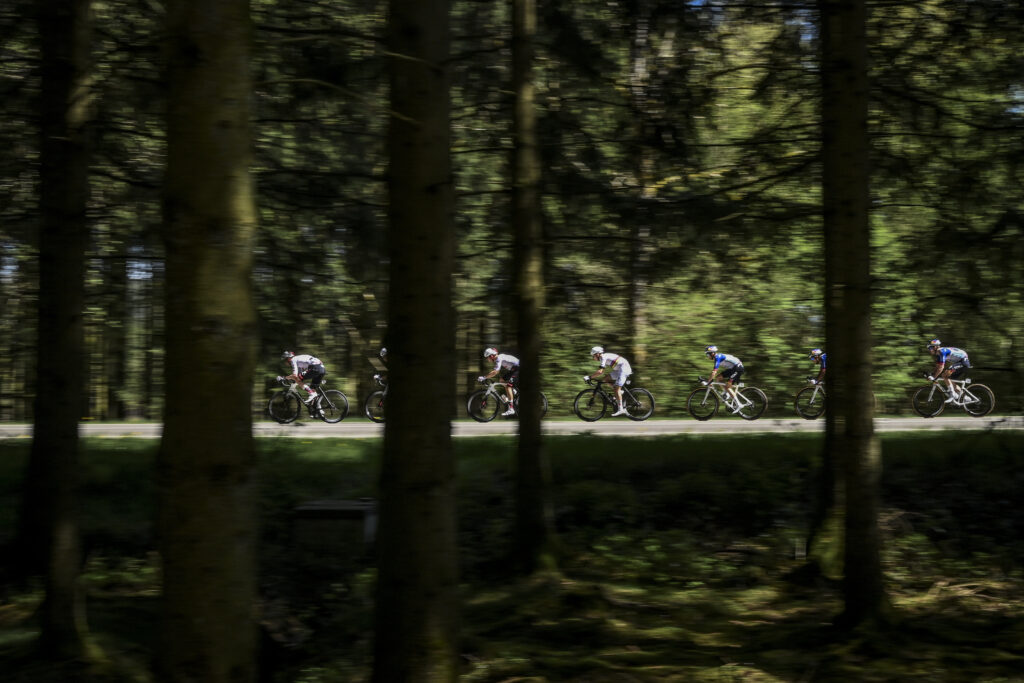
Strade Bianche and the Tour of Flanders were pretty straightforward affairs, certainly, but the rest of the spring saw Pogačar hit with a prolonged streak of bad luck, a concentrated bout of misfortune he hasn’t really experienced since crashing out of Liège three years ago.
At Sanremo, UAE’s best laid plans appeared to have gone agley following their leader’s ill-timed crash just before the Cipressa. In a race where every flick of the pedals matters, surely that was it, we all thought, the Primavera monkey would remain firmly perched on Pogačar’s back.
But, ripped jersey and all, the world champion leapt off the ropes and grabbed the race by the scruff of the neck. The pesky presence of Tom Pidcock ensured he still had to absorb a few jabs, but Pogačar had enough in the tank to land the killer blow in the sprint. Job done. And just like Ali in Zaire, that uncharacteristic triumph on the Via Roma could well prove the defining moment of his career.
Paris-Roubaix, if anything, was even more chaotic, a puncture with 120km remaining leading to the uniquely bizarre sight of the world champion forging ahead on the cobbles, for a while a least, with one of Shimano’s blue neutral service bikes.
Forced back against the ropes again, Pogačar then went on to produce his best Roubaix performance yet, entering the velodrome with the win in sight, only to be outsprinted – much to the cycling world’s delight – by Wout van Aert. Would the Slovenian have fared better in the final kick without that unfortunate flurry of mid-race bike changes and subsequent chase back to the bunch? Probably not, but I suppose we’ll find out next year.
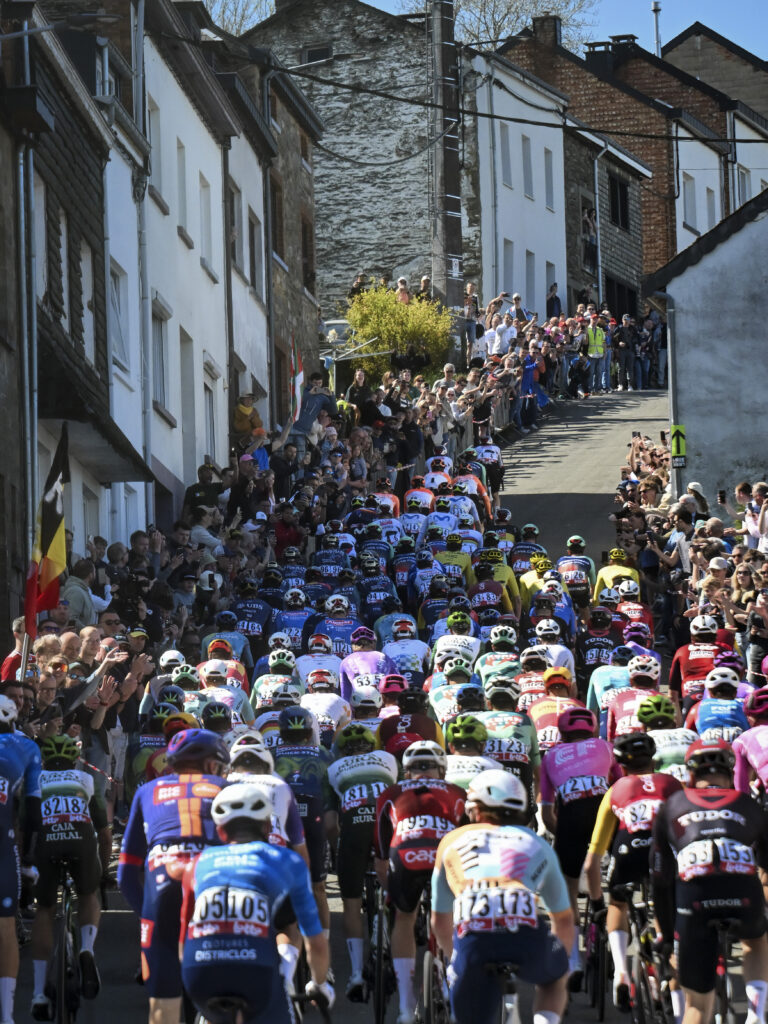
Bad luck comes in threes, of course, so it was no surprise at Liège this weekend that things went wrong almost immediately for the world champion. An early crash split the bunch, the race exploding as a 52-rider group, including two-time winner Remco Evenepoel, slipped away.
Pogačar and most of his UAE team were caught minutes behind, but by then their rope-a-dope classics strategy was firmly established. Instead of swinging aimlessly at the wind, UAE remained calm and were willing to take a few punches to the stomach, as Evenepoel built up an early lead on the scorecards.
‘Is that all you got, Remco? Come on, you can hit harder than that.’
Just bide your time, he’ll tire himself out, Pogačar’s inner Ali seemed to whisper. And in the eighth, you strike.
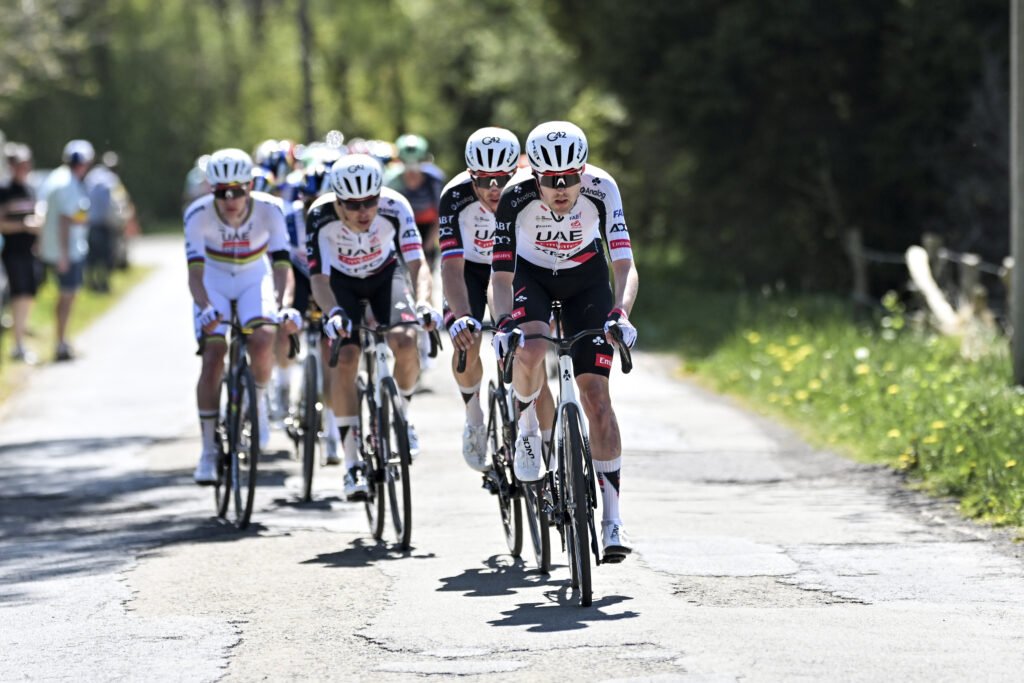
So it proved – by the race’s proper finale, things were back together, as Red Bull’s early offensive fractured, the Foreman-like cracks starting to show. That sustained attack, with UAE seemingly floundering on the ropes, left Evenepoel and his squad vulnerable on La Redoute, where the world champion threw a haymaker and Remco clattered to the ground. Rope-a-dope, baby.
This year’s spring classics campaign, it’s fair to say, showcased a different side of Tadej Pogačar. He’s still been bewilderingly, unbelievably dominant, of course, shattering records everywhere he goes. But the 27-year-old has also been forced to adapt and respond to setbacks like never before, and harness the chaos of one-day racing to his advantage, rather than attempt to smother it with sheer power, like he may have tried in the past.
His counterpart in the women’s peloton, Demi Vollering, has enjoyed an almost entirely serene passage to similar levels of spring dominance this year, one wrong turn at Strade Bianche notwithstanding.
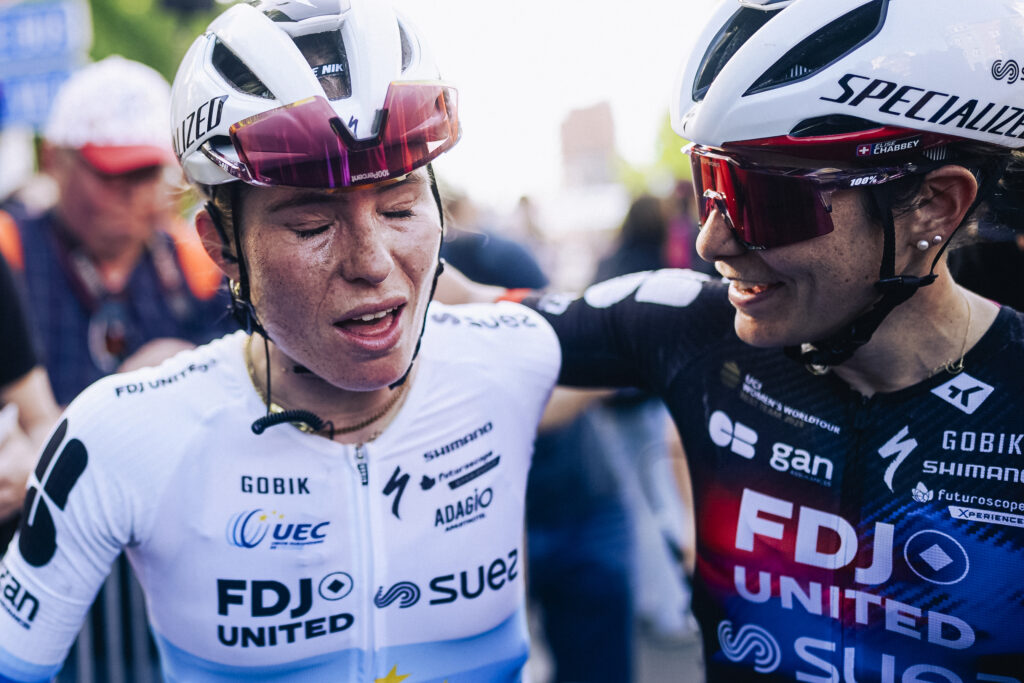
Vollering has floated like a butterfly and stung like a bee, a figure of complete control and poise as she accelerates away, in the saddle, from her rivals.
Pogačar, on the other hand, has lacked that control this year. But he’s still won. And in many ways, that makes him an even more frightening proposition. Just when you think he’s on the ropes and can’t take another punch, you’re knocked out.
He’s also had to deal with another previously unknown factor this year: the emergence (or re-emergence) of new rivals pushing him to the limit. While we’ve relied on Van der Poel and Vingegaard to challenge the Pogi dictatorship, the 2026 classics have further democratised the racing world.
Pidcock played the role of plucky underdog at Sanremo, and Van Aert fulfilled his destiny with a stunning coup in Roubaix, two longstanding opponents, often consigned to watching the Slovenian disappear up the road, rising to the occasion.

But in Liège on Sunday afternoon, cycling may have just entered a brand-new era. At just 19, Paul Seixas did the unthinkable in the steep hills of the Ardennes. He pushed Tadej Pogačar to the limit, on his own terrain, on his own terms. The next five years of men’s racing was mapped out on the slopes of La Redoute. And it was great.
Tadej admitted that he was surprised when he saw the young Frenchman on his wheel after his race-shattering attack, “looking impressive”. He knows he has a new, unpredictable, exciting rival to battle against, one who could soon deliver the perfect, hard-hitting combination.
After all, Seixas matched him pedal stroke for pedal stroke on the fastest ever ascent of La Redoute (during the fastest ever Liège-Bastogne-Liège), Pogačar’s new teenage nemesis only falling at the final hurdle, on the Roche aux Faucons.
Following his shock knockout win over Foreman, Ali took on his old nemesis Joe Frazier in the Thrilla in Manila, 14 brutal rounds that saw ‘The Greatest’ emerge victorious – but which ultimately precipitated his physical decline and eventual downfall.
Will Seixas, the dreams of a nation on his back, prove the Frazier to Pogačar’s Ali, pushing his sport’s greatest ever champion to ever higher levels – and, maybe, just maybe, to the brink? If he does, years from now, cycling writers could be reflecting wistfully on the Siege in Liège and how it changed the sport as we know it.





















7 thoughts on “Rope-a-dope: Tadej Pogačar’s chaotic classics campaign proves even bad luck (and exciting new rivals) can’t stop cycling’s greatest landing the knockout blow”
“Siege in Liège”
Chapeau indeed.
As opposed to Hinault’s 1980 win, which was the Neige in Liege.
For Seixas of course it’s the Coming of Age in Liege.
Pity it doesn’t really ryme.
You keep using that word. I do not think it means what you think it means.
Exactly…silly use of the term.
No pretending to be ‘on the ropes’ by Tadej, ever. Everyone knows when he’s going to attack. He fakes nothing.
Nothing dopey about Seixas pulling turns with Tadej either, it’s about honour and respect. Winning (or not) fair and square.
Nice write-up, Ryan!