


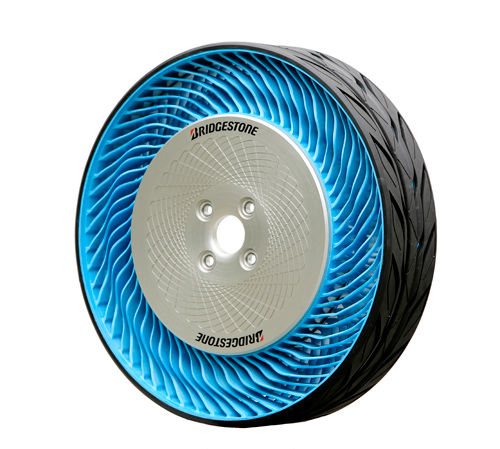

Bridgestone have become the latest to develop an air-free bicycle tyre, and plan to make tyres with their patented ‘Air Free Concept’ technology available to the public by 2019.
Tannus launches new Aither 1.1 solid tyres
The Air Free Concept technology uses a unique structure of resin spokes stretching along the inner side of the tyre, which supports the rider’s weight in place of air. Bridgestone say their innovation will also “enable proposals of next-generation bicycles which have never been seen before” due to the high flexibility that resin allows in terms of design.
In addition, the thermoplastic resin used for the spokes tick the eco-friendly box, as it can be re-moulded after cooling and heating so it can easily be recycled.
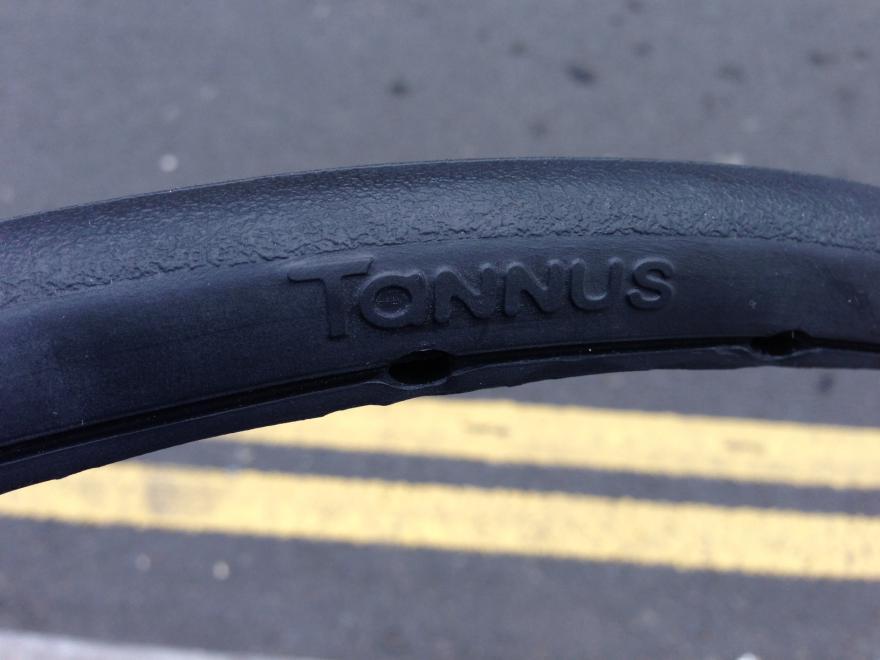
Air-free tyres have been tried and tested with various degrees of success to date, with perhaps the best endorsement so far being the Ukrainian National cycling team using Tannus Aither 1.1 solid tyres for their training rides. Although the weight and rolling resistance of the Aither 1.1 still isn’t comparable to a high-end clincher, Bridgestone claimed back in 2013 that their Air Free Concept car tyre prototype achieved the same rolling resistance as their pneumatic fuel-efficient tyres, so we’re hoping for more with Bridgestone’s innovation.
Although the intended 2019 release date at the time of writing means we’re a long way from being able to test, the promise of puncture-free riding means we’ll be following Bridgestone’s updates in earnest over the coming months…






11 thoughts on “Bridgestone latest to develop a puncture-proof bicycle tyre”
Not really a tyre, more like
Not really a tyre, more like a whole new wheel!
Would you be able to replace the wornout contact surface, or do you have to discard the whole thing?
It would be interesting to see how this design will cope with the side loads experienced when cornering too.
There are perfectly good uses
There are perfectly good uses for airless tyres. Heavy-duty weight bearing wheels on slow moving machines, or the sort of metro trains that run on tyres, for instance.
When will the manufacturers work out that bikes are not one of those use cases?
jollygoodvelo wrote:
Hopefully never and eventually crack the code on light, fast, puncture free tyres.
Looks like if would
Looks like if would necessitate disk brakes…
Michelin and others have been
Michelin and others have been working on these for a long time for car and truck use also bikes – have a look on YouTube for examples and have a look at this for some radical-looking bike tyres: http://www.energyreturnwheel.com/ERW-Bicycle.aspx
What you lose with these systems is the ability to tune the pressure on the fly – some systems seem to allow you to change the elastomer stiffness, but it’s not a trivial job that can be done in a few minutes or at the roadside.
so people don’t drive to work
so people don’t drive to work because they worry about getting punctures?
antigee wrote:
Car tyre punctures are extremely rare. I haven’t had one in over a decade. Covering the same mileage, my bike tyres puncture at least 5 times a year.
antigee wrote:
Huh?
Theyre pretty rare – the sort of debris a bike tyre picks up all the time from makes little difference to a car tyre.
In 35+ yrs of driving, I’ve only once had a car flat, and in the case of my OH, one or zero in 20yrs and a lot more mileage.
On a cycle commute of 2-4 times a week -once or twice a year. And I’d usually only find out as I went to leave.
So not a deal breaker, but a PITA. Many people already use heavier tyres for commuting because of better puncture resistance – and some aren’t very good at swapping tubes either (the same applies to car wheels)
Would love to see the real
Would love to see the real world effects of wind on these….
aero effects could be amazing (in a bad way) but I reckon you could probably wind them up to sound like a jet engine if you tried!
Commenters – you do realise
Commenters – you do realise that the pictured wheel is an automotive application?
Update?
Is there any update on this ?