


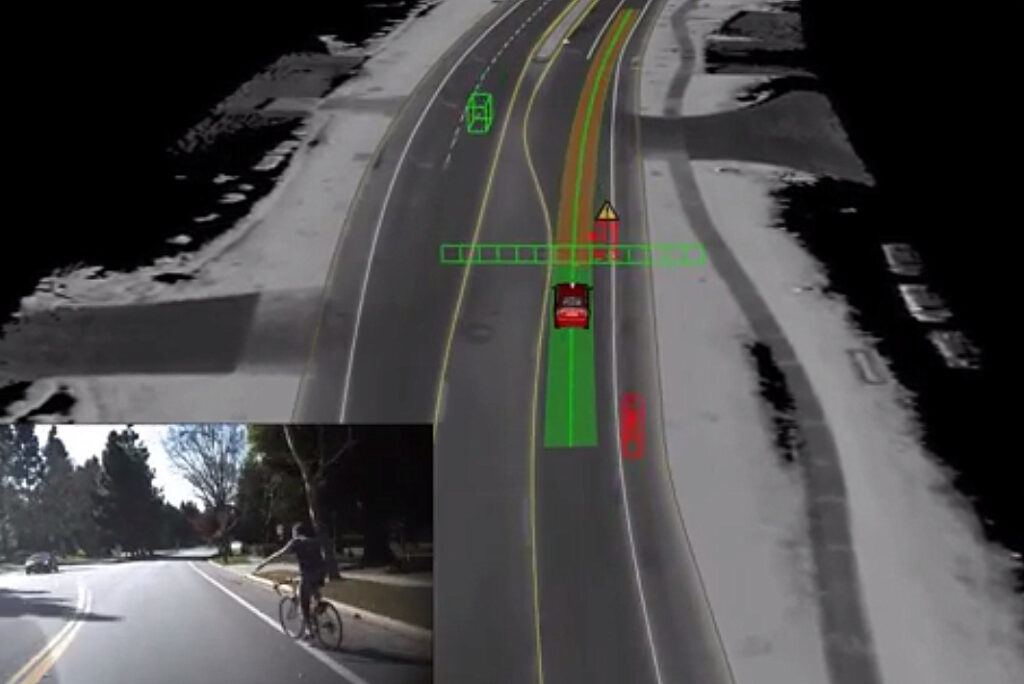

Google has released a new video showing how its self-driving car is being taught to cope with common road situations such as encounters with cyclists. We’d far rather share the road with a machine that’s this courteous and patient than a lot of human drivers.
We’ve all been there. You need to turn across the traffic, but you’re not quite sure where, so you’re a bit hesitant, perhaps signalling too early and then changing your mind before finally finding the right spot.
Do this in a car and other drivers just tut a little. Do it on a bike and some bozo will be on the horn instantly and shouting at you when he gets past because you’ve delayed him by three-tenths of a nanosecond.
But not if the car’s being controlled by Google’s self-driving system. As you can see in this video, the computer that steers Google’s car can recognise a cyclist and knows to hold back when it sees a hand signal, and even to wait if the rider behaves hesitantly.
Later in the video we see the car waiting to turn right at a junction, the equivalent of a UK left turn. Not only does it wait for cyclists ahead of it to clear the junction, but it detects cyclists behind it and lets them through before making the turn.







61 thoughts on “Video: Google’s self-driving car meets cyclists and out-performs far too many human drivers”
Self driving cars are the
Self driving cars are the future, I’m a big fan of taking the idiotic and dangerous part of cars out of the equation.
On the video at 1.27 the car at in the RH lane at the bottom appears to door the cyclist passing in the bike lane. Why?
It’s likely to be that when
It’s likely to be that when the bike went past the car, the google car could only tell one big object, hence why the bike disappeared for a bit. It then reappears as the sensor realises it’s actually two separate objects.
It’s great tech, now if only
It’s great tech, now if only they could harness the power of being beeped at by the idiots behind who’d rather it just ran straight through any two-wheeled obstacle. Regenerative beeping, come on you eggheads, it can’t be that hard.
Self driving cars are
Self driving cars are definitely the future. Road safety has been incrementally improving over the last 50 years (mainly for car occupants) but taking the human factor out of it will be a huge step-change.
Hopefully the sensors/computers will be able to notice more subtle signs, such as a cyclist looking over their shoulder when approaching a turning, often the prelude to a hand signal, and a sign that good drivers will recognise.
Brilliant, really really
Brilliant, really really impressive! =D>
I was talking to my kids
I was talking to my kids about this the other day, they are 7 and 8, I seriously doubt they’ll be driving a car like we currently do.
the sooner computers take over the better.
I know some drivers are bad
I know some drivers are bad but i’m amazed that the comments so far for self-driving cars are positive.
To some extent, the thought scares the life out of me whilst another bit of me quite likes the idea.
I do not think this these self drive cars are imminent. Just like the google drone deliveries, bit of a gimmick designed to grab headlines.
Any such move would come with an awful lot of safety systems/testing before any governemnt would accept it on the road and rightly so.
SB76 wrote:I know some
it’s definitely coming. All the manufactures are working hard on this. Several already have working demo systems. Legislation is already being discussed in Europe and the US. It will probably be on the roads far quicker than you might expect. As seen in this video they have the potential to be far safer than an existing human controlled vehicle. When the technology matures the legislation may switch the other way and make ‘manual’ cars very highly regulated
I know it’s coming, i’ve seen
I know it’s coming, i’ve seen some of the kit developed by small tech companies for the car companies wrt collision avoidance.
Some really good stuff already getting deployed on high branded cars to will deploy breaks/produce audible warning in the event of collision detection. Very, very clever stuff espcially considering how poor reverse sensors can be.
I know it’s coming, i’ve seen
I know it’s coming, i’ve seen some of the kit developed by small tech companies for the car companies wrt collision avoidance.
Some really good stuff already getting deployed on high branded cars to will deploy breaks/produce audible warning in the event of collision detection. Very, very clever stuff espcially considering how poor reverse sensors can be.
SB76 wrote:I do not think
I disagree. Google have spend considerable time and resources in research and development on this, as well as political lobbying for laws to be passed allowing the cars to drive on public roads.
The Amazon drone deliveries, as far as I know, is nothing more than words.
Driverless cars are coming, sooner than you might think, IMO.
See: http://en.wikipedia.org/wiki/Google_driverless_car
Don’t all get excited.
Don’t all get excited. Believe it when you see it.
SB76 wrote:I know some
How much thought do you give to the fact that pilots very rarely fly aircraft?
It’s already legal to road
It’s already legal to road test self-drive cars in various jurisdictions. Presumably they have to have a human driver and dual controls. I’d be surprised if they aren’t legal somewhere within ten years and compulsory within thirty.
Personally I can’t wait. Computers are much better at things like driving than humans. If people still want to drive around themselves then there should be a massively extended test and instant bans for all minor infractions.
ollieclark wrote:It’s already
That’s highly debatable.
They haven’t done enough miles yet to know if they’re safer to all on average.
They get driven in the easiest roads for computers to understand.
Google naturally shows us clips of when they did well, even then, they couldn’t tell the difference between 1 cyclist and 2 cyclists.
Knowing what mistakes humans make is easy to account for as a cyclist, but god only knows when a google-car would mistake a shadow or a plastic bag as something to avoid and make some crazy move to avoid it.
Watch the video again, the car doesn’t see clearly, it’s seeing some amorphous blobs, it can’t tell a cyclist from a horse, it can’t tell which way a car is facing. The technology has a long way to go.
The google cars have had backup humans who have had to take control of the cars a few times, this means the tech isn’t yet ready.
This doesn’t mean I wouldn’t like driverless cars, I just think the tech needs to be better.
Worst case scenario for cycling: less deaths overall due to massively less passenger deaths, more pedestrian, cyclist and horse rider deaths. /devils advocate
kie7077 wrote:The technology
Well, yeah- it’s years away from being ready, nobody’s saying otherwise. But I wouldn’t bet against it progressing pretty quickly.
Just look at the progress in the DARPA grand challenge since the first year.
SB76 wrote:I know some
The second part of that explains the rationale behind the first. We simply can’t afford to test every single driver to the standards we’d expect of, say, pilots: hence, there are a lot of crap drivers.
We can, however, hold a few companies to a very high standard. Perhaps more importantly, when a driverless car does err, a team of intelligent people with the sole task of making cars better, with far less emotion clouding their judgement, can learn from it, and (if new hardware is not required) distribute that lesson to all driverless cars, with the cost of the latter being negligible.
It’s the difference between treading water and rowing a boat – we’re not going to need to expend resources keeping our road network just barely afloat (safety-wise) anymore. All the resources are being used to go forward.
It’s going to be some years
It’s going to be some years yet before we get true self drive cars, but it’ll probably mark a further shift away from private car ownership.
The commercial carpools that are becoming increasingly popular in our cities start making even more sense when the cars can also drive themselves. Need a car for a few hours to go and buy something big and bulky (your latest n+1 bike of course…). No need to walk to the collection point, just book it by phone and wait for one to drive itself to your door!
Why would anyone spend a large chunk of their income on a private car when you can hire one just for the time you need it with all the convenience of a chauffeur as well. Carpool and taxi essentially merge, with Google’s brain replacing the cabbie.
It’ll be interesting to see how Google will eventually sell or license this technology, but I suspect they’ll do something disruptive rather than just sell it to the car manufacturers.
We will however see more and more of this kind of technology appearing in private cars as safety features. The cars won’t drive themselves, but they will actively intervene to prevent an accident.
bikebot wrote:
We will
They already do. VW has an “anti-accident” function. OK, it only works at certain speeds. But, it’s out there. And Mercedes (I think) have had a car take a drive under its own initiative – well, they gave it a destination and let the Sat Nav do it.
I suppose that’s my current concern: sat nav isn’t accurate enough. Take a look at your Garmin / Strava / whatever traces of your rides to see how they wiggle all over the road. OK, a dedicated car-based sat nav should be better. But, how many times do we hear man drives into lake following sat nav, or some such nonsense?
In summary, not sure.
bikebot wrote:It’s going to
To be honest, car companieshave been looking into this, it’s just Google want to advertising. The sensor application behind it wont be google developed so i cant see any chance for google to create a disruptive technology.
SB76 wrote:To be honest, car
It’s not the technology that’s disruptive, it’s the business model.
Correct, at the moment the technology is being developed by several car companies and Google. As the car companies are also developing the tech, Google obviously isn’t producing it for licensing revenue.
Car companies are in the business of selling as many cars as possible, Google isn’t.
Do you start to see how that might be enormously disruptive?
I wonder about the
I wonder about the step-change this will lead to. Realistically, a self-driving car will likely come with some disclaimer that the occupant of the driving seat is still responsible for safe conduct of the vehicle, ostensibly to ensure safety in the event of something unexpected happening that the AI can’t deal with. BUT we already see people being massively distracted when they have a proper task (driving) to contend with – with this stuff they’ll be welded to their phones or laptops etc. In a sense that’s a good thing, because it will remove the stress of driving; they’ll be engrossed in something else entirely and driving will become no more interactive than using a lift – unless it goes wrong, at which point the ‘driver’, the manufacturer and the third party (injured cyclist?) are all blaming each other.
So I guess your safety would actually depend on understanding the AIs limitations and working within it, because driver intervention probably won’t happen.
Stop this nonsense, if
Stop this nonsense, if vehicles become driverless what would road.cc forum members have to chunter on about? 😉
coldbeer wrote:Stop this
Hipsters. The bastards. And horses.
Cars by a computer company.
Cars by a computer company. Computers don’t crash much, do they?
allez neg wrote:Cars by a
I think there’d definitely be the odd crash. But at the moment people crash all the time- I’m pretty sure computers will generally do a far better job than people do so I’m all for it.
allez neg wrote:Cars by a
There’s always one!
Home computers crash because they are not subject to strict quality control on both hardware and software levels. But the bulk of problems are down to user error and expectation.
If a driverless car malfunctioned the vehicle would stop (as safely as possible) and call for assistance. Meanwhile it’s onboard comms would be alerting all nearby vehicles and the smart signalling network that is was stuck so they could dynamically reroute traffic to minimise disruption.
Failsafes would be built in to minimise the impact of a failure, this is done at module level from a very early stage in the design process for all automotive components already and autonomous systems would likely be even more stringent to start with.
allez neg wrote:Cars by a
I don’t think they are suggesting running this stuff on Windows Vista or something. Safety-critical systems don’t crash that often, and when they do, good design will bring everything to a halt without killing anyone.
allez neg wrote:Cars by a
Aircraft auto pilots.
Next.
mrmo wrote:allez neg
With the caveat of course that a pilot is still ultimately overseeing the flight and can override the autopilot at any point.
The more intelligent flight control system revolve around several system developed indepently using different method and decisions are made by majority decision. Very clever until all systems come up with entirely different intentions.
SB76 wrote:With the caveat of
Autopilot systems in planes are indeed very clever, but they don’t come up with different intentions as you suggest relative to human intent.
In aircraft and cars, there are 3 primary causes of crashes; navigational error, mechanical failure or operator error. Mechanical failure per the autopilot system malfunctioning is extremely rare compared to pilot intervention (Air France and, likely, Malaysian Airlines).
Looking at the road, operator error is extremely common (running red lights, DUI, texting friends, etc). Reducing this through automated cars would result in a significant decrease in the accident and mortality rate of vehicle accidents, and it’s extremely unlikely that we’d see the accident rate being commensurately replaced by autopilot operational error.
If its switch-off-and-on-able
If its switch-off-and-on-able then it’d be great – leave it on and have a nap on the boring commute to and from work, and be able to switch it off for a bit of enthusiastic helmsmithing (as Troy Queef might say) and apply the requisite dab of oppo when you’re in the mood.
No more taxis back from the boozer either!
I believe the US military use
I believe the US military use driverless trucks in places where they worry about IEDs. Best not dwell on the ethics of that, if the system isn’t safe for locals.
Great thing about the google cars is they’ll not go above 20 in the 20 zone, hopefully.
The commercial airliners,
The commercial airliners, most notably have developed very sophisticated systems to do alot of the flying, even the landing. It works well but not without some pretty fatal accidents. The Frankfurt air show is the most notable. That led to Airbus changing the polling system that decided what to do from 3 machines to 5 then 7. In that case, the airliner and system had undergone many million hours of testing yet it had a massive flaw.
Whilst self drive cars would be a serious step forward and step change, massive concern would exist regarding the true actual safety of the driver not having any involvement. The cost to gain the safety clearance would be akin to the SIL rating utilised on safety critical systems.
Drones are an interesting comparison as governments clearly would like to use them over manned flight (will happen in time) but quite a sizeable lobby have massive concerns that will be difficult to write off.
What will happen is an increased addition of assistance systems that still ultimately have the driver in override control. Enough time and proven quality of these systems will result in the eventual leap forward
SB76 wrote:The commercial
It is true that self drive cars might go wrong, but then again i don’t think a self drive car would take a selfie, post it to Facebook and then run off the road.
The major issue we have at the moment is most drivers can not be trusted to obey the law. Why do we actually need speed bumps as an example, what do they achieve? In theory there is no need, set the speed limit on a road and the driver will obey the limit, pay attention to pedestrians other road users etc. However it doesn’t happen.
Another example is driving in fog, drivers can not be trusted to drive at a safe speed, again the number of crashes in poor weather underlines this point.
So what is the solution, accept crashes and poor driving, or deal with the weakest link in the car?
There is absolutely no
There is absolutely no denying that self drive cars would be ‘safer’, the tech is definitely good enough now to be able to react quick enough as in quicker than us.
The slight issue is any inherent bugs within the system would exist across all vehicles rather than as is currently the case in humans in a case by case basis.
My views aren’t anti the technology more an awareness of the testing that would be required would be massive and then the next battle is that of mind. It being safe is different to people believing it to be safe.
Bikebot has it, spot on.
The
Bikebot has it, spot on.
The manufacturers want to sell cars and the present message “this car gives you the freedom of the road, enlarge your man part etc etc” isn’t going to work with a self driving car. They may pick up a few sales from additional safety features but that’s it, why spend money on something that upsets your market.
I can see them setting up some new brands, maybe sell them as taxis and it will be sooner rather than later google “internet of everything”.
IanW1968 wrote:Bikebot has
I’m inclined to disagree. Car marketing is pretty clever – if as I said earlier the tech is switched on/off as the owner chooses then it could still be a car for those who enjoy driving, but also with the benefits of a train (you can sleep/read/work/be pissed) without the downsides of a train (lateness, lack of seating, shared space, the inevitable puking drunk) for when you can’t be arsed to drive.
As the technology matures, no more tedium of parking as it could drop you off then go park itself, and no more Dad’s taxi for teenage daughters either as it could drive itself while you stay home!
I’d love it, although would certainly want to retain the option of taking control for when the tarmac turns twisty.
allez neg wrote:IanW1968
I’m inclined to disagree. Car marketing is pretty clever – if as I said earlier the tech is switched on/off as the owner chooses then it could still be a car for those who enjoy driving, but also with the benefits of a train (you can sleep/read/work/be pissed) without the downsides of a train (lateness, lack of seating, shared space, the inevitable puking drunk) for when you can’t be arsed to drive.
As the technology matures, no more tedium of parking as it could drop you off then go park itself, and no more Dad’s taxi for teenage daughters either as it could drive itself while you stay home!
I’d love it, although would certainly want to retain the option of taking control for when the tarmac turns twisty.— IanW1968
I do wonder though whether this would result in an increase in the number of cars. If you’re rich, why not buy a car for each of your kids, regardless of their age? Send one to collect something (person at the other end would need to help, obviously!) when you’re at work. The limiting factor isn’t how many seats you can put your bum on, it’s just financial.
If we’re going to insist on
If we’re going to insist on having multi-tonne metal boxes wizzing about at high speed, I’d prefer to have them computer controlled.
This is a comparatively low-tech implementation of robotic guidance systems (logistics based):
Apparently, the Google car does much the same in real traffic now and has been on the road constantly for over a year.
Bring on the robocars 😀
I love driving. Amazing
I love driving. Amazing technology though. I would prefer to have a choice of several self drive options. For instance a switch to choose full self drive or partial self drive . In the latter the human could remain largely in control of the vehicle but the computers could adjust speed and steering .Eg that way it could be ensured that a car only overtakes a cyclist giving plenty of space, or prevent people from Generally driving stupidly, without completely transforming the nature of driving.
Sub5orange wrote:I love
I can see the first stage being the Volvo approach, basically if the driver tries to do somethings the car over-rules. Quite how it works?
Try and tailgate and the car intervenes, exceed the speed limit the car intervenes, etc. Or if the driver starts to weave, i.e. tiredness, the car makes decisions and either compensates or stops.
Problem is cars are a tool for getting from a to b, but they are also an ego extension for too many people.
So who wants a self riding
So who wants a self riding bike then?
drfabulous0 wrote:So who
It’s a fair point. I’m sure auto-pilot e-bikes would be welcomed by some for the commute, but if society removes the ability to drive for pleasure, why would it leave alone the ability to ride for pleasure?
Sh*t sh*t sh*t! Stop, stop now, no more of this self-driving car madness! :O
drfabulous0 wrote:So who
Self-walking roboshoes?
This is all pie in the sky.
This is all pie in the sky. Any car that is programmed to make a priority of cyclists is entirely missing the point. Does society depend on cyclists and cycling? No. Only a tiny minority of 60 million do it and see it as viable. Those who do, are mostly only temporary anyway and those that really worry and lobby about these things are in a tinier minority still.
Yes no doubt in the distant future there will be such things but one thing I am sure of, all other unnecessary road users like horses and cyclists will be removed to make it economically and safety viable and even then the economy simply couldn’t afford it.
We have driver less trains but no cyclists or pedestrians mingling with them. Be careful what you wish for.
Typically of a cyclist group, the assumption is that what cyclists perceive as inconsiderate, is actually very safe and considerate. That is their own alert systems trying to tell them ‘I don’t like it here’. Their brains are thinking from a cyclist’s perspective and not that of a driver. And before anyone replies ‘but I’m a driver’ maybe but not when you’re thinking like a cyclist you’re not.
A much cheaper and safer idea? Cyclist less cycles. :))
I cant wait for driverless
I cant wait for driverless cars, driving is no longer a pleasure in the UK, and poor driving make the roads very dangerous for other road users.
I have to ride through Leytonstone Leyton Hackney Marshes Hackney Bow, Poplar Docklands Greenwich and Lewisham on the days i cycle commute and frankly ANYTHING is likely to be an improvement over the fools behind the wheels I encounter on my route.
Out on the roads at weekends its not much better either.
The UK needs a proper cycle infrastructure and equally important if not more so, compulsory training for vehicle drivers and cyclists alike to change attitudes and raise awareness of cyclists, mind you in all fairness its not always the drivers that behave like idiots!
Don’t really like the idea.
Don’t really like the idea.
Gives me nightmare visions of streets constantly filled with bumper-to-bumper robo-cars cruising round endlessly, with-or-without actual occupants, who by that point are all corpulent blob-people barely able to move in any case.
While pedestrians and cyclists alike are further pressured into staying off the road entirely in order to simplify the computations and smooth the now perfect, uninterrupted and eternal ‘traffic flow’.
Plus, the US, where “cruise control” seems to be very widely used, also seems to have endless arguments over alleged “sudden acceleration incidents”. I really don’t know if these are really down to computer malfunctions or if they are, as some claim, really due to elderly drivers getting confused, but the more computerisation there is the more room there is for these sorts of legal arguments.
There was a case a few years
There was a case a few years back in this country! Car driving up the M1 and the guy couldnt turn cruise control off/slow it odwn. Seem to remember he had a police escort until it ran out of petrol or something.
Thankfully these things are rare but do happen.
Sure, your dystopian vision
Sure, your dystopian vision is frghtening but there is a different possible future – far fewer motor vehicles on our roads. It’s been argued, by Google and others, that driverless cars will spell an end to private car ownership and public bus services. Instead, there will be fleets of robo-taxis, working 24/7, carrying passengers from point to point and fully networked to maximise journey sharing. If that utopian vision was to happen, I reckon it’s at least 20 years away.
And cyclists would certainly miss the cheery banter of taxi drivers. 😉
cycling science – the book
I love the dream and as a driver who doesnt love driving (due to idiots/traffic/tedium), i hope they’re right. Sadly i suspect they’ve got one hell of a battle to convince much of the public to make the change. I suspect the task will be tough in the UK but no doubt far tougher in the USA where it was an immense battle to convince drivers to use seat belts.
Although it would be lovely to think that we had no more idiots drinking and driving.
SB76 wrote:Sadly i suspect
There are so many potential reasons why these will be attractive to consumers though:
* Cheaper insurance premiums
* Better fuel economy
* “Drive” whilst drunk
* “Drive” whilst asleep (overnight travel to the South of France 🙂 )
* “Drive” without a license.
Impressive stuff. However the
Impressive stuff. However the roads around Mountain View in California where they are trailing this right now are nothing like the UK – perfectly perpendicular junctions, no potholes to dodge, very wide lanes. Plus the cyclists in Silicon Valley have the luxury of often enormous cycle lanes, making them much less of an issue for the average driver or robot.
I can’t help but wonder how well the software they are developing would work when faced with central London, or a winding country road…
One thing is for sure, it will be a great time to be a lawyer when these things hit the street for real.
giobox wrote:Impressive
Well to be fair to them, that’s typically how you develop stuff and it is on their doorstep. Start simple, build up. The sign and gesture (signal) recognition looked good, as did the handling of the traffic cones (something it would have to do a lot over here in the UK).
As for windy roads, the cars have already done a lot of miles including winding roads (they do exist in the California) e.g. gone around Lake Tahoe, which has some lovely roads up and down and through the trees, and even down Lombard Street, SF (something more than a few humans seem to have a problem with).
So, yeah, they’re probably not ready for prime-time yet, but I don’t see a huge difference from a algorithmic/programming point of view between parts of California, Nevada and Florida and a lot of driving here. London ? That’d be a challenge mind – for Californian or computer.
Looks to be on the right track and certainly needs more miles, which is why Google are pressing for more legislation to allow driverless vehicles. It is getting closer, quickly though – and while I might have issues with some of what Google get up to, their R&D department is top notch.
Too true alas…
Oh i agree, lots of great
Oh i agree, lots of great reasons for it to be attractive but you’re also fighting with over a century of deep ingrained belief that the car and ownership is directly associated to our freedom, personal rights, life…..
Frankly a whole lot of public relations BS. :&
simply amazing. even if the
simply amazing. even if the computer makes mistakes and kills a few people it doesnt matter, because you can guarantee the computer drivers will make far less mistakes than the human drivers!
why should the car be able to
why should the car be able to differentiate between a horse or a cyclist? To be fair why should it differentiate between any object? It is in the way so avoid it.
Or are you one of those people who will slow to 2mpg go as far to the other side of the road as possible when you meet a car, but do nothing when you meet a cyclist?
mrmo wrote:why should the car
Horses, cyclists, pedestrians and (heavens, no) caravans behave rather differently. I’d rather have my robocar be able to distinguish, and know the more common “faulty” actions to better avoid them.
For example, passing a cyclist at 30 mph probably means simply giving enough room, with a horse it’s giving the same amount of space (more if possible) and also slowing to 10 mph. Also, the cyclist will usually only veer off on a tangent, or go straight down. The horse may bolt at 90 degrees, or even turn around.
Maybe that helps explain why a car needs to be able to figure out what an obstruction actually is?
@mrmo
What I’m trying to say
@mrmo
What I’m trying to say is that these cars have the equivalent of really bad eyesight, if a human had such bad eyesight they wouldn’t be allowed on the roads.
Like people don’t ‘see’ the light that hits their retina – they see the brains interpretation of that information. The google cars don’t see the nice hd video feeds they get, what they see is satnav info mixed with laser-distance measurement info and software interpretations of the images received. Writing software that recognises objects in video is very hard to do.
Watch the video again, and realise the difficulty the computer has recognising cars etc. Can the cars computer even tell the difference between a car and a picture of a car? Or a car at a distance and a box etc?
What happens when it snows? that’s taxing enough for the human brain, I’d bet these cars can’t handle snow on the ground + heavy snow falling.
Another thing that occurs to
Another thing that occurs to me is that genuinely good driving would require contextual knowledge that a robocar is unlikely to have.
A football bounces out into the road in front of a moving car…would a robocar be able to anticipate that a child might soon follow it?
And have they managed to
And have they managed to crack the robotic-hoover problem yet? Given the trouble they seem to have programming a device to safely make its way round the average living-room I remain skeptical that these cars will ever be able to cope with real world environments (unless those environments are themselves controlled – with more restrictions on actual human beings).