


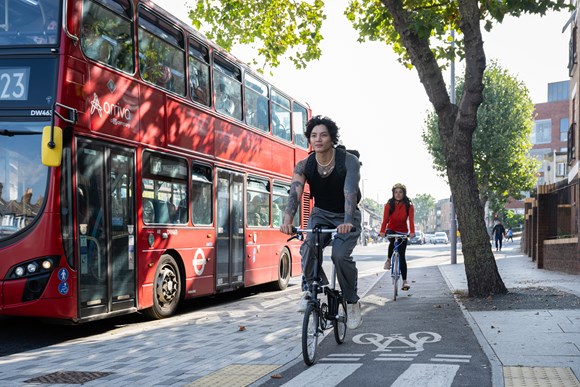

A researcher from Malmö University who studied attitudes towards cycling has suggested that building more cycle paths is just one part of encouraging more people to cycle and that there is “a range of needs and preferences to consider”.
Zahra Hamidi published her work ‘Examining Inequalities in Cycling Motility: A Pathway Towards Cycling Justice’ with Malmö University Publications, in which she aimed to inform policies to promote cycling by “providing insights into what could make cycling achievable for more diverse social groups through engaging with theoretical perspectives from transport geography, the mobilities paradigm and social justice”.
Speaking to Phys.Org Hamidi explained her view that building more cycle lanes is just one part of the equation to get more people cycling, but it is not sufficient on its own to achieve that goal.
“If you want more groups to cycle, you can’t just build more cycle paths,” she said about her research, which included examining attitudes towards cycling via a survey of a representative sample of 1,145 people in Gothenburg and Malmö.
By noting responses on the availability of different forms of transport in households, travel habits, attitudes towards cycling and considerations of safety, Hamidi also looked into factors which may define an individual’s potential to cycle, such as bicycle access, ability and knowledge of cycling, if their self-image fits cycling, and whether their social group has a positive image of cycling.
It is these factors, accessibility, knowledge and attitudes which Hamidi suggests determines whether people cycle or choose alternative modes of transport, and therefore she concludes, “If you want more groups to cycle, you can’t just build more cycle paths”.

“The study shows that higher income is linked to higher potential for cycling. For example, you need a smartphone to locate app-managed municipal bicycle docking stations,” she said, while adding that older people’s potential for cycling is often impacted by them finding bicycles less suitable for their needs and abilities, potentially suggesting the potential benefits of more widespread use of electric bikes.
“Cyclists are not a homogenous group, and today there are many types of bikes that can make cycling easier for people with different abilities,” she said. “It therefore needs to be recognised that there is a range of needs and preferences among cyclists. Those who need assistance to go out should perhaps be offered help. You may be able to afford to buy an electric bike, but you also need to feel that it’s safe to cycle. There is a range of needs and preferences to consider.”
> Cyclists wearing helmets seen as “less human” than those without, researchers find
In May, we reported a study from Australia which concluded that cycling infrastructure should be built with women in mind and that it is “about planning for the trips that aren’t taken as well as those that are”.
“Gender differences were stark in terms of the barriers,” Dr Lauren Pearson said. “We were really surprised at just how substantial these differences were, and how many women were reporting these concerns.”
Having surveyed 717 women across 10 Melbourne areas, Dr Pearson was able to assess the factors preventing more women from cycling, research that showed 77 per cent of women are interested in riding a bike, suggesting “massive potential” for enabling active travel further.
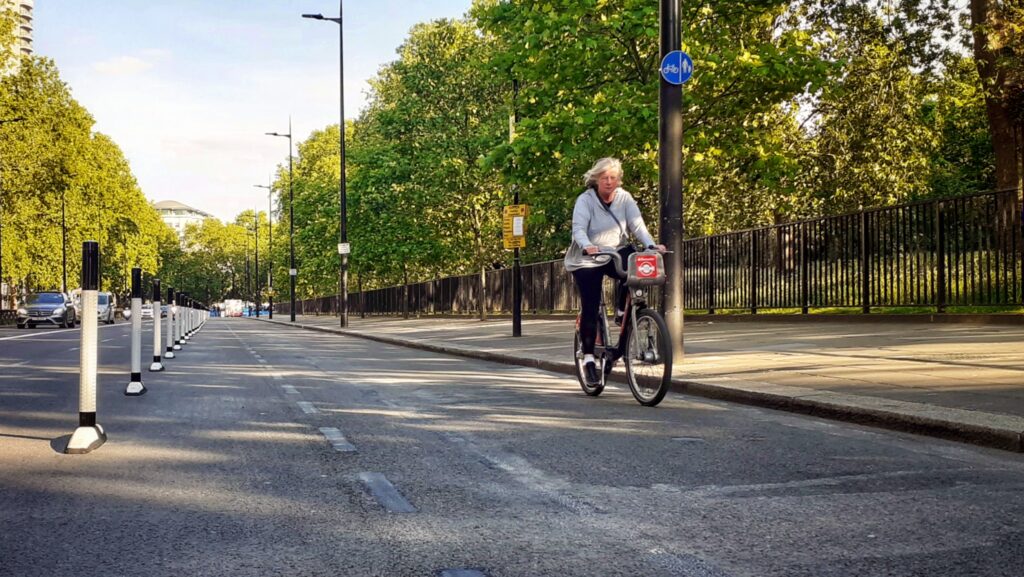
One such suggestion that came from the survey was segregation, the study noting that physical separation from motor traffic “may support more women to ride a bike through reducing motor vehicle interactions”, something many said they lacked confidence with.
Compared to men the survey showed that the women were less comfortable with the idea of cycling near traffic, and would be encouraged by segregated cycle lanes. Nearly half of the women surveyed said well-lit areas are an enabler of them cycling.









39 thoughts on ““If you want more groups to cycle, you can’t just build more cycle paths”: Researcher behind study into attitudes towards cycling suggests “range of needs and preferences” must be considered”
I think the UK’s problem is
I think the UK’s problem is that we have tried a lot of things except building proper cycle lanes.
Absolutely. The time to call
Absolutely. The time to call for “more than just cycle lanes” isn’t before the cycle lanes have been built as it just becomes an excuse not to even build the cycle lanes. Not enough is better than nothing at all.
Best interpreted as “cycle
Best interpreted as “cycle infra is the first step, not the last step.”
the little onion wrote:
Have we? On cycling, at least. I know some people in some places have tried some things at some times – but joined up strategy and consistent good delivery doesn’t seem to have been very widespread. Many here-today-gone-tomorrow funding pots and strategies that are forgotten about before they have a chance to become embedded.
It seems to be the British way – policy by announcement and the more new announcements the better. The typical voter will have forgotten the last one – give them another!
Uk’s problem is that actively
Uk’s problem is that actively hostile/dangerous driving behavior is accepted & not policed. Add in woeful level of roads maintenance.
Cycle in Stevenage & you’ll likely experience worse drivist behavior when you inevitably need to use the road, as they believe you should only be using a (non-existing) cycle track.
In continental Europe, where this isn’t the issue to the same extent, cycle lanes improve the efficiency of travel for everybody, with the almost side effect of reducing collisions.
Uk’s problem is that actively
Uk’s problem is that actively hostile/dangerous driving behavior is accepted & not policed
More to the point, it’s actively non-policed by the b*****d police which therefore encourages the hostile behaviour. This is VW M222 SGB giving me a fright- awaiting upRide.
I love my bike wrote:
Things are as you say in the UK but I think it’s partly a symptom rather than cause.
There is a difference in attitudes towards people cycling between here and there. “In continental Europe, where this isn’t the issue to the same extent …” – why do you think that is?
From what I’ve read (and a couple of visits to Belgium / NL) it’s the same humans they have over there. If you cycle in the wrong place you’ll still hear “get on the bike path!” and where there are cycle lanes (not separate paths – yes, they even have some still in NL) you may even get a close pass or two (but of course, those will be at much lower speed than in the UK because greater clarity about roads it is safe to mix cycling and driving on).
What I think is different is that there’s a virtuous circle whereby because cycling is mainstream people don’t think of “those cyclists” (as opposed to me and my friends) so much. Hence there’s agreement about making sensible provision for that everywhere, which means this is a normal activity etc.
Another part of this is people in e.g. NL (drivers, cyclists etc.) still want to get places fast but there seems to be understanding (from the government down to individuals) that this isn’t done at the cost of someone else’s safety.
That principle and the infra helps engineer out some of the inequalities of the UK public space.
I have mixed reactions, since
I have mixed reactions, since for me cycle lanes was a key factor to start commuting by bicycle. On the other hand, these lanes (and their adjacent roads) are mostly empty from bikes, but to be honest it is quite hilly where I live.
The cycle path level is not Dutch level good, but decent. Reasons for people still reluctant to cycle is I guess hills and the fact that parking by car is not that difficult.
Where I live you can say
Where I live you can say exactly the same about pavements and walking.
Quote:
Hmm. It’s my observation that all but the destitute tend to have a smartphone – I don’t think the want of one is a significant barrier to cycling. If anything, there is a perception that cycling is the poor man’s (woman’s) transport, to be cast aside as soon as they can afford a car, as exemplified:
Indeed, the prevailing attitude is that cycling is somehow not a valid repectable means of transport. It is a diversion for the wealthy, or a stop-gap for the impoverished, or an idiosyncrasy for the misfits and failures.
That does depend where you
That does depend where you live. Here in Paris, now that cycling to work has become popular, it is seen as a middle-class thing. The arguement given is that you have to have the time available to cycle (even though cycling around Parisian region is quicker than by car).
In the UK people live too far
In the UK people live too far from workplaces,shops and recreation facilities for cycling to be viable for anything other than a hobby. Add in the weather,physical attributes and terrain and it’s hard to see anything enjoyable in it as a hobby.
That’s true, some people live
That’s true, some people live more than 200m from the shops. And some people won’t get on a bicycle (/ tricycle / use a wheelchair or mobility vehicle) any more than they’d eat sprouts.
You won’t want to be wanting to have a look at the UK National Travel Survey or an analysis of an earlier one I imagine. But it should be of interest to someone sensible making those arguments. And some further reading around your throwaway lines here, here, here and possibly here.
Childhood experience of some
Childhood experience of some (such as Davie?) may dictate adult perceptions of distance.
Also, multimodal travel is often underplayed.
Jitensha Oni wrote:
Very interesting – yes, other self-reinforcing cycles there eg. ‘my parents tend to drive me more so then certain distances / types of trips are seen as “requiring a car” ‘.
Of course multi-modal has more points of possible failure. This is very obvious in the UK. Especially when compared to the normal “competition” e.g. driving – which is very often effectively door to door.
Trying to take a journey involving public transport you could find that there *is* no useful public transport, or there is but it seems wildly expensive, or it’s completely unreliable, or it doesn’t reach one or both ends of the journey. If you have a bus + train – double that. If using a bike you may find there’s nowhere safe to store a bike, or find your bike gone when you arrive. Taking your bike with you may not be allowed / there may not be space.
davie977 wrote:
I’d always assumed that I was commuting (I live six miles from my office and ride to get from one to t’other) but you’re now telling me that I am mistaken? Huh. You live and learn…

Obviously you are doing it as
Obviously you are doing it as a penance for various sins committed.
My office is 25km away and I
My office is 25km away and I cycle there and back everyday (quicker than by car or train). I have a colleague who lives 35km away and he does the same. So, stop the embarrassing excuses, either you want to cycle to work or you don’t. There is no need to justify not enjoying cycling, if you don’t enjoy it, fine. (Saying that, a lot of people who do not enjoy cycling really enjoy electric bikes)
Saying that, a lot of people
Saying that, a lot of people who do not enjoy cycling really enjoy electric bikes
Can’t argue with that. E-biking is better than driving- you’re moving a lot less metal around, for a start
wtjs wrote:
And a lot of people who absolutely love cycling also enjoy electric bikes.
People live too far from
People live too far from shops ???
Are you on some remote Scottish island?
You can’t get there from
You can’t get there from Twitter – you have to somehow get to another site (possibly one of the food delivery sites…)?
davie977 wrote:
WTF? “In the UK SOME people live too far…etc”. There, fixed it for you.
You should Google “percentage of trips by car less than 5 miles” and “…less than one mile”. You might learn a thing or two.
I split my journies to work by car and bike. It’s only 5 miles by car, but that is a terrible road to cycle on. So when I commute on my road bike…I actually go further! And I even enjoy it more! OMG? Maybe you are wrong?
You are right about the
You are right about the weather ,when going to work in freezing weather i saw a cyclist come out from a side road he made no effort to brake and took the turn far to fast for the road conditions lost control ,he and the bike parted and slid right across the road , fortunately all the cars were driving for the conditions and all were able to stop . Yet another example of I’m on a bike I’m alright jack put others at risk of harm and got away with it
Didn’t happen.
Didn’t happen.
Troll alert.
Troll alert.
experience in London suggests
experience in London suggests a very different picture, all sorts of people cycle commute there now since they have put in a network of good cycle lanes.
…my experience of London
…my experience of London moved me to Cambridge. I think it might have been something to do with dangerous angry taxi drivers and blind cement mixer/skip lorry drivers.
it might have been something
it might have been something to do with dangerous angry taxi drivers and blind cement mixer/skip lorry drivers
This is outrageous prejudice and bias! Don’t the blind, aggressive and incompetent also have the right to drive?
wycombewheeler wrote:
Can’t be as simple as that! It must be due to better driving or changed societal attitudes or awareness campaigns or more diverse representation or the weather being better or cyclists wearing less sporty clothing or people suddenly not needing to travel so far or people not having enough money to travel any other (better!) way…
(Sorry, feeling better now. Of course it takes a mix of things to encourage cycling but while possibly not completely sufficient a network of good quality infra / routes would appear to be necessary).
Before we waste any more
Before we waste any more money ,there needs to be a lot of improvement in bike riding , compulsory tests, with mots on bikes , compulsory proper lighting ,insurance, number plates enforced riding in cycle lanes and observation of all road rules with fines to pay for new lanes
I’ve suspected for some time
I’ve suspected for some time that you are a complete and utter twat , now my suspicions.have finally been confirmed, many thanks!
Aw bless. My wife and I
Aw bless. My wife and I usually go to our local M&S cafe once a week for a bite to eat, usually Wednesday but sometimes Thursday. I usually have a halloumi and falafel wrap and my wife has a fruit scone. It’s a simple pleasure but one we look forward to. Well, we turned up last week only to find they have changed the menu – no halloumi/falafel wrap. I was so disappointed. I couldn’t find anything on the new menu I liked so I ended up having a fruit scone like my wife. We both had a coffee as well. It was pleasant enough but not the same. I had an Americano and my wife had a Mocha. Do you have any disappointing cafe related stories to tell?
I once went to a cafe in
I once went to a cafe in Dundee for fruitcake but they were out of their eponymous product. Worse – on the way back we tried Abernethy but they didn’t have any of their biscuits either.
I feel your pain. I forgot to
I feel your pain. I forgot to mention I used to have chips with my halloumi/falafel wrap. Can’t really do that with a fruit scone, it just seems wrong somehow.
Cheese with your fruit scone
Cheese with your fruit scone though – or even more so with rich fruitcake? I always keep some handy for visits to road.cc
Have you tried halloumi chips
Have you tried halloumi chips instead ?
I like your thinking .Very
I like your thinking .Very nice indeed.
There aren’t many cyclists or
There aren’t many cyclists or cycle lanes in North Lancashire, for obvious reasons. Cycle lanes do exist in Preston, but are not very controversial as they’re universally ignored by drivers and the police