


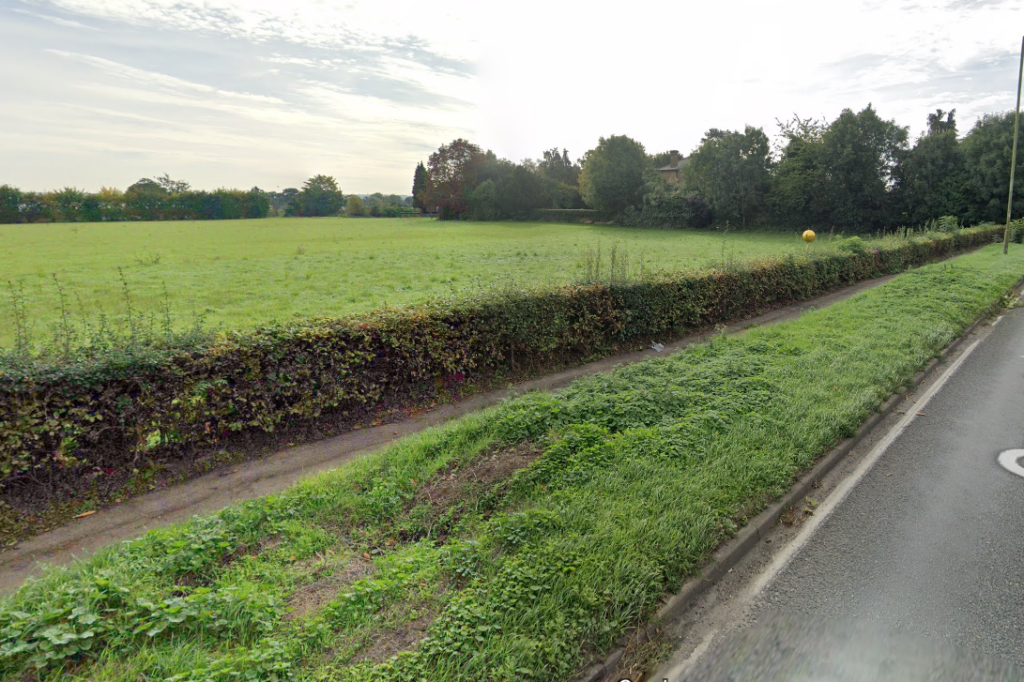

A High Court judge has found a council not liable for the injuries sustained by a cyclist who crashed into a hole on a grass verge next to a narrow path while attempting to overtake a runner, breaking his neck and resulting in the loss of his job.
Vikram Sachdeva KC, sitting as a deputy High Court judge, found that Hertfordshire County Council had taken reasonable care, under Section 58 of the Highways Act 1980, to ensure the section where the cyclist sustained his injuries was not dangerous, while claiming that the rider was “negligent” and “contributed to the accident” by failing to assess the route ahead for defects and by cycling at what he described as an “excessive” speed of 10mph.
The incident took place in April 2020 on a path separated from the busy A10 road near Cheshunt, Hertfordshire, by a grass verge, which began marked as a shared cycle and pedestrian path, LocalGovernmentLawyer reports.
However, just north of the Paul Cully walking and cycling bridge, opened in 2010, the path narrows from 2.5 metres-wide to around one metre, with no signs denoting any change in the path’s shared-use status.
While returning home on the path, the claimant began to overtake a runner, turning sharply onto the grass verge and colliding with a hole, throwing him from his bike. The cyclist suffered a complex fracture of the second vertebra, which saw him forced to leave his job as a social worker, this week’s hearing heard.
The claimant told the hearing that Hertfordshire County Council had breached Section 41 of the Highways Act 1980 – concerning the duty to maintain highways at public expense – and a duty of care owed at common law.
He claimed that Section 41 was breached because the county council had failed to heed the “obvious” risk posed to the path’s users and that its narrow width at that point meant that interactions between pedestrians and cyclists were inevitable. He also argued that it was clear that some users would have to move onto the verge to let others pass and, because the hole was located only 0.7m from the path, it should have been identified during routine inspections.
Since the path south of the bridge was clearly marked as dual use, a sign should have indicated that this status came to a stop where the path narrowed, the cyclist added.
“This was a large hole and he did not see or avoid it”
After hearing evidence from highways repair contractors and council staff, Judge Sachdeva found that no significant hole had been present on the verge during the last routine inspection before the incident, in February 2020, and that the hole – which he said could “vary in size over short periods of time” – was likely created in the interim by burrowing animals.
“I find that, on the specific facts of this case, that stepping onto or cycling onto the grass verge in this case is a normal use of the highway, and that the public have a reasonable expectation that substantial holes in such a verge would be repaired within a reasonable period of their discovery,” the judge said.
“Such substantial holes constitute the sort of danger which an authority may reasonably be expected to guard against. I do not accept that this finding would place an unrealistic or disproportionate burden on highway authorities’ limited budgets.”
> Council pays cyclist five-figure settlement over “harrowing” pothole crash
However, Mr Sachdeva also noted that the council’s policy of biannual walked inspections of the path and verge “is accepted as being in accordance with national guidance and lawful”.
By arguing that there was no reason to believe the February inspection was “anything other than competent”, the judge ruled that the council was not liable under Section 41 of the Highways Act. He also accepted that nothing required the council to have signified the changing status of the path north of the Paul Cully bridge, since the absence of any signs “implies that the path is not shared use. There is therefore no liability in negligence in this case.”
Describing the cyclist’s actions at the time of the crash, the judge added that had he found for the claimant, he would nevertheless have reduced his damages by 33 percent for contributory negligence.
“In my judgment the speed of 10mph was excessive for the conditions, and the sharp right-hand turn was a manoeuvre which [the claimant] should have avoided because it made it difficult for him to see the route ahead,” he said.
“Given that he was entering a verge where it might be more difficult to see and avoid unevenness, he ought to have taken more care to give himself time to look out for defects and to be able to avoid them.
“This was a large hole and he did not see or avoid it. His actions were negligent and contributed to the accident.”





















12 thoughts on “Council cleared of liability after “negligent” cyclist crashed into grass verge on narrow path, breaking neck”
For the love of god, is today
For the love of god, is today April 1st?
He rode of a relatively
He rode of a relatively smooth path onto grass and fell off. Well what a surprise.
Now, I would do just that but wouldn’t try to blame the council for my own stupidity. I assume that the cyclist had eyes.
Of course this is the usual Roadcc repporting with only half the details.
? ?
? ?
(Not sure if road.cc is fishing here or the judge was…)
Most of that is difficult to
Most of that is difficult to call (the stuff about magically self-enlarging and shrinking holes is weird), but I am not convinced that an absence of shared path signs indicates it is not a shared path.
That is buried somewhere in the 500+ pages of the TSRGD.
Would anyine really expect a
Would anyine really expect a verge to be bowling green smooth?
So, cyclist ticked-off for
So, cyclist ticked-off for “not seeing a large hole and avoid it, resulting in negligence’, but motorist hits cyclist and magistrates “of course dear motorist, no one could possibly expect you to remain focused and see a cyclist and take steps to avoid colliding with a vulnerable road user”
The bit about shared use
The bit about shared use paths not really counting unless it’s directly under a sign was a bit concerning.
Isn’t the rule that you have a right unless it’s explicitly taken from you?
Judge should be sacked, get
Judge should be sacked, get one from planet earth
Couldn’t help thinking of
Couldn’t help thinking of this year’s Ronde van Vlaanderen…sympathy for the injuries suffered but it is hard to see why the council should be liable for a rider’s decision to go offroad.
If you end up with those
If you end up with those injuries I guess you will try anything, no matter how unlikely.
Last I checked, councils do
Last I checked, councils do have some obligation re road verges, especially on narrow roads (i.e. they have to allow for the possibility of traffic passing). Hence soft verge warning signs on some narrow roads.
It is fairly common for cycle tracks to be narrow for extended periods where the only way for anyone to progress is for some users to go off track into verges. I have also seen roadworks etc set up that expect pedestrians to use verges…
So the same obligation would appear to apply here.
But it is similar to potholes – the conditions will change, so the councils obligation is to make reasonable efforts – i.e. periodically inspect. Which they did. I also suspect the requirements for a verge area are significantly lower than for the path or road. So for the council to be liable you probably have to prove that either the hole was reported, or it has been there, at comparable size, for several inspections (i.e. years)
Personally I think the better argument was that the cycle track is dangerously narrow. It wouldn’t suprise me if there are no passing points despite being tighter than a singletrack road (relative to vehicle width). Of course this shows a huge issue – the lack of any obligation to clearly sign where a cycle track begins or ends; We are expected to give motorists a dozen signs of a restriction, yet a cycle track can be marked out with a tiny repeater roundel…
It can be a bit of a mess,
It can be a bit of a mess, with county and borough council playing off each other.
Agree with you regards the width issue there, if that is designated as shared use then it’s ridiculous and way too narrow.