


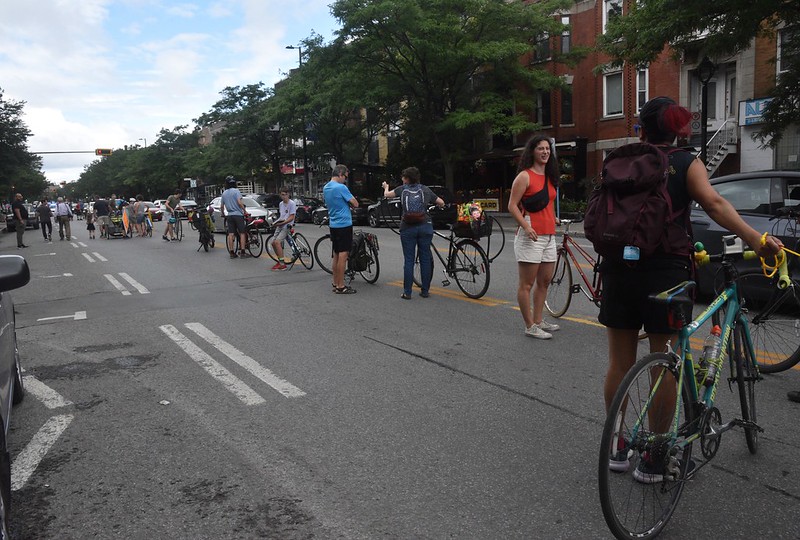

After the city’s cycling infrastructure plan was updated without mention of a segregated bike lane on a busy road where two cyclists have been killed in collisions, protesters and campaigners took to the street, forming a ‘human bike lane’ to raise their safety concerns in an eye-catching way.
Montreal’s Parc Avenue has two ghost bikes, white bike memorials to cyclists killed in collisions, the first commemorating Andrea Rovere who died in September 2021 after being hit by a truck being driven on the route.
Another can be found up the street at the spot where Suzanne Châtelain died almost exactly a decade ago in another collision, the first ghost bike installed by Vélo Fantôme, the organization behind Saturday’s protest.
The group installs and maintains white ghost bikes in Montreal, saying they are “a symbol to encourage reflection on the dangers of motor vehicles, while commemorating the life of the victim.”
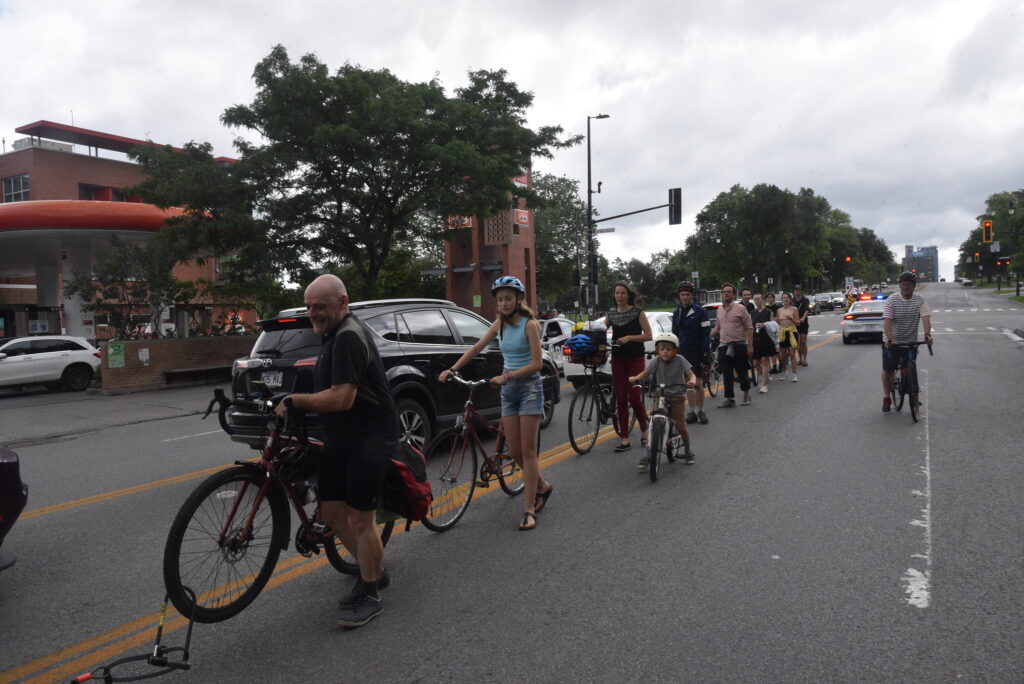
On Saturday morning the group organised a ‘human bike lane’ spanning the length of the route from one ghost bike to the scene of the other fatality, calling for change.
One attendee compared the road to like “having a small piece of the Décarie [a major Montreal expressway] in your neighbourhood” and was part of the Vélo Fantôme crowd.
The group’s organiser Séverine Le Page told CBC: “We talk about these collisions and then nothing happens so it has to change”. She explained how it does not feel safe to cycle along Parc Avenue and said she would never let her children use the route.
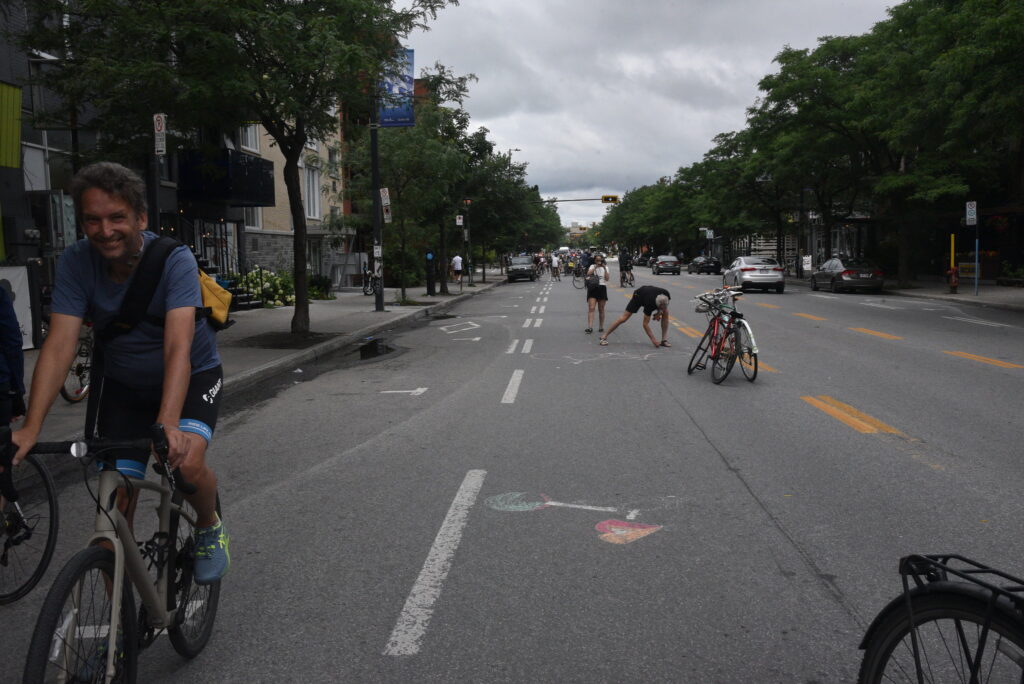
Another local resident at the protest with his two kids in a trailer said: “You can live your whole life in a vehicle like this with your family and go anywhere as long as the roads are safe.”
The protest came after the city’s biking infrastructure plan, updated at the end of May to outline an “extensive network of 901km of bike lanes” that “makes it easy to get around streets, parks and along the waterfront” omitted any plan for segregated cycling infrastructure on the route.
Le Page said such a lane would “give more space to everyone” and “reduces the amount of traffic that can travel through… it’s just much safer.”
Marie Plourde, a city councillor and the city’s deputy mayor, attended the protest with her bicycle and called the issue “complicated” but stressed her desire to “do something permanent”.














10 thoughts on ““We talk about these collisions and then nothing happens so it has to change”: Cyclists form human bike lane at site of fatal collisions”
We talk about infrastructure,
We talk about infrastructure, cars and collisions like people driving so badly that they kill other humans is inevitable.
Yes, separating people on bikes from people in cars will keep the cyclists safer and would likely improve the throughput of the road network but if all drivers drove safely it wouldn’t be necessary.
With stricter, regular retests for drivers to remove the incompetent ones and massively harsher punishments for poor driving to remove the malicious ones we could treat the source of the issue rather than put a plaster over the symptoms.
Patrick9-32 wrote:
TL/DR: it takes more than “better driving” – all drivers will never drive safely enough. Several things are needed.
Two views of this. The current common “accidents will happen” and shrugging our shoulders to tragedies, police making excuses for the driver etc. I certainly think we can definitely do better than where we are now.
But can we make drivers perfect (or at least much better)? Is it just a matter of removing a few wrong ‘uns? Plus a bigger group who shouldn’t be there either e.g. grandma whose eyes have started to go, little Jimmy whose judgement is overpowered by his hormones and Steve who’s a responsible parent but has a nasty little prescription addiction?
I think not. I agree it’s “a few people most of the time” but sadly it’s also “potentially all of us, some of the time”. Even if instead of “mass motoring” we had “elite motoring” with a selected few drivers trained to the level of pilots (with ongoing testing) we’d still see a certain rate of crashes again (as we do with pilots) because humans.
I believe that while we can improve driving standards somewhat (and should) crashes are a product of lots of drivers times our current infra. Yes, there is a good sprinkling of cultural acceptance of “I had to drive” / “you can’t pay attention all the time” / “we put in traffic lights – it’ll be too expensive / slow people down to do any more” also.
Our current infra is something which has “evolved” – safety measures have mostly been patched back in *after* making mass motoring possible everywhere. In spaces “designed for” walking / horse riding and then utilised by cyclists! There is a whole different design goal we could apply and a different way of thinking about this – we should seriously look at it.
You’re taking the idea of
You’re taking the idea of improving the frankly fucking awful driving standards and acting like we need to go from 1 to 100 to fix most of the issues. We don’t. We need people to understand that a driving licence is a priviledge. I would wager that the vast majority of accidents could be avoided if enforcement was more strict.
People should have to retake their test every 10-15 years regardless of age and then every 5 years once they hit 60. If they have a madical condition that could impare them then it should be more frequent.
No excuses when you lose your licence. No bollocks about hardship.
If you are caught driving intentionally dangerously you lose your licence for 6 months immediately and your car is confiscated.
If you drive without a licence or insurance you are banned for a few years and if you do it again you go to prison. Fines should be heavily used here and if you can’t pay then your car is seized and sold.
Currently you don’t even get a proper punishment for killing someone in a car. The needle needs to swing way over in the other direction to the point where people pay a little fucking attention to what they are doing because they just might not be able to drive if they can’t spare that little bit of attention driving requires.
Yes infrastructure should be better but the UK is not a country that makes that easy to do. We need to completely change our driving culture as well.
mctrials23 wrote:
I simply think that we will quickly hit a point of diminishing returns.
The question is “what improvements do you hope to see for how much additional expenditure – both cash and time / energy actually making this happen?” There will definitely be resistance!
Yes, there is some fairly low hanging fruit in terms of enforcement of the existing law. There is the “test once per lifetime” which we should improve on. There is some legal nonsense that really needs fixed.
However I bet that if the goal is to e.g. get from our current “not very many people killed” to “half of that” would take an exponential increase in police funding. Equally if the idea is to get more people to cycle (statistically the UK is very “safe” so it’s not really that) police-state levels of coppers would probably be needed.
Again I’m certainly not against the idea of doing more here – especially if we can be creative. So things to stop banned drivers driving (insert licence to be able to drive?), perhaps we can do more with tech in cars, national standardised online reporting of camera footage with a decent process etc.
I just don’t think more stick in isolation will do much. Equally I think this is a less effective intervention than infra (and possibly rule) changes.
I would love to see the numbers on this. I suspect – again don’t know – that there are a few “wrong ‘uns” causing a lot of damage, but the majority of crashes are due to a) less culpable “cutting corners / not paying enough attention because I’ve got used to driving” and b) “fallible humans”. The former might be affected by a great deal more enforcement (greater alertness). Both would be affected by doing more in our street and rule design to take this into account and eliminate certain kinds of errors and mitigate consequences elsewhere. A random example – just prevent overtaking into oncoming traffic and a whole class of accidents goes away.
It’s not easy anywhere. We have narrow streets (etc.) Yet other countries with dense cities, historic places and widely-spaced settlements have managed to start?
However what we *can* do is tame the car and shift some of the space to make active travel safer in urban environments – these are relatively small areas where a LOT of people live. We could make it *possible* in some suitable places which are more rural e.g. where the only route between two places is by extremely unfriendly roads. Lots of places there is not even a footway…
It’s a more complex answer but I think we need a range of measures which support each other. It’s about accessing a virtuous circle. Measures which gradually lead to more people choosing to walk / cycle for some journeys. That reduces the volume of traffic (so more pleasant to cycle) and demand for motor infra (so less angry voices yelling demanding parking / more road space). It means that cyclists start to become not “them” but our family, friends, people at work, maybe even our role models. It means more people now saying “it’s really inconvenient to cycle from A to B and it feels unsafe – we want more cycling routes / infra / safer junctions / slower motor vehicle speeds / better policing of driving” etc.
I think that much more general process is how the culture (maybe) changes.
At the risk of repeating
At the risk of repeating myself ad nauseum, all this will be covered in the soon to be completed comprehensive review of road law. It must be finished soon if it was announced all those years ago.
I fundamentally disagree with
I fundamentally disagree with the idea that we have tried to improve the standard of driving and it hasn’t worked as positied in the first article linked. We haven’t properly tried because to try anything meaningful would upset motorists and no government is willing to do that. Look at the ULEZ reaction:
Gov: “You can drive as much as you want but please do it in a vehicle which is not extremely polluting, otherwise you will have to pay a small amount to offset the impact of that driving”
Gammons: “You are literally nazis.”
As a country we have tried nothing which has a realistic chance of improving the standards of driving.
There is no reason an attack with a car should be treated differently by the courts to an attack with a knife or a gun. There is no reason you should be able to buy a car capable of going more than 70mph. There is no reason that hit and run drivers should not face mandatory prison sentences. There is no reason for any of those things except “car companies hold the purse strings of industry so we can’t upset them”.
We could fundamentally and dramatically improve the standard of driving on UK roads. Our governments choose not to because to do so would be political suicide.
Patrick9-32 wrote:
I partly agree with “not done enough”. Definitely the case that anything seen as seriously limiting the ability of just about everyone* to drive, where they want, when they want is (now) seen as regressive. If not actually repressive! And quite a few restrictions on “how you can drive” are ignored: parking rules, speeding in many situations. After a lot of effort drink driving is mostly seen as a bad thing but clearly plenty think that using other drugs and driving isn’t really.
* Actually quite a large minority – children, those with certain conditions etc. but still “most adults”.
I’d say “not trying hard enough” applies with building cycling infrastructure and very much with “encouraging cycling”.
I’d say it’s not true we have tried nothing. Albeit it’s shutting the stable door after our lords and masters encouraged the motoring horse to run out, but we have gradually (over decades) brought in changes. Driving tests have changed quite a bit (e.g. from my grandfather’s day) – though maybe not so much since the addition of the separate theory test? There are speed cameras, road policing has changed, we breathalyse etc.
With the benefit of hindsight we can see that not enough was done, not widely enough. I’m not sure whether or not that was “by design” – it’s possible it was.
I think if we “did enough” that would necessarily reduce the number of people able to drive to the regulations by quite a lot. Probably enough to start a revolution! But – like the highly trained pilots – without other changes (tech, infra) people would still keep crashing – because they’re human.
I would like to see it. I just disagree – and perhaps it’s a question of degree – on:
a) how easy it would be to “fundamentally and dramatically” improve the standard of driving? We certainly could and should remove the worst but how much would that shift the average?
b) if this succeeded what would change? Don’t forget, per billion miles the UK is currently a very safe place to walk, cycle and drive compared with the rest of the world. Would you expect the number of crashes to plummet? Would knowing that it was “safer” encourage more people now driving to cycle – among cars and lorries? I’d say definitely not to that, because it hasn’t (lots of other reasons why this doesn’t work like that).
Patrick9-32 wrote:
I guess a good question (I don’t have answers here) would be “is there anywhere in the world where we can see the standard of driving is fundamentally and dramatically better than in the UK”? Or has fundamentally and dramatically improved from a globally “reasonable” base?
If there is – how has that occurred? That is of interest so we can judge what path to that point was for them and what the cost – finanical, social, political – is. (I would do this when looking at the impact of cycling infra – comparing e.g. UK cycling levels, type and coverage of cycling infra with other countries.)
Perhaps only a few people are have cars? Maybe it’s a city / very small nation / there are few roads e.g. the Vatican? Perhaps they’ve only had cars recently? Or maybe like North Korea the right to have a car is tightly controlled so it’s strongly linked with other important social considerations? (See also crime reporting, enforcement and penalties in that case!)
Is the training / testing regime different and how?
What is the “feedback” – community reporting, cameras, police and penalties etc.
There’s one major factor that
There’s one major factor that could be changed to not only reduce the vast damage done by cars to humans in crashes but many of the other damages cars do to the environment and all that lives in it: legislate to prevent car manufacturers from designing, building and selling intrinsically dangerous technologies that also induce human nature to behave dangerously in employing those technologies.
There’s no reason for most cars to be so big, to weigh so much, to have the top speeds and accelerations they do. There’s no reason not to install all cars with a device that automatically reduces their speed when they enter various kinds of domain, such as those in which there are other vulnerable way-users present. And so forth.
Well, there is one “reason”: the desire of manufacturers and their customers to enjoy the freedumb to drive aggresively and dangerously in service to the human desire for that feeling of thrill-from-power.
It’s a terrible tradition, not least because its a tradition now having an immense momentum, worldwide – one tied into all sorts of other foolish traditions to do with freedumb – that stupid belief that every “individual” ought to be able “to do what I like” even when its really something that some other powerful agency wants them to do in service of their own damaging agenda, usually making loadsamoney and sod the consequences; even when such freedumbs can easily kill and maim not just others but oneself.
Cars and other motorised transporters are a serious blight on the planet and every living thing in it. If we can’t ban ’em we should at least restrict their potential for harm-doing. We’ll never change human nature, after all.
Cugel wrote:
I couldn’t agree more.