



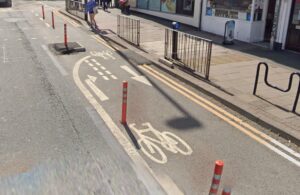
A protest marched along the route of a controversial new cycle lane in Kildare in Ireland this weekend, critics of the 3km bike path accusing the council of wasting money on a “North Korean-style project” which will make the road worse for all road users.
We first reported the situation concerning the R448 between between Moone and Timolin last week, local farmers speaking out about the construction which they say has made the road too narrow for combine harvesters and other large vehicles. Some reported “struggling to use the road because of the works and that larger combines have had to divert from using the road completely”, the picture below shared online last week.

A protest march was held on the road over the weekend, hundreds of people carrying banners and walking along the R448 in opposition to the major infrastructure project, which is expected to cost around €1.6m.

A couple of people with bikes were spotted among the protesters, the critics of the scheme claiming they have the support of cycling groups and local cyclists.

One road.cc reader local to the route told us: “I live in the area, it’s a lovely wide road with a wide hard shoulder. I’ve cycled it a few times a year for the past ten years and never once thought this section needed a cycle lane. Next time I pass through, I’ll be expected to cycle on the cycle lane and will probably get a puncture from all the crap that’ll never be cleaned out of it.”
The Irish Cycling Campaign also raised concerns during the consultation stage, however Kildare County Council believes the project will make the route more accessible for active travel journeys, the speed limit also set to be reduced from 100kph to 60kph during the construction phase.
On Friday disgruntled locals marched in protest at the project, people seen carrying placards and banners which said ‘Bike 3 Cars 300 Logic 0’ and ‘Why not a unicorn lane too?’. Other signs also referenced concerns about a lack of consultation, however Kildare County Council is clear that the scheme went through statutory public consultation in 2024, with amendments made in response to submissions.
Stating that the protest turnout was “very heartening”, Mark Hilliard of the Moone Timolin Positive Action Group (and Road to Nowhere anti-cycle lane campaign) said it proved “that the community is behind us”.

Last week, Mr Hilliard said: “Nobody asked for it and nobody will use it. It’s a North Korean-style capital project,” he said. “By anybody’s standards, it’s a complete and utter white elephant. We’ve had no help from elected representatives – it’s a disaster. It’s our desire that the roadway is put back to the way it was or, at the very least, engagement from Kildare County Council. This has been rammed down our throats.”
The Kildare Nationalist reported that local cycling clubs had told them they would not use it due to junction crossings and other issues, the narrower road now less pleasant than the previous layout — although it’s worth also remembering that active travel schemes are not aimed at experienced sport or leisure cyclists and the council is aiming to encourage new cyclists with a protected, accessible route alongside a busy main road.
The local news site said a cyclist, Barry Moore, had told them: “No cyclist will go inside that kerb with no one to clear the debris. No one wants punctures, and we have to stop at the junction and get off the bike.”
Other protesters who weren’t cyclists called the new layout an “obstacle course” and a “death trap”.
During the consultation last summer, the Irish Cycling Campaign also expressed concerns and while the campaign group said, naturally, it was happy to see such a cycling infrastructure project being advanced, there remained issues surrounding the “shoddy presentation of this important pilot scheme”. Local campaigners have now planned a follow-up public meeting for later this week.











40 thoughts on ““North Korean-style project”: Anti-cycle lane protesters block road and claim new bike path will make route a “death trap” and “obstacle course””
That’s the problem with
That’s the problem with cutting cycle lanes out of existing roads. Better perhaps to use some or all of the verge, but I can hear the screams from those who consider them a wildlife refuge. Fact is the UK and Ireland are small, comparatively densely populated and every square metre is contested.
Excellent point we’re island
Excellent point we’re island nations and where that infrastructure is actually needed they refuse to do a thing or do the painted lane thing and claim it’s safe 🙄.
I’ve already pointed out on another article about the lack of cycle infrastructure where I live and as soon as you find the “oh so safe green lane” it’s a broken line lane painted green with cars parked so staggered you’re forced onto the road anyway, that’s what passes for UK road safety.
Born_peddling wrote:
As everyone knows, non-island nations come with telescopic borders. Go-go-Gadget-borders
StevenCrook wrote:
The thing is … those who say “this is clearly attacking motorists” are partially correct … eventually, if things do change. See – where people don’t cycle now, or very few cycle now, a large part of that is because they or others drive.
It’s not zero sum but from where the UK is we really need a push (away from driving) as well as a pull (attractive alternatives). If we do not also make driving less attractive then – from where we are in the UK and Ireland – it’s quite unlikely cycling can be made attactive enough alone to overcome the (easy, convenient) default of driving.
But it’s a very delicate balance – having too much push OR pull without the other being appropriately timed to balance it will also probably fail!
Why do we need push – surely if cycling is that good people will just flock to it if we build the infra?
a) lots of / fast motor vehicles on roads suppress active travel! It just doesn’t feel safe or pleasant to be on the road or cross the road – even where traffic lights you’ll have to wait. Or even be next to the road. So busy roads / fast traffic disconnects nearby places for walking and cycling. It becomes more effort to do that relative to driving.
b) … and where it’s easy to drive, Brits/Irish drive. And we have for over a century been fixing it so it is very convenient to drive everywhere. Many (though barely even the majority, in some urban places…) have access to a motor vehicle, it’s “just there”
c) … and having paid the “fixed costs” of buying a vehicle, tax, insurance, the remaining fuel “cost per journey” usually appears to people to be competitive if not much cheaper than any public transport option. So we have a vicious circle where “public transport is rubbish, unreliable, infrequent, doesn’t go where I need” – because of course as people have cars they’ll tend to drive so takeup of public transport drops, with demand and revenues… And public transport is important for active travel – they work well together to provide a better range of transport options and cover more of the current use-cases of the private car.
So the network view goes back
So the network view goes back to property planning law and practice. If houses are designed to be a village with all amenities including stations in walking distance, almost nobody would go to the trouble and expense of motor vehicle ownership and operation.
More than 100 years marketing (influence operations) have embedded so many bad choices into the popular psyche including local government that the interests of big oil and big auto are just blindly accepted.
15 minute cities are bold solutions but once built the mistakes continue for a long time..
lonpfrb wrote:
Totally agree – but fortunately we can still start from where we are – that is in the places the majority of the population live in in the UK e.g. urban environments.
Travel surveys consistently show that most journeys are short enough for normal people to walk or cycle. Certainly that hides some nuance e.g. “short journeys – but I have to take the kids to school, then come back, then go to work (in smart clothes / carrying things), then do the shopping, then pick the kids up again …”
It is true that the built environment – like a skeleton – guides how we travel. And looking in detail at e.g. how amenities are organised in NL we can see there are significant differences. But … it’s not totally alien there. And – again like a skeleton – the built environment does (slowly) respond to how we travel. (We didn’t get so many of these out-of-town malls and centralised schools and hospitals before we had mass motoring…)
StevenCrook wrote:
Well… relative to where? Some of the UK is very dense, however e.g. rural Ireland – where they’ve put the cycle path – is less so. Same applies the other way – even in most “sparsely populated” countries there are fairly dense urban environments.
Everywhere is “contested” – we have capitalism and land ownership and everywhere is owned by someone, or a national park / nature reserve. It certainly means time and “planning” … but doesn’t seem to stop us road-building, or indeed expanding…
People manage to find space in many urban places with “historic centres” and “narrow streets” … and not just in The Netherlands. On the flip side we can ignore “but we don’t have enough space for cycle paths on every street, so infra will ‘never work’ “. AFAIK nobody is calling for that nor is necessary. (It’s certainly not the case in NL, and it’s little trouble to cycle in comfort everywhere).
It’s simply about how we choose to allocate the space. Do we want to prioritise the movement of motor vehicles, or do we want to prioritise the safe movement of all road users (people)?
In this case I don’t know if this is the “best” place for this infra. Maybe, maybe not – and if not sadly it wouldn’t be the first time in the UK and Ireland where infra is built “where we can”. E.g. where it disturbs drivers / residents / businesses the least, not where it’s most needed. And in the UK / Ireland there is always somewhere else where “it would make more sense”. But we need to keep adding it!
Note that in this example the infra a) in no way stops anyone driving and b) even if there isn’t a very high demand for it it might still be sensible, e.g. if the speed / number of motorists on the road there before was unsuitable for people of all ages cycling.
StevenCrook wrote:
That’s a huge overstatement, and irrelevant. Places like the Netherlands have exactly the same population density, streets that are just as wide for historical reasons, but they allocate space more intelligently (and plan new developments properly). It just comes down to how you use the space you’ve got.
Urban areas are different to
Urban areas are different to rural. I live in a rural place where the speed limit is 60mph on most of the roads, and they are narrow. The only way to secure them would be to use what verge there is.
The A421 in Buckinghamshire is busy, nasty to cycle along and too narrow to steal tarmac. But there are generous verges…
In most cities it’s less than 40 and what they’ve done is either steal tarmac from roads or force pedestrians to become second class citizens on pavements.
New developments are largely irrelevant, because, the overwhelming majority of roads already exist, and they’re what present the problem.
StevenCrook wrote:
It’s not stealing if it was stolen from you in the first place.
StevenCrook wrote:
Agreed – and the countryside in the UK (well … anywhere) is more tricky.
On the one hand “but the reality is we’ve only got the roadspace to work with” / “there’s no space”.
But … that “reality” changes as soon as there is a new development, or we want to “ease congestion” or “upgrade”. All of a sudden we notice there’s all this green space around the route (see below) and – albeit often with significant delay, pushback and/or the need to CP stuff – the project happens! Magic!
It’s just choices. Of course – where driving is seen as the primary mode, “strategic”, vital, “economic essential” and an involuntary adult activity … while active travel is seen at best as a “nice to have”, not vital (people will work round it), an economic cost not a benefit, a recreation / hobby activity …
… then it’ll always be easier to justify the choice to spend hundreds of millions (or more) on the former and not a few million on the latter. But as other places have shown that can change – it’s not a “law”.
In fact I think the main issue of “transport in the countryside” is that only a very few people will regularly cycle (or walk!) the distances most current cyclists (ramblers) are content to cover. So a significant proportion of the transport demand will be for distances longer than people will choose active travel for. (Although probably not *most* – most trips are actually still walked; e.g. within a village. IIRC that applies in the country as well as urban environments). And we have already cemented (tarmaced) in that expectation because private motor transport has been made so accessible and convenient. (It’s complicated … the accessibility of “remote places” is why there aren’t many people in the countryside, but also why there are still people in the countryside…)
StevenCrook wrote:
“Steal tarmac” – that is exactly how people see it because “I have to drive” and “the roads were made for cars”. It doesn’t make it true – so that view needs to be reframed – in terms of both “how we want to move” but more “how we want our places to be (nicer)” and “how we want to spend our time” (probably not sat in metal boxes).
I agree – in the UK we’re currently at the stage where we’re still really “ticking boxes” for cycling / active travel. Which is understandbale because “nobody cycles” – a self-fulfilling prophesy. But … >50 years back they certainly used to and around 100 years ago it was the major mode, everywhere. Wonder what happened and why …?
Pedestrians are already second class citizens (because driving). And cyclists are clearly 3rd or less. Because combining pedestrians and cyclists in most places is not good for either but it really stops cycling from being attractive.
New developments are very important – because we’ll never get anywhere if we continue to build in the status quo and in fact increase the demand for driving! (All that extra traffic from those people in the new houses will eventually want to use the – much fewer – main roads…)
StevenCrook wrote:
This is – apart from the very urban sections – surrounded by open land / fields pretty much all the way. I see space …
EDIT – and having a cycle path right next to this road – horrible! People who dare cycle there already likely won’t use it – and for sure few others will…
Looking at this road, I’m guessing in e.g. NL there would be little expectation that many people would cycle the length of that (although in fact they are creating long-distance inter-city “fast cycle routes”). Certainly not on the existing road – that would be in “motorway” category. Not safe or desirable.
How could it work? I’m guessing in NL they would not just try to string a cycle path (well separated!) along this, but look at connections between the nearer individual towns/villages. (For isolated properties, I don’t know). If they did I’m sure they’d do better than grabbing a verge for a cycle path right next to the danger. (They do sometimes have cycling right next to the main road where “there is no space”, but that is for less busy / lower speed limit roads I believe e.g. here).
This looks like a comparable location – along the A7 in northern NL. A few big population centres, a “main road” and countryside. Here’s how a “B-road” is treated – separate bi-directional cycle path (the A421 is like a B-road in places e.g. not dualled ). The other main road in this region is a dualled road, definitely more like a motorway. There isn’t *any* cycle provision here – but there are (some) parallel roads (maybe the “old” road) and those are provided for, variously (e.g. here) – the most important part is that they will not have much traffic because that is directed on to the major road..
StevenCrook wrote:
Netherlands 544 people per km2, UK 279. Who has the better cycle provision?
Paris 21,000 people per km2, London 5,690. Who has the better cycle provision?
It’s not space that’s the problem.
Yes. Certainly density and
Yes. Certainly density and space and distances can be very varied within a region, never mind a whole country.
However the nuance is that these things do make differences. And the details of development patterns (zoning restrictions) *do* make significant differences. Sometimes via indirect routes. Say it becomes aspirational for young professionals to have an individual family home (rather than say appartments / terraced housing etc). Fast forward some years and that means a large number of those responsible for designing and building places / setting policies etc. and with the most influence and resources feel that “low density development” is the way things should be. Even at the expense of the greater numbers living in more dense urban environments where changes like “more public transport, less private motoring” would be the most obvious choice.
There is an odd ‘coalition’
There is an odd ‘coalition’ against this cycle lane. Some of them are pro-cycle lanes in general, but have reasonable concerns about the quality of this one, which doesn’t appear to be designed by anyone who has ever ridden a bike. I’ve opposed some cycle lanes near me on the ground that it makes cycling more dangerous and difficult. I.e. the one on Kirkstall Road, Leeds, which has a bus stop in the middle of it.
The comments about unicorns etc are the usual “no one cycles and cyclists don’t belong” brigade.
Sometimes it’s “both are true
Sometimes it’s “both are true in some part”.
It’s certainly true that we’ve built plenty of actually crap infra in the UK. And more that even with the better parts most is “just not good enough” (fails basic tests, like being too narrow, not connecting to stuff, still giving way to the motorist at points, not tackling junctions).
Of course – part of the latter points is “it’s not really about the infra design – it’s about the network“. (And in fact when we keep running into “but buses” and “but junctions” it normally means that we’re still trying to fiddle about at too low a level rather than stepping back to look at the network and disentagle routes. Which is entirely understandable where the idea of serious numbers of people cycling is essentially a “new” thing.)
The main “anti” argument of this lot though seems to be the familiar “nobody is running across the motorway running through the town, so clearly we don’t need an underpass / bridge”.
Was there any kind of
Was there any kind of consultation or is this a “look what we’ve done” project?
Was there any kind of volume of cyclists on the road previously that might have triggered the need for it?
I have a suspicion that this is one of those useless stretches of cycling infrastructure, that has no logical start / end points and doesn’t go anywhere that cyclists actually *want* to go.
The article does state that
The article does state that this infra is aimed at Active Travel cyclists, not existing sport cyclists. However your point about the road network is also key for Active Travel.
Not sure where you got “sport
Not sure where you got “sport cyclist” from and why you think it’s relevant.
The “type” of cyclist is irrelevant. If you’re on a bike you’re a cyclist.
That you are powering the bike makes you “Active”, and that you are going from A to B makes you “Travel”.
All cyclists [with the possible exception of velodrome users actually using the velodrome] are “Active Travel” cyclists.
Anything else is just elitist bollocks.
I suspect active cyclist is
I suspect active cyclist is someone travelling greater than 15mph on a bicycle, which is the maximum speed on a cycle lane
I suspect there may be valid
I suspect there may be valid points re have they built infra in towns at either end of what appears to be a rural route.
Of course I also suspect that everyone protesting would also protest infra in the towns…
Best thing you can do for uk
Best thing you can do for uk cycling is get a class of ebikes thats legal to have assisted power upto 35mph to keep up with uk road traffic.
Yet to find a person who’s not instantly sold on a ebike that can keep up with the traffic around town.
That’s glossing over many things but that my starting point.
As for “cycling infrastructure” just make bigger better roads. You cannot make them to big as we always need to expand them down the line anyway.
Webstaff wrote:
All the towns around me are now 20mph limits on most roads.
Would work for me at the
Would work for me at the moment but probably not in 10 years time or for the majority of people who wouldn’t feel safe at those speeds and it certainly wouldn’t be safe for kids. For the sake of the environment we need for them to be safe to cycle to school and not be dropped off. Its similar for most folk we need to be presenting a safe option which might encourage them out of cars.
I’m gonna take this as
I’m gonna take this as sarcasm… but maybe not?
Just get a motorbike and be done with it then – the requirements (licence, tax, helmet, MOT) are the same.
Pick me! Although that’s because I can use these, and (currently very) small amounts of this kind of thing where the traffic is busier / faster.
Just buy a car then, after all “the roads are built for cars”. And everyone doing that is why we’ll “always need to expand them down the line anyway”.
Roads (as opposed to streets) – with our current level of mass motoring / speeds / “maximise motor traffic capacity – will never be suitable “cycling infra”! That is infra which feels safe and convenient to cycle on, whether you’re 8 or 80, whether you’re cycling to work, doing the shopping, travelling with your luggage, giving a couple of people a lift or out for a quick century ride…
Why don t we all buy cars
Why don t we all buy cars then congestion would be so bad no one would be able to move – fact
It’s ironic that active
It’s ironic that active travel is being used to protest active travel.
What the f…’s a “kph”? You
What the f…’s a “kph”? You do understand that they use metric units in Eire, don’t you?
arowland wrote:
Quite right – it should be expressed in decidays.
arowland wrote:
I use kph all the time, and everyone seems to know what it means.
Feck the stupidly long km/h, a whole character longer, ffs.
As long as you pronounce it
As long as you pronounce it “kipper”…
article wrote:
If that’s true, I have some sympathy for the campaigners — so long as the aim is to improve the project.
I can see experienced cyclists avoiding the cycle lane because they don’t want to get caught in it and having to give way at the junction, leading to a narrower road with cycles in it that’s worse for all vehicles. Also, it’s not impossible for councils to invest in snow and debris equipment for cycle paths, just as they do in the Netherlands, and prioritise cycle path clearing. But will they?
This does have the feel of a self-fulfilling prophesy because of piss poor planning.
Anyone cycling over 15mph
Anyone cycling over 15mph have to use the main carriageway anyway.
Is that the law there?
Is that the law there?
I think citation is needed
I think citation is needed here.
It would be interesting to see what Law states that cyclists over 15mph *have* to use the main carriageway.
Motornormativity at its best,
Motornormativity at its best, drivers getting everyone to protest so that they can get a wider faster road!
I think the complaint about
I think the complaint about combine harvesters seems legit. Farmers need a way to move their equipment when needed. Perhaps a sign that says “Give way to combine harvesters”? 🤔
The original issue IIRC was
The original issue IIRC was that it was the road works that caused them problems.
Not so much of a story as “farmers don’t receive / forget / ignore notification of roadworks”. Or even “imperfect coordination between those responsible for road works and local ‘stakeholders’ “.
It’s absolutely bloody stupid
It’s absolutely bloody stupid, pointless and un-needed.
In common with many Irish main roads it used to have a wide yellow-deliminated hard shoulder on both sides and all classes of traffic co-existed quite well.
Now, it’s fucked up.
Some asshole in a planning office decided they’d be Cycling Conscious that week.