



Proposed changes to a busy junction in Bristol city centre, which involve installing planters on the pavement to restrict crossing points near a cycle path, will “worsen” the conflict between cyclists and pedestrians at a spot where people on bikes already “get annoyed”, a councillor has claimed.
However, the local authority has said that, by funnelling people into a narrower space, it will prevent them from crossing at a “more dangerous and hazardous position”.
The council also admitted that it is reluctant to start clamping down on motorists encroaching on a nearby yellow box, labelled one of the “most abused in the city”, and blocking the cycle lane – because it means they will have to start properly enforcing others, some of which they claim are not “ideally designed”.
Bristol City Council are planning to spend £1 million to overhaul the layout of the junction at College Green, Anchor Road, and St Augustine’s Parade.
According to B24/7, at some parts of the junction the pavement will be made much wider, reducing the width of the road in the process. However, in others, new planters will be installed on the pavement and road, to funnel pedestrians onto a narrow crossing.
The council says this is necessary because the small pedestrian crossing that leads from the fountains to St Augustine’s Parade near Denmark Street is often overcrowded, prompting people to walk on the road instead to cross.

The changes to the junction form part of wider plans for Park Street, which include implementing a bus gate that would prevent through-traffic from accessing the shopping street and a banned left turn coming off Anchor Road onto College Green, while also upgrading the traffic lights.
But while Bristol City Council says the planned vegetation at the junction will prevent pedestrians from “dangerously” walking on the road, one councillor told a recent meeting of the local authority’s transport committee that the plans would only increase conflict with people on bikes crossing over to the cycle path next to the pavement.
“The pedestrian crossing over St Augustine’s Parade is still in its existing place, and vegetation is being put into the east of it,” Liberal Democrat councillor Nicholas Coombes said this week.
“But that constricted crossing that conflicts with the fairly newish cycle path is still as is, which I think is a missed opportunity to fix some of the problems of the earlier scheme.
“I mostly use this during peak time, and there’s a lot of conflict at that particular crossing. There are lots of pedestrians, lots of cyclists get annoyed with them because they want to be moving quickly, and there are people trying to be on both sides of the cycle path and both sides of the road. The introduction of vegetation to the east makes the conflict worse.”
Coombes also pointed out that moving the stop line for cars further back could create more space for pedestrians – a suggestion kiboshed by the city’s head of transport, Adam Crowther, who argued this would reduce the junction’s capacity and add to safety issues.
However, Crowther did note that the recently installed bike path could be painted a different colour to “better indicate its purpose”, while admitting that he doesn’t believe there’s a “perfect solution” in that location.
“It has been looked at in detail and we’ve gone round lots of different options for how that could work to get to the concluded design,” he said.
“I don’t think there’s a perfect solution in that location, due to the space available and all of the movements happening through there.
“The vegetation is to discourage people from crossing in advance of the traffic stop line. We’re asking people to cross across the cycle route and use the pedestrian crossing, but obviously a lot of people won’t do that, they’ll cross across the advance cycle stop line.
“That bulge is to stop people from crossing in front of the traffic stop line, a more dangerous and hazardous position.”
Crowther was also asked about the junction’s yellow box, which is designed to stop motorists from entering part of the road unless they can exit to prevent congestion, but which councillors says is one of the “most abused in the city”, with drivers often ignoring the rules, clogging up both the road and the cycle lane.
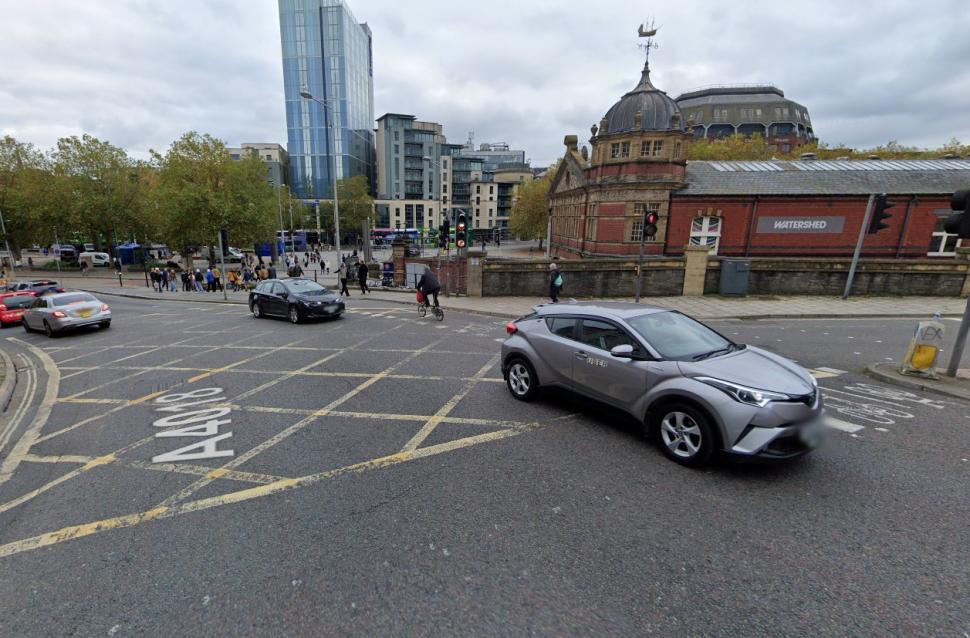
“Enforcing yellow boxes is quite challenging, because if you start enforcing one then the implication is that you’re enforcing lots,” Crowther said.
“Some of the older yellow boxes may not be ideally designed. One of the issues with yellow boxes is that people drive into them thinking that there’s a space to get out, and then there isn’t. You can be caught unawares.
“There’s a risk that if you start enforcing them, without properly reassessing all the yellow boxes, then you can have negative impacts.
“People would go ‘well I’m never going to go anywhere near a yellow box’. When you look at some yellow boxes on roundabouts, for example, it’s quite difficult for a driver to know if there’s going to be a gap at the end of the yellow box.”











24 thoughts on “Plans to funnel pedestrians onto narrow crossing will “make conflict with cyclists worse” on new bike path – but council says it’s reluctant to clamp down on drivers “abusing” yellow boxes and blocking cycle lane”
The yellow box statement is
The yellow box statement is bollocks. My council selectively enforces yellow box encroachment via cameras on certain junctions where it holds up traffic flow and not on other’s where its less of an issue. Nice little earner for them too. There is one where you have to be super careful not to get caught because of the layout and traffic flow, but the signage is clear and they did a 2 month warning letter trial to get people accustomed to it.
Its not the councils job to worry about how badly behaved drivers may moan.
‘One of the issues with
‘One of the issues with yellow boxes is that people drive into them thinking that there’s a space to get out, and then there isn’t. You can be caught unawares.’
Which is why you’re not supposed to drive into them unless there’s a gap on the other side. Is ‘unawares’ a new word for ‘being stupid’?
To be honest, it would just
To be honest, it would just be nice to be able to ride on the new (not so new) cycle path along the side of the Centre without having to dodge oblivious pedestrians…
brooksby wrote:
Do you mean the one where pedestrians are oblivious because permission for cycling is indicated only by grey carvings in grey paving slabs? At least that is superior to the place where you are supposed to dive across a traffic lane (or jump a red light at a pelican) to join a short contraflow bike lane, all on a steep downhill. In fact all of the bike infra there, plus the lane along Baldwin Street, appear to have been designed by someone whose principal aim was to maximise conflict.
Maybe John Franklin designed it. I definitely stay on the road and behave like a vehicle. Probably a pizza delivery moped, since I do occupy the bike boxes at the lights.
That’s the one, although it
That’s the one, although it also has a grey dashed centre line so it’s like a brutalist interpretation of a road…
Well… they tried. (I’m
Well… they tried.
I’m rather in favour of lines of paint … within (bidirectional) cycle paths, although I suspect that may be a waste of money also if only because they’ll be full of pedestrians anyway *. Then: any “new cyclists” may just ignore convention also.
* The usual catch 22; people walk there because no one cycles, because people walk there. Where cycling is more than a few % the system can flip, then nobody walks there because people cycle there (and pedestrians have their own space. )
“A brutalist interpretation
“A brutalist interpretation of a road”


So true. Grey markings on grey paving slabs surrounded by other grey paving slabs…
slc wrote:
That’s the most ridiculous cycle “lane” that I’ve seen – almost completely invisible unless you already know that it’s there and you specifically look for it.
I can’t understand how the designer looked at every other country that makes cycle lanes a different colour and then decided that they should go for a new “invisible” design instead. I suspect they were told to design it to create as much pedestrian/cyclist conflict as possible.
Good idea – it’s a new take
Good idea – it’s a new take on shared space! Again they can say “no – we have built a cycle lane” (cycle path/track, here) – but hopefully without triggering the usual suspects. Then just wait ’till the public demand it be removed (or cyclists banned) because “safety”!
chrisonabike wrote:
Bristol aims to be cyclist friendly on paper, so I think it’s sheer incompetence in this instance.
hawkinspeter wrote:
It has some pretty stiff competition. My favourite is the one on the downhill side of Durley Hill, heading into Keynsham. Basically a white line joining drain gratings, put there to provoke punishment passes because you are not using it.
Do you mean this one? Or
Do you mean this one? Or even further on here (they obviously employed a miniaturist to paint that symbol!) Yeah … that looks like “consider running skinnier tyres to ensure you’ve got clearance”!
Possibly even giving one of Edinburgh’s sillies at the Foot of the Walk a run for its money.
Oh! It’s a classic! At the
Oh! It’s a classic! At the entrance to Keynsham a picture perfect “who is this space intended for? Why are we pretending it’s not just for those driving?” image.
Notice the line of bollards on the left – because clearly people have been caning it into the wall there. Fortunately they’ve managed to find a narrow footway to install them in. Seemingly less to protect pedestrians, more to dissuade them – by both forming an obstacle and suggesting what might happen to them if they proceed…
Hoorah for the “little person
Hoorah for the “little person”! Formerly the elite did what they liked and the law followed. Now we have a wider franchise – anyone with a motor vehicle can vote with their tyres: the law will in practice reflect “realities on the ground”. Yellow boxes? Merely a suggestion, until the paint wears off, then nothing at all.
“The Code is more what you’d call guidelines than actual rules.”
If I hadn’t lived in the UK for at least a day, or listened to Chris Boardman’s talks I’d be baffled (in the 21st century) by a city’s head of transport offering excuses for behaviour by drivers that would probably see them fail a test. Or objecting to creating more space for pedestrians because this would add to safety issues (!) or reduce capacity for cars.
(However as Chris Boardman has pointed out – basically all our bureaucracy’s “success or fail” public space and transport metrics are geared to “preserves or increases capacity for motor vehicles”. Which sounds like almost as good an example of “state capture” by the motoring trades as the switcheroo that led to potential victims of motorists being condemned for the new criminal offence of “jaywalking”).
Don’t they know there’s a climate/health/cost of living/cost of paying for stuff Trump wants us to pay for crisis on?
“Enforcing yellow boxes is
“Enforcing yellow boxes is quite challenging, because if you start enforcing one then the implication is that you’re enforcing lots,” Crowther said.
Utter bolox. Does a speed enforcement camera imply that you’re enforcing all speed limits everywhere?
Glad it wasn’t just me!
Glad it wasn’t just me!
That’s why we can’t enforce speed limits, obviously. Or pavement parking. Or road crime in general. Or presumably any crime; because as soon as a policemen stepped
intoout of the station they would be swamped by all the crimes they’d see and be legally unable to prioritise…Adam Crowther wrote:
“There’s a risk that if you start enforcing them, without properly reassessing all the yellow boxes, then you may have to enforce all of them and restore order. Will nobody think of the poor motorist?.— Adam Crowther
GMBasix wrote:
Is whale mince particularly thick, compared to say, your standard pork or beef? And how do you know?
mdavidford wrote:
Glad you asked. It generally thicker due to the blubber – it has a higher fat content than animals who have been bred for eating.
Secret_squirrel wrote:
Correct. And I found out when I was conned after ordering turtle lasagne.
Ah, so we’re talking pre
Ah, so we’re talking pre-cooking, then, rather than cooked?
Some folks here have you
Some folks here have you covered, if you wish for recipes. Although they don’t have the cullen minke, blueburger or cream of sperm whale I was half-expecting.
Ryan Mallon wrote:
Your regular reminder that footways, cycle lanes/paths and verges are still parts of “the road”. It’s just that those parts are not carriageway and are set aside for peope who turn up without a motor vehicle. The reverse is not true.
By creating more space for more space-efficient, vulnerable/public modes of transport, you are actually increasing capacity.
If the motor capacity cannot be exercised without motorists committing offences (enforced against or not), then you do not have capacity, you’re over capacity and should be deterring demand.
We have here an example from a council that is de facto accepting the existence of high demand from pedestrians and cyclists, yet choosing to prioritise the more inefficient and hazardous use of road space to the detriment of pedestrians and cyclists.
Having been caught and fined
Having been caught and fined for stopping in a yellow box while working in London previously I made damn sure that I didn’t make the same mistake twice. As another Bristolian with experience of that area generally it’s a complete mess that leads to conflict with pedestrians at almost every part of the city centre.