



The Department for Transport (DfT) has issued a call for evidence for proposals on how more ‘last mile’ deliveries can be carried out using electric cargo bikes and electric vans.
According to the DfT, the consultation, which goes under the title, The Last Mile – A Call for Evidence on the opportunities available to deliver goods more sustainably, “will allow us to improve our understanding of the scale of opportunity as well as some of the current barriers to delivering goods more sustainably.”
It says that the call for evidence is aimed at helping it examine:
how electrically powered e-vans, micro vehicles and e-cargo bikes can provide better service to customers for cargo in comparison to light commercial vehicles
the scale of the potential environmental and other benefits
the barriers to sustainable last mile delivery
what incentives might be appropriate to encourage a large-scale shift to clean, last-mile delivery options
measures to improve logistical efficiency (eg urban consolidation centres / hubs).
While the government acknowledges that electric vans and electric cargo bikes can be more efficient and have a lower environmental impact than light commercial vehicles, it has highlighted some potential barriers to their adoption.
Those include the higher labour costs for electric cargo bikes, which carry smaller loads than a van, although that is offset by the lower cost of the bikes compared to the motor vehicles they would replace.
Restrictions on the weight an electric cargo bike can carry, and their unsuitability for some kinds of loads, has also been coted as a possible issue, as is the question of insurance.
The replacement of large out-of-town warehouses by more localised urban consolidation centres is another issue that needs addressing, although the DfT points out that improvements in efficiency could lead to lower costs for operators as well as reducing congestion and air pollution.
The DfT also highlights electric cargo bikes as being particularly well-suited to the narrow streets often found in the UK’s historic cities.
Transport minister Jesse Norman said: “In recent years the Department for Transport has taken steps towards encouraging sustainable last mile delivery, including through the Road to Zero strategy, the Clean Air Fund, the creation of one of the most comprehensive global programmes of support for ultra low emission vehicles and through the £246 million Faraday Battery Challenge.
“Now we are seeking your thoughts, experience, evidence and expertise on how we can harness new opportunities for greener delivery in the commercial and residential parts of our cities and towns.
“Last mile deliveries have been transformed in recent years by the growth of home deliveries driven by the boom in internet shopping. This has led to a marked rise in van traffic.
“According to the latest road traffic estimates van traffic increased by 4.7% to 49.5 billion vehicle miles in 2016 alone.1 Most of these vans are diesels. Thus this shift has had immediate economic benefits for consumers, but it has also led to congestion, poor air quality and other environmental problems.”
He added: “The purpose of this review is thus for us to learn from as wide a range of stakeholders as possible as to the scale of the opportunity.
“We want the UK to explore all modes of e-cargo and emerging transport technologies for last mile deliveries, so we can help create beautiful, liveable, green and connected towns and cities.”
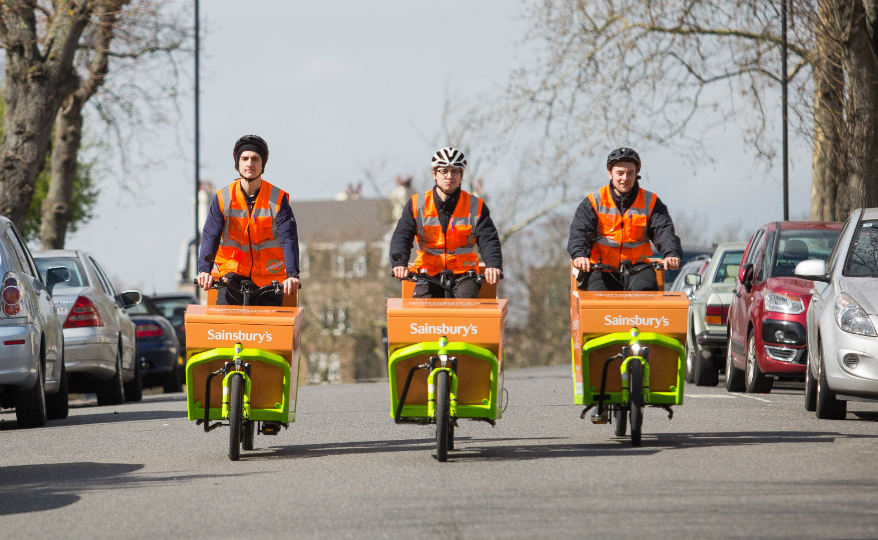
Some major businesses have already begun using electric cargo bikes in their day-to-day operations.
Earlier this year, the supermarket operator Sainsbury’s began a trial of using them to deliver groceries from its Streatham Common store in south London.
> Sainsbury’s launches electric bike delivery in London
The trial is being run in partnership with e-cargobikes.com and the bikes, which can carry several orders at the same time, are able to satisfy 100 deliveries a day.
When the scheme was launched, Clodagh Moriarty, Sainsbury’s director of online said: “We’re delighted to be the first supermarket to trial grocery deliveries by electric cargo bikes.
“We’re always looking for new ways to make sure we can best serve our customers and this trial will help us explore whether there might be a more flexible way to deliver Sainsbury’s groceries to those who live in busy cities.”
Other companies trialling electric cargo bikes include the delivery firm UPS, which last year started a pilot scheme in London and which says that each of its bikes can handle a load of up to 200kg.
The consultation, which forms part of the government’s Future of Mobility Grand Challenge, closes at 11.45pm on 10 September 2018, and you can find out how to respond here.
https://www.gov.uk/government/consultations/the-last-mile-a-call-for-evidence
















4 thoughts on “DfT seeks ideas for using e-cargo bikes for last-mile deliveries”
Sanity at last! What’s not
Sanity at last! What’s not to like? No more precariously parked delivery vans trying to emulate Fiat 500s on narrow, parked up streets. Fit and friendly riders like other cargo bike delivery companies, not grumpy and obese van drivers. There are huge environmental and health benefits, so it would be sensible to introduce tax incentives.
I see that I can borrow a cargo bike at Homebase, but what happened to those trailers that you could borrow from Waitrose? (I already have a trailer, but I’m contemplating a Long John for my N+1, to make downhill load carrying less exciting:)
Those Sainsbury’s cargo bikes
Those Sainsbury’s cargo bikes need to be somewhat bigger, they’re too small to carry an effective load and the claim that they can deliver more because they can get parked up and return to base and reload again simply isn’t true for 99% of deliveries even in and around very congested city streets.
I was talking with my son about this and he’s a former delivery manager for JS, there isn’t enough space in the refridgerated/frozen for a start off and unrefridgerated the goods have a limited timescale to be in that uncontrolled temperature before they are considered to be not viable/acceptable to be passed to customers.
The logistics of having only the very smallest deliveries – 20 items max I think Sainsburys declared (which is flawed due to item size and would be or rather should be on volume of order) and those with non ambient goods is made much more difficult due to the size of the cargo volume/hold and thus the numbers as yet do not add up re the ‘we can deliver more using cargo bikes’. Certainly greener/safer for sure and the number of van brake downs and even parking/speeding tickets add up to the cost/time consideration.
That’s not to say i don’t back deliveries by bike (electric assist or otherwise) but to make it work/work better there needs to be more thought in terms of the capacity of the cargo bike itself and what electric assist the bikes receive. The fewer trips back to site the better. Double the volume of the cargo hold including temperture controlled (which is absolutely viable based on what Sains are using currently) and you cut down the ‘wasted’ time travelling back to store and out agaon, however because the cargo unit is still small by comparison to a van it’s still able to pull up directly outside a delivery address without blocking the road/spending time to find a parking spot and be able to get to more addresses along the way due to being able to take on more orders of a certain size.
While it’s great that they’re
While it’s great that they’re having a consultation, it would still have to be funded, and the history of this government actually providing meaningful funds for anything to do with cycling is just about good enough to call abysmal. I’ll believe they’re serious about this and other cycling initiatives when they get as much money as is spent on new roads. Until then, it’s all hot air.
No – until then it’s an
No – until then it’s an amount of money between zero and “as much money as is spent on new roads”. We just need to try and make sure it’s more towards the latter than the former.