



Cycling UK has said it is willing to provide legal assistance to the cyclist knocked off his bike by Chris Grayling. ‘Car dooring’ is a criminal offence punishable by a fine of up to £1,000 – although the charity has been campaigning for stiffer penalties.
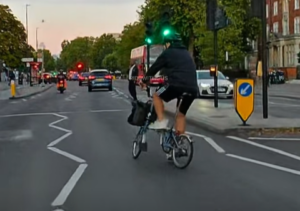
Footage of the incident, which took place in October, shows the Transport Secretary opening the door of his ministerial car into Jaiqi Liu, who was cycling past.
Liu said his bike needed a series of repairs and that he experienced pain later on, after the shock had worn off.
Grayling is said to have implied that the incident was the cyclist’s fault, claiming that Liu had been riding too quickly (despite not appearing to have seen him).
Liu said that after checking he was okay and shaking his hand, Grayling left without leaving his name or details. The cyclist then reported the incident to police.
Cycling UK’s Senior Road Safety and Legal Campaigns Officer, Duncan Dollimore, said:
“Mr Grayling as a former Justice, and the current Transport, Secretary should know it’s a criminal offence to open any door of a vehicle on a road so as to injure or endanger anyone. Currently, it’s treated as a minor offence with a maximum £1,000 fine, despite the fact that people have been killed and seriously injured by car dooring.
“Cycling UK spoke to Justice officials in September suggesting that a review of the offence and penalties of the car dooring offence is needed. Disappointingly, Grayling’s former department rejected our suggestions and omitted them from their review of offences they announced two weeks ago. Hopefully, the Ministry of Justice will now listen to us, and reconsider the entire remit of what is a very limited review.
“Cycling UK is keen to speak to Mr Liu to see if our Cyclists’ Defence Fund is able to provide legal assistance. There are questions about why Mr Grayling was not prosecuted for what appears to be an offence, and CDF has in the past been prepared to commence private prosecutions on behalf of injured cyclists.”
‘Car dooring’ is a criminal offence under Regulation 105 of the Road Vehicles (Construction and Use) Regulations 1986 and Section 42 Road Traffic Act 1988.
Cycling UK points to incidents such as the death of Sam Boulton as a reason why the offence should be reviewed. The current maximum penalty is a fine of up to £1,000 and penalty points cannot be imposed on the offender’s licence.
Dollimore also pointed out that incidents such as this could be affected by government plans to increase the small claims limit for personal injury.
“We sincerely hope Mr Liu suffered no lasting damage as a result of the Transport Secretary’s actions. Unfortunately, had he suffered a moderate but non-life-changing injury, as is common in such situations like a broken wrist or collar bone, if the Government has its way, Mr Liu would not recover any legal or other cost.
“Under current proposals to increase the small claims limit to £5,000, any compensation could easily be swallowed in legal fees as the Government thinks road victims, rather than insurance companies, should pay their own costs.”
Cycling UK, together with RoadPeace and Living Streets, yesterday launched the Road Victims are Real Victims campaign, which opposes the plans.
















112 thoughts on “Cycling UK suggests Chris Grayling should be prosecuted for dooring incident”
Front page of the Guardian,
Front page of the Guardian, not that it will make any difference, it would have to be the mail to cause him any distress, and we know how they are about cyclists.
I had forgotten about the former Justice secretary angle. Makes him kind of doubley hipocritical.
If they need a tenner to fund
If they need a tenner to fund a private prosecution, count me in.
No, make it twenty, this is the b*****d who won’t fund cycling.
Failing to stop and report a
Failing to stop and report a traffic accident could in theory incur a prison sentence. Or community service. There’s a happy thought for the weekend.
Edit. Drivers, not passengers. Still, it’s a happy thought all the same. Burn the witch!
Argos74 wrote:
He did stop. He ensured the cyclist was OK. He apologised. Both went their seperate ways. That is as much as the law requires where there is no damage to person or property
“Section 170(2) of the Road Traffic act 1988 provides that the driver of the motor vehicle must stop and, if required to do so by any person having reasonable grounds for so requiring, give his name and address, the name and address of the owner of the vehicle and the identification marks of the vehicle. The duty to stop means to stop sufficiently long enough to exchange the particulars above: Lee v Knapp [1966] 3 All ER 961.”
Griff500 wrote:
There may not have been initial signs of personal injury but there was damage to the cyclists property which would have been immediately apparent if investigated.
ClubSmed wrote:
Indeed – and if the video and subsequent account is anything to go by, the rider was still seeing stars when Grayling buggered off.
davel wrote:
He did stop. He ensured the cyclist was OK. He apologised. Both went their seperate ways. That is as much as the law requires where there is no damage to person or property
“Section 170(2) of the Road Traffic act 1988 provides that the driver of the motor vehicle must stop and, if required to do so by any person having reasonable grounds for so requiring, give his name and address, the name and address of the owner of the vehicle and the identification marks of the vehicle. The duty to stop means to stop sufficiently long enough to exchange the particulars above: Lee v Knapp [1966] 3 All ER 961.”
— ClubSmed There may not have been initial signs of personal injury but there was damage to the cyclists property which would have been immediately apparent if investigated.— Griff500 Indeed – and if the video and subsequent account is anything to go by, the rider was still seeing stars when Grayling buggered off.— Argos74
I think if you watch the video gain, you will see that Grayling is still standing there as the cyclist wanders off, followed by the guy with the camera! We don’t see Grayling “bugger off ” anywhere.
Grayling is undoubtedly liable for £1000 for dooring. But nobody can serioysly watch the video and say he did not give the cyclist opportunity to request details as per section 170.
Griff500 wrote:
The video I’ve seen (embedded in the road.cc and guardian articles) doesn’t show the cyclist wander off. He doesn’t go to get on his bike or even have chance to check it over before the footage finishes. You might have seen an extended version or the director’s cut, but the cyclist doesn’t wander off in the version I’ve seen. He still appears woozy as he goes to his bike.
The cyclist actually says “Definitely he should stay a bit longer to check on me. But maybe he had something more important than this to rush to.”
We don’t have Grayling’s version, other than a spokesman saying they shook hands and left.
My point is that the cyclist was shaken up – quite possibly injured – and in those circumstances the onus has to be on the pillock who caused the collision and injury to make sure correct procedure is followed, not on the victim whose head is still spinning. You’d hope the transport secretary would have a clue what that procedure is.
Are you suggesting that the onus should be on the cyclist, in the 60 or so seconds following a car dooring, to ensure details are exchanged?
davel wrote:
Rightly or wrongly, that is precisely what the law (Section 170) says. That is also precisely what a motorist would have done, because every motorist has it drummed into him to get details no matter what (just in case he decisdes to likely to slap in a whiplash claim later).
How long is long enough to satisfy Section 170, and/or any moral obligations? I assume in your version of the video there was also the protracted handshake, during which there appeared to be a conversation taking place. In the absence of audio, we have no idea what was said, and what indication was given of the cyclist’s state of mind, or whether he was OK or not. Furthermore, how much of this has been fired up two months after the event (at which point the cyclist had no intention of pressing charges) by the Guardian and others.
Griff500 wrote:
….precisely states that the injured party has to request details? I don’t see it like that.
I think it places the obligation on the driver (or doorer, Grayling, in this case?) to provide details at the time or to the police, should there be a need. Injury/damage suggests a need, so the driver should have provided details – that’s how I’m interpreting it, and I think is the point of the Graun article.
Argos74 wrote:
burning’s too good for them, nail them up I say, nail some sense into them!
If the cyclist was trying to
If the cyclist was trying to squeeze down the inside of the car then it’s his own fault. Despite whatever you think of Chris Grayling !
Batchy wrote:
While I tend to agree that the cyclist was partly to blame, that’s not the way the law sees it. As far as the law goes, the onus is on the “door opener” to check that the way is clear rather than the overtaker.
There was damage to person
There was damage to person and property. There was no exchange of details, in fact from the story there appears to have been some deliberate concealing of identity (putting the ID in the pocket) The victim did not know who doored him causing the damage to person and property. There was no “Hi, I’m the right honerable Chris Grayling, Secretary of State for Transport and former Justice Secretary” whilst he shook the confused and disorientated victims hand. The driver did not stop and identify themselves and exchange details.
Look at the picture, the “mandatory” cycle route starts just there 2 cars in front of the offending vehicle, and where is it? On the inside of the large vehicles.
The cyclist was in the wrong.
The cyclist was in the wrong.
Rule 163 of the Highway Code states “Only overtake on the left is the vehicle in front is signalling to turn right, and there is room to do so”.
Rule 163 applies to all road users. It’s about time it was enforced properly.
My point is not an anti-cyclist perspective. Far from it, I want to encourage cycling. But that requires safety-orientated behaviour by both drivers and cyclists. Every time a cyclist passes a narrow gap on the inside of cars, it helps to legitimise the dangerous idea that a car need only give that same narrow space when overtaking a bike.
rollotommasi wrote:
overtaking relates to flowing traffic not passing queueing vehicles.
Or are you suggesting that a bus in the bus lane should not pass stationary traffic?
If the car was doing 20mph and the cyclist tried too ass on the inside that would clearly be overtaking on the left and at fault. But as the highway code expressly states that cyclists may pass stationary traffic on either side you can’t say rule 163trups that, as there would be no circumstance where that statement would be true.
by your logic we can never pass lines of cars because they never give room to do so and certainly not leaving space on the right. So might as well get in our cars instead.
As to close passing, if I am stationary with feet on the floor I am quite happy for cars to pass within a few feet, but when moving less so. It’s totally different. Without even considrink relative danger and protection issues.
Also worth pointing out that the cyclist did not hitthe open door, the door was opened into him.
As to buses/hgvs those signs are there due to poor visibility resulting in increased risk in doing so. If I wear a jersey that says drivers do not overtake me dies that make it law? Grayling has no poor visibility excuse in a regular car.
finally please explain why the ONLY legal access into the advanced stop bos is on the left of the vehicle that has stopped at the stop line? If filtering on the left is illegal this would be entrapment, no?
there is nothing in the video to suggest the cyclist was filtering recklessly. I’m more inclined to question whether he was deliberately bashed with the door.
rollotommasi wrote:
Nope. The Road Vehicles
(Construction and Use) Regulations
1986, SI 1986 No. 1078, reg 105,
which provides: ‘No person shall
open or cause or permit to be
opened any door of a motor vehicle
or trailer on a road so as to cause
injury or danger to any person.’
Section 42 of Road Traffic Act
1988 states that a person who fails
to comply with the Regulations is
guilty of an offence.
rollotommasi wrote:
In the context of the Highway Code ‘overtaking’ means passing a moving vehicle. It does not apply to filtering in and around stationary traffic, which is dealt with in other paragraphs.
Filtering is not against the
Filtering is not against the law. Rule 160 states that road users should ‘be aware of other road users, especially cycles and motorcycles who may be filtering through the traffic’ Rule 211 says that ‘it is often difficult to see motorcyclists and cyclists, especially when they are filtering through traffic’.
And please look at the picture above, where is the “mandatory” cycle route? On the inside of the big coach. Do you mean that such wonderful infrastructure cannot be used unless the coach was indicating to turn right?
ktache wrote:
At worst the cyclist could be accused of contributory negligence. Irrespective of this Grayling showed a clear “failure in duty of care”. Note that no harm or damage needs to have occurred, merely endangering somebody through opening a car door without due care is enough to land a dooring charge. The maximum fine however is only £1000.
Just because Rule 160 states
Just because Rule 160 states that road users need to be aware of others’ actions, doesn’t make those actions acceptable. Rule 163 still applies.
And the existence of a cycle route ahead does not make undertaking ahead of the start of that route legitimate.
Rule 239 states- you MUST
Rule 239 states- you MUST ensure you do not hit anyone when you open your door. Check for cyclists or other traffic.
and that is a MUST one, enforcable by law.
The onus is on the driver and it is they who is responsible for their passengers. It was the driver who should have stopped and exchanged details and reported the incident to the police.
We are having a go at Grayling because he is the Secretary of State for Transport, former Justice Secretary and should know better.
ktache wrote:
Rule 239 does not override Rule 163. And, had the cyclist abided by Rule 163, then the situation would not have arisen where Rule 239 might be breached.
So blame rests primarily with the cyclist.
rollotommasi wrote:
Rule 163 is mainly aimed at motor vehicles and although the recommendations should be followed by everyone, it’s tricky for cyclists to check their mirrors and wouldn’t be considered at fault for not having mirrors. Rule 239 is a MUST rule rather than a recommendation, so it is considered more important to follow than Rule 163.
It’s ludicrous to blame the cyclist.
hawkinspeter wrote:
Hold on. Rule 163 is NOT “mainly aimed at motor vehicles”. It applies to ALL road users. It would be nonsense to suggest otherwise, just because a couple of phrases are specific to motor vehicles. Were it intended that Rule 163 should not apply to cyclists, then it would have been explicit about that.
And Rule 239 is NOT more important than Rule 163, because the 2 rules should not come into conflict. If the cyclist had complied with Rule 163, then the collision would not have occurred, pure and simple. Which means Rule 239 would not have been an issue.
So I repeat – the cyclist is primarily to blame.
rollotommasi wrote:
You really need to look up ‘should’ and ‘must’.
davel wrote:
I know exactly the difference between “should” and “must”, thank you very much. And I also know that BOTH “should” and “must” instructions are to be complied with. You can’t argue that you can ignore something in the Highway Code because it says “should”.
It’s also Rule 163 which states that road users should “give motorcyclists, cyclists and horse riders at least as much room as you would when overtaking a car”. That’s not a “must” instruction, but I would expect that to be complied with. Wouldn’t you?
And the fact remains the cyclist failed to comply with Rule 163. If the cyclist had complied, then the collision would not have occurred.
rollotommasi wrote:
The cyclist did comply with Rule 163:
rollotommasi wrote:
Um, yes, you can. That’s the whole point of having two different words. ‘Shoulds’ are advisory only, not legally obligatory. By definition, you can chose not to follow advice. That’s why its advice not orders.
So it seems to me that you _don’t_ know the difference between ‘should’ and ‘must’.
And I think you will find that motorists ignore pretty much everything that says ‘should’.
For example, since when have drivers followed the rule about not parking facing against the traffic flow? Or the one saying ‘you should not park on the pavement’ (in London, and only in London, its a ‘must’ but many drivers still do it even there).
rollotommasi wrote:
I thought cyclists were allowed to filter in stationary or practically stationary traffic, on either side (isn’t there a Highway Code rule about watching out for filtering cyclists/motorcyclists?). And in this specific case, the cyclist was in a gap where two cycle lanes hadn’t been joined up. In practically stationary motor traffic. So: no, not the cyclists’ fault.
(Isn’t rule 163 about giving sufficient room when overtaking?)
rollotommasi wrote:
That seems a peculiar interpretation. It’s like waving around a hammer and then complaining when people get hit that they shouldn’t have been so close.
Although Rule 163 should apply to all road users, it’s clearly aimed at motorists:
You’ll also notice the sentence that indicates the behaviour that the cyclist is following:
Quote:
No. It’s like waving a hammer and then complaining when people get hit that a statutory code told them not to get so close.
You’re contradicting yourself. Either the “no undertaking” passage in Rule 163 applies to all road users or it doesn’t. Even you accept that it does. There’s nothing in that passage that applies to drivers of motorised vehicles only.
That passage is about roads with more than one lane. It talks about staying in lane, and being able to pass traffic in a queue in the right lane if it’s moving more slowly than traffic in your lane on the left. That’s irrelevant in this case, where the cyclist and cars were sharing the same lane, and the cyclist was trying to undertake within that same lane.
I also go back to a point I made at the outset. It’s hard enough ensure that all drivers give cyclists plenty of space when overtaking as it is. If cyclists undertake through narrow gaps, it provides justification for drivers to overtake cyclists with the same small gap.
rollotommasi wrote:
I’m not contradicting myself – Rule 163 is aimed at motorists despite not explicitly stating that. It’s a list of recommendations about safe overtaking, so it technically should be followed by everyone, but I have trouble with the following applying to a bike:
That passage is about roads with more than one lane. It talks about staying in lane, and being able to pass traffic in a queue in the right lane if it’s moving more slowly than traffic in your lane on the left. That’s irrelevant in this case, where the cyclist and cars were sharing the same lane, and the cyclist was trying to undertake within that same lane.
I interpret that as applying equally to lane-splitting. I’m effectively making another lane by finding sufficient room between the kerb and the car and the cycle lanes before and after echo that sentiment.
Personally, I often overtake slow/stationary vehicles either to the left or the right depending on the particular situation. Both methods have pros and cons which is why the Highway Code warns drivers about cycles and motorcycles overtaking either side.
I appreciate that point, but I partially disagree. The situation isn’t symmetrical as drivers tend to overtake with a much greater speed difference and obviously impacts cause more injury to the cyclists. If I’m overtaking a slow car, then I’m usually only going a few mph quicker than them and it’s much easier for me to judge speed and distance (and I would come off worse if I get it wrong). However, I do see that motorists might not understand the distinction.
rollotommasi wrote:
No. It’s like waving a hammer and then complaining when people get hit that a statutory code told them not to get so close.
You forgot to mention that the code merely advised them not to get so close, while the same code says the hammer holder is legally obliged to look where he is waving his hammer.
I think the people who are
I think the people who are saying the cyclist shouldn’t have overtaken on the left are wrong.
It may be unwise in general, but here the infrastructure (painted line) indicates that this is what is intended. The cycle lane on the left is a very few metres further on. Yes, where the guy was hit, there was a break in the lane, but it doesn’t seem logical to me to expect someone riding a bike to swerve to the outside of the traffic where there is no painted lane, and swerve back in again afterwards.
HarrogateSpa wrote:
I agree, the infrastructure is awful here
HarrogateSpa wrote:
Sorry, but your point makes no sense to me. When there’s a break in the lane, the cyclist has the option of moving to the outside of the traffic (in which case overtaking with care is allowed) or stay to the left or adopt primary position. In the latter 2 cases, the cyclist then stays within the line of traffic.
The point is that any attempt to undertake other traffic where there’s no cycle route contravenes Rule 163 of the Highway Code.
This is the third tread on
This is the third tread on this story, Cycling UK are willing to use their Cyclists’ Defence Fund to help the victim in this case. Cycling UK’s legal experts do know quite a bit about cycling and the law. I’m guessing that Grayling’s legal team are doing a bit of damage control at the moment. I wouldn’t mind knowing what The Cycling Lawyer, Martin Porte QC has to say about this.
One question that springs to
One question that springs to my mind: How close to the kerb should one’s vehicle need to be without having to consider the possibility of a vehicle passing between the door I’m about to open and the kerb? Another question: Should I really expect a vehicle to ‘undertake’ my vehicle when my vehicle is already in the lane nearest the left-hand kerb?
For vehicle, consider anything from an HGV to a bicycle. For kerb, consider a one-way street and both the right- and left-hand kerbs.
Reading the reports, it seems someone said Jaiqi Liu was travelling “too fast”. Other than the relevant 20/30 mph limit, is there a speed above which one is ‘travelling too fast’? If so, I think we should be told.
W12 Hatter wrote:
You must always ensure that it’s safe to open your door, irrespective of distance to the kerb. There could easily be someone walking/jogging on the pavement, so you can’t just throw the door open without making reasonable effort to ensure that it’s safe.
The question of “too fast” on a bike is subject to debate. Speed limits are generally motorised speed limits (unless specifically targetted at other vehicles) and thus don’t apply to bikes. In theory you can be prosecuted for “pedalling furiously” but there’s no clear definition. It’s irrelevant to this situation as swinging a door into someone’s path is careless no matter the speed that they’re travelling.
W12 Hatter wrote:
The minister’s car hadn’t pulled over: traffic was practically not moving and this looks like a classic case of “this is taking too long, I’ll just get out here”. It doesn’t matter how close to the kerb you are, or whether or not there’s a cycle lane: the law says you look before you open your door. End of.
Yes, allegedly, Mr Grayling who didn’t see the cyclist was able to see that the cyclist was travelling “too fast”.
W12 Hatter wrote:
Distance from the kerb is utterly irrelevant. I’ve been doored while walking on the pavement by an twunt of a BMW driver is his new-ish 3-door convertable (ie longer than average doors) as he threw the door open in his rush to get to the takeaway shop across the pavement, all the while as he was looking at the out his windscreen. Luckily for me (not for him) I was on my way to take some photos and had a tripod in the hand nearest his car, which left a nice dent in the door, also just coming out the takeaway was a local policeman with his lunch. So as well as leaving with his lunch, and a dent in his door he was also lucky enough to get a fine for his carelessness.
I’ve also been almost doored in a cycle lane when a passenger decided to hop out a few metres ahead of me. . . ringing of bell and shouting had no effect.
It is the responibility of the person opening door to make sure they are doing so safely.
StuInNorway wrote:
This. To add another example, I’ve heard of people being doored on the cycle path the other side of the oddly shaped high kerbing/miniwall from the carriageways:
https://goo.gl/maps/XTzgWkj9uNn
As for much of the rest of the discussion, Highway Code interpretations or not, people do filter up the inside. A lot. Search on YouTube for “Student Rush Hour – Cambridge, UK – 8h58am” . Reputations well and truly destroyed, eh? No way back, really. But perhaps that’s because in general you are better protected from the effects of dooring (or of being squeezed off line by car bodies moving obliquely to lanes) by filtering on the nearside than on the offside? You get pushed onto the footway, rather than, in the worst case scenario, under someone’s wheels.
It’s a shame that nobdy
It’s a shame that nobdy doored Grayling really. Complete waste of oxygen.
Brooksby, its rule 211- It is
Brooksby, its rule 211- It is often difficult to see motorcyclists and cyclists, especially when they are coming up from behind, coming out of junctions, at roundabouts, overtaking you or filtering through traffic.
Notice how it seperates overtaking and filtering. Filtering is at most a grey area. Cyclists are advised to show extra care when filtering, but that seems mainly in respect for turning vehicles.
This is a dooring. And of course Rule 239 states- you MUST ensure you do not hit anyone when you open your door. Check for cyclists or other traffic.
The driver is ultimately responsible for this, now in the video you don’t see the car drive away, but the traffic does start to move, indicating to me that the car is no longer there. And I think it would be pushing our credulity, that our Secretary of State for Transport was not responsible for his own actions. But still the driver should have stopped to exchange details, or should have reported it to the police, as we know from http://road.cc/content/news/212905-red-light-jumping-cyclist-causes-crash-driver-court-failing-report-it that even when the cyclist was running a red light it was the responsibility of the motorist to report the incident. Five points and a fine. Just because a rule is being broken doesn’t mean other rules stop applying.
Griff500 there has to be exceptions with the immediate exchange of details, there can be a delay, especially when injuries have been sustained, happened to me, I was rushed off to hospital with breathing difficulties, one of my ribs had been broken and punctured my lung, strangely enough, no exchange of details. The cyclist did appear to be dazed and confused.
ktache wrote:
Exactly… So off the driver (not the cyclist) pops to a cop shop, except in this case it appears that he didn’t…
I know I’m a fairly new
I know I’m a fairly new poster on this site, but I did read it quite obsessively for about a year before joining and commenting, and I very much enjoy the back and forth nature of this wonderful cycling forum. I will always be happy to discuss the finer point of the cult of cycling with the regular contributors to this site. But I’m not going to feed the “I’m not anti-cyclist” troll anymore.
My whole premise for
My whole premise for contributing is that, if we’re serious about encouraging cycling in this country, we need to focus on safe conditions for cycling. If we’re serious about that, then that requires a range of things:
So, while others may argue that what I argue for isn’t so important, neither ktache nor anyone else has any right to simply dismiss me as some kind of anti-cycling troll.
Unfortunately, too many comments on this thread are all about:
Which is why some posters are desperate to justify undertaking under the Highway Code through tenuous interpretations which try to minimise what it requires of cyclists, even though undertaking against both the letter and the spirit of the Code.
rollotommasi wrote:
Ah… The spirit.
Ok, if you’re not an anti-cyclist troll, you’re an anti-English troll. You claim to understand the difference between Should and Must, and I think I believe you. The thing is, you then set about demonstrating that you don’t understand the difference – or are choosing not to in this particular context.
There’s word no.3 for you to look up this weekend: ‘trolling’.
davel wrote:
Wow, straight into ad hominem attacks there. How very reasonable of you.
As for your comment about the difference between “should” and “must’, I suggest you read my last post, including that:
Your comments are simply apologies for reckless cycling, on grounds that “I can do anything, unles the law or Highway Code states I must not”.
rollotommasi wrote:
It’s not ad hominem if it’s about your argument. There’s no.4 for you to look up 🙂
rollotommasi wrote:
You seem to be creating a strawman argument there. Lane splitting is definitely legal and it’s expected behaviour for cyclists to undertake when safe to do so. Rule 72 mentions:
There’s other mentions of checking for (motor)cyclists overtaking on either side.
I think you’re positing that undertaking isn’t allowed just for the sake of arguing. It would be highly dangerous in that particular road for a cyclist to go from the cycle lane on the inside, cross between cars to then overtake on the outside, then cross between cars again to go back to the cycle lane on the inside.
I also notice that your blaming of the cyclist (if he wasn’t there, it wouldn’t have happened) doesn’t mention the double yellow lines – no stopping at any time. There was also no indication from the car and thus Mr Grayling should NOT have been exiting the car at that position even if he had looked. It’s so clearly Mr Grayling’s fault that I’m beginning to think that you’re L. Willo.
hawkinspeter wrote:
There’s nothing in the Highway Code that legitimises lane splitting. You’ve weaved in your own imagined provisions. And undertaking is not “expected”. It’s become tolerated, because there’s so little enforcement. The fact that buses have to have notices reminding cyclists not to pass on the inside, which too many cyclists still choose to ignore, illustrates this.
There’s other mentions of checking for (motor)cyclists overtaking on either side.
As I’ve already said, that doesn’t justify undertaking. In the same way as, when the Highway Code warns cyclists to be aware of vehicles pulling out of junctions in front of them, it doesn’t mean it’s acceptable for a driver to pull out.
That’s a false argument, as again I’ve already explained. The cyclist doesn’t have to cross to overtake on the outside. S/he can do that, or they can hold their place in the line of traffic (including in the primary position if they so choose). And the situation is no justification for potentially dangerous undertaking manouevres.
No actually. Double yellow lines prohibit waiting, not stopping. And, as far as I can tell, the car had stopped because it was in a stationary queue.
I’ve no idea what you’re on about. But whatever it is, you’re well off the mark.
[/quote]
rollotommasi wrote:
There’s nothing in the Highway Code that legitimises lane splitting. You’ve weaved in your own imagined provisions. And undertaking is not “expected”. It’s become tolerated, because there’s so little enforcement. The fact that buses have to have notices reminding cyclists not to pass on the inside, which too many cyclists still choose to ignore, illustrates this.
There’s other mentions of checking for (motor)cyclists overtaking on either side.
As I’ve already said, that doesn’t justify undertaking. In the same way as, when the Highway Code warns cyclists to be aware of vehicles pulling out of junctions in front of them, it doesn’t mean it’s acceptable for a driver to pull out.
That’s a false argument, as again I’ve already explained. The cyclist doesn’t have to cross to overtake on the outside. S/he can do that, or they can hold their place in the line of traffic (including in the primary position if they so choose). And the situation is no justification for potentially dangerous undertaking manouevres.
No actually. Double yellow lines prohibit waiting, not stopping. And, as far as I can tell, the car had stopped because it was in a stationary queue.
I’ve no idea what you’re on about. But whatever it is, you’re well off the mark.
— hawkinspeter[/quote]
You stated ‘the cyclist is primarily to blame’. Making such an absolute statement, with no attempt to justify it (other than citing a point about “_may_ be used to attempt to show partial liabilty “- a sentence that doesn’t in any way justify your comment), is the mark of a troll.
Actualy I think this is more about you doing that usual ‘complete terror of feeling vulnerable’ thing that causes some people to desperately search for a way to blame the victim when anything bad happens. The psychological motivation is pretty obvious. Once you’ve done that you can escape that fear of being vulnerable to other people’s mistakes and feel ‘safe’ again. (Something that occurs in many domains, not just road traffic collisions)
Also its impossible to take seriously your insistence that where a cycle lane has a break in it, the ‘correct’ thing to do is to make a 90 degree turn, squeeze between cars in the adjoining lane of slow-moving or stationary traffic, travel on the outside for the length of a couple of cars, then make another 90degree turn and squeeze between cars again, before resuming on the left. In what world is that safer than continuing in the space on the left?
rollotommasi wrote:
Small point, but if the car was waiting, why did he get out of the car? Don’t you have to stop to get out of a car? Is it acceptable to get out of a vehicle that hasn’t stopped?
rollotommasi wrote:
There’s nothing in the Highway Code that legitimises lane splitting. You’ve weaved in your own imagined provisions. And undertaking is not “expected”. It’s become tolerated, because there’s so little enforcement. The fact that buses have to have notices reminding cyclists not to pass on the inside, which too many cyclists still choose to ignore, illustrates this.— hawkinspeter
[/quote]
http://www.cyclelaw.co.uk/overtaking-and-filtering-whilst-cycling
I think you’re taking an unusual stance there. The Highway Code doesn’t explicitly allow/disallow filtering, but it does infer that it is allowed. Your comment about buses is just trolling.
hawkinspeter wrote:
Implies not infers!
Apart from that, agree. Not least because the location of cycle lanes pretty much makes it clear that its expected for cyclists to pass on the left. The idea that cyclists can pass on the left for the length of a ten-yard-long cycle lane, then are supposed to stop and wait till traffic crawls forward, when they can trundle on another ten-yards to the start of the next ten-yard cycle lane segment, is just absurd.
rollotommasi wrote:
This whole comment is predicated on the existence of a ‘we’ that doesn’t actually exist.
rollotommasi wrote:
This comment is just nonsense-on-stilts. Its hard to know where to start.
There’s the weird use of ‘we’, to imply some collective responsibility, for starters.
There’s the unsupported claim that “we want to be safe when cycling on roads” (no, I want _everyone_ to be safe when cycling on roads, I have no idea who ‘we’ are)
There’s that sneaky reference to ‘making other road users responsible for our safety’ (a common petrol-head line, subtly trying to insinuate cyclists are trying to offload responsibility for things they are objectively responsible for).
No, other road users (i.e. motorists and road planners) mostly _are_ responsible for the safety of cyclists and pedestrians, because they are the ones responsible for the danger, and who have most of the control reducing it.
And there’s the weird implication that if every cyclist obeyed every non-compusory point of the highway code (including, I presume, high-viz and helmets) that would somehow make vulnerable road users safe and ‘earn’ them collectively the right to not be killed by others (when it would do nothing of the kind). Oddly, motorists manage to ‘earn’ safety without having to do anything of the kind.
You aren’t a troll, but you seem to be a conservative fellow who appears to think taking the side of those with power will get you better treatment.
So, for example, when
So, for example, when hawkinspeter says that he interprets Rule 163 as referring to lane-splitting, there’s nothing in the Rule which refers to that. Indeed, the passage in question is clearly about what you should do in your lane next to traffic in another lane (which is why it starts “stay in your lane….”).
Fluffykitten’s claims that drivers often ignore “should” rules is not an excuse – in the same way as it shouldn’t be an excuse for a driver to claim they should be able to ignore “should” rules because many cyclists do. As a general rule, ALL road users should adhere to “should” rules. And they should be enforced, particularly in order to keep roads safe.
And the claims that “should” rules in the Highway Code are advisory only are misleading. Should rules aren’t voluntary. The start of the Highway Code makes clear that failure to comply with “should/should not” or “do/do not” rules may be used in any court proceedings under the Traffic Acts to establish liability.
Interestingly, West Midlands Police are now threatening to prosecute drivers who fail to give sufficient space when overtaking cyclists. That’s something I hope we can all support. But giving sufficient space is another “should” rule in Rule 163.
On which point, I found hawkinspeter’s comments on the symmetry of cyclists undertaking drivers and drivers overtaking cyclists thoughtful and interesting. I accept that we might not expect exactly the same gap to be left. But they need to be pretty similar. First, while s/he argues that a cyclist will undertake slowly, it shouldn’t be an excuse for a driver to claim it’s okay to overtake a cyclist with barely a gap, just because they were also doing so slowly. And secondly, reasons why the gap is so important (the need to avoid uneven roads and obstacles such as drain covers) apply just as much where a cyclist might be thinking of undertaking as when a car overtakes a cyclist.
rollotommasi wrote:
Fair points, but there is plenty of grey in the Highway Code, which is why the Musts are used as a fall-back.
I don’t see many parallels between cyclists filtering slowly in traffic, with maybe 20cm to spare, and being close-passed by a car.
1. if the cyclist makes a mistake in either scenario, it could be game over, so they’re much more motivated to be careful, and 2. they’re likely to be doing what, 10mph ish? I don’t have a problem with being close-passed in similar circumstances (if I’m stationary and a car passes at 10mph). At 50mph it’s blatant disregard for my life.
davel wrote:
Okay, more reasonable tone of argument here, so due credit for that.
I respect your views here. But I also stand by the point that reasons for the need for a gap apply whether a cyclist is undertaking or being overtaken, and regardless of speed. And that’s the need to take evasive action at short notice to avoid hazards – e.g. poor road surfaces, drain covers, other road users encroaching (e.g. pedestrians stepping onto the road).
rollotommasi wrote:
That refers to both multi-lane roads and lane splitting. It explicitly mentions a queue of traffic on your right and that you may pass on the left which is exactly what the unfortunate cyclist was attempting to do. You stated that the cyclist was to blame as he wasn’t following rule 163, whereas he most clearly was following it (despite it being instructions for motor vehicles).
You MUST ensure that it is safe to open your door, and that clearly did not happen – I just don’t understand how you can blame the cyclist for this incident.
Anyone catch Steve Berry on
Anyone catch Steve Berry on Jeremy Vine?
Terms like “anti-cycling
I’m perfectly happy about my understanding of terminology, thank you.
Terms like “anti-cycling troll” and “anti-English troll” are not critiques about my argument. They’re ad hominem attacks on me.
Where you have actually bothered to make an argument on the issue rather than label me, I’ve responded in a responsible way (including acknowledging points I think have merit).
rollotommasi wrote:
You be as happy as you like. It’s Christmas. Don’t be surprised when people pull you up for being wrong, though.
Your behaviour is very similar to trolling. Nothing ad hommy there.
It is perfectly legal for
It is perfectly legal for cyclists and motor cyclists to filter through slow or stationary traffic.
Chris Grayling should not be
Chris Grayling should not be prosecuted for this but he should be prosecuted for being part of a government that is destroying this country
I can’t memorise 200+ odd
I can’t memorise 200+ odd rules – only one – if you go up the inside, YOU WILL DIE
beezus fufoon wrote:
So why are cycle lanes in that position?
hawkinspeter wrote:
One of Vine’s listeners was pushed on that point as to whether it was legal to filter in a cycle lane where traffic to the right was stationary. She claimed it to be a grey area.
hawkinspeter wrote:
Because too many of the people responsible for building/painting them don’t ride bicycles…?
brooksby wrote:
I reckon it’s a conspiracy with inner tube manufacturers to make sure we get plenty of punctures
beezus fufoon wrote:
Unfortunately most people memorise an even simpler rule – if you cycle on the road, you will die. Not sure why your over-simplification is any more valid than the more popular one.
It aint Willo, I read a lot
It aint Willo, I read a lot of WIllo, and no matter how much I disagreed with him, he occasionally had a point and contributed somewhat to the discussion.
By the way if you start looking back through some very old posts, because he has been totally erased from history, it does make some of the threads very bizarre.
ktache wrote:
I think I’m beginning to miss him…
I’m not sure how much he rode, though. He knew his way round a bike, definitely. But his ‘defer to everything’ approach was completely impractical and smacked, to me, as theory over practice.
Willo rode, he was so wrong
Willo rode, he was so wrong on many things but you could tell he rode.
rollotommasi wrote:
Small point, but if the car was waiting, why did he get out of the car? Don’t you have to stop to get out of a car? Is it acceptable to get out of a vehicle that hasn’t stopped?
Edit – actually i withdraw this point – seems its only illegal to stop to drop off/pick up if its the markings outside a school, not yellow lines.
I remain dubious as to why its legally allowed to open car doors when you aren’t actually parked at the kerb, though.
Too many amateur lawyers on
Too many amateur lawyers on here! The non law graduates here would be better off looking at how real lawyers and judges have interpreted the law in the past, instead of trying to interpret it themselves. The Google archives are littered with examples of previous verdicts, mainly involving motorcyclists rather than cycles, filtering through traffic, being involved in accidents of various types. Contributory negligence is the usual verdict, which serves only to reduce the sentence against the other party.
Griff500 wrote:
Reduce the damages won by the injured party 😉 Or, in some, to find against the motorcyclist altogether.
Thing is, motorcycles are still massive great fast chunks of dangerous metal, hence those outcomes. Very few cases still decided in relation to cyclists at all. I suspect, if the cyclist in the above were to bring a case, he’d be very likely to have no finding of con neg at all. In addition, in the criminal law, there’s no defence of ‘but he was on the passenger side doing nefarious cycling.’
Griff500 wrote:
If I claim that you haven’t really resolved the fact that neither Grayling, not his driver, gave his details to the cyclist, or the police, following the dooring, will you charge me an exorbitant fee to address that?
Weren’t you an expert engineer in another thread? The thread where you referred to yourself in the third person?* Wasn’t that you? I love meeting polymaths in the internet.
I suppose I might refer to myself in the third person if, whenever a topic got technical, I was already an expert in it. Or one of my other logins was…
* either that or got caught talking to yourself via different road.cc accounts.
davel wrote:
Too many amateur lawyers on here! The non law graduates here would be better off looking at how real lawyers and judges have interpreted the law in the past, instead of trying to interpret it themselves. The Google archives are littered with examples of previous verdicts, mainly involving motorcyclists rather than cycles, filtering through traffic, being involved in accidents of various types. Contributory negligence is the usual verdict, which serves only to reduce the sentence against the other party.
— davel If I claim that you haven’t really resolved the fact that neither Grayling, not his driver, gave his details to the cyclist, or the police, following the dooring, will you charge me an exorbitant fee to address that? Weren’t you an expert engineer in another thread? The thread where you referred to yourself in the third person?* Wasn’t that you? I love meeting polymaths in the internet. I suppose I might refer to myself in the third person if, whenever a topic got technical, I was already an expert in it. Or one of my other logins was… * either that or got caught talking to yourself via different road.cc accounts.— Griff500
I am not claiming to be an expert in law. I am merely pointing out that those of us who are not, me included, might get closer to how a legal judgement would be made by looking at past cases. I have done that. I don’t see hoards of people being prosecuted for filtering through traffic, which some here seem to suggest is illegal.
Griff500 wrote:
I’d wager that no-one was ever prosecuted for it, at least on a cycle and, most probably, on a motorcycle. There may be cases where filtering was charged, following an accident, as careless or dangerous driving (but not cyclists).
But the cases cited are CIVIL, they are not prosecutions. They are cases where the motorcyclist claims compensation and the court has to address whose fault it was. In some of the report cases the motorcyclist is found to have contributed to the accident (and/or injury) and had their overall damages reduced by the extent of that percentage finding.
Don’t professional legal
Don’t professional legal experts find it difficult to agree on anything? Sometimes it would seem that their beliefs change depending on who is paying them.
ktache wrote:
As in ‘lawyers?’
Yes. That’s pretty much why we exist. That said, don’t rule out the fact that a lot of clients, properly advised, want you to run their case anyway using the strongest ‘other’ argument you can muster.
After all, that’s pretty much what the Supreme Court Brexit case is about. The lawyers representing the government don’t really believe what they’re saying 😉
Bender, I thank you. I didn
Bender, I thank you. I didn’t use the term lawyer as I’d always thought of it as more of an americanism, I thought we had solicitors, QCs, barristers and judges, I also realise there are overlaps there. If you are one, and are prepared to admit it, could you resolve my issues? Cheers.
What a fascinating series of
What a fascinating series of posts. I suppose it’s what’s to be expected when you challenge Groupthink.
Some just can’t tolerate having their prejudices challenged, and resort to accusing me of trolling.
Fluffykitten appears to hold this strange black/white binary notion that either cyclists are responsible for their own safety or motorists are responsible for cyclists’ safety. S/he claims I believe the former, and then argues that the latter should be the case.
As far as I’m concerned, neither position is right. All road users have a mutual responsibility for their own and others’ safety. So, for instance, drivers are rightly under a duty of care for the safety of other road users, especially those more vulnerable. But by the same token, cyclists should take all reasonable steps to stay safe.
Hawkinspeter’s reference to a cyclelaw article is interesting for a couple of reasons. One is that it strangely doesn’t refer to Rule 163 at all. The other is that, even so, the article highlights the hazards of undertaking (e.g. “Cyclists should keep in mind that undertaking on the left is dangerous even where vehicles are stationary or where there is a cycle lane on the road.”).
And as for Fluffykitten’s final comment that
…the more relevant point is that, if the road designers had intended cyclists to be able to pass on the left for the full length of the road, they would have built a continuous cycle lane. The fact there’s a break in the cycle lane strongly suggests there is a reason why cyclists should not pass on the left at that part of the road.
rollotommasi wrote:
So do you think cyclists should
(a) stop dead at the end of the discontinuous cycle lane and wobble slowly forward for for the next five minutes while the traffic next too them crawls forward to the next bit of cycle lane?
(b) squeeze between vehicles to get to the outside, ride a bit, then squeeze back again to the kerb (assuming the traffic didn’t start up in the meantime, trapping them on the outside)?
(c) teleport
(d) (what I sometimes do) get off and walk along the pavement for a bit, and think yet again that maybe its time to get the message that cyclists just aren’t wanted on the roads.
I note you have resorted to the desperate line of ‘people disagreeing with me mysteriously proves that I’m right’ and ‘everyone else’s arguments are just prejudice, though I can’t actually show that, I’ll just assert it anyway as I’ve run out of rational arguments’. Given you explicitly supported the dominant ideology of ‘the primary responsibility is on the more vunlerable party’, I’m not sure you are in a strong position to accuse others of ‘group think’.
rollotommasi wrote:
You explicitly said ‘the cyclist was primarily responsible’. Dont’ try and wriggle out of what you said. You have been arguing for the former, don’t pretend otherwise.
You then went on to accuse cyclists of expecting other road users to ‘take responsibility for their safety’ – implying that its wrong to expect anyone but cyclists to take such responsibility.
Please at least try and argue honestly rather than constantly shifting your argument.
@trollotommasi couldn’t
@trollotommasi 🙂 couldn’t resist: I am only kidding, but…
How are you meant to ride that stretch of road?
Cyclists can fiter wherever
Cyclists can fiter wherever they want, left/middle/right side of slow or stopped motor traffic. British cycling had a good guide for the practical decisions of how to filter:
https://www.britishcycling.org.uk/knowledge/skills/article/izn20130830-Effective-traffic-riding-part-2-0
All Vehicles have a duty of care to those filtering, as mentioned by multiple HC rules.
The cyclist was filtering cautiously, a door opened close in front of them, leaving not enough to avoid a collision.
But for the door opening, the cyclist and their property would have been undamaged and no incident would have occurred.
All highway users (drivers and passengers) owe others a duty of care, Grayling owed a duty of care to the cyclist. Therefore he was negligent.
Damage to the bike is easily proved. Therefore he should be fined for the negligence, and be ordered to compensate the cyclist for their property damage and any Costa associated with their injuries.
I did no such thing. You’re fixated with the idea that people are either pro-cyclist or anti-cyclist. Because I’ve dared to challenge some cycling practice, that must make me anti-cyclist.
Well my fluffy friend, that’s totally wrong. I’ve stated the cyclist was primarily at fault, not because they’re “the vulnerable party”, but because they were best placed to prevent the collision from occurring. Their decision to breach Rule 163 was the first link in a chain of causation which led to the collision.
And that principle applies in my mind equally if the tables were turned between motor vehicle and bicycle. If a car pulled out of a junction in front of a cyclist, and the cyclist had the opportunity to react had they been cycling carefully but didn’t, then (as in this case) both parties would have committed breaches of the Highway Code which led to a collision arising. But the primary responsibility would rest with the driver, as their breach was the first, and it started a chain of causation leading to the incident.
rollotommasi wrote:
In the second example does the cyclist begin their careless cycling after the car pulls out?
rollotommasi wrote:
I watched Shutter Island last night. That experience was about 285,945.27 times less mind-bending than reading a post claiming that someone filtering on a bike, just past the end of a bike lane, caused a collision with a door opened by someone who didn’t look.
Anyhoo, let’s see you deal with JS’s deconstruction.
rollotommasi]
I did no such thing. You’re fixated with the idea that people are either pro-cyclist or anti-cyclist. Because I’ve dared to challenge some cycling practice, that must make me anti-cyclist.
Well my fluffy friend, that’s totally wrong. I’ve stated the cyclist was primarily at fault, not because they’re “the vulnerable party”, but because they were best placed to prevent the collision from occurring. Their decision to breach Rule 163 was the first link in a chain of causation which led to the collision.
That’s what you _say_ but it clearly isn’t true. You are so mired in unexamined recieved-ideas that you don’t even notice what you are doing. Your reasoning is specious (pretending a ‘should’ takes priority over a ‘must’) because your underlying idea is that the more powerful party mustn’t be held responsible.
By the way I wouldn’t say I’m ‘pro-cyclist’. I don’t even know many cyclists (and I can well believe a fair share of them are knobheads, what with their being human beings). If a cyclist hits a pedestrian I’m likely to be on the latter’s side.
I’ve spent far more of my life as a pedestrian than a cyclist.
I am, however, opposed to motor-car-worship. You are mired in a car-centric way of thinking. Group-think, sums it up, I think.
There was a link on the old
There was a link on the old CTC website to a High Court decision from about 1909 on filtering which specifically stated that filtering was legal. Unfortunately I can’t find it as the website has changed to CyclingUK.
However in the more recent case of Davis vs Shrogin (2006) the High Court judge said that “a filtering motorcyclist passing stationary or very slow moving traffic could not be to blame if a collision occured if the rider had no chance to take avoiding action.”
Until the High Court changes its mind or new legislation is enacted, filtering (carefully) remains legal.
Careful WiznaeMe, what with
Careful WiznaeMe, what with your facts and evidence, not in this post-truth world.
Quote:
In which case, you’re now shifting the focus of discussion. You were claiming Rule 163 is “recommended” behaviour, which is “not supported by force of law”.
Well, Rule 163 is expected, because it’s subject to law – civil law. And as I’ve previously mentioned, also criminal law, judging by West Midlands Police’s recent steps to prosecute drivers for not abiding by what the Rule says about giving cyclists sufficient space when overtaking.
Wrong. Failure to read my posts properly on your part does not constitute selectively ignoring on my part. I’ve already pointed out that this rule applies to where a road has more than one lane in any direction. That’s why the sentence before what you state says “Stay in your lane if traffic is moving slowly in queues”. It doesn’t say anything which permits lane-splitting.
And it certainly doesn’t justify undertaking. Because it only justifies passing on the left when traffic ON YOUR RIGHT is moving more slowly. Undertaking is not about that. It’s about passing traffic AHEAD OF YOU moving more slowly than you want to. That traffic’s only on your right AFTER you’ve already started to undertake.
rollotommasi wrote:
In which case, you’re now shifting the focus of discussion. You were claiming Rule 163 is “recommended” behaviour, which is “not supported by force of law”.
Well, Rule 163 is expected, because it’s subject to law – civil law. And as I’ve previously mentioned, also criminal law, judging by West Midlands Police’s recent steps to prosecute drivers for not abiding by what the Rule says about giving cyclists sufficient space when overtaking.
Wrong. Failure to read my posts properly on your part does not constitute selectively ignoring on my part. I’ve already pointed out that this rule applies to where a road has more than one lane in any direction. That’s why the sentence before what you state says “Stay in your lane if traffic is moving slowly in queues”. It doesn’t say anything which permits lane-splitting.
And it certainly doesn’t justify undertaking. Because it only justifies passing on the left when traffic ON YOUR RIGHT is moving more slowly. Undertaking is not about that. It’s about passing traffic AHEAD OF YOU moving more slowly than you want to. That traffic’s only on your right AFTER you’ve already started to undertake.
“You keep using that word. I do not think it means what you think it means.”
I. Montoya
rollotommasi wrote:
In which case, you’re now shifting the focus of discussion. You were claiming Rule 163 is “recommended” behaviour, which is “not supported by force of law”.
Well, Rule 163 is expected, because it’s subject to law – civil law. And as I’ve previously mentioned, also criminal law, judging by West Midlands Police’s recent steps to prosecute drivers for not abiding by what the Rule says about giving cyclists sufficient space when overtaking.
Wrong. Failure to read my posts properly on your part does not constitute selectively ignoring on my part. I’ve already pointed out that this rule applies to where a road has more than one lane in any direction. That’s why the sentence before what you state says “Stay in your lane if traffic is moving slowly in queues”. It doesn’t say anything which permits lane-splitting.
And it certainly doesn’t justify undertaking. Because it only justifies passing on the left when traffic ON YOUR RIGHT is moving more slowly. Undertaking is not about that. It’s about passing traffic AHEAD OF YOU moving more slowly than you want to. That traffic’s only on your right AFTER you’ve already started to undertake.
You’re just talking nonsense now. Please supply an example of contributory negligence that supports your views or just accept that you are wrong.
oh rollo, you’re so right but
oh rollo, you’re so right but so wrong!
going past on the left on a bicycle is generally permissible when the traffic is stationary
blindly opening a passenger side car door while sitting in traffic, not pulled over to the curb, is generally not permissible
the road markings here are unclear and ambiguous at best
personally, I would settle for a 50-50 split on the damages
but publically embarrasing Chris Grayling – that’s priceless
Rollo: how is someone meant
Rollo: how is someone meant to ride that stretch of road?
Filtering by cyclists (and
Filtering by cyclists (and motorcyclists) through stalled traffic is allowed in the UK. The cyclist did not appear to be moving too fast but since Grayling didn’t look before opening the door, it has to be asked how he knew the cyclist was going too fast. Grayling did not leave his details with the cyclist and should have realised that the cyclist was shocked following the incident. Grayling should also have seen that there was damage to the bicycle. Give Grayling’s inside knowledge of the law, he should be aware that he has left himself open to criminal prosecution. If I was the cyclist I would most certainly be pursuing this case. Too many people get away with causing injuries and in this specific instance, the guilty party has even fewer excuses than most.
This is getting somewhat
This is getting somewhat bizzare. The BBC featured the Andrew Mitchell plebgate affair 24/7 for months, but they will not mention this case, of a minister responsible for road safety knocking off a cyclist, failing to exchange details, hiding their parliamentary pass and not reporting it to the police. Which one is more newsworthy?
I’ve been in touch with BBC Newswatch to ask them to feature this case, and it would help if other people did too: 03700106676, newswatch@bbc.co.uk
burtthebike wrote:
Plebgate was bigger. Beneath the surface was a power battle between government and police, a very big deal.
Not unrelated, I expect our new friend Rollo Tomassi is not just a concerned fellow cyclist… https://theintercept.com/2014/02/24/jtrig-manipulation/
Malaconotus wrote:
The name kept bothering me so I googled it – wasn’t Rollo Tomassi the name given by one of the main characters in L A Confidential to the unknown person who had killed his father? So, a made-up person.
burtthebike wrote:
Just to play Devil’s Advocate here:
Yes he was responsible for knocking someone off their bike but he did so sorry and stop to check on the cyclist.
He may not have exchanged details but I think that legally it is the driver who needed to do this.
The parlimentary pass may have been hidden, but if it is anything like my place of work badges are not supposed to be visible outside of the grounds.
He may not have reported it but I believe that it is technically the drivers responsibility to do so not the passenger.
ClubSmed wrote:
As he’s the Transport Secretary, I would expect him to go above and beyond just the legal obligation in this instance. As he caused the accident (unless you subscribe to Rollo’s theory), I’d expect him to provide details for himself or at least prod his driver into providing some.
I don’t think anyone is accusing him of deliberate assault – it looks like he was simply careless, so he should ensure that the cyclist is absolutely fine before leaving him.
ClubSmed wrote:
Maybe compare and contrast with this thread.
http://road.cc/content/news/212905-red-light-jumping-cyclist-causes-crash-driver-court-failing-report-it
atgni wrote:
Just to play Devil’s Advocate here:
Yes he was responsible for knocking someone off their bike but he did so sorry and stop to check on the cyclist.
He may not have exchanged details but I think that legally it is the driver who needed to do this.
The parlimentary pass may have been hidden, but if it is anything like my place of work badges are not supposed to be visible outside of the grounds.
He may not have reported it but I believe that it is technically the drivers responsibility to do so not the passenger.
— ClubSmed Maybe compare and contrast with this thread. http://road.cc/content/news/212905-red-light-jumping-cyclist-causes-crash-driver-court-failing-report-it— burtthebike
That thread is talking about the driver. Whilst Grayling did not fulfil his moral obligation he did fulfil his legal obligation as he was not the driver and therefor legally not responsable for reporting it.
Malaconotus, I wondered that
Malaconotus, I wondered that quite early on, the name made me wonder, LA Confidential and all that, I envisaged tory boys at party HQ grinning, back slapping and a few celebratory lines of the real thing when they came up with that one. It made one comment on Edinburgh’s “bold” plans, and oddly stuck to only one of the Graying threads.
Living abroad, I have only
Living abroad, I have only just come across this news story.
To my mind, greater by far of the two idiocies shown in the video of the Grayling/cyclist car door collision, and I speak not only as a cyclist but as one who has been carless for more than 10 years now, is the cyclists recklessly riding, at some speed to boot, on the inside of the traffic lane, i.e. in the narrow space between the left-hand side of the cars and the pavement. Recipe for suicide, imho. And therefore sheer idiocy!
Grayling is wrong but the cyclist is triple wrong, and should as a London road-user (and yes, Grayling, he is a “road-user”) know better. But then again, I never cease to be amazed by the reckless road behaviour of far from a few London cyclists.