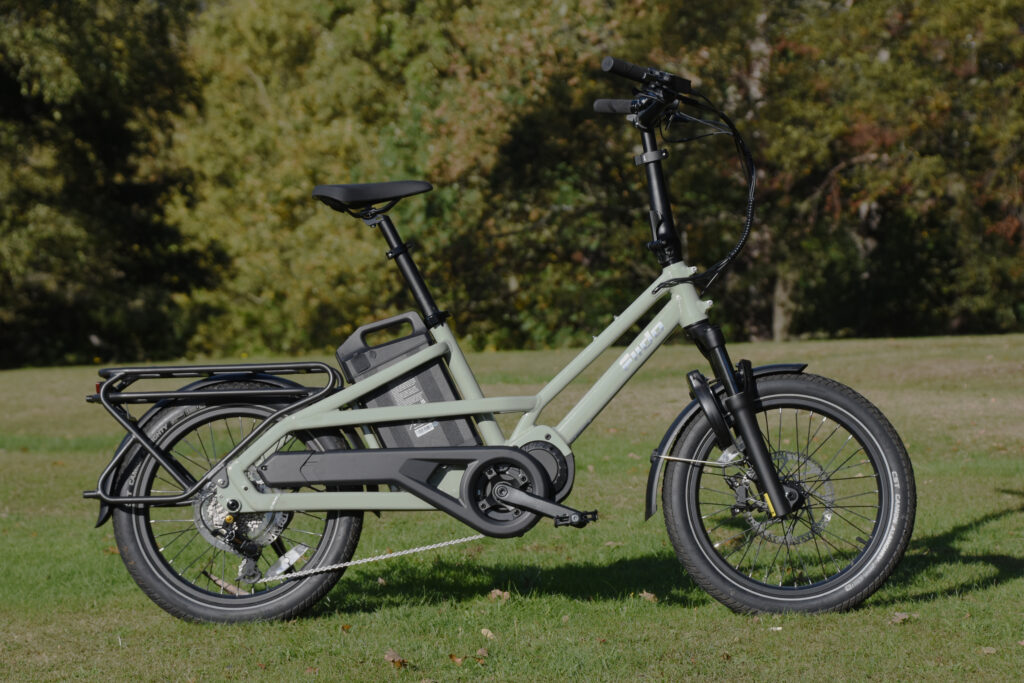
Electric bikes were big again at Eurobike, and every year they seem to get bigger. It’s a trend much more noticeable on, and driven by, continental Europe but we still see its effects filtering through to Blighty. So what’s happening? Electric bikes are getting better No doubt about it, the technology has come a long way from the 40kg behemoths that used to pass for electric bikes five years ago. To see how far technology has come I had a spin on the top-of-the-range (2,800 Euros) Diamant, a Trek sub-brand that’s distributed in Germany and Austria.
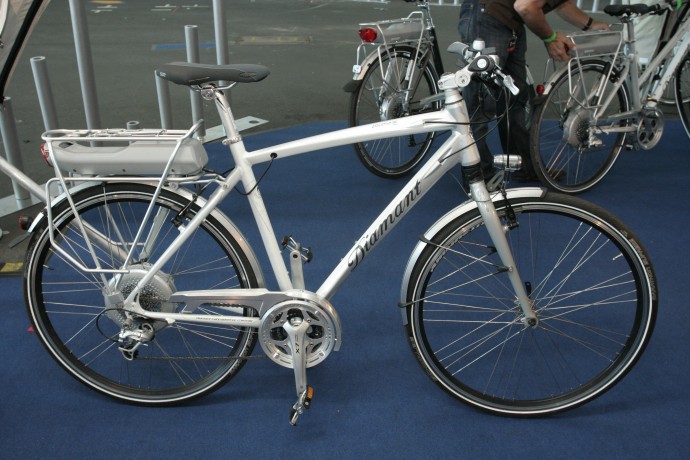
What’s refreshing from the outset about this bike is that it’s obvious that without the battery and associated gubbins it’s a well-thought-out and competent city cruiser. You get a well made Aluminium frame, decent rigid forks with a small headshok-type damper, sensible wheels and new LX running gear. It’s the kind of upright urban steed you might expect to weigh maybe 26-28lb. With the battery, motor and controls the total weight is considerably higher at 46lb, but it’s still a perfectly manageable bike even with the motor turned off.
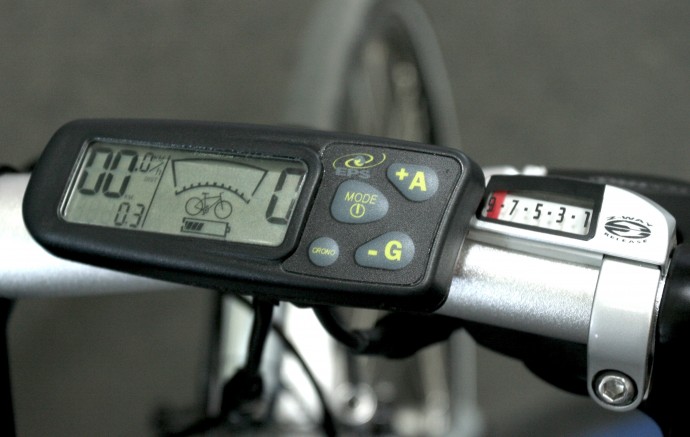
Add some power and it really comes to life. The bike uses the Pedelec system (it adds to your pedal input) and there’s four levels of assistance, from 25% to 200% of pedal power. Braking is regenerative, helping to charge the battery, and there’s also four charge settings for longer downhills, or if you just want to make life difficult for yourself. On the full power setting it was so impressive that I had to stop to confirm with the Diamant guys that it really was just a road legal 250W motor; on the continent electric bikes can be twice as powerful, but need to be licensed.
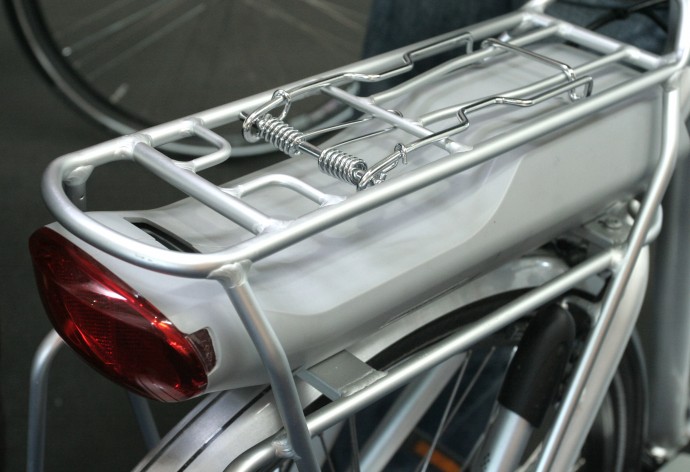
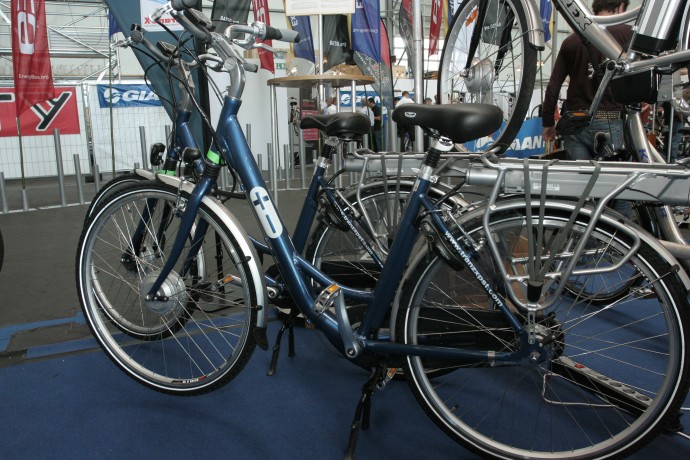
Obviously this is a high-end machine with a price tag to match – the scarcity of Lithium Ion batteries isn’t helping to make these bikes affordable at the moment – but there were plenty of other good-looking bikes on show for a lot less; I also had a spin on a mid-range Trans-X Pedelec bike that was very likeable if not as impressive as the Diamant. Pedelec seems to be the system of choice right across the board now, and twist-shift systems appear to be losing favour.
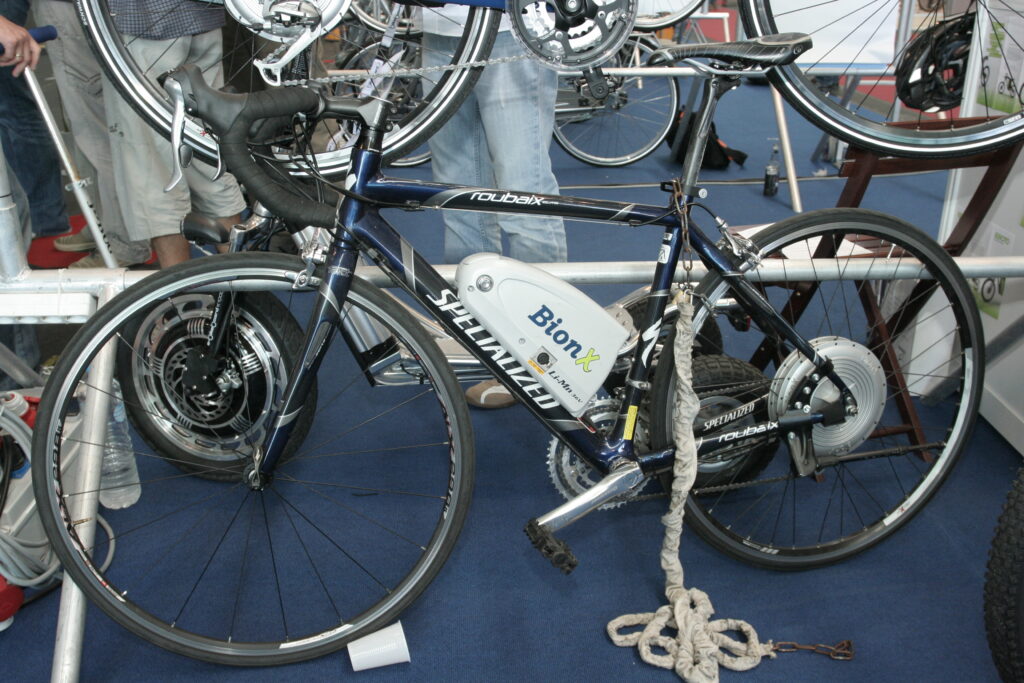
On the retrofitting front the Bionx system was all over the place as well, fitted to all sorts of bikes including the Specialized Roubaix at the top of the page that they wouldn’t let me have a go on. A modified version of Bionx is also the power behind the new electric Birdy – more on that later… And the bad news? Well, mainly that there’s too much faffing around with the actual bike design when all that’s really needed is a light and efficient way of adding power to what we already know are the most sensible bike shapes. We don’t need shaft drives, nor unusual frames; these things just add weight without giving any operational advantage. Similarly there’s a big obsession with front and rear suspension, which is even more unnecessary on a town bike on the continent than it is over here. Just fit some bigger tyres, and do us all a favour: the systems are generally rubbish, and it’s just more mass to push around.
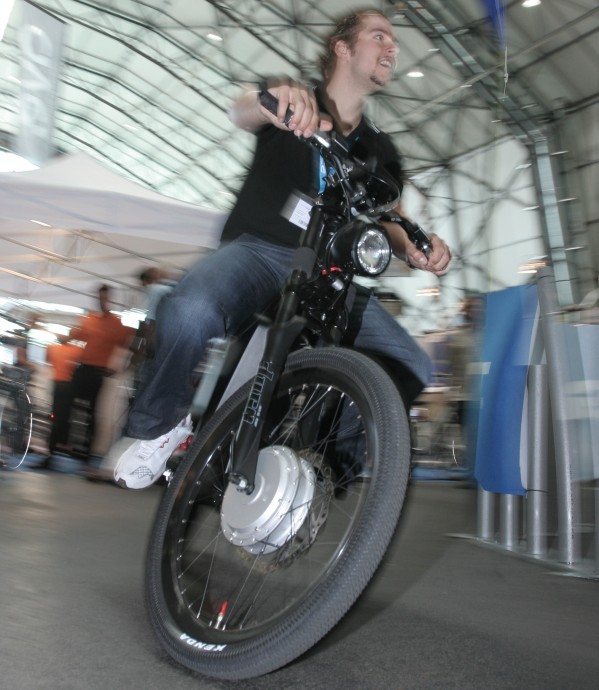
There was plenty of ‘urban utility vehicles’ knocking about too, basically motorbikes of one description or another with their petrol innards replaced by electric ones. I can’t help feeling that this is a hiding to nothing: it’s not as if the world can’t cope with a few 50cc mopeds pootling into town, and I’m yet to be convinced that firing up some manner of power station to supply the energy to charge the battery of said electric moped is better than a tiny petrol engine anyway. Having said, I’ve got a lot of time for the e-Bikeboard scooter, simply because it’s such tremendous fun. Sadly, I think it’s too powerful to be legal in the UK…
- News

Electric Bikes – the future?

Add as a preferred source on Google
Help us to bring you the best cycling content
If you’ve enjoyed this article, then please consider subscribing to road.cc from as little as £2.49. Our mission is to bring you all the news that’s relevant to you as a cyclist, independent reviews, impartial buying advice and more. Your subscription will help us to do more.
No Comments
Read more...
Read more...
Read more...
Latest Comments
It's true, you aren't feeling yourself any favours wearing black/dark colours, BUT you've got to look, soo many dont and the campaign should be for motorist - look, simple as, it's not hard and drop the speed to, maybe if the police where actually outside rather than on Facebook looking for the naughty words/viewpoints, drivers would be caught speeding, not looking, pulling out, not braking in time, going through red lights, overtaking at a bad time, cutting up cyclists and a lot more..
@Rome73 There are still too many motor vehicles in the central Oxford Street area. There should be zero, except for delivery vehicles at proscribed... prescribed times
@Hollis Jones The crucial difference is the fact that Richardson stopped, exited the vehicle, tried to pull Mr Mullins free and when he couldn't got back in and drove on. He knowingly, actively and voluntarily engaged in the harmful behaviour that caused Mr Mullins' death, which is what made it murder. The hit and run driver hasn't deliberately hit a cyclist and although driving away is of course utterly reprehensible it's only covered by the laws regarding failing to stop at the scene of an accident, which only attracts a six month prison sentence maximum. It's high time the law was changed so that firstly the penalties for failing to stop and render assistance are far higher and secondly so that if the medical evidence is that the victim would have survived with prompt assistance then the driver can be charged with manslaughter or murder. However as it stands murder requires evidence of malice aforethought with an intention to kill or to cause GBH resulting in death. Richardson clearly displayed this by resuming driving even though he knew Mr Mullins was stuck under his car; the hit and run driver in an "accident" didn't have that intention so can't be charged with murder however atrocious their behaviour after the event.
@robgru76 "I am gobsmacked by the number of cyclists I see" So you had no problem in seeing them, what's the issue?
@jaymack I know, sorry! I do accept they deserve some credit for not trying to pass it of as a DBDD but the evidence is so clear it would have been s scandal even by British justice vs cyclists standards if they'd gone for anything below manslaughter.
@Rendel Harris yeah but it could have been spent on widening a few metres of road...
I have worked and socialised around Oxford street for decades. There has been major change in that time - as you would expect in a major metropolis. When I was young you could drive down the whole of Oxford St. When that was stopped everyone screamed the world was going to come to an end. Then it was narrowed in parts to a single lane, the pavements widened and New Oxford Street and Charing Cross road were closed to cars. Everyone screamed the world was going to come to an end. Then Tottenham Court Road was made two way!! And yes, you guessed it, the world was going to come to an end. Then cycle lanes were built all along Gower Street down to Shaftesbury Avenue and the taxi drivers went mental with rage, and the world was going to come to an end. Soho, where I worked for over 10 years, was slowly purged of through vehicles and every time a road was closed or made one way - the world was going to come to an end. But the pedestrian and cyclists increased and so did retail and bars. Thinking back to it, it’s crazy to remember how soho was once clogged with cars, all stuck in self imposed traffic, belching fumes and poison into the narrow streets - until ULEZ and road closures reduced all that. There are still too many motor vehicles in the central Oxford Street area. There should be zero, except for delivery vehicles at proscribed times.
@slc Just read that comment to Mrs H, worryingly she looked thoughtful and said, "Mmm...how nice a bike are we talking here?"
@DrG82 The implementation costs were £32M and there has been an additional £3M spent on adjustments. It's estimated that the savings to the NHS and other bodies in terms of fewer casualties with which to deal come to around £44M. Odd economics where a £9M net saving is a waste of money.
@DrG82 is a liar. First off, who here said they got everything right? "I wouldn’t say that the Welsh government got everything right." The article contains commentary saying they didn't get everything right. I suppose saying something obviously true sets you up to lie later... "They applied the speed limit changes uniformly, without considering exceptions" You are a liar. The Welsh Government guidance contained rules that would allow councils to exempt roads from 20mph. As an example, much of my route into town stayed at 30 and 40mph because my council bothered to apply the exemptions. I particularly enjoyed your unsupported claim of "This has been a massive waste of money". The article states "collisions involving all road users on 20mph and 30mph are down 37 per cent, with casualties dropping by 35 per cent". I'd say a one-off cost of changing road signs for a permanent 1/3rd reduction in collisions is gonna save the taxpayer a chunk of healthcare costs and owners and businesses a chunk of money not fixing car bodywork. Nothing but contempt for you. Take your lies elsewhere.