

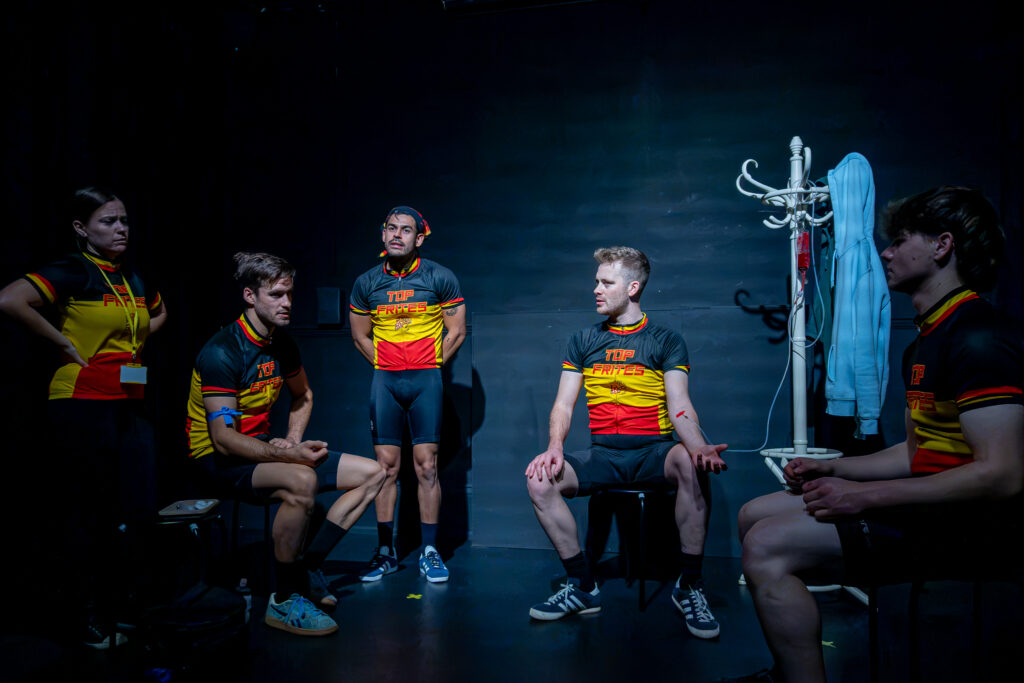

I don’t particularly like fainting, I like even less like writing about it. But all praise to my editors who pointed out the value of my medical anecdote as a framing device.
Still, to write about fainting at the theatre presents me as something of a Victorian waif – ill-disposed towards high drama, bright lights, and shouting around hypodermic needles and blood bags. Whether that’s a fair assessment of my temperament depends on your judgement of a new fringe play tackling doping in professional cycling, or at least this review of it.
Playwright Callum Murray pulls no punches when discussing the topic with me when we meet beforehand. A former sports journalist who covered cycling being “undermined” before his own eyes, he’s clear-eyed in analysing the risks young athletes took, “pumping sludge” into their body in pursuit of performance.
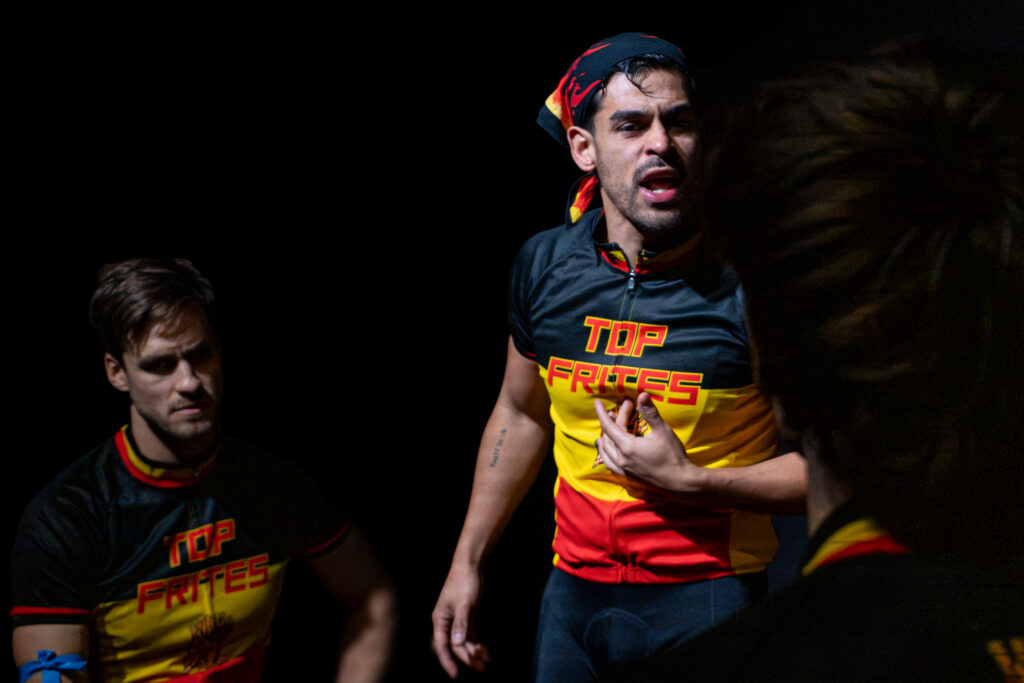
“The whole world of doping is a world of secrets and lies. A world in which what people say and what they do are not aligned. And that is great dramatic material, especially when you know that the audience in some cases knows more than the actors.
“The play is set in 1991 to 1993 for a very deliberate reason, it was the wild west of EPO taking. When the riders knew that people were dying, but they didn’t believe it could happen to them. They were taking it in an unsupervised fashion and it was anything goes.
“This is not a morality play. Good doesn’t triumph over evil. If you come here expecting to be told doping is bad, then you’ve come to the wrong place. What this play tries to do is to understand how a clean young rider who does not view himself as a cheat, who has never cheated in his life, can be turned into a doper.”
It’s tempting when addressing the subject of doping to descend into a spiral of detail. After all it’s a topic as long as the history of the sport itself. For instance no ordinary sports fan should know as much about haematocrit levels as fans of cycling’s past do.
But The Thousand Days does not dwell in these rabbit holes. Instead, over the course of an hour, the audience is faced with a punchy illustration of the cycle of coercion that leads vulnerable neo-pros to be co-opted into a system of silence.
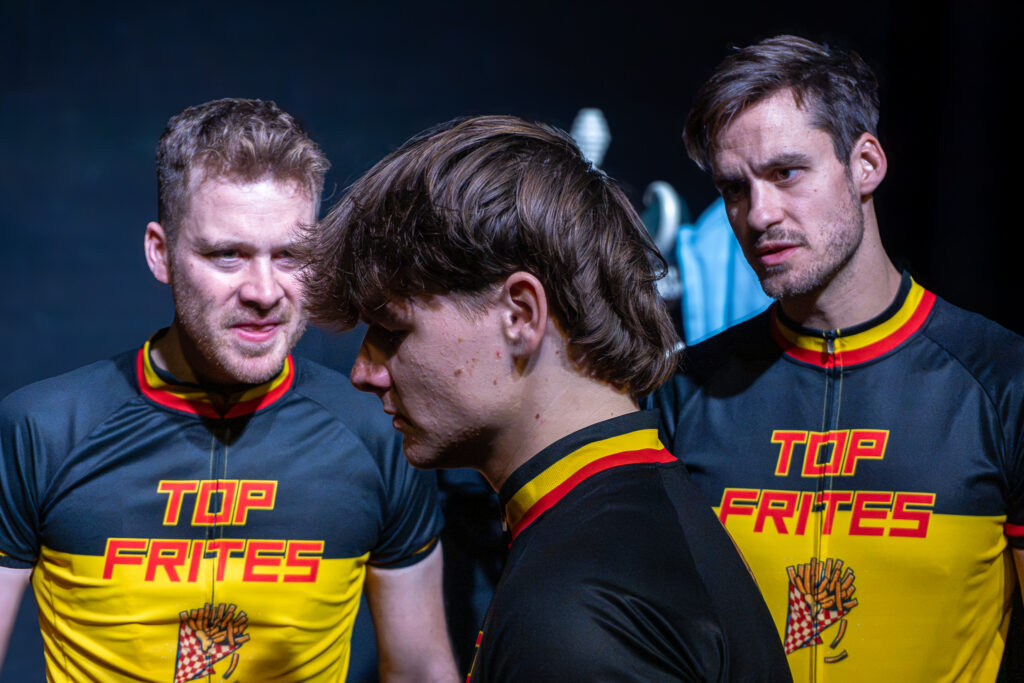
The story follows David, a young, naïve cyclist on his first professional contract, joining a Belgian team in 1991 with the sincere belief he can race clean, and could even happen his way to winning the Tour de France. Early training camps brutalise him, before he is confronted and betrayed by his teammates’ behaviour and made to consider his future in the sport.
But between the gravitas of these reckonings, there are surreal elements of make-believe, nightclub dances around syringes, and transfusions set to music. They’re all allusions to cycling’s debaucherous reputation, before these elite athletes gained their modern, robotic reputation.
Despite these tangents, the story knows its history. The play’s name derives from Tyler Hamilton’s estimate of the time it takes for a rider to join a team’s programme, Lance Armstrong’s “sorry” for the sceptics and the cynics is skilfully folded into the script, and there’s the voice of Phil Liggett and Channel 4’s archive tying strands together. There’s even a cameo from a beautiful Starfrance bike.
It’s all a nod to the audience in the know, whilst contextualising the madness to those for whom this experience doubles as a history lesson. Not that attendees even need to understand the sport to understand the story’s key theme:
“I think everyone understands cheating. Even unsporty people know what you mean by cheating in sport”, Murray says.
“David says from the start, ‘I’m not a cheat. I would never cheat.’ And perhaps, especially in the Anglo-Saxon mentality, that is a very strong thing still, the idea of being a cheat or not being a cheat.
“We see it all the time. People watching football matches are outraged when they see somebody diving because it’s cheating, because it’s trying to fool people. They really, really despise that. We have quite a corinthian idea of sport, going back to the days when it was played in public schools as an amateur sport. And that still lingers, I think.
“The play tries to get beyond that and ask why would people cheat? Why would somebody who does not regard himself as a cheat end up, or might he end up as a cheat, as a doper?”
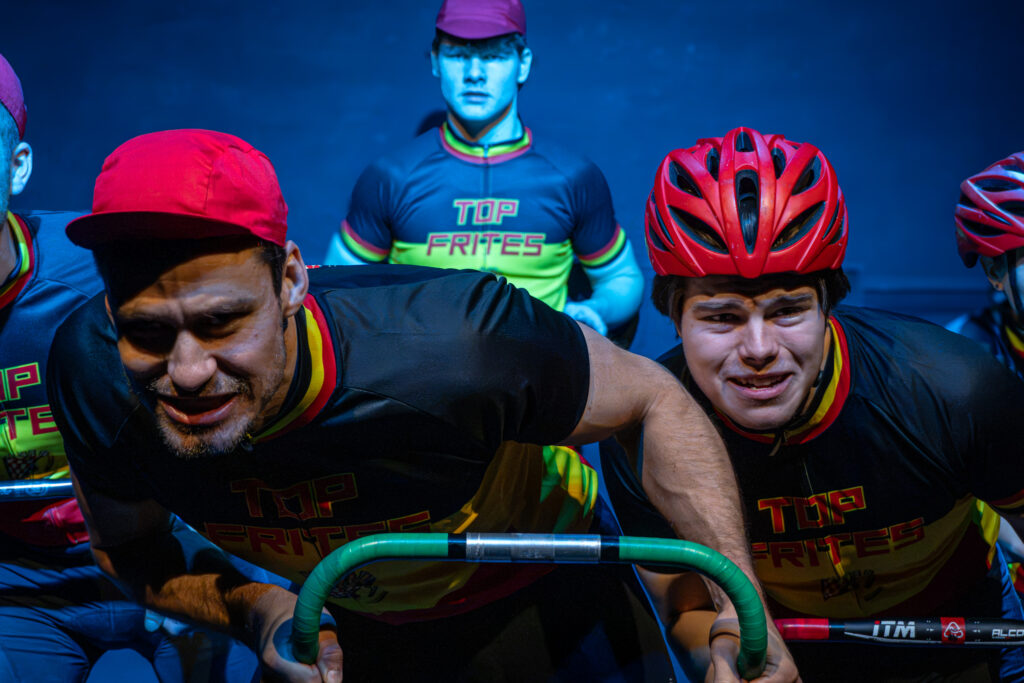
Working with a young cast, Murray took it upon himself to try and immerse his actors into the sport, frequently sending them old footage of races that already predate their own existence. But the topic has been at the front of his mind for a while, and reflects the complicated relationship Murray has with cycling.
“It’s quite complicated, my passion. I think it’s a great sport, I love watching it. But I think it’s a ridiculous sport. It’s absurd to expect the human body to do what it’s expected to do.
“And I have tried to get across to the cast just how hard it is. And I think none of them would have considered that before. I think they would have just thought it’s another sport, they wouldn’t have thought it was uniquely hard. But I think it is uniquely hard, and I hope they have grasped that.
“I’d been writing about doping for a long time. When I went freelance, I had more time to myself and I wanted to write for myself now, not for other people. And doping just seemed like such an obvious subject.
“I could have set it in the Armstrong era, but there’s been quite a lot of stuff about that. But also I liked the idea of it being set before ideas became fixed. When it was still doping, but it was undetectable. So in some ways there was a feeling that if you didn’t test positive it was okay.”
Within Murray’s play the characters all have their roles – the team leader, his bullyboy, the reluctant hanger-on and a powerless physio, all trapped within a system of their own making, aware they have to recruit any new signings into their systems of omerta and complicity.
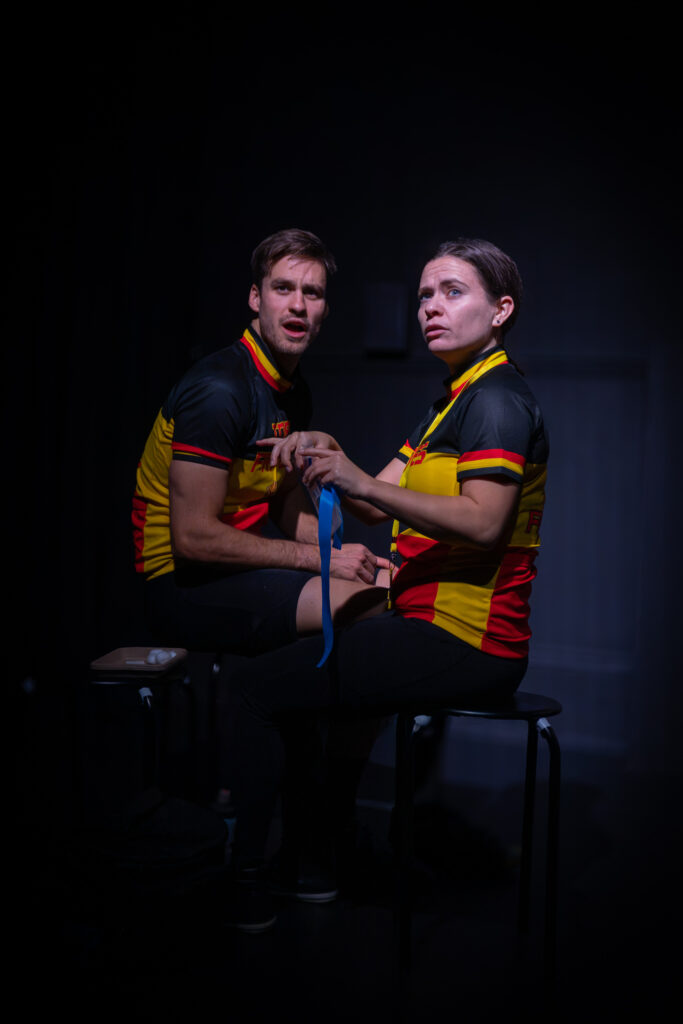
It’s compelling stuff, compelling enough that despite collapsing the previous night, I was keen to return to watch the play to its conclusion, invested in how Team Top Frites’ young pro handles the ethical dilemma he is faced with. After selling out its London run, the play heads to Brighton this weekend before Murray begins the task of taking his production further.
“I absolutely believe it has legs. I think it would really benefit from a larger audience, but also a larger stage. But I think Grace [Ward], our director, and Jennifer Johnson, who has done the choreography, have done miracles. What they’ve done with the movement on a very small space, I think is amazing.
“I’ve actually been having conversations for some time, with an English language theatre in Brussels. That would be great, although how they would respond to a Belgian team being singled out in my play, I don’t know.”
In the meantime, Murray has a final weekend of shows to look forward to, with two shows an evening set to test the energy reserves of his cast. Here’s hoping they don’t resort to questionable means of performance enhancement, or end up fainting through exhaustion.
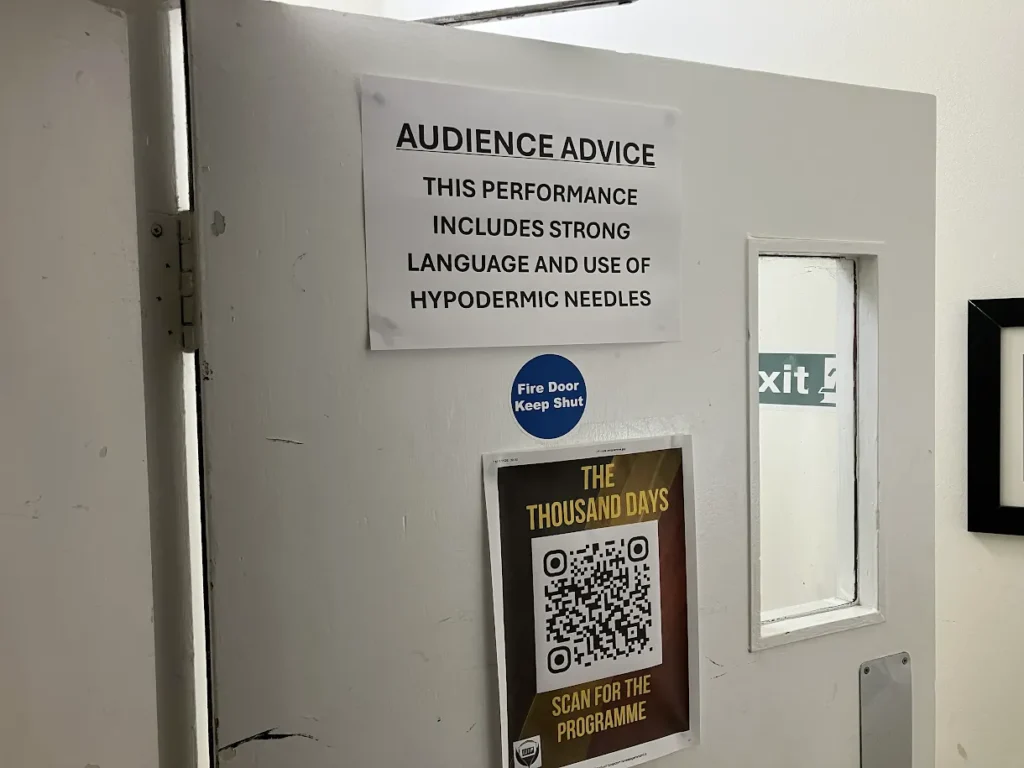
The Thousand Days is at The Actors in Brighton on 27-28th November, with performances at 7pm and 8:45pm. More information about the production is available here.
I would like to thank the staff at The Bread & Roses for accommodating me after I fainted and for admitting me the following night despite the play being sold out. I also wish to thank Jennifer Johnson – one of the show’s performers, its choreographer, and a nurse – who tended to me in the immediate aftermath.