
If you’ve ever considered an e-road bike, you might have thought: “well I’ve already got a nice road bike, why can’t I just convert that?” But the options have been a bit limited and also, mostly, sub-optimal.
If you’re replacing a wheel you get mismatched wheels, unless you’re prepared to build a matching wheel, or pay for someone to do it for you. Sometimes the batteries look a bit shonky and the wiring can be ugly. Not all conversion systems have all of these issues, but there hasn’t really been anything specifically designed to look great on your Sunday best bike. But maybe that’s about to change…
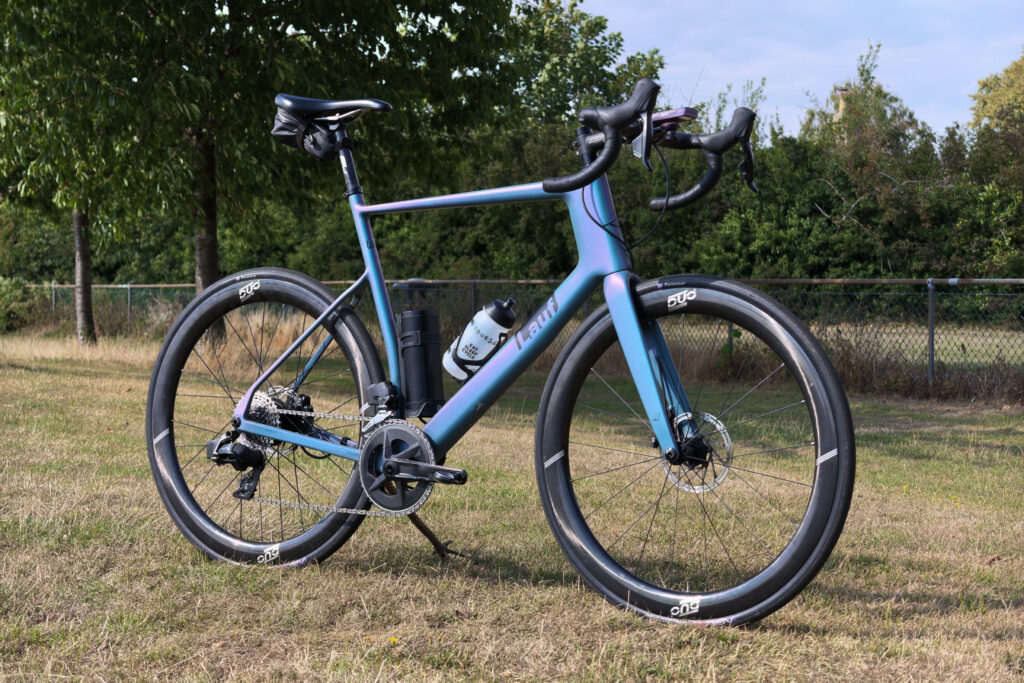
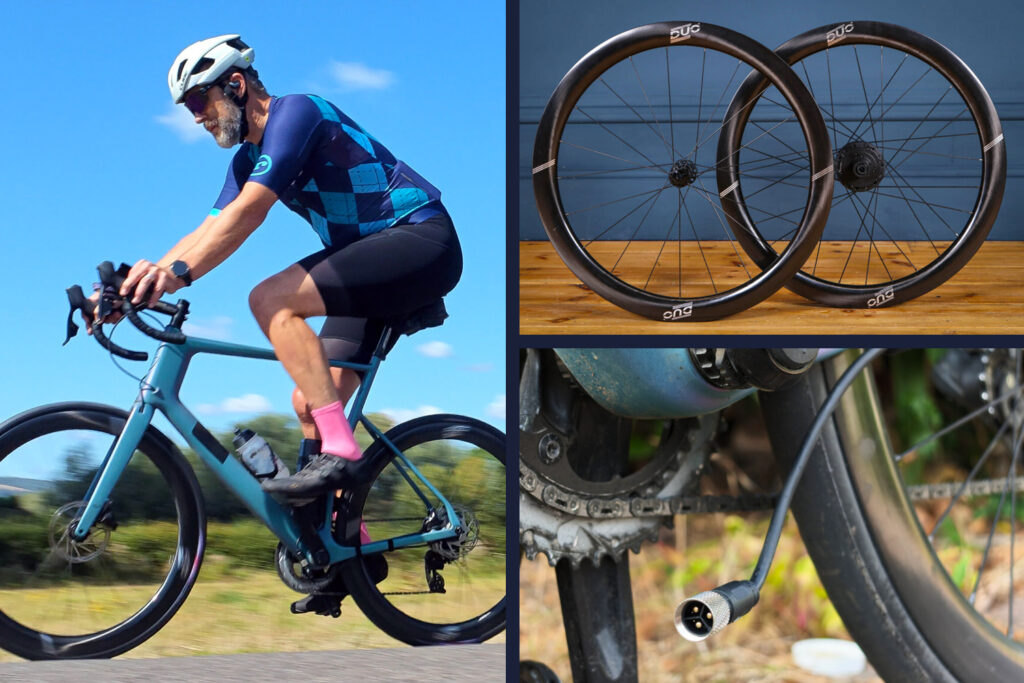
The Duo Wheel system is designed specifically for that job, and the clue’s in the name: it’s a full wheel system so you get both a front wheel and a rear wheel with matching deep section carbon rims. There’s a 250W rear hub motor in the rear wheel to help you up the climbs and you get a 250Wh bottle battery that just slots into a specific bottle cage on your seat tube. It’s all very neat, it’s all very lightweight and it’s easy to fit: pull the wheels out, put the Duo wheels in, fit the battery, plug the two bits together and turn it on.
The hub senses torque from your pedalling so there’s no need for a cadence sensor on the cranks, and there’s nothing to fit to the bars. You’ll probably need to adjust your brakes and tweak your gears at the back, but from cold it took me less than half an hour, and all you really need is some Allen keys. I fitted the system to the excellent Lauf Úthald and spent some time with the Duo system up and down the many hills in and around Bath. And how did I find it? Well, overall, I found it pretty good.
First up, I do think there’s a market for a system like this. You only have to look at how many e-road bikes there are out there: it’s a growing market. The system we got to play with is a pre-production one, and there are a fair few things that aren’t finalised, one of which is how much it’ll cost. But whatever it costs it’s going be considerably cheaper than getting a full, equivalently-specced second bike, because of course it is. If you’ve already got a bike you really like, can you fit this system and have the best of both worlds? Well. Kind of.
> Best e-bike conversion kits
The system doesn’t add much weight. I weighed my bike before I did the swap, and it was 8.9kg, including the half-kilo of tools I insist on dragging around, and after the conversion it was about 11.8kg, so the system, for me, was just under 3kg overall, swapping out some decently light Superteam wheels. That’s good: there are lighter systems, like the Cyplore one we covered on the site back in April, but James at Duo told us they’ve prioritised a decent battery size and a powerful motor over the lowest weight.
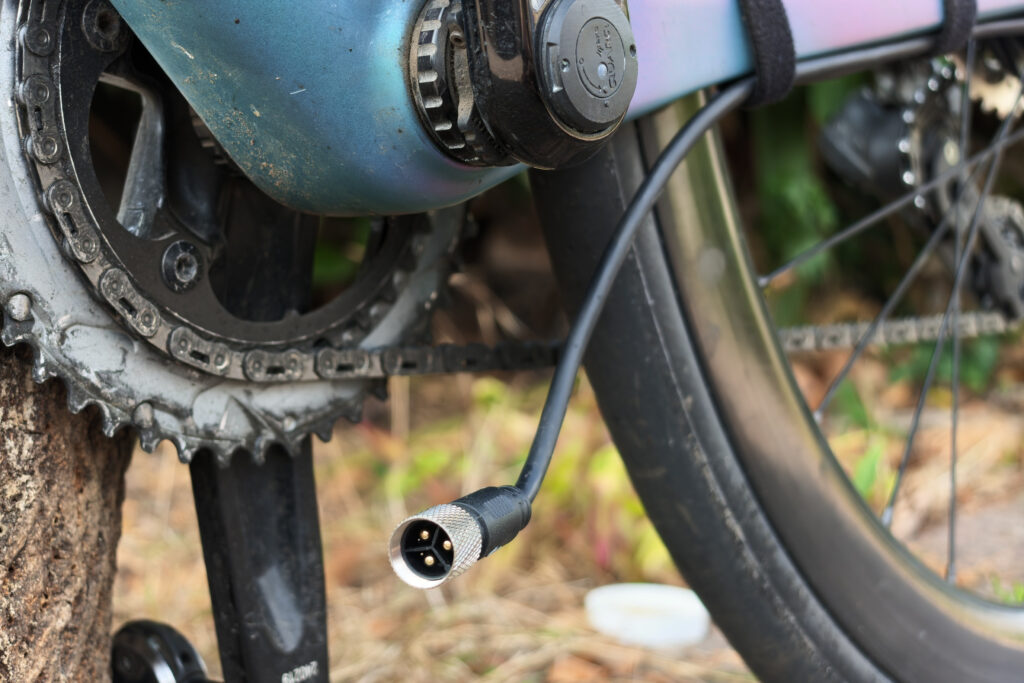
1.6kg of that weight is in the battery, and if you wanted to ride your bike without power on any given ride you could just leave it in the shed, in theory. At the moment, though, the system doesn’t really work like that: you’re left with a dangling lead from the motor under the bottom bracket, with an open connection that’ll fill with road crud the minute you leave the house. At the very least the system needs to come with a cover for that lead, and a way of attaching it to the down tube if you’re not running the battery. It would probably be better if the connection was nearer the motor so you could just leave it attached to the chainstay.
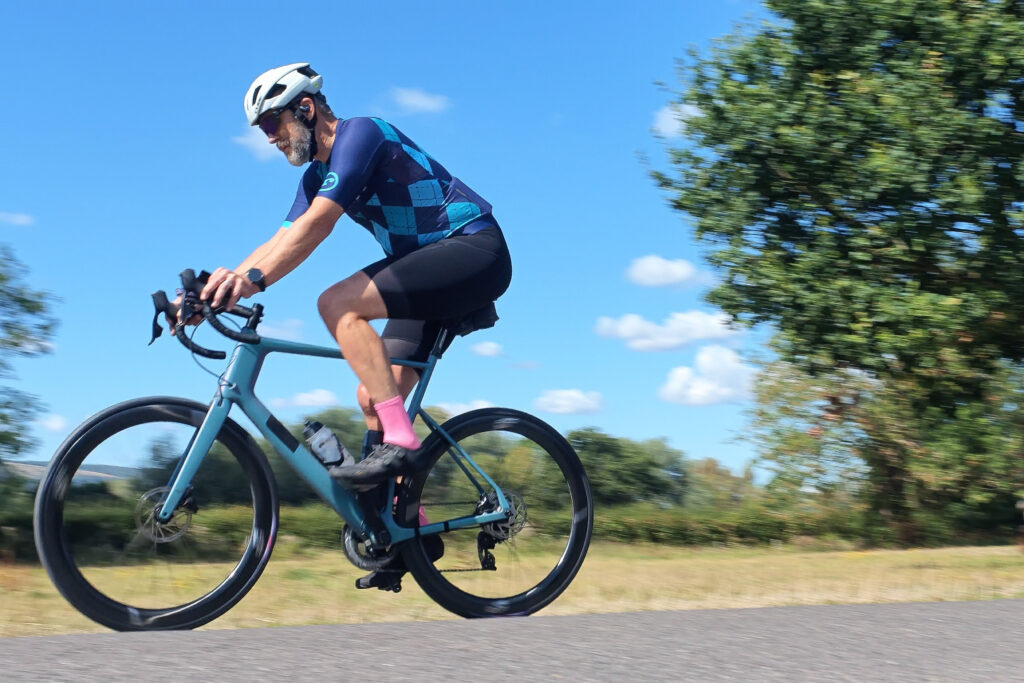
You’re no doubt wondering what the performance is like, and I’d say it was broadly comparable to a full-build, hub-motor e-road bike. Not a surprise, I guess: it’s a very similar system to Mahle’s X30 motor which has had a big share of the e-road market.
The motor we’ve got here is a fair bit noisier than an X30 unit but again, it’s pre-production and we’re told the final ones will be quieter. It’s a powerful enough motor that it has made some objectively hard climbs pretty easy during testing, including some long slogs up onto the Mendips. It’s powerful enough that of the three assist modes, I didn’t use the top one all that much.
Normally with city e-bikes I’ll just slap them in whatever the highest mode is, but e-road bikes are different, for me at least: it’s more of a joint effort. What I generally find, and I found here, is that I don’t end up doing a load less work, it’s more that I’ll complete a loop faster. You don’t have to go as deep on the climbs and because of that there’s more in the tank for the other bits: it basically flattens out a ride. For a standard 60km loop, my average speed was about 2km/h an hour faster and my average power, measured at the cranks, was a bit lower.
> Your guide to electric road bikes
Battery life will depend on how you’re using the motor. I mostly only turned on the assistance for climbs and draggy bits, and left it off the rest of the time. Changing modes is via the button on the top of the battery, and it’s one of the least good bits of the system as it stands. The button is small and hard to find, and it cycles through the modes, so if you want to go from three to two you have to go round the block. It’s crying out for a simple Bluetooth remote on the bars. Can we have one of those please? There’s a smartphone app in development but I don’t personally think that’s anywhere near as good as a physical control.
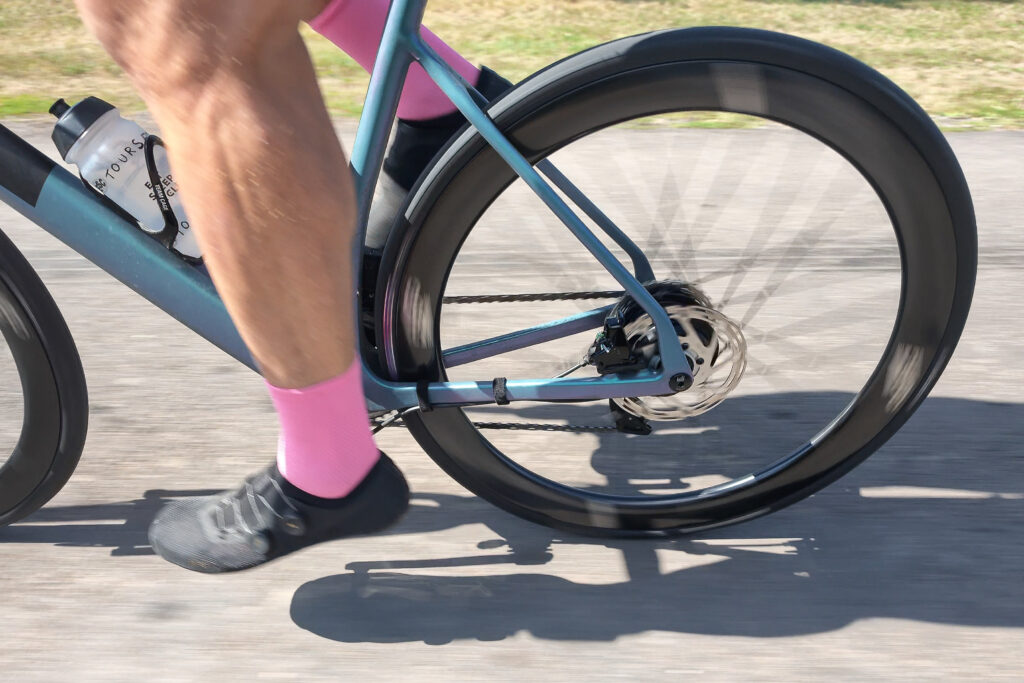
I had two bars of the five left after a 60km loop with 800m of climbing, more than I expected, and overall I was pretty impressed with the range. You could probably get round a 100km loop and make it a fair bit easier for yourself if you were judicious with the assist.
Of course with a system like this running out of battery isn’t the end of the world, you’re just on a road bike that’s a bit heavier: there’s no significant drag from the hub motor. The battery charges via USB-C so you could always plug it in at a cafe, but you’ll probably have to stay for longer than you’re welcome to get it fully charged, because it doesn’t charge especially quickly.
The wheels are pretty well behaved on the road. They’re not the best I’ve tried when it’s really gusty, but they’re mostly fine, and the rim is a sensible depth and width that’ll work with a wide range of road bikes, and gravel bike too: they’re wide enough internally for a chunkier tyre.
The wheels are well-built, and they look good. James from Duo says he’s still playing around with rim and front hub options, so again, what you see here won’t be their final form. But whatever they do look like, they won’t be out of place on your nice bike.
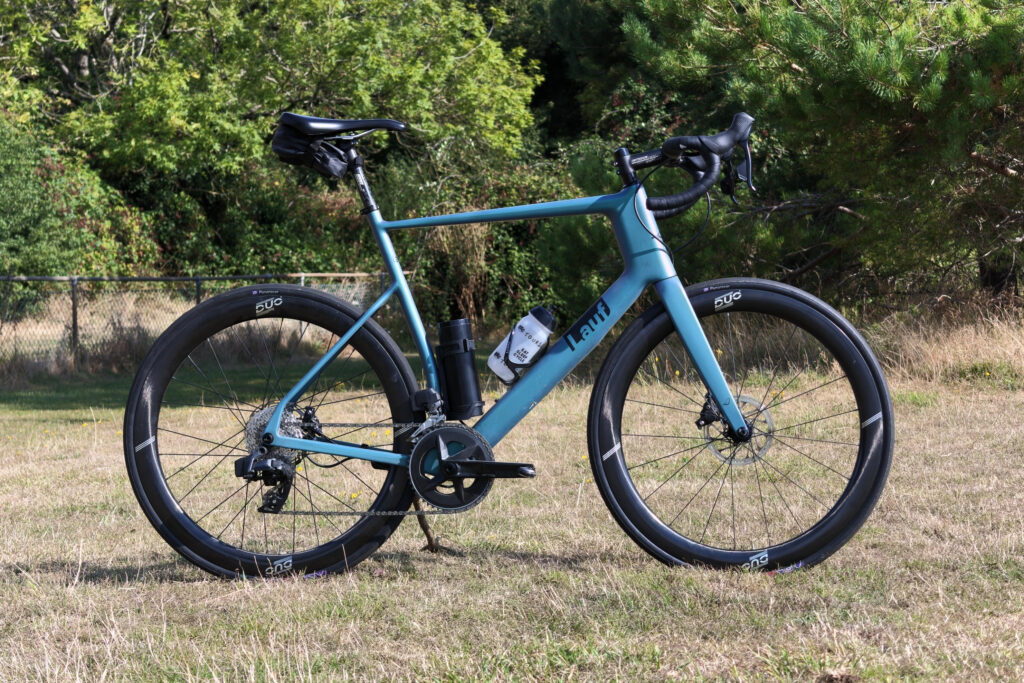
Overall I’d like to see some minor changes, but I think this is a pretty well-considered system, and I can definitely see it appealing to plenty of people who might otherwise be in the market for an e-road bike. It’s the nicest-looking conversion kit for a road bike I’ve seen, and the performance is up there with the normal pre-built options, so it might be a cost-effective way of getting some assistance for your Sunday best rides.
Comment below if it’s the type of thing you’d consider!