Princeton CarbonWorks has announced the launch of the sixth generation of its flagship road wheelset, saying that “the Wake 6560 Evolution II is the fastest UCI-legal wheel we have tested in the wind tunnel”.

Princeton CarbonWorks is a company of unapologetically singular focus: “Your purpose has to be clear and pure… The problem that we are solving for is what is the fastest wheel for that application,” says CEO and lead engineer Harrison Macris.
Princeton doesn’t make entry-level wheels, and it doesn’t make mid-range wheels: everything is designed and manufactured without compromise, and its collective attention is split over a very small number of products you can count on two hands. Consequently, it is very well represented on podiums and dream-build wishlists.

It has today announced the sixth iteration of its flagship wheel, the Wake 6560 Evolution II.
Whilst it’s obvious the wheel is aesthetically the evolution of its forebear, it’s also clear Princeton’s developments are much more than superficial, and have been achieved by starting from first principles, and thinking of the wheel and tyre as a more systemic and holistic entity.
This began at the leading edge, the tyre itself. It mounted varying widths of tyres from 23-32mm wide, on 21mm, 22mm, 23mm & 24mm internal width rims and 3D scanned them to create “a complete portfolio” of tyre cross-sections. These could then be manipulated and tested in CFD (computational fluid dynamics), and cross-referenced with the appropriate rolling resistance data to find the most efficient combinations of tyre size, tyre shape and rim shape.

The most successful models were then brought back into the real world and the wind tunnel to prove the CFD results. Then, working with professional athletes who trained and raced on them, their development was validated when they were used to win the men’s Ironman and 70.3 (half Ironman) world championships last season.
Developed with support from Luca Oggiano (with whom Macris had collaborated on projects including Filippo Gannna’s World Hour Record wheels) and Themis Petridi from Nablaflow, a wind simulation and aerodynamics company, Princeton has arrived at a final design that Luca says is the “fastest UCI-legal wheel we have tested in the wind tunnel.”
Like its predecessor, it features a characteristic variable rim depth, oscillating between 60 and 65mm deep, but the internal rim width has increased from 21mm to 22mm internally – still conservative by modern standards – and from 28.2mm to 33mm externally. Additionally, an all-new carbon layup has led to a huge 50g saving per rim, reducing the total wheelset weight by 10%, all whilst exceeding 120J impact testing, (three times the UCI’s required 40J).

The new rim is still a hooked design.
“We are actually kind of moving against the market trend, and using wider hooks as opposed to micro hooks or hookless… we wanted to control the width of the tyre more proactively,” said Macris.
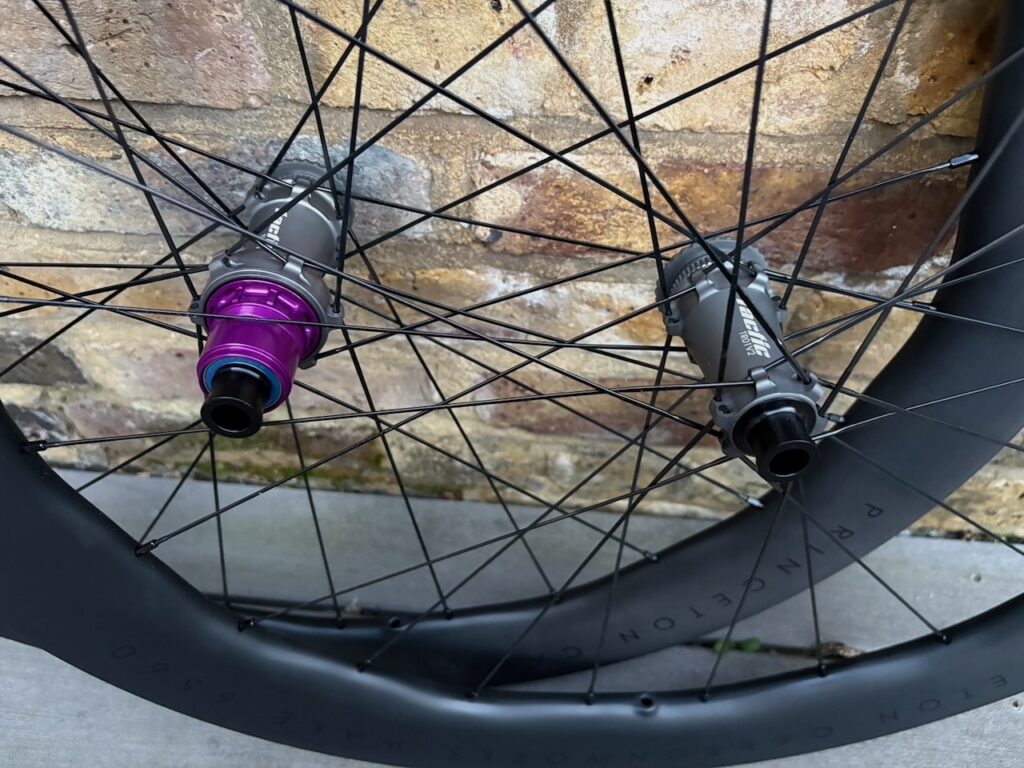
With Tactic Racing TR01V2 hubs and steel spokes, the new Wake 6560 can weigh as little as 1,250g.
Princeton says that it has produced a wheelset that, with 28mm tyres, is aerodynamically faster across the board, but particularly at larger yaw angles (+/- 12.5° and more).
Non-drilled tyre beds remain, making tubeless setup a cleaner and more secure affair, without the need (and weight) of rim tape, and the new wheelset is now ‘pre-balanced’ presumably to account for and offset the weight of valves, to reduce vibrations.
“The new wheels are strikingly beautiful. They are considerably lighter. The decal design and the graphics… we spend a ton of time on,” said Macris.

Princetons have never been ones to hide their beauty under a bushel, but based on these images, they’ve raised the bar yet higher.
The Wake Evolution II is available in six different hub options, and 10 different paint finishes (Matte Black, Gloss Black, Matte White, Gloss White, Gloss Gold, and Gloss Chrome, and four new colourways: Gloss Sand, Gloss Cobalt, Gloss Red, and Gloss Chameleon).
All wheelsets include tubeless valves and padded wheel bags, and are available immediately from local dealers, distributors, and at PrincetonCarbon.com
Weights go from 1,250g to 1,455g depending on hubs, and prices go from $3,550 – $4,500 (we don’t yet have a UK price), so this is definitely a set to keep in your favourites in case of a lottery win.
The First Ride
With about 2 hours until launch, I headed out on them.
Everything I had done in their setup, and tyre choice was to give them the best opportunity to shine, but nature had other plans. The weather forecast showed this: 34 mph gusts. Hmmm.
It was windy, and gusty. Very gusty. So much so that I passed not one other cyclist as I threw the Wakes around the 5k loop of Regent’s Park a few times.
I was disappointed these weren’t ideal conditions, but it occurred to me, what better way to really pressure-test a set of deep-section wheels than under challenging conditions? It was at this moment, that a strong side gust snapped me out of my reflecting… You need to be awake to ride these wheels in these conditions. Pun, very much intended.
So what are they like?
I think I saw them at their best and their worst in these challenging conditions. First of all, there’s no denying they’re fast. They’re really fast, positively zippy. The circular loop of Regent’s Park was a terrific test track, giving me experience with the wind coming from each direction. Once up to speed, these wheels are in their element. They were happier cruising along than any other wheel I could call to mind. They really cut through the air quite prodigiously.
They’re stiff and tight too, not uncomfortable, just very exact. There’s no hint of unwanted flex laterally, surprisingly. Those fine spokes I expected to give a bit, but the wheel ran very straight and true.
The lack of flex was again something exciting. As you pull away from a standstill, there’s no complaining or straining, just the wheels spinning up quickly; a compelling accumulation of speed. I’ve been riding Zipp 353 NSWs a lot recently, and the Princetons are different animals. Admittedly, these were shod in a good few millimetres less rubber than I usually run on the Zipps, so there was less vibration absorption by the rubber, but again I’d call the ride firm, not jarring.
My Karoo told me an interesting story. The Princetons felt faster, and the computer concurred. In windy conditions, I set several PBs. Most notably, on the slight uphill section. I absolutely flew up the hill faster than usual, and for fewer watts too. I’m an avid windsurfer, so know the power of a good breeze, but couldn’t tell you if the wind was at my back or three-quarters, but it was the most pronounced sailing effect I’ve experienced on two wheels, like catching a good wind on a beam reach, and away you go.
The side gust that woke me up was certainly an exciting moment. Are these 65/60mm deep wheels magical at negating wind? No. Have I had stronger jolts in less wind on shallower rims? Yes. Does the variable depth help in crosswinds? Perhaps, without A/B testing I certainly couldn’t say. But even at their ‘shallowest’, these are 60mm wheels, and you’d expect them to be a little hairy on occasion, in wind like that. But anecdotally, it ‘felt’ like it could have been a lot worse.
I came away thinking that these were exciting wheels. At their best, the deep rims cut through the headwind very impressively. The sailing effect, I have to say, was rather addictive, and very noticeable from the right angles. If any conditions are going to catch out deep wheels, it’s going to be these, so perhaps I could say, even in the most inhospitable conditions to wheels like these, they behaved admirably well.
All in all, these wheels have reminded me there really is a time and place for an aggressively designed road wheel, shod in 28mm rubber. They both felt, and ‘were’ (in places) the fastest wheel I’ve ridden. I think, they’re inordinately good-looking too, which is a terrific thing. The psychological effect of having a bike adorned with wheels you love means you ride it more, with more passion and a little more zeal in your crank revolutions. Okay, these were a very much anticipated first ride and perhaps there’s some confirmation bias here, (and I’ll continue to ride them) but I’m rather smitten by these. They made me feel a better, faster rider than perhaps my wattage would support. The mechanical aid of the deep sections is a wonderful thing.
These things absolutely hum along when at speed, and hang on to it stubbornly. The hubs are smooth, and systemically, they make the most wonderful purring buzzing whooshing sound.
However, the truth is, you’re either in the market for some $4,500 65/60 mm deep wheels or you’re not, and there’s no escaping that sticker price. If you are, I think it’s impossible not to put these wheels near – or at – the very top of any shortlist.