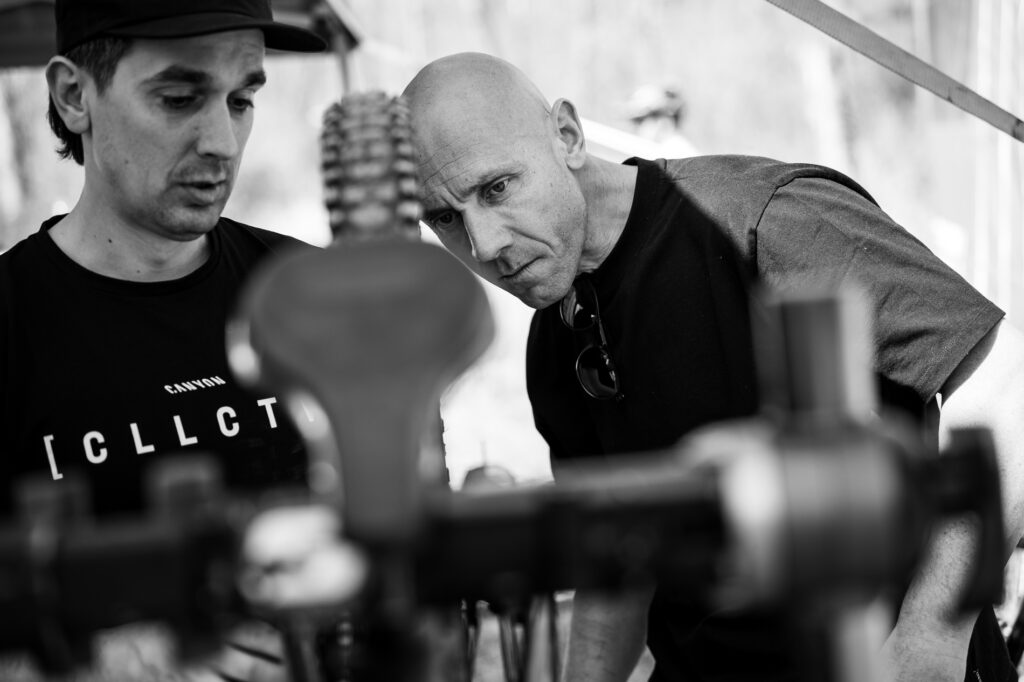

[Images by Boris Beyer]
Hailing from the mountain biking hotbed of Peille in the south of France, Fabien Barel grew up riding alongside near-neighbour Nicolas Vouillioz, and was picked up as a sponsored rider in his early teens by the then dominant SUNN team. From his Junior Downhill World Championship win in 1998 to Elite downhill world titles in 2004 and 2005, he sidewinded into enduro a few years later. He was one of the top riders in this new discipline, and later plugged into e-Enduro, where he won the first-ever UCI World Cup. It’s safe to say Fabien is one of gravity racing’s all-time greats.
- Bike check: Fabien Barel’s Canyon Strive:ON CFR LTD
- “I could not have dreamed of a better place to say goodbye than Lenzerheide”: the great Nino Schurter is looking back (and forward) after calling time on his glittering career
- On and off the record with Katy Curd
Through much of this time, right up until now, he has also been heavily involved in bike and product development, and has brought through a number of radical changes which have helped shape where bike technology is at today. He worked for many years with Canyon on development, and also with their gravity racing team.
Back in November, while testing product, he had a horrific accident. We caught up with him to learn more.
Off.road.cc: How are you after the accident?
Fabien Barel: It’s going in the right direction. I definitely have stronger arms and legs now, and mobility is back to 100%, including my neck which is close to 80%, which is great news. I’m struggling a bit with the sensitivity in my right hand, because my nerve was in touch, but I’m working really hard on that. I hope to start being able to go in the water and get proper mobility early in January, so it’s going in the right way.
I also manage to keep up with the work, which is quite important. The rehab is pretty intense, too, so I’m really happy with that. In April, I’m going to be stronger than ever, so be ready, guys (laughing) – I’m not gonna give up.
Testing times
ORCC: When you had the recent accident, you were product testing; when you are testing unknown bikes and products, how far do you push things, and how far do you have to push the limits?
FB: It really depends on what phase things are at in the product development. If it’s a product that’s near to finished, then you have to push it near to the limits to see how far it goes and find what the real improvements you can make are. In the early phases, you can ride as low as 60-70%, depending on what stage things are at.
ORCC: When testing, how much of the feedback is based on feel and experience, and how much on the technicalities, the limitations and data? And how do you mix that?
FB: This has really changed in the last seven years. Around seven to 10 years ago, it was 100% (rider) subjectivity. We had almost no data from the engineering side. We had theories that were brought to us, and the feedback was 100% subjective.
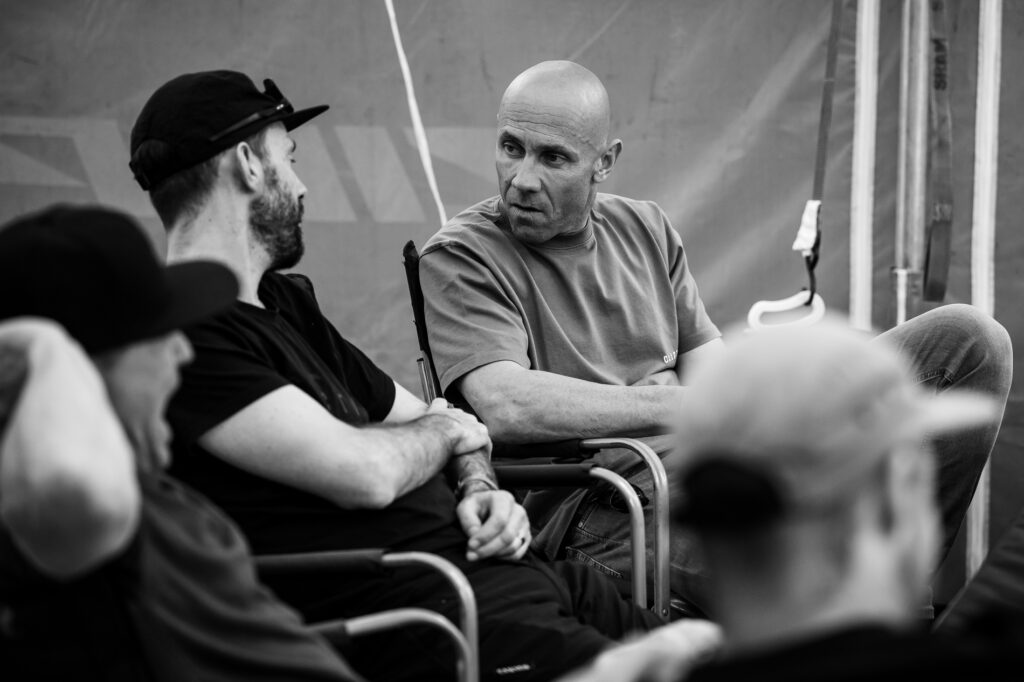
When bench testing and dyno in-house testing with the engineering started to appear, we started to cross over and create a lot more data, along with rider subjectivity, with pure data coming from the companies. This has changed the mindset of testing; even if nowadays we still end up with the dyno and bench testing, the on-bike data acquisition, which is going deeper and deeper with accelerometers, suspension sensors, and brake sensors for brake power, we also have a lot more info coming in, along with the actual position of the rider on the bike.
This is balancing around 50-60% coming from the riders and 40-50% from the data. This has been a big change over the last seven to 10 years. It has been implemented in R&D, and it’s also true in racing. This is why my role with the race team is becoming so fascinating, because back in the day, this was mostly about the coaching subjectivity with the athlete, and you had to create a real dialogue. Whereas nowadays we have the capacity to be able to say to the riders that they’re going in the wrong direction (or not) – from the data, so we know if they can keep on pushing, and this is mostly proven by the clock.
We’re in a world of change with this, and it’s only the beginning.
ORCC: How did you develop such an interest in the technical side of bikes, as opposed to just being given a bike and leaving it to the mechanics?
FB: This came straight away. I’m a very pragmatic person, and I quickly realised that having a good bike, and the right bike, was part of the success, and that the sport was very mechanical. That was a bit in my DNA, and this was a little part of the approach. But I would also say that designers were also having this approach, with Olivier Bousard (especially), the engineer who was in charge of all of the SUNN development at the time.
I’d say that global exposure at an early age of my racing career, plus my pragmatic approach, made me realise that I could win by my talent and hard work, without a doubt, but also that the mechanical aspect was crucial to this.
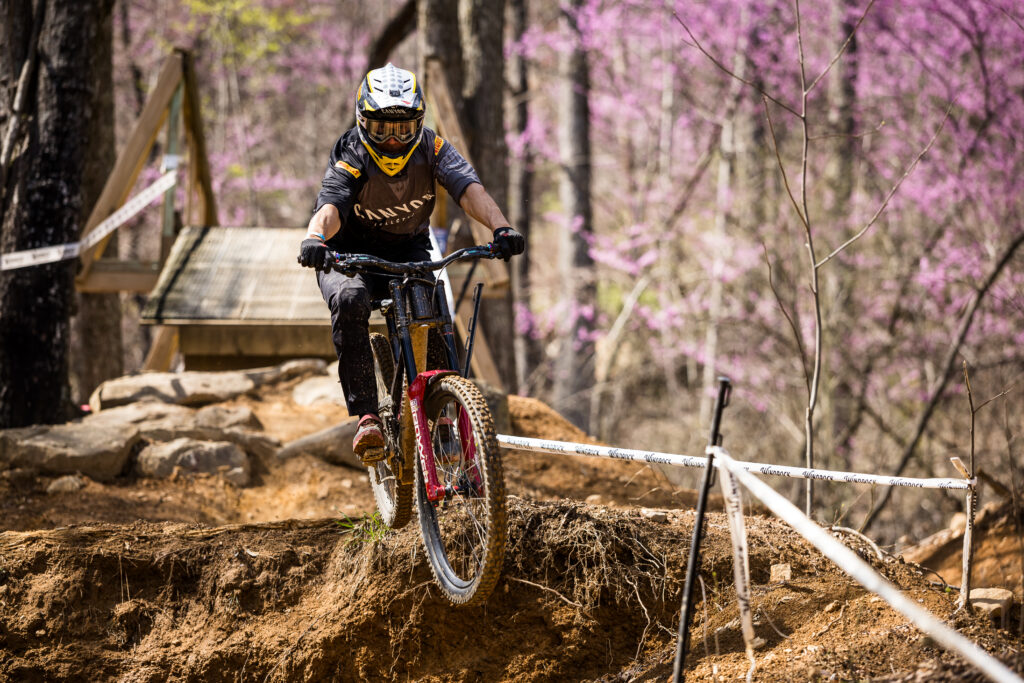
This falls into the perspective, even of riders today. When you look at someone like Loic Bruni, Thibaut Daprela, and Loris Vergier, the three top Southern French riders, those guys have a very mathematical approach when it comes down to bike setup, too.
Evolutions and revolutions
ORCC: With such a long career, given the huge evolution of bikes and race courses, what have been the major things you’ve noticed and tried to implement on the tech side?
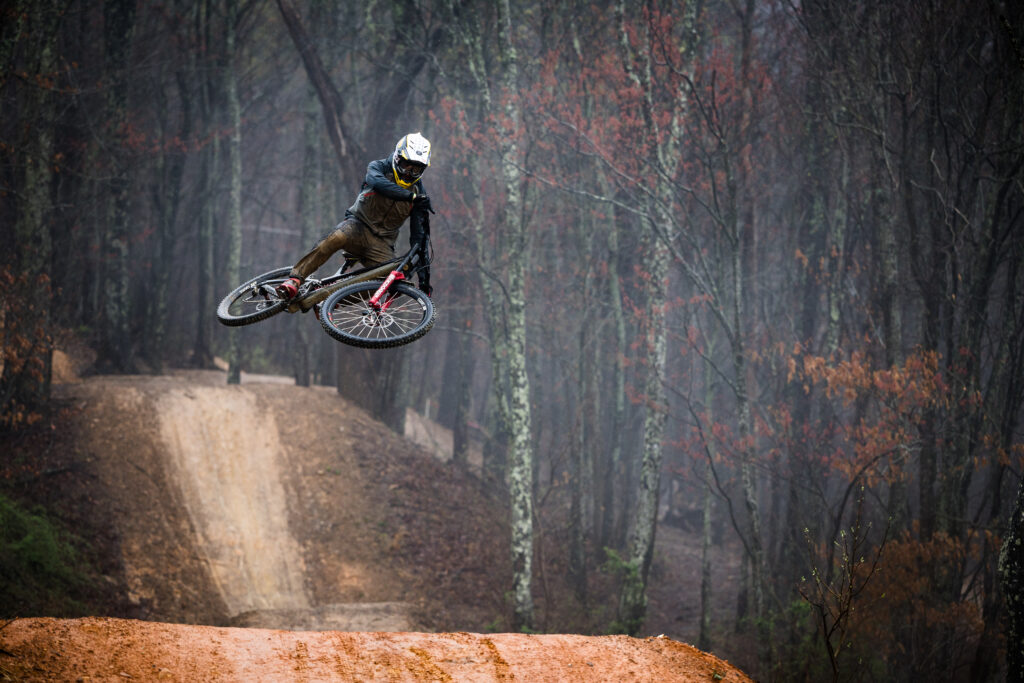
FB: There’s been a lot, as you can imagine. Through suspension, braking, geometry, and the stiffness of the bike. But if I had to choose one thing that’s still relevant nowadays, because it needs to be properly understood and evaluated, it’s the centre of gravity of the athlete. The position of the centre of gravity of the athlete between their braking point and the wheels is the thing that has evolved the most, and will probably keep evolving, for one simple reason: in any other mechanical sport, the machine is the heaviest, but in our sport, the body is. The body is 100% subjective to the individual athlete; the way they’re shaped, the way they ride and their actual strength. So there is a big biomechanical effect on the riding capacities of the athlete that directly impacts the grip between their front and rear wheel.
I soon realised this when Sam Hill came along. He was probably the first one to come in with a very centred position and the capacity to find a very unique grip. That was when I probably started thinking that I was going in the wrong direction with my setup and wondering what I could do. I investigated a lot with engineers and biomechanical engineers from motocross and downhill skiing. These were the two sports where I tried to properly understand how the ground was felt.
I did a lot of testing with flat pedals and geometry testing, etc, because when Sam showed up, he was dominating. It was embarrassing just how much he was dominating, and this was simply not acceptable for me. I’d say that my Livigno World Championship title in 2005 is probably a direct reflection of this hard work, and beating Sam in that race was one of the biggest things I’ve done in my career.
ORCC: How often have you gone to brands with new ideas that come to fruition?
FB: I can’t remember them all, but in order, way back when I went to a 60-degree head angle, that was something people thought I was crazy with, but I was World Champion with it. When I invented the floating calliper back in the days, to utilise the energy to stabilise the chassis balance, it was something that was kind of out of mind.
After that, the forward geometry at Mondraker was something rarely seen, and we made that crazy 11mm stem that was really shocking visually, but nowadays, if you look, all geometries are inspired by that. It was back in 2006/7, with very long fronts and short chain stays to balance the centre of the athlete.
When I came to Canyon, one of the craziest ideas was the Shapeshifter technology, which is something that we implemented straight away. I always had this idea to change the geometry, the travel and the flight all in one action, and when the opportunity came up, Vincenz Thoma was one of our best engineers at the time, and really pushed and developed this technology, which was very important for me.
The combo of the high bar linkage and MX link that we have on the Sender, which we developed from day one, has been a historical concept that has given us the ability to really work through the wheel past the chassis balance independently of the kinematic compression curve. That really helped us to develop a great combo of a race bike.
I do believe that technology is crucial for racing, and I always say that downhill is the Formula 1 of racing, because that’s where all of the development and innovation and high-end technology is developed. I’m convinced there’s a bright future for that, and I’m convinced there’s still a lot that can be done.
Knowing Fabien, he will indeed follow up on his promise to be back shredding as fast as ever soon, and we wish him all the best in his recovery.
You might also like:
- ABS brakes on a podium topping e-mountain bike? Tracy Moseley reveals all about her unique Trek Rail 9.7
- “The decision to not offer me a rerun wasn’t what I was expecting”: Harriet Harnden on switching from Enduro to DH, THAT incident in Poland, and aiming for a first World Cup win
- “These are my holidays, this is the time I work for and to get, so if it would give me misery, why would I do this?”: Justinas Leveika on balancing nursing with winning ultra races