


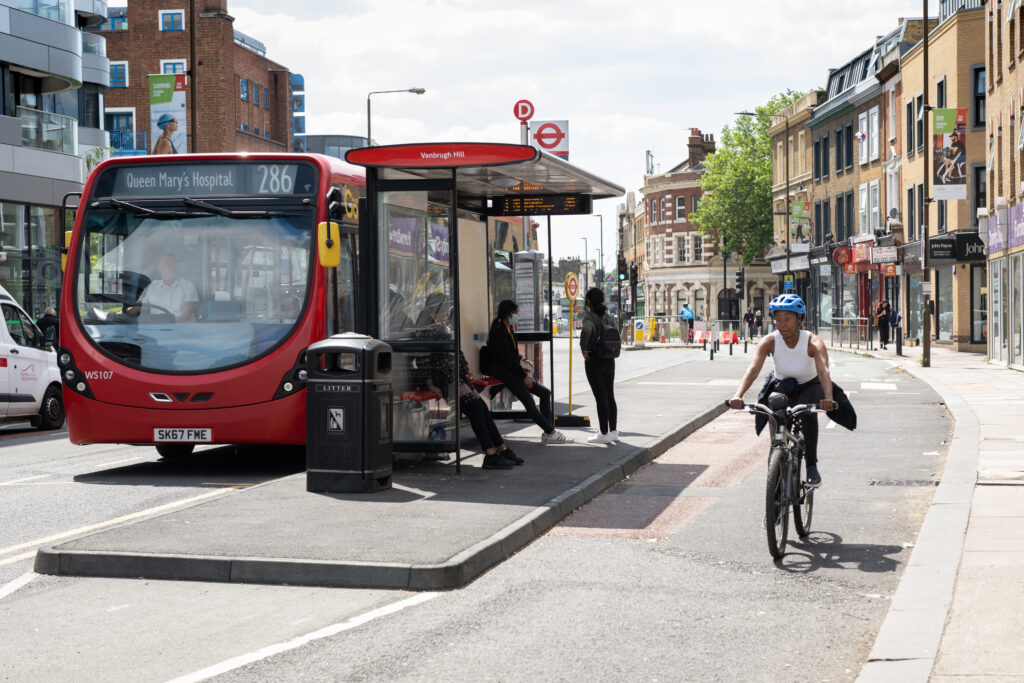

New rules announced by the Government and the Mayor of London to support housebuilding in the capital include reduced requirements for the building of cycle parking.
Developers can pay financial contributions instead of building bike storage, or build the storage off-site, to avoid “costly requirements”.
This was rationalised in the documents published by the Ministry of Housing, Communities and Local Government, citing the rise of dockless bikes and e-scooter hire.
The rules, which will undergo public consultation before probably coming into to force early next year, intend to accelerate the building of affordable homes in the capital.
“Small amounts of cycle parking aren’t what’s making housing developments unviable,” Tom Fyans, chief executive of the London Cycling Campaign, told the Standard.
“The mayor is committed, for climate, health and many other reasons to increasing cycling for the next two decades – homes and offices built now will need to cope with demand in 50 year’s time.
“Moans from some property developers their central London cycle parking spaces aren’t well used also seem specious given they’re often in areas hostile to cycling and/or crammed into a badly-lit corner next to the bins.
“It’s also interesting that in this housing emergency, the government isn’t talking about cutting car parking or making it easier to turn car parks next to tube stations in outer London into housing.”
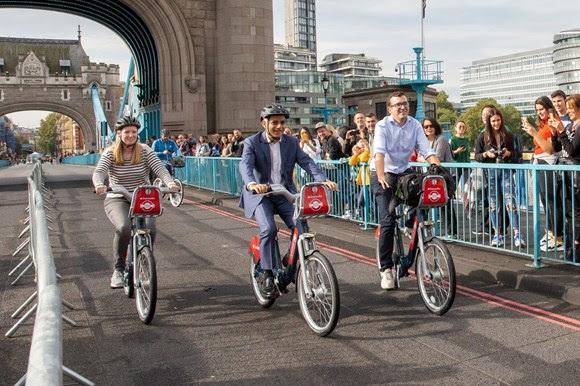
The London Mayor’s Transport Strategy aims for “80% of all trips in London to be made on foot, by cycle or using public transport by 2041.”
The Cycling Action Plan 2 says, “access to cycle routes and good-quality cycle parking have shown that embedding the Healthy Streets approach to home-building leads to sustainable travel outcomes.”
Khan’s cycle scheme goals are slowly being achieved, as after the tube strikes in London last month, 28% of Londoners say they are now more likely to cycle in future.
However, given the high rate of bike thefts, secure cycle storage close to homes is essential.
The documents, released on Thursday, state that “The GLA (Greater London Authority) propose to reduce requirements for cycle parking at residential developments, taking into account higher densities of development in London and the rise of dockless cycle and e-scooter hire.
“Additional flexibility will also be proposed in how the cycle storage is provided to avoid costly requirements (e.g. for extra basement levels or loss of housing units); this could include off-site provision, contributions in lieu, and other options.”
























15 thoughts on “Sadiq Khan’s emergency rules on affordable London housing “reduce requirements for cycle parking” and allow financial “contributions” instead of building bike racks”
A massive backwards step IMO
HLaB wrote:
Indeed, the property developers research is flawed since there are both examples of doing it right, as I posted above, and in the Nordics, where I’ve worked for years, it’s normal for an office building to have many floors of basement parking for cars and bicycles. -20°c winters do encourage serious thought about employees safety. Weirdly stable low temperature does enable safe cycling on hard packed snow. Ice is only a problem for the few weeks where the temperature crosses 0°c with recent rain. Snow fall sorts it out.
So these property developers are working against their own best interests in frustrating cycle transport, so shortening the tenants demand for their building. Let’s hope the building owners are smarter and taking the long view..
It will depend on the area,
It will depend on the area, but there are benefits, other than provision of (bike) parking by having all or even some of a large building as an undercroft.
Where there’s poor air quality, that extra distance from traffic can make the difference between needing an air quality assessment or not needing one, and in some cases, not needing to have windows sealed shut with air coming from a vent on the roof.
In noisy areas, that extra distance from the road, or passers by can make life a lot more pleasant, not to mention the additional privacy.
And if the property would need protection from ground gas, the undercroft itself acts as mitigation.
Affordable housing and
Affordable housing and affordable transport would seem obvious bedfellows.
Moreover, when there is no convenient safe and secure cycle storage, residents will roll their own by storing their bike indoors, obviously. And if their bike is an aftermarket e-bike lashup, that puts all the residents at risk.
Indeed, or bikes are simply
Indeed, or bikes are simply stored on stairs and in corridors and present an obstacle all the time and a potentially serious one in a fire. Or (because London and presumably “affordable” means living in a cupboard) people just won’t bother owning bikes (when leaving them outdoors means they’re gone).
And if NL is anything to go by they’re just ain’t going to be enough hire bikes of any description to provide for “mass cycling” (Plus that’s also less convenient for all).
Unless … the idea is that would be something they actually don’t want to encourage? Because then the people might demand eg. better cycle provision, maybe even at the expense of motoring?
I would guess this is entirely coming from the developers?
Meanwhile not so far away… https://bicycledutch.wordpress.com/2013/07/11/parking-your-bike-at-home/
They even have a workaround for “older housing stock, honestly no space”: https://bicycledutch.wordpress.com/2017/10/31/home-side-bicycle-parking/
Not entirely. London’s
Not entirely. London’s housing policy has got to the point where it really needs to be put into ‘special measures’ so the mayor is scratching around trying to make it look like he’s doing something and not a failure.
So politics and nothing to do with London, londoners or housing.
chrisonabike wrote:
IIRC, new housing (which is what is being discussed here) in London has to conform to “Nationally Described Space Standards” (NDSS), which relatively few other areas achieve, and one bedroom flats need to be a minimum of 37m2.
The other issue with
The other issue with “affordable housing” is that it simply means “more people” to a first approximation.
Did your town / city have “issues” with traffic before? Adding more people (even less well-off ones) without some serious work on moving existing people away from incredibly inefficient transport modes is … not wise in the medium term.
Of course, some politicians won’t be there then… Plus the council may be under such immediate pressures that trading land for cash or simply generating housing stock and perhaps some local construction jobs may seem like the only play.
That’s an excellent point.
That’s an excellent point.
I’d also add that while dockless bikes are cheaper than owning a car, they will be more expensive than owning your own for most who cycle with any regularity. When people have used one a few times they are more likely to decide it is worth investing in their own bike, at which point they will get the full benefits of cycling. Removing that choice by removing the opportunity to store their own bike is unfair.
And that’s before considering how much frustration is caused by thoughtlessly abandoned dockless bikes. If space can’t be found for dedicated cycling storage for residents, where are they leaving their dockless bikes? Or will the space be rented out to one of the hire companies that has docks?
I don’t know if the current
I don’t know if the current regulations include car parking, but many places do, so how about cutting that before cutting cycle parking?
They do include car parking.
They do include car parking. All new developments in central London will NOT include any car parking space – other than a small provision for disabled, drop off and emergency vehicles.
Reduced car parking is the
Reduced car parking is the way – although that’s moderated in the short-medium term by current societal expectations (and forever because humans almost always choose path of least resistance).
Example – my flats don’t have their own designated parking, but there is a large area (shared with neighbouring flats) round the back, a small amount next to adjacent building, and some on the road – a whole 15m away(!) Result – parking all over the pavements, and utterly baffling stupid parking by delivery vehicles, waiting driving instructors (really), and of course anyone who can’t see a space within about 4m of where they want to get to…
Amazon and a random showing how it’s done here:
I used to live near there I
I used to live near there I think (maybe the block to you right), it was the same thing with the parking anyway; looking on street view there’s now cars allover the place despite there being plenty of spaces not far away. Its similar in the estate opposite where I am now. There’s plenty of parking but because its not in front of folks doors they won’t use it. This estate is much better despite everyone having an allocated space or more depending upon the size of the house!
I once had the good fortune
I once had the good fortune to work in a London high rise office outside the centre where cycling was sustained with secure parking, lockers and showers in the basement because car parking was very limited compared to the office occupancy. Even with an integrated multi-storey car park, drivers were only allowed three days per week parking to share the limited space equitably. So for full time working, cycling was the best choice limited by slight overallocation. Seasonal factors sorted that out, and I only missed a couple of days per year due to street gritting not covering the cycle lanes with ice and snow. Cycles can’t win against black ice. On the rare occasions that I had to use public transport, it was 20% slower than cycling, but I did get there in one piece.
So long story short, the property developers are wrong, and a smart building tenant knows that they can’t enable car parking fully, even if they wanted to. Healthy minds in healthy bodies are a bonus for any business..
lonpfrb wrote:
The problem is often that the people in the property development business are not the same ones who will be occupying the space and we end up with a lot of commercial buildings that are, essentially, cheap to build but expensive to run, which has huge repercussions for sustainability.
Many developers still do not consider it to be in their interests to build to the kind of quality that quite clearly puts the long term interests of the planet, future building users, or even future building managers ahead of a modest boost to their short term profit margins. Which is why progress needs to be led by forward thinking regulation.