


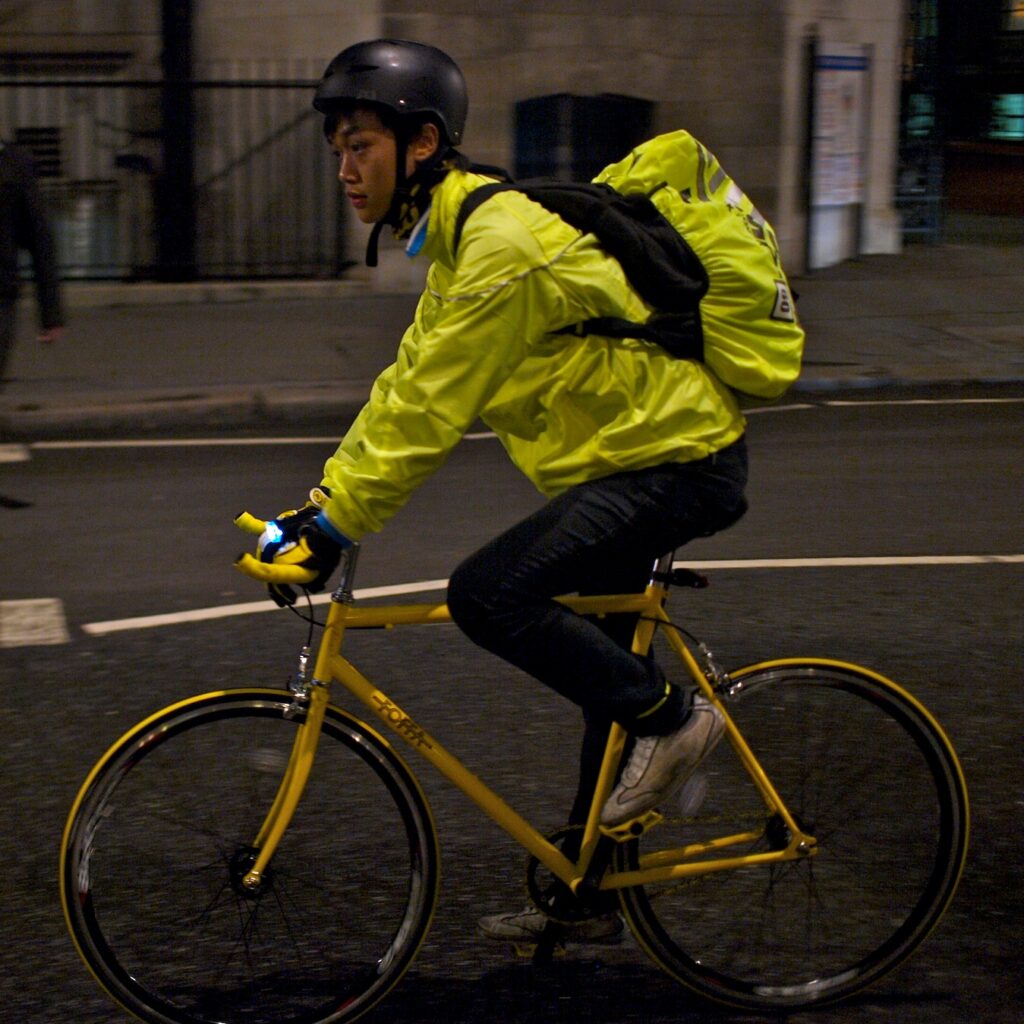

A researcher at an Australian university says that cyclists could be exposing themselves to greater danger of being struck by a car due to the driver’s inability to see them, particularly when the light is poor, and says reflective, not high-visibility, clothing is the answer to being seen in the hours of darkness.
Philippe Lacherez, who is a post-doctoral fellow at the School of Optometry and Vision Science at the Queensland University of Technology (QUT) conducted his research among 184 cyclists – most of them Australian – who had been involved in a collision with a car.
Their responses highlighted that in a lot of instances the driver “looked, but didn't see” the rider in sufficient time to avoid hitting them.
"We asked the cyclist about the time of day, the weather and general visibility at the time of the collision as well as what they were wearing and the lights on their bikes," commented Dr Lacherez.
"We found that crashes disproportionately occurred during low-light conditions such as at dawn, dusk or at night. Only 34 per cent of cyclists in these low-light crashes were wearing reflective clothing and 19 per cent of them said they weren't using bicycle lights at the time of the crash.
"We're concerned that this means cyclists are making themselves more vulnerable by not being adequately visible to an oncoming driver.”
Some might see that finding as giving an excuse to so-called ‘SMIDSY’ – standing for “Sorry mate, I didn’t see you” – drivers, with the claimed inability to see a cyclist because they were dressed in dark clothing, or the sun was shining in the motorist’s eyes, at times employed as a defence in court.
Dr Lacherez went on: “What is surprising is that 61 per cent of cyclists attributed the crash to driver inattention,” he added. “Only two of the 184 directly attributed the crash to their own visibility."
He said cyclists could make themselves more visible through using reflective clothing but cautioned that high-visibility clothing by itself was ineffective at night.
"Fluorescent clothing needs UV rays to be reflective and so don't work at night," he said.
"Cyclists should add reflective strips to their knees and ankles because the pedalling movement makes light from the headlights bounce back to the driver making it easier to register they are there.
"Cyclists also need to wear a reflective vest and, of course, have lights on their bike to increase their chances of being seen in low-light as well as at night.
"Our previous research has clearly demonstrated that when cyclists add these strategic reflective markings it leads to a large increase in visibility, which in turn leads to motorists recognising a cyclist on the road much earlier. This simple step could make cycling in low-light much safer," he added.
Some of those findings – such as dawn and dusk being particularly dangerous times for cyclists – have been widely reported before, and doubts have also been raised previously about the effectiveness of fluorescent clothing whether during the daytime or at night.
Earlier this year, the Guardian Bike Blog highlighted a report form the Transport Research Laboratory (TRL) – with the caveat that it was based on research of motorcyclists, not cyclists – which analysed a dozen studies, some of which had suggested that high visibility clothing could improve rider safety.
However, the TRL said that in many cases, that was based on the hi-viz clad rider being placed against a uniform background, rather than a changing one, as would happen in motion.
Two more recent reports cited by the TRL suggested that what was important was not the use of high-visibility clothing in itself, but rather the contrast against the background, with white or even black clothing found to perform that function.
The TRL said: “The results are interesting in that they show the previously held assertion that a bright reflective jacket will improve rider conspicuity may not always be true …
“[T]he message seems to be that the most conspicuous outfit will be dictated by the lighting conditions and local environment at the time, which may be extremely variable within the confines of even a fairly short ride.”
It added: “Given that environments may differ over even fairly small changes in time or location, there is not likely to be a one-size-fits-all solution, meaning that motorcyclists need to be aware of the limitations of whichever interventions they use.”
In the United Kingdom, Rule 59 of the Highway Code says, among other things, that cyclists
… should wear…
• light-coloured or fluorescent clothing which helps other road users to see you in daylight and poor light
• reflective clothing and/or accessories (belt, arm or ankle bands) in the dark.
Some police forces have at times sought to distribute high-visibility vests to cyclists, with Hampshire Constabulary having undertaken a campaign in which it also targeted people riding bikes without lights in November 2009.
Earlier this year, in separate inquiries in New Zealand involving the death of cyclists, two coroners said that bike riders should be required to wear high-visibility clothing.
Following publication of the verdict in one of those cases, a spokesman the country’s Ministry of Transportation said it was giving serious consideration to the coroner’s remarks.
DfT figures released last week reveal that in Great Britain in 2012, some 2,091 cyclists were killed or seriously injured in incidents that happened from Monday-Thursday.
The most dangerous times of day were between 7am and 9am, and from 3pm to 8pm, when each hour saw serious casualties reach three figures in aggregate across the year.
That’s partly explained by the fact that those hours coincide with the morning and evening commuting peaks, as well as rush hour.
Lighting conditions do vary across the year – in Manchester in midsummer, for instance the sun rises at around 4.4am and sets at approximately 9.4pm, while in midwinter, sunrise and sunset times are roughly 8.25am and 3.50pm.
While many cyclist casualties, even at peak times, will happen in hours of daylight – the summer months tend to see a higher number than winter ones, for example – changing light conditions at dawn and dusk are believed to be a factor as road users’ eyes adjust.
In 2009, the TRL published a study into cyclist casualties based in part on STATS19 forms completed by police after a road traffic incident, which are also used to compile DfT road casualty statistics.
It found that cyclists wearing dark clothing, or riding at night without lights were considered by police to be a factor in just 2.5 per cent and 2 per cent, respectively, of incidents in which the rider suffered serious injury.



75 thoughts on “Study says cyclists should make themselves seen – but reflective clothing, not hi-vis, is the answer”
And black cars? Do we see
And black cars? Do we see the same level of discussion about the likelihood of them being involved in a collision?
I’ve mentioned this before,
I’ve mentioned this before, but when I had my SMIDSY accident I was wearing all black. My own fault then? Well, not in my view. It was shortly before noon on a bright sunny day, the ‘background’ that the driver didn’t see me against was bright early-summer green. I happen to believe that all black is more more visible than high-vis (or reflective) in such situations… having said that I’ll be riding with a flashing front light even in daylight in future.
Gizmo_ wrote:I’ve mentioned
sorry to hear you had an accident but surely at least some of your background would have been black tarmac?
TheHatter wrote:Gizmo_
Not from the height of a car driver’s seat. And when was the last time you saw beautiful clean new tarmac in this country?
I have at least 3 rear
I have at least 3 rear lights, one is on whenever I am out, no matter the time or day or weather.
As for the comment about the black car…..They have powerful lights….making them visible in dark conditions.
They way this “research” is going, all cyclists are going to need a follow car shortly, with flashing lights and a sign warning of cyclists ahead.
Gkam84 wrote:
As for the
And silver/grey cars in thick fog who don’t bother using their lights!!!!
A problem with cars having
A problem with cars having powerful lights is that the bike light can be easily lost in the noise. The one SMIDSY I had was such a situation. I was a small light source with a load of very big ones further up the road behind me.
Cyclists with helmet lights are very visible due to the movement, but they can be very bright for motorists.
I have high visibility orange clothing, steady and flashing lights, and retroflect tape on places like the cranks to make up for lack of pedal reflectors riding clip-in shoes. I also have spoke reflectors and reflective rims on the tyres. I think the moving reflectives such as pedals and spokes work well.
I need to replace my bar tape soon. I wonder why there’s no retroflective bar tape on the market.
Quote:Only 34 per cent of
So were cyclists with reflective clothing under or over-represented in this sample, or does the 34% figure also represent cyclists who weren’t in crashes? This is the most important piece of information yet seems to be missing.
Yet it could be entirely accurate, there is seemingly nothing in the research to prove or disprove the statement.
This seems like a poor piece of research.
Where was it published and who has reviewed it??
Incredible.
Almost every
Incredible.
Almost every study concludes that it’s the cyclists who “should” be doing something, in order not to get killed. The most ridiculous being the one on body armour…
No wonder that judges love using lack of reflective gear or a helmet as a mitigation when “sentencing” drivers.
What I would like to find out is why even with high-viz/reflective gear and 900lumen flashing light(s), drivers still pull out at the front of me, regardless of the time of the day/night.
BBB wrote:Incredible.
Almost
This, i wonder who funded this nonsense.
Reflective clothing is not needed.
I’m reminded of a poem which
I’m reminded of a poem which applies to sailing:
“Here lies the body of Johnny O’Day
Who died Preserving His Right of Way.
He was Right, Dead Right, as he sailed along
But he’s just as dead as if he’d been wrong.”
Drivers may be in the wrong for the vast majority of SMIDSY accidents but that doesn’t help much when you’re lying under the from wheels of a car. It’s plain stupid to not to do something which is likely to improve your safety on the basis that someone else should be responsible.
b3nharris wrote:
Drivers may
The problem is in knowing what to do. Research tends to suggest that hi-viz is not very effective and that black and white clothing is best during daylight. So how does the rider know what is best to wear when the advice and research are neither consistent or reliable?
At the end of the day there could be anything on the road, a child, an animal, a skip, a big hole but it is ALWAYS the responsibility of the driver to be sure every piece of road is clear before driving onto it.
b3nharris wrote:It’s plain
Be careful where you go with that. It’s the same line of reasoning used to criticise women wearing normal western clothes.
I don’t mind being told to fit this or that safety device to the bike, but how I choose to cover my body is personal. And personally, I prefer to look like a normal person when I’m on and off the bike, rather than an alien from the planet Hiviz!
Like it or not we are all
Like it or not we are all responsible for our own safety. I’m not convinced of the efficacy of hi-viz but I do think that reflectives and good lights make a huge difference in low light and in the dark. I certainly don’t want to see a law that mandates that we all have to wear the YJA but if you ride outside of well lit town centres in poor light or in the dark then using reflectives and bright lights is just common sense.
There are so many drivers out
There are so many drivers out there, not paying attention, maybe texting or even checking Facebook, I feel much safer wearing a hi vis vest.
They weigh virtually nothing and I carry two different sizes so I can still be fairly aero even if I strip down to just one layer. If you have a needle and thread, you can make any cheap hi vis a custom fit, so it doesn’t flap about.
IMO, motorists often don’t
IMO, motorists often don’t see cyclists simply because they are not expecting to see any. I noticed last night a few instances where riding past intersections, cars pulling up to the stop were not looking for me, but motor vehicles off in the distance behind me.
Speaking as a NZer, I was
Speaking as a NZer, I was horrified at the coroners remarks. Apart from the “cyclists need to be responsible for their own safety so car drivers can ignore them” implications, here in Hawkes Bay high vis yellow is like camouflage against our bright spring/summer foliage and grass.
If you get a bunch of people
If you get a bunch of people running around carrying scissors, why are we looking at the behaviour of the people without scissors? And if some of the first group are carrying 12 foot long scissors and wearing an eyepatch, then wtf?
This isn’t so much a question of victim blaming, more carrying out a semi-detailed study of the most effective way to blame the victim. And I ride out festooned like a bloody Christmas tree.
Reflective clothing won’t
Reflective clothing won’t help in low light conditions if the car behind doesn’t have the headlights switched on.
That said, I cannot understand why most cycling specific clothing lacks reflective strips. It doesn’t cost much and doesn’t detract from the style during the day.
As usual here its blame the
As usual here its blame the cars.
I DO think that many of them are a bloody menace and that the drivers are complete idiots. I Do think that most car drivers show little interest at best in cycle safety.
However I doubt that very few actually want to hit a bike. We do need to make some contribution. Cars need lights on when they are out in poor light. Why shouldn’t we as well. You rarely miss a lorry in the rain but you do miss smaller cars or silver ones for example.
It has to be accepted that we make some effort. Its not human to expect all car drivers to spot everything. I defy any of you to say that you have never lost your attention for a minute. Every little helps. It also gives us another weapon when we do get the SMIDSY excuse, especially if it goes to court. Sad to say that but it will be true.
Why the objection to bright kit?
Fashion and the I am too cool for sparkly bits.
Now if Rapha added reflective they would be come all the rage.
Maybe people such as the Rapha designers have a slight responsibility there. But would they dare make a reflective jacket.
NO
There are a lot of cars now
There are a lot of cars now that are made with sensors fitted that automatically switch on your side lights when certain light levels are reached (like street lights).
Unfortunatley its all the big expensive models that have it fitted. Perhaps its time to get them all fitted.
stumps wrote:There are a lot
Laws changed, ALL new cars have to come with daylight running lights, there is usually a way to turn the lights off, but if tends to be involved.
mrmo wrote:stumps wrote:There
Laws changed, ALL new cars have to come with daylight running lights, there is usually a way to turn the lights off, but if tends to be involved.— stumps
Didn’t know that mate, thats good news for us that cycle when its getting dark. Mind you they shouldn’t be allowed to switch off the system.
I think its an individuals
I think its an individuals own choice but I feel slightly safer with a front and back day light lights on plus my Hi Vis ruck sack when I commute to work from Stockport to Manchester, if I can make drivers notice me I stand a better chance of getting to work safetly, now the mornings are getting darker I am horrified to see cyclist riding dressed in normal or Black clothing surely they are putting themselves at risk, I am not to happy for cyclist to ride on the pavement in busy areas but it makes me smile to see cyclist riding on the pavement with flashing lights on..
Mattsccm: Rapha winter stuff
Mattsccm: Rapha winter stuff normally has reflective panels. My wind jacket has reflective arms and back lettering and my pro team jersey has a reflective arm band. Neither will help if a car pulls out on me from a side road of course!
Rapha also do bright orange and yellow macs but you won’t catch me wearing them as I don’t want to dress like a prat just to allow motorists to keep on braking at the last possible moment. Reaction time is not governed by visibility but by speed.
Vehicle headlights operating
Vehicle headlights operating on dipped beam are *designed* not to cast significant amounts of light upward beyond a certain angle. Accordingly, if you are in the carriageway on an unlit road wearing Hi-vis only (i.e. no lights, no reflectives)…you will not be sufficiently illuminated to be seen by a driver travelling at anything above ~20-30mph until it is too late. Reflective is the only thing that works in those circumstances.
Meh. This is the helmet
Meh. This is the helmet debate writ large. Sciencey-types can’t agree what is better, ‘common sense’ is apparently wrong, and in the real world people don’t like the danger-ification / looking like a road worker.
Seems the only answer is to get into the arms race that is ever-increasing lumens front & back, day & night.
…
FWIW, my lovely ShuttVR kit is almost totally black, but with lovely contrasting white and rainbow bits. And there’s reflective stuff sewn in all over the lovely black Performance jacket.
Now we just need some seriously chilly days to justify getting it out 🙂
Hmmm, I light myself up like
Hmmm, I light myself up like a feckin’ Christmas tree on commutes – 2 rear 2 front lights (one set to flashing one solid) reflective strips on the bike and my bag has reflective tape.
That didn’t stop some moron try overtaking me at a pinch point and nearly running me of the road, he backed off when I suggested ‘kindly’ to reconsider.
What really pissed me off though was this particular moron decided that he didn’t need to see out of any of his windows – they were completely steamed up which would have meant even with lights and what nots, if he’d gotten past me he would have most likely not given me the clearance due to obstructed mirrors and quite possibly cut inside of me again due to no visibility.
Cyclists can only do some much – unfortunately there are eejits like this on the road prepared to risk the lives of anyone in the way.
@stumps – I can’t turn my ’12
@stumps – I can’t turn my ’12 plate corsa lights off. They are now always on – I think as others have said it is now mandatory.
I think that there is a few
I think that there is a few things happening here, and as you would expect, rather than sorting out the cause, we are trying to find and fix the symptoms.
In the first part, Hi Viz vests are now to common place, you see someone walking to work or HGV drivers, as well as cyclist and runners. So drivers are becoming blind to Hi Viz. Have a think for a moment, anyone that drove into work today, how many white vans did you see? probably lots, but you wont remember how many you saw, but if you saw a gilded coach drawn by 6 white unicorns you will remember that.
The next problem is Cognitive capture, there is so much going on in our lives and in our cars that we loose the ability to take everything in, its pretty much the same in some ways to inattentional blindness, especially during work commutes, on the way in everyone is paying attention to the car in front, listening to the radio, thinking about how is following them on twitter, the in car Sat Nav, looking for speed cameras..the list goes on. Unfortunately there is probably nothing can be done about this. I recently read about a scheme where bikes are fitted with a device that will send a signal to a receiver in a bus or HGV and an alarm will sound. This, like the Hi Vis will work well for a little while, but it will not take long until the sounds are ignored, or become white noise.
So what we cyclist are becoming is white noise on the road, and we need a way to fix this.
I agree that lights should be used during the day, especially at the back of the bike, and both front and back should be flashing during the day. Appropriate clothing is also a good idea, but this wont solve the issue if its not noticed.
There is an answer, but it will never be popular, and I doubt that it will ever be implemented, and this is by changing driver behaviour. When driving home last night, I took note on how drivers we behaving on the road, in a 2 mile stretch down the A49 in Warrington i saw 5 cars change lane without indicating, and only 1 did indicate, at every set of lights cars had front wheels over the stop line…note, this was at every set of lights, at the McDonalds a car come out of the car park turned right and traveled at speed down the wrong side of the duel carriageway, at high speed, and took the corner dukes of hazzard style, anyone crossing the pedestrian crossing would have been killed. A car in front of me merged into the gutter at a set of lights to stop a cyclist from filtering, a HGV run a red light in a roundabout, 2 cars overtook and changed lane in another roundabout….
The reason all of this happens is that the Police are not doing anything to stop it, and this may well be due to staffing, or other priorities, but if there is no one enforcing the laws people will brake them. I lived in Australia for 36 years, the road laws are very heavily enforced and penalties are very high, and as a result the culture on the roads is completely different, thats not to say that its safer for cyclist as I dont have those figures, but if we use that example in introduce strict laws for drivers behaviour around cyclists, and also enforce the laws that we have in the first place, drivers may be more conscious of what they are doing behind the wheel. Imagine if there was a £200 FPN for driving without due care around a cyclist.
And whilst Im at it, the fines for cyclist should be enforced, especially no lights at night, running lights etcettera
As an example of the difference in road policing between Australia and the UK, at least every 3 months, I would be stopped by traffic police for either a Random BAC test, or licence check. When ever a driver is stopped the police administer a BAC test as normal procedure, and I think now they are doing saliva tests for drugs. I was once stopped because the police saw me drive past and thought that my tyres were to worn…and they were close, they did the normal checks, put me on the bag, rego check and sent me on my way. I was stopped once by a plain car as one of my rear lights was flickering, the copper told me I should get it fixed, did all the checks and sent me on my way, all with a smile, very professional.
So whats my point? Im not to sure now, I have lost my thought trail, but what I think im saying is we need to police to enforce the laws and we need the Government in introduce new laws to protect cyclists. Make drivers more aware of us on the road, and enforce penalties when they do not
Research done by me
Research done by me suggests:
As the majority of motor vehicle drivers are lower down than cyclists, the most obvious colour to wear is the one which will contrast most greatly with the sky, black covers this in most daylight situations.
rich22222 wrote:Research done
Rich, to you and Gizmo…
GET REAL!
If you are that far above the drivers eyeline you are airborne… even if said driver is in a very low slung (traditional) mid-life crisis appeaser*.
*ie a sports car rather than a very expensive carbon fibre bicycle 😉
Lights/reflectors work at
Lights/reflectors work at night and hi-viz works in low light (dawn/dusk)…..how is this news? Surely its obvious?
Sure, you’d be stupid to ride at night wearing black with no lights down an unlit road in fast traffic. This isn’t the typical case though.
On the subject of visibility, the elephant in the room is that plenty of accidents happen in broad daylight. How can a driver say that they didn’t see someone they hit in broad daylight. Of course most of us have a suspicion as to what the true answer is; bad driving.
It seems to me that most accidents happen because a driver wasn’t paying attention or executed an ill-advised manoeuvre. If you bother to get an explaination from the driver (which this study seems to have failed to do) then its only to be expected that a driver will try to defect the blame and make an excuse. Its extremely rare for a driver to admit fault. Don’t ever recall anyone saying; “Mi-lud, I overtook around a blind corner, suddenly was suprosed by the oncoming traffic and drove over the cyclist to avoid a head on collision.”
Not only obvious that dayglo
Not only obvious that dayglo isn’t much use of itself after dark (see the clue in the name, for a start), but something taught for years.
In other news, round wheels offer less rolling resistance than triangular ones.
Deary me.
My observations as a
My observations as a commuting cyclist and occasional car/bus user:
Hi-Vis – okay during daylight, useless on its own at night. Best spotted at medium distance 2-400 yards
Black clothing – why did Ninjas wear black? It doesn’t stand out against anything other than snow. You may look cool in black but it does not, in general, help make you visible.
White clothing – stands out slightly more than black against most backgrounds. Quite visible at close range.
Mixed clothing with high contrast is the most visible at close range.
Reflectives – limited daylight application. Effective at night IF caught by bright white light. Starts working under 200 yards from light source.
Lights – Flashing attracts attention 8} Red light has limited visibility in daylight unless VERY powerful lamp.
I do around 4000 commuter miles per year in all weathers and ambient light conditions. This is in Glasgow where it is probably generally darker than the UK average due the prevalence of cloud and rain. My standard visibility kit consists of:
Clothing:
Jacket/jersey – whatever is clean, generally two colours from red, white or green and usually having a small reflective strip as part of the garment. (I wear mostly TORM gear). I never wear hi-viz, mainly because I don’t own any.
Bottom half – bog standard black. May or may not have any reflective bits.
Shoes – Gaerne TRON shoes, which I love http://img2.annuncicdn.it/6e/52/6e522cdc640c7e6787ffe02cdc9c5f86_orig.jpg No idea if they work.
Lights – front on flash at all times. Rear on flash in low light and Flash + constant in darkness.
Taking “incidents” to date as the measure, I’m far more visible in the dark than during the day! As mentioned above though, it doesn’t matter what you do or wear when you are at the mercy of the “inevitable idiot”.
Regretfully I’ve taken the
Regretfully I’ve taken the decision not to ride on the roads anymore other than during a race. I’ve grown tired of an apathetic government sanctioning the cull of people simply trying to enjoy an amazingly rewarding sport.
I can think of no other similar environment where the levels of injury and death is so readily accepted. 38 dentists struck off for malpractice according to a recent news clip ending years of study, financial commitment and permanent loss of income – they are unfit to practice so the government correctly seeks to protect the public.
In contrast we learn that Scottish driver kills twice ‘by accident’ and still the government restores his ‘right’ to drive. What did he invest to get his licence? 25 hours perhaps and a 45 minute farce of a test he can repeat as many times as he wants before fluking a pass. He still has his income and has the option of using public transport or dare I say it, actually use his legs to get about.
Indoor trainer and a spot of mountain biking is the best I can hope for now. The government has well earned the obesity crisis and all that comes with embracing the car at all cost.
So should cyclists only be
So should cyclists only be allowed on the road, if they have a marching band in tow. Should the marching band also be dressed like an xmas tree or would that be over the top?
Perhaps we should get the red
Perhaps we should get the red flag act back for cars? The death and injury figures would justify it and can you imagine the instant impact it would have on the roads?! Will never happen of course.
Victim blaming, pure &
Victim blaming, pure & simple. Many drivers see a cyclist and make a concious decision that, as the cyclist will come of worst, the cyclist WILL give way.
The fraction of a second it would take for them to wait is more important than the life of a cyclist. That’s the attitude that needs changing. How that’s done is difficult, but heavier penalties would be a start.
Another story today (http://road.cc/content/news/95382-sussex-driver-involved-crash-claimed-cyclists-life-friday-jailed-20-weeks) was a driver, who killed a cyclist, getting 20 days prison & 3 year ban for driving without insurance or MOT. Compare that to killing a cyclist and getting community service (http://road.cc/content/news/92738-community-service-driver-who-killed-cyclist-while-eating-sandwich) & 1 year ban. Something is seriously wrong with the balance.
After years of trying all the
After years of trying all the options I now always mount my front light on top of my helmet (No sniggering at the back Oli Pendrey).
1. You can point it towards the left edge of the carriageway when cars are oncoming so that…
2. …you can run a properly bright light without it dazzling drivers.
3. Additionally, if you get to a junction where a car may be pulling out into your path & you think there’s even a small chance that they haven’t noticed you, just turn to look them in the eye directing your light towards their face for a moment.
NOW they’ve noticed you.
Neurologically, the human brain, as powerful as it is at coping with a constant flood of information from all of our senses, still has to prioritise – something we aren’t conscious of in the moment – and tends to ignore constancy. Our brains are, however, exceedingly alert to changing stimuli. So a flashing red light is always more visible to another road user than a constant one. It also makes sense that a driver’s lights glinting off reflective patches of clothing are going to be more noticeable than brightly coloured clothing.
Dont let it put you off. Ride. Enjoy. But ride defensively – even if it is technically your right of way (the earlier post by b3nharris is spot on…) – and do everything you can to be seen & keep yourself safe. Even if that driver IS in the wrong, their car is harder & heavier than you are.
Rubber Side Down.
herohirst wrote:After years
Yes, +1 for that. As well as my helmet light I also have bright fixed ones fore and aft.
Herohirst: you’re unlikely to
Herohirst: you’re unlikely to get done by the police for what you’re doing, but the law does require you to have a compliant light mounted on your bike. Regardless of how good it is, a helmet mounted light does not comply with the legal minimums.
They again, how many of us ride at night with pedals that are that are non compliant? Do you have orange reflectors on them visible front and rear? There are such things that can be bolted into SPD-SLs. You’re to struggle on Speedplays! And remember, again, shoes don’t count!
Jason Timothy Jones has hit
Jason Timothy Jones has hit the nail on the head. Drivers need to change their attitudes. This is the ONLY solution. Yes cyclists can do more but where does this end. Multi-coloured florescent clothing, reflective strips on clothes, bikes and bags. Two to three front lights, two to three rear lights. Reflectors on pedals, spokes, handlebars, seatpost. Must be wearing a helmet (cause getting hit by a car without one is the cyclists fault, clearly!), don’t break any road laws, etc etc. Doing all this will not stop idiot drivers driving dangerously around you or not see you at all (the recent story about the driver who was playing with her satnav for 22 seconds without looking at the road who ended up hitting and killing a cyclist).
If drivers followed what is already taught (ie the highway code) to the best of their ability, I am very sure casualty numbers would dramatically fall and cyclists would feel hugely safer on the road, by not getting overtaken at pinch points (or even on a wide road but still only given 2 inches of space!), drivers actually obeying speed limits(!), etc. If this happened there would be little to no need to change cycling/road infrastructure (blue paint, segregated cycle lanes etc), imagine that.
As said, the current laws need to be enforced with high penalties. The Australian system sounds quite good. Also proper penalties for killing/ injuring other road users (6 months driving ban and 200 quid fine is not a joke, it’s an insult). I would add that the driving test would need to be retaken every 10 years with mandatory training before each test, so as to teach current best practice.I mean you are in charge of a 1+ ton metal box! Will any of this happen in the UK any time soon. No chance!
Recently I was out on my
Recently I was out on my bike, with two lights front & rear (one of each Hope vision super bright hobbies) with a top with reflective piping on. A police car pulled me over to tell me a car had nearly hit me, which I had noted myself due to eyes. I think they were telling off the wrong person.
I suppose it’s little
I suppose it’s little surprise that in a road.cc forum so many posters love and swear by their no doubt expensive and expansive kit, in the belief it will keep them safe from the destruction meted out by inattentive or malicious motorists: the rest of the site is festooned with adverts for the latest hi-vis, reflective and expanded polystyrene panaceas.
But such measures only work if those same motorists are attentive and benevolent, and that they give a damn about who or what they hit while driving.
(I notice that in the helmet review section no mention is made of the single most important reason for buying a helmet – will it save my life in the event of a collision? Some of these items cost well over £160 – I’d want something a bit more definite and reassuring than ‘offers great streamlining’).
In the current climate experienced by people using bikes in the UK, much attention is paid to ‘educating’ the various groups of road users (viz the ridiculous NiceWay Code). But as someone pointed out on a US blog, education is a slow and tedious process, and what’s slowest and most tedious is “educating” motorists, who have no particular incentive to learn.
Many drivers resist education because they believe they already know all they need to, and with penalties for poor standards of driving so feeble, they have little to fear from the courts for their actions while driving.
**Opinion Alert**
Speaking as
**Opinion Alert**
Speaking as a driver, if in daylight, you can’t pick a cyclist out wearing whatever the feck they want, you are not driving with due care and attention, and deserve to have your license revoked. The same can be said in poor visibilty if the cyclist has adequate levels of lighting.
The argument of ‘that is not going to save you when someone doesn’t notice you’ can be applied to every level of preventative action you take, and ranks about as high as the playground jibe ‘I know you are, you said you are, but what am I?’.
Whatever your mode of transport, if you use the roads;
i. pay attention,
ii. abide by the current laws,
iii. behave with courtesy
and people will get hurt less. As jason timothy jones said, all it needs then is for those behaivours to be politely and professionally enforced.
I fully agree with those
I fully agree with those comments about driver attitude it’s got little to do with what you are wearing/light up with.
Yes being seen will help, however I am increasingly getting fed up with cyclist blinding me, both as driver and fellow cyclist, with their mega super bright lights. Hello people, time to realise drivers can not see you if they are blinded by your lights. Do we really need to head down bigger/brighter is better? Also how far a head do you need to be before you become background? By this I mean do people really focus on what’s happening a mile in front at 30mph or 2 minutes away. Or do we focus mainly on the next 10 seconds or the next corner. Therefore how far a head do you need to telegraph your presence to be safe?
I was stopped the other day by a driver who ranted at me for wearing black on a day of clear blue sky. They shut up when I pointed that they had seen me, not once but twice, therefore their arguement was null and void. I’ve had more close calls on the bright yellow and green frame than the dark blue one. Strangely enough I feel safer wearing the black “Blood Cyclist” shirt than I do with a red and white Katusha or a plain white shirt.
(RE)Educating all drivers to look out for the hazard called “a cyclist” and to give the cyclist space and time to sort themselves out would be the best start. Not forcing all road users to be lit up with 2 million candle power and only wearing day-glo yellow or orange.
Jeez, think of the environment and where does the power come from.
Yorkshie Whippet wrote:how
If I’m on a road with bends with poor visibility I like to hope I’ve been seen by the car behind before entering the bend.
As a driver I’ll tend to look a reasonably way ahead and see something going into a bend.
m0rjc wrote:Yorkshie Whippet
My opinion is that you have to ask yourself how the majority of accidents involving cyclists happen, and where. The answer is they mostly happen around junctions and are caused by errors in judgements that need to take place at close quarters and possibly in a fraction of a second.
Being seen miles away doesn’t help.
I’ve done some pretty intense academic literature searches in the field of visual cognition as it might apply to traffic situations. ( using the reference chapter in a book called “traffic” by Tom Vanderbilt as a starting point. The upshot is that being bright doesn’t really influence decisions made at close quarters in a fraction of a second and may even slow down the decision making process. Go do some proper research!
Lights > Reflectives >
Lights > Reflectives > ‘Hi-Viz’. Simple.
‘So a flashing red light is always more visible to another road user than a constant one’
Is, of course, absolute toss. Have you ever asked yourself why all the other vehicles on the road don’t have flashing lights? a *moving* light is more visible, not a flashing one. Flashing lights are only good for battery life.
@andyp – here’s a test for
@andyp – here’s a test for you tonight, if it’s not too cloudy. Look at the sky – you should see four “types” of light
1) still and steady light
2) still and flashing/flickering
3) moving and steady
4) moving and flashing/flickering.
Which ones catch your attention best?
What about pedestrians?
Would
What about pedestrians?
Would any researchers dare to suggest that they too “should” be wearing certain types of high viz/reflective gear while e.g. crossing a busy street?
Genuine question.
There’s clearly lots of
There’s clearly lots of opinions about hi vis clothing, but imagine the following experiment.
Get several hundred cyclists (half with a hi vis vest and half without). Now intruct those cyclists to mix things up a bit, by varying their speed and direction at random on an inner city route.
Now imagine you’re driving a truck, and trying to spot every cyclist, using all three windows and six or seven mirrors, plus do all the other things you have to do, like keep an eye on cars, pedestrians, traffic lights, signs, weight limits, bridge heights, etc.
I think most people would be far more likely to spot the cyclists wearing hi vis, rather than those who are not wearing hi vis.
Maybe some organisation could recreate this type of experiment, stick it on Youtube, and let people decide for themselves whether they want to ride without any hi vis clothing.
Problem: 90% of the
Problem: 90% of the “reflective” cycling clothing available is totally inadequate at night. Reflective piping that is 3mm wide? Reflective dots a couple of centimetres across? Reflective lettering, for Christ’s sake, that is 2mm thick and which I would stuggle to read from 5m away? The clothing needs to have big panels of the stuff all over the front, back, sides, arms ands legs. Until a manufacturer starts selling this, I will not feel safely dressed at night.
chokofingrz wrote:Problem:
Have you taken the time to look at your ‘invisible’ 3mm piping from a distance under headlights? Or are you just making assumptions. ? I think you’lll find a little reflective in the right place ( mainly on the legs) is highly visible under headlights at night. I don’t believe that even quite bold reflectives on the torso are terribly effective as dipped lights don’t tend to fall on them.
I wear pretty much all black
I wear pretty much all black clothing. When visibility decreases I use front/rear lights. If a driver can’t see bright lights in front of him, then he won’t see me regardless of what I’m wearing.
Then again some idiot cyclists take it to the extreme, blinding all other road users with their stupidly bright lights pointed at eye level. That’s dangerous! The aim isn’t to blind, it’s to see/be seen!
Contrary to previous
Contrary to previous comments, most Tarmac appears to the human eye as silver to white. Black clothing actually contrasts pretty well with Tarmac.
I am convinced also that hiviz yellow actually makes motorists pull out on you more often than not. This is precisely because it is associated with cyclists an only cyclists and therefore a. Very small minority of vehicles on the road . There is good research evidence also that in a complex traffic environment, hiviz distracts drivers and leads them to do what is not the safest thing in any situation.
If only more cyclists would learn the importance road positioning in all lighting conditions (most haven’t got a clue!) then we might be getting somewhere. It trumps clothing colour , bright lights , the lot!
The conclusions of the Aussie
The conclusions of the Aussie study seem like deja vu. God knows how long ago it was but I read or heard from somewhere that contrast was the biggest factor in improving visibility to an onlooker. From the source I was already aware that depending on light conditions dark clothing or light clothing could be effective. It does seem logical, though where these things are concerned logic is not always the best guide so a study is rather welcome.
In the UK we tend to have a lot of overcast days so even during the day it is probably better to wear light clothing. Also as most urban and rural backgrounds at pedestrian, vehicular and cycle level are darker than hi-viz it is probably better to wear light clothing at all times. However, with many road cyclists having a penchant for black attire and many forums decrying the wearing of anything other than black as wholly unstylish it may be a while before we see anyone other than Dads, Mums, Geeks, and kids wearing reflective Hi-viz. I for one hate the stuff but can’t deny it’s benefits.
With respect to reflectivity I still think that dark clothes with reflective elements are not as visible as light (White or Hi-viz) clothing with the same reflective elements when riding in subdued light or the dark. I own a few Campagnolo items that are predominantly black with reflective ‘IQseen Clearly Visible’ elements. I’m yet to be convinced they are merely ‘better than nothing’. They are very reflective, being visible at 160m, but unless the driver of a car realises the flash of light is a cyclist they probably won’t respond accordingly.
To illustrate the point, I knew a chap who was speeding down a country lane and thought the headlights he saw in the distance were from an approaching car. Turned out it was a reflection of his own headlights from a driveway mirror, located on a sharp bend in the road. He was nearly killed as he hurtled into the drive and it convinced me that drivers can easily be fooled at night when they don’t see the whole picture or person. With Hi-Viz the outline of the cyclist is better defined and that can’t be a bad thing when you only get one life.
I think the key point is to
I think the key point is to distinguish between offering advice about precautions that may be worth taking, and making out that any cyclist who doesn’t do so is “acting irresponsibly”.
Of course it makes sense to offer sensible, evidence-based advice on how cyclists can maximise their chances of being seen and, perhaps more importantly, noticed (yes, they are different!) in poor light conditions. Of course it makes sense to be lit and to wear something reflective if riding on unlit roads at night. And it should preferably be something that moves, e.g. an ankle-band – this article rightly notes the evidence that this is more likely to catch drivers’ eyes than ‘static’ reflective gear (e.g. jackets).
However it’s another matter altogether to suggest that cyclists who don’t dress up like Xmas trees (including on lit streets or in daylight) have only themselves to blame (or even partially to blame) if they get hit. The last thing we should be doing is giving drivers, the legal system or motor insurance companies any excuse for yet more of this kind of atrocious victim-blaming – see http://www.roadjustice.org.uk/node/515.
* * *
While I’m on the subject, let me also share a story I remember seeing years ago on the letters pages of the London Cycling Campaign’s magazine. It was from an LCC member who also rode a motorbike. He described a one-person informal experiment he had conducted, which he felt was equally applicable to cycling.
To test out what difference it made if he was brightly clad / reflective etc etc, he firstly spent a month riding on normal dark-ish clothes, and observed how often other road users infringed his right of way. I don’t remember the number, but let’s say it was 1.9 times per day, for the sake of argument (it was something like that).
He then spent a second month riding in the brightest, most reflective kit he could muster. It made no difference – 1.9 infringements per day.
So he spent a third month riding in clothing which came as close as he could get away with to looking like a police motorcyclist. The number of infringements nose-dived – say, 0.2 per day.
See what I mean about the difference between “being seen” but “being noticed”?
Roger Geffen
Campaigns & Policy Director, CTC
It seems to me that the basic
It seems to me that the basic concept of : Are cyclists stupid or what, is in question here.
Do they understand the difference between Hi-Vis in daylight and Reflective in poor light conditions?
If they don’t well then they need educating in the most simplistic terms.
There are some Hi-Vis Greens and Yellows that are far more visible at night than others.
A simply resolve to both would be a Hi-Vis jacket with Reflective Edges and a Lightweight Reflective Gillet over the top when light levels begin to diminish.
There will come a time and not so very far away that Flash Harry Lawyers/Barristers will be claiming that the injured or dead cyclists were not Pro-active enough in the preservation of their own well-being/life,they will then be deemed as instrumental in their own injuries or death and be left looking the prats that they doubtless are or were;if dead.
TheCyclingRooster wrote:There
Already been tried by Churchill. Where there is shared liability for an accident, lack of safeguards may be used as a reason to mitigate or reduce the damages paid out. In this instance, the courts had already found against the driver in terms of criminal liability, so the insurer was unsuccessful in reducing their civil liability.
My next commuting bike is a white hybrid. Combined with yellow hiz jacket with reflective panels, white lid and black commuter trousers. Deffo.
Why do cyclists need to be
Why do cyclists need to be recognised as cyclists per se? What’s wrong with being mistaken for a motorcyclist or being acknowledged as a vehicle on the road in the generic sense? That’s one reason I wear black from head to toe and very bright lights .
We should be as pro active in our own self preservation as any other vehicle on the road. The day painting a car bright yellow makes a sods worth of difference is the day I’ll think twice about using excessive hi viz and or reflectives.
wyadvd wrote:Why do cyclists
Totally with you on that, forget hi viz, superbright lights front and rear are the way forward. Cycle at night all the time and actually feel pretty safe.
So spend £200 to £300 on descent lights especially the rear ones and it’s pretty impossible not to be seen.
What about bike manufacturers
What about bike manufacturers painting the frame with reflective paint. I think it would also look cool.
perelik wrote:What about bike
My winter hack has had the frame “reflectivized”, with the use of the white sleeve from a traffic cone and a few dozen zipties. Sets off the spoke reflectors rather nicely…
Just another couple of
Just another couple of thoughts.
Can someone point me in the direction of good quality cycle gear that is not black and is both day-glo and reflective? I don’t want over jackets or tabards (I have enough of the later from motorsport). Stuff like shorts, 3/4, even tights, maybe jersey or two. I miss my day-glo sock from the 80’s. Very much doubt the likes of Santini, Vermarc even Gore do something.
The second is why, when people instinctively slow down when are they are unsure, do we encourage drivers to continue at speed. Surely if you are wearing black and driver is unsure that they have seen something they will slow down. Slower speed, more time, less likely to have an accident and if they do consequences will be less painful. Safer! No?
Thirdly, yesterday evening I nearly rode into two cyclist. Both had high vis jackets and red lights both flashing and steady. Both rode straight off the pavement and into my path after looking at me. And then apoligised as they “didn’t realise I was travelling so fast”. Morale: Wear what you like, it doesn’t stop you from being a pillock!
I dont think it matter what
I dont think it matter what we wear there are always going to be numpty drivers.
Mind you i was in the car this morning and where the road narrowed there was an old chap cycling towards myself and some young un in an Audi tt in front of me.
The cyclist had right of way but the Audi just kept on going. The cyclist must have thought “bugger it” and kept going playing chicken with the Audi.
Needless to say the cyclist won, the Audi mounted the pavement samcking his lovely alloys off the kerb and slewing to a stop. The cyclist waved as he passed me and i gave him the thumbs up.
The young lad in the Audi just got out of his car and stared at his now heavily scraped alloys – oh joy i wish i had a head cam at the time.
I know its got nothing to do with the article but i thought it might bring a smile to a few faces.
I entirely disagree that
I entirely disagree that hi-viz doesn’t really work, in whatever light condition.
Black/charcoal is the colour of shadow and tarmac.
As I am a cyclist, runner, motorist and a lorry driver, I entirely agree that it is the responsibility of the most vulnerable of road-users to ensure, by whatever means possible and in whatever lighting condition they are in, that they are seen.
However, it is as much as it is the responsibility of motorists and drivers of large vehicles (buses, coaches, trams, etc) to look more than once, using driver aids such as mirrors and possessing an attentive & tolerant attitude, for the most vulnerable road-users (including pedestrians, joggers/runners, cyclists, motorcyclists, horse-riders, et al).
Most incidents could have been avoided.
Cyclists should be aware of driver’s blind-spots and not ride there and should NEVER, EVER cut down the near-side of a large vehicle ANYWHERE, whether the vehicle is stationary or moving. It’s only common-sense and survival instinct.
These 5 Smith Keys to safer driving/riding might help:
1. Aim High in Steering
Look 15 seconds into your future. (Don’t just look at the vehicle in front of you)
2. Get the Big Picture
Look for Hazards. (Other Motorists, Pedestrians, Vehicle doors opening)
3. Keep Your Eyes Moving
Don’t stare: Use your peripheral vision and stop the fixed-stare habit
4. Leave Yourself an Out
Monitor the space cushion around you and your bike.
5. Make sure They See You
Use your Lights, Bell/Horn, Hand SignalsWear light and/or reflective clothing & accessories, Make Eye Contact.
Here’s a pic of a cyclist
Here’s a pic of a cyclist with two LED lights and a hi-vis vest, taken though the windsreen in the rain. They haven’t got mudguards, so there’s no muguard reflector and no pedal reflectors either. The led lights are probably cheap ones. Notice that even though the hi-vis is bright yellow, it is only the reflective part of the garment that is visible in the photo.
The hi-vis vest makes the cyclist far more visible, and also helps the driver to recognise that this is a person in front of them, rather than possibly misjudging the distance and mistaking the led lights as maybe lights further down the road.
Neil753 wrote:Here’s a pic of
In that case they are riding illegally. A rear reflector does not need a mudguard and pedal reflectors – which a 1980s TRRL study found to be most effective in identifying a pedal cycle to following drivers – can always be fitted if you choose your pedals carefully. (Clipless users may need a different system on the bike they use in the dark.)
Crankwinder wrote:Neil753
I know the cyclist was illegal, and I know reflectors are available to fit to a bike without mudguards. What I was trying to show was how little the LED lights showed up, and how amazingly effective the hi-vis vest was. I used this particular pic because many serious cyclists don’t have reflectors on their pedals, just relying on maybe a couple of LED lights, and how wearing a hi-vis (and I mean a proper one – not just some cycle top with the odd bit of reflective material here and there) can make an enormous difference to how visible they are to motorists.
why are some people who
why are some people who comment on road.cc so stubborn minded?
as a more vulnerable road user (cyclist, horse rider, motorcyclist) its your responsibility to help yourself be seen, that includes reflective stripes on your t-shirt / trousers. so why not help prevent a collision ? Whether it is your fault or not it doesnt matter, i dont know many people who WANT to crash!
fine, dont help yourself, but when the motorist says “SMIDSY” dont be surprised when the judge gives a lenient sentence (if it evern gets that far!!!) because you were wearing black at dusk.
as for lights, it doesnt matter how bright and amazingly expensive your helmet light is, get a little one for the handlebar and seat stem too! they are 99p on ebay. oh, and its the law (highway code tells you where you MUST position your lights, its not on your helmet. by all means stick one there too, but help yourself out and stick to the letter of the law as well).
as for reflectors, if the highway code says orange ones on your pedals then do it! if you get hit and you dont have all of the legal requirements you wont have a leg to stand on, (excuse the pun) which might be literal in some cases.
moving on to helmets. yea, motorists shouldnt “blame the victim”. but as a more vulnerable road user if you chose not to wear extra protection and then you are in a minor low speed collision in which you bump your head then the EXTENT of the injury will be increased because you were so stubborn minded and wouldnt wear a helmet!
why not do everything you can to protect yourself, including giving way when its your right of way, or wearing a helmet even if you think “its the other persons fault you got hit”….. better to do it than be dead.
Totally agree hood – the
Totally agree hood – the forum is attracting a lot of miliatants and trolls these days.
Only one reason I can think of and that cos reflectives, hi viz and helmets aren’t cool. And fair enough I support their right to ride in black with no helmet but don’t whine if you get hit.
Like most studies this one
Like most studies this one seems skewed to achieve a certain result. It doesn’t clearly state here that this applies to night or low light situations. Yet it implies that the findings apply to all light situations. I find reflective gear of little use in daylight. The study author even declares his ‘surprise’ at findings. Dr Lacherez went on: “What is surprising is that 61 per cent of cyclists attributed the crash to driver inattention,” he added. “Only two of the 184 directly attributed the crash to their own visibility.”
To me it boils down to looking for more ways to blame the cyclist and I’m sick of it. This past weekend I lost an old friend when a driver (suspected of being drunk) took out 2 of the 3 riders with such force one rider crushed the car roof killing a passenger as well. This driver who police suspect of being drunk crossed a double solid centre line to take out these riders on a sweeping curve with good visibility midday with clear skies. Amazingly some people have started going on about how the cyclists shouldn’t have been on this quiet rural roadway as if that’s the problem.
This culture of blaming the cyclist no matter what has to stop. Drivers need to take responsibility. Not to say a cyclist can’t cause their own problems but studies like this just feed ways to blame the cyclist for an inattentive driver. I think this is valid for night riding but the findings or article should clearly state that not imply otherwise with sweeping statements. I don’t ride at night, I’ve turned around in heavy fog and gotten off the road in bad forest fire smoke as well. I do not want to be hit neither because I can’t be seen or because someone just can’t be bothered to see me SMILBIDSY or whatever that stupid acronym is they used.
Like most studies this one
Like most studies this one seems skewed to achieve a certain result. It doesn’t clearly state here that this applies to night or low light situations. Yet it implies that the findings apply to all light situations. I find reflective gear of little use in daylight. The study author even declares his ‘surprise’ at findings. Dr Lacherez went on: “What is surprising is that 61 per cent of cyclists attributed the crash to driver inattention,” he added. “Only two of the 184 directly attributed the crash to their own visibility.”
To me it boils down to looking for more ways to blame the cyclist and I’m sick of it. This past weekend I lost an old friend when a driver (suspected of being drunk) took out 2 of the 3 riders with such force one rider crushed the car roof killing a passenger as well. This driver who police suspect of being drunk crossed a double solid centre line to take out these riders on a sweeping curve with good visibility midday with clear skies. Amazingly some people have started going on about how the cyclists shouldn’t have been on this quiet rural roadway as if that’s the problem.
This culture of blaming the cyclist no matter what has to stop. Drivers need to take responsibility. Not to say a cyclist can’t cause their own problems but studies like this just feed ways to blame the cyclist for an inattentive driver. I think this is valid for night riding but the findings or article should clearly state that not imply otherwise with sweeping statements. I don’t ride at night, I’ve turned around in heavy fog and gotten off the road in bad forest fire smoke as well. I do not want to be hit neither because I can’t be seen or because someone just can’t be bothered to see me SMILBIDSY or whatever that stupid acronym is they used.