



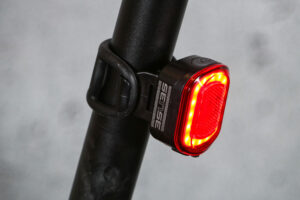
Whichever way you cut it, the £100 Coospo TR70 Smart Radar Tail Light is an excellent device. It matches the best in radar performance, and beats the competition in other key areas. It’s a really impressive bit of kit which also happens to be priced very competitively. I can’t really find any weaknesses in this product, so put it high up – or on top of – any list of radar/lights that you’re considering.
Up to now, the gold standard for radar/lights has been the Garmin Varia series. I have an RCT715 unit (with the camera) which is otherwise the same as the RTL515 with regard to radar and light output – their differences are down to weight, USB plug types and battery life. However for the purposes of comparison, I will talk about the RTL515 as it is closer to the TR70 as a direct competitor.
Radar
As a radar, the TR70 is excellent. It is a very reliable, accurate and dependable provider of information. It detects cars at pretty much the same time as the Garmin, with the alert beeps going off at the same time in a side by side static test.


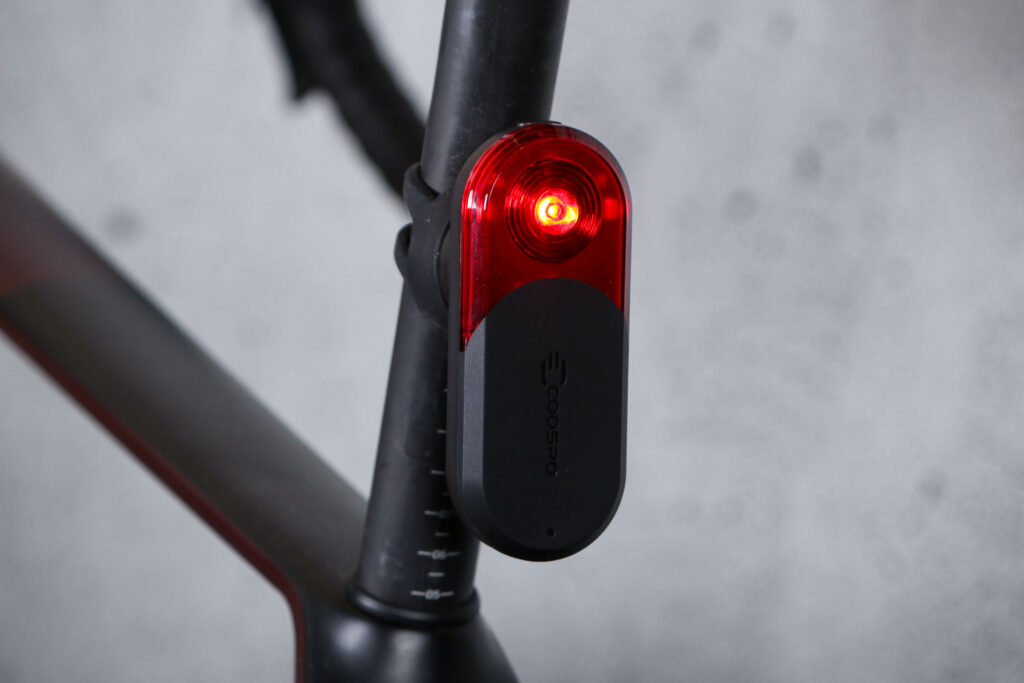


The TR70 can display up to eight vehicles at a time, according to Coospo, and I saw four and five displayed regularly. The only difference that I could see was that the TR70 shows a car for slightly longer on the display screen as it overtakes you.
Often, when testing a new radar, I spend a lot of the ride comparing its behaviour to the Garmin, and wondering why, how and where it’s different. With the TR70, I fitted it and just rode – by which I mean it told me what was happening in broadly the same way as the Garmin. I wasn’t thinking, ‘I can hear a car, why have I not been alerted?’ or ‘Only one car is showing, why are two overtaking me?’ It told me what I heard and observed, and in a similar way to what I’m used to.
Light
The Coospo TR70 has seven light modes. Two of these modes provide solid light, the next four are flashing, and the seventh is a radar only mode where it flashes whenever a car approaches.
Most of the modes are 20 lumen outputs. Notable exceptions are the Low Solid mode, which is 8 lumens, and the Day Flash, which has a 70 lumen output.
Battery life is stated as 14hrs for the High Solid light through to 30hrs for the Day and Night Flash settings, with the Radar Only mode supposedly capable of 40hrs.
As a light, I compared it to my other benchmark, the Exposure TraceR mk2. The Exposure weighs 49g (light and seat post bracket) while the TR70 is 84g for the equivalent setup. The TraceR is noticeably brighter in High Solid mode (3hr run-time) and Flash (6hrs), but when I select the Mid Solid mode with 6hrs run-time it is similarly bright to the TR70, with the TraceR nudging it as its lens creates a bigger ‘footprint of light’. It was getting really close however.
The TR70 Day flash is very visible, but there is darkness between each flash. The Exposure’s Flash mode (12hrs battery life) is therefore superior as the light is always on, with a pulse/flash every half a second or so. However, that difference also means the Coospo has a run-time of 30hrs in this mode.
Where the TR70 really shines over all the competition (that I’ve tried, tested or observed) is with its battery life. It boasts double or triple the battery life of its competitors in equivalent modes.
For example, for a High/Solid 20 lumen mode, the TR70 has a stated life of 14hrs, whereas the Bryton Gardia offers 8hrs, Wahoo claims 10hrs and the Garmins are 6hrs (with the camera off).
In Day Flash mode (up to 70 lumens), the TR70 will last for 30hrs, The Bryton’s equivalent is claimed to be 17hrs and the Garmin is 10hrs or 16hrs depending which model is used (RCT715/RTL515).
You can also set Auto Sleep and Power Saving mode on the App. AutoSleep will be activated after three minutes if no motion is detected, while Power Saving mode will reduce brightness when you drop below 15 per cent charge.
Coospo’s run-time claims seem reasonable. I managed to get 13:25hrs with the High Solid mode rather than the claimed 14hrs. However I exceeded the 22hrs in Breathing mode by a full hour, and still had 8% battery left. For all my testing I had Power Saving deactivated.
A full charge from 0-100 per cent took 2hrs using a 5V 1A computer USB source.
Usability
Pairing was really easy. I used a variety of devices, such as a Wahoo Elemnt Roam, an iPhone (on IOS26), and a Garmin RDU2 (radar display unit) which used either ANT+ or Bluetooth protocols. I had no issues at all, with easy initial pairing and reliable and robust connection when in use.
The app, meanwhile, is excellent. Although I didn’t ride with it on a phone, I used it in my roadside testing. It worked well there, but it is the options available via the settings that were exceptional. Not only could I switch between light modes on the app, I could also order them into a sequence that made sense to me.
I found that three settings suited me and my riding situation best (a solid night mode, the breathing flash for day, and the radar only mode), and this meant that I didn’t have to keep scrolling through unwanted modes. This is an absolutely brilliant idea – well done Coospo.
Plus it’s super easy to change if you need a different mode again. My riding buddy thought that the High Solid mode was too bright when riding on my wheel, so at the next stop I reactivated the Low Solid mode. This helped his eyes, while still being clearly visible from a long way down the road.
Additionally, you can see the exact percentage or battery charge in the app. This can be useful as the unit only gives you a couple of clues. It’s either green for 16-100 per cent charge, or red when you drop below 15 per cent.
The unit is classed as IP67 which means that it can withstand temporary water immersion, up to a depth of one meter, for 30 minutes – a really good standard to achieve. The USB-C port cover kept out any rain or spray.
The unit seems well built and there were no issues during testing. It also has a lanyard hole and a lanyard is supplied for those wishing to tether the unit to their seat rails. I also found that the quarter-turn Garmin-style fixing was solid through testing.
Value
Priced at £100.63, the Coospo TR70 Smart Radar Tail Light is significantly cheaper than nearly all the direct competition, apart from perhaps the Bryton Gardia R300L – although that’s still more expensive at £120.
The Bryton offers perhaps 95 per cent of the performance of the Garmin Varia. It will alert a second later than the Garmin and the light is very good, with fractionally inferior side lighting.
However, the Coospo beats the Bryton on price, while matching the Garmin on radar performance. The Garmin Varia RTL515 (£169.99) is also starting to show its age by still using a Micro-USB socket, and it is starting to trail with regard to battery life. Add in the TR70’s app customisability and its much lower price and it’s pretty much a no-brainer as the unit to get, unless you want a camera (Garmin Varia RCT715) and are prepared to pay for that feature (£299.99).
Even buying the Garmin RVR315 radar-only unit at £129.99, which is 51g plus a bracket, doesn’t seem such good value when you factor in a measly 7hr battery life. The Coospo is £30 cheaper, 13g heavier, has a ‘car approaching’ flash and a 40hr battery life in radar-only mode.
> Best rear bike lights 2026 — increase your day and night visibility with a bright beam at the back
The Coospo TR70 matches many of the performance aspects of the Garmin radar-wise, it has a great app, and it absolutely blows all of the competition out of the water with its battery life.
It’s a really impressive offering that functions well in all areas and is keenly priced. The competitors should be quaking in their boots.
Test Report
What does the manufacturer say about this product?:
The TR70 Smart Radar alerts you to vehicles approaching from behind, keeping you safe and aware on every ride. It is also a rear light with seven modes. It is meant for road riders and commuters who wish to have more information about who is behind them, as well as remaining visible to other road users.
Tell us some more about the technical aspects of this product:
Dimensions: 96*39*23mm
Weight: 64 g
Battery Life: 40 hours
Charging Time: 2 hours
Charging Port: USB-C
Detection Distance: 5-140 meters
Relative Speed Detection: 6-128 KM/H
Line of View & Angle: 1.6 KM & 220 degrees
Connectivity: Bluetooth & ANT+
Battery life is between 14 and 40 hours depending on mode selected
7 light modes:
Low Solid 23hr 8lm
High Solid 14hr 20lm
Breathing 22hr 3-20lm
Day Flash 30hr 70lm
Night Flash 30hr 20lm
Group 26hr 20lm
Radar Only 40hr –
Any further comments on quality?:
It feels well made and has had no durability issues during the test period.
Any further comments on performance?:
This is a good quality rear light. It has enough light modes to suit most purposes. I settled on the Low Solid and Breathing modes, as they suited my needs the best.
How does the price compare to that of similar products in the market, including ones recently tested?:
Priced at £100.63 it is significantly cheaper than nearly all the direct competition with no obvious compromise on performance.
Any further comments on design and usability?:
A single button powers the unit on and off. The same button will toggle through the modes. It paired easily to an iPhone using the app as well as a Wahoo bike computer. Once paired there were no issues and the connections were reliable.
Any further comments on the clamp?:
The clamp was easy to fit onto a seatpost. The quarter-turn Garmin-style attachment was solid and there were no issues with it. There is a lanyard supplied if you want extra security.
Does the light have a waterproofing rating? If so, what is it?:
IP67
Any further comments on waterproofing?:
IP67 rating was dust tight and would cope with a temporary immersion into water. In practice it worked during and after a heavy and cold winter downpour without any problems. No rain had gone under the storm port flap.
Any further comments on battery life and recharging?:
The battery life is exceptional. Only the 14hr High Solid light mode fell short (by 45 mins) in testing. The 22hr Breathing mode was exceeded by an hour and there was still 8% battery life left. For my soak testing I had the Low Power setting switched to Off. The battery charged from 0-100% in 2 hours using a 5V 1A standard computer USB port.
Any further comments on weight?:
84 grams for the light unit and round seatpost clamp option. The D insert and Aero inserts add 7g and 11g respectively.
Did you enjoy using the product? Yes
Would you consider buying the product? Yes
Would you recommend the product to a friend? Yes
Use this box to explain your overall score
The Coospo TR70 either matches or beats the competition in all areas of performance. If you were sceptical about radars, and thought that they were expensive, then the price of this one might make you think again.
About the tester
Age: 25 Height: 173cm Weight: 65kg
I usually ride: Road bike My best bike is: Road bike
I’ve been riding for: Over 20 years I ride: Most days I would class myself as: Semi pro
I regularly do the following types of riding: road racing, general fitness riding, fixed/singlespeed, mtb,

15 thoughts on “Coospo TR70 Smart Radar Tail Light”
Left out two things
The Garmin 820 exists.
There are two versions of this device both named TR 70. If you get the older version it doesn’t work nearly as well to the point of being useless. So how do you know if you got the newest version?
I suppose you don’t know until it arrives. I never have gambled so it’s a no from me.
Care to explain if there are any differences between the 2 versions of TR70 so people can avoid the “older version”? Even if it’s the sku number on the packaging ?
Also as you appear to have experience with both “versions”, do you care to elaborate on the “doesn’t work nearly as well” ?
Thanks
GPLama has reviewed both versions on youtube, the new one on ‘avoid these four radars’. He gave them credit for improvements over the old one but as they have the same model name you wouldn’t know which one you were buying.
Pictures of the back of both models show
OLD
REF 2540 ID 01074
NEW
REF 2605 ID 07030
You just need to update the firmware to the latest version.
Another nonsensical review from Road.cc, comparing a new release with the previous and now discontinued model from Garmin. How can it be that it thus ‘beats the competition’?
The RTL515 hasn’t been discontinued, Garmin is still selling it on their site. I think their new release is supposed to be a level above, hence the 7** and massive price increase. I expect a new 5** will appear within a year or two that is price competitive with all the other radars but without the new 7** features.
8**
Yeah I was going off memory and realised after. Alas this site doesn’t let you edit comments and I figured I got the message across regardless.
Totally valid to compare to the Varia 515 in terms of performance as that has been the gold standard of bike radars for so long.
Not so valid for a purchase comparison if the 515 is no longer for sale (it is still right now), and Garmin is totally out of consideration if it’s only radar light becomes the 820 at ~£300 RRP!
Assuming this is the new version (it looks like the one in the review, but comments above suggest there is an older version), it is £70 including delivery
⭐️TR70 Smart Radar Tail Light
The earlier version becomes the latest version with a simple firmware upgrade
I purchased a Garmin 820 rearvue to replace a five year old 510 and I really, really , don’t like it.
The software is the issue- it uses a two lane display that shows cars moving over to pass when they come close that is clunky in execution and pointless . What are you going to do if the reported vehicle doesn’t move over ? Brace yourself ! ?! The amount of real estate this new two lane display overlays on my data screens renders half of my 840 screen useless. Add in the enlarged vehicle rectangular ‘dots’ that for some reason have even larger representations of the air being pushed off the front of said ‘dot’ and it s just a mess.
I’ve copied the DC Rainmaker way to revert to the older single lane display but seriously what a poorly written ‘upgrade’. I’m seriously considering buying a 515 before they are all gone.
I’m a fresh new owner of this device, and don’t have it long so won’t comment on it’s performance untill i do some more road driving with it.
BUT i see there is mention of 2 versions. That is true, but the older version and the newer version are hardware wise the same and the only difference is the firmware version. old one is 1.0.7 and new one is 1.0.8 at the time i’m writing this. Currently as far as i know there is no update process for the old one, but coospo representative has said on a few yt reviews of this products that the update is in the works, and should be available down the road. So if you have, or get the older one you will be able to update it down the line. Also according to him all the newly bought ones arrive with the updated firmware, and i can confirm mine did!
Just picked a Coopso TR70 radar unit up for £69. The app indicates that the firmware is v1.09. First impressions are good. It seems one needs to turn the garmin light network off on the Edge 830 unit, so that the light is controlled simply by button presses on the unit itself – which is fine.