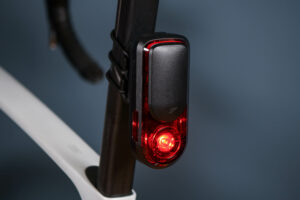
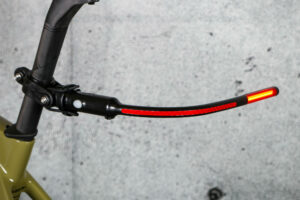
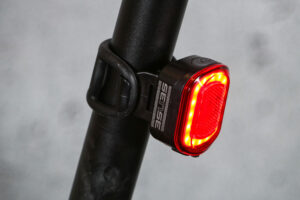
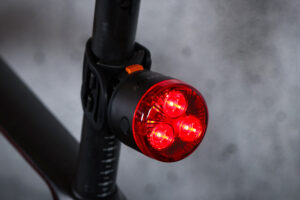
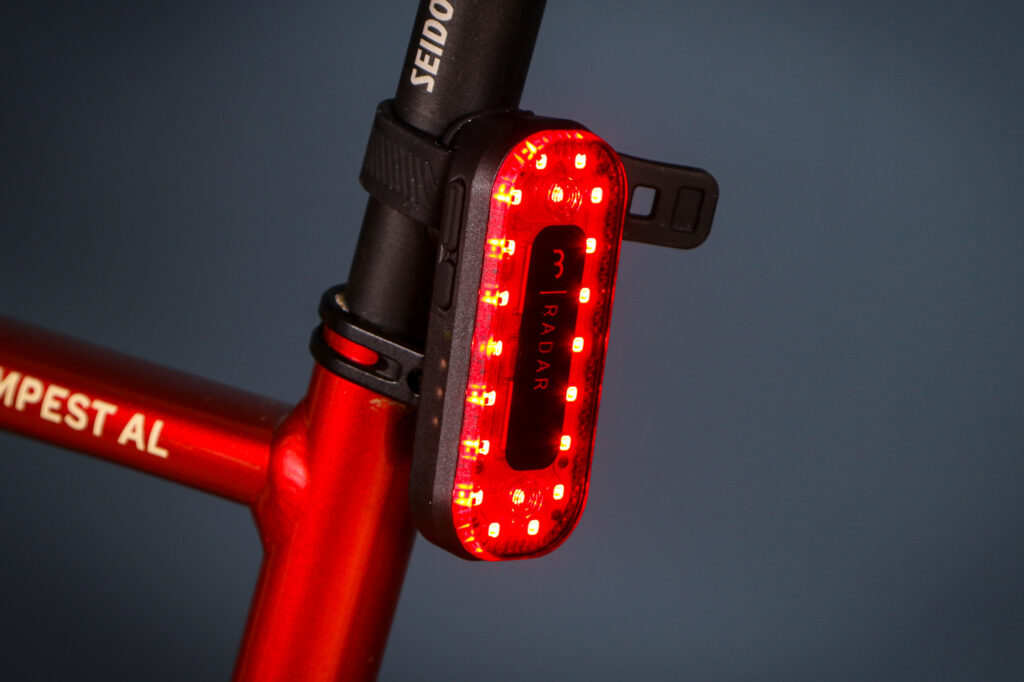
The BBB Signal Radar Rear Light boasts a maximum of 80 lumens, radar technology to detect approaching vehicles and a high degree of tunability – either via computer or the smartphone app. It can also function without a bike computer thanks to its integrated speaker and the price is favourable. The radar is generally accurate and on a par with some competitors I’ve tried, but a little more sensitive in certain contexts.
The Signal Radar Rear Light tips the scales at a moderate 88g and is 99mm long. The body and lens are made from polycarbonate.
I was initially surprised to discover – according to the box – that the Signal only meets IPX4 for weatherproofing, although BBB’s site says IPX6. This sounds low by contemporary standards, although the charge port and similar elements seem relatively well sealed.

In practice, I’ve not had any issues in heavy rain, or with mucky slurry thrown up along farm tracks and country lanes. I’ve tended to remove it while giving bikes a wash. However, I’ve forgotten on a couple of occasions and have had no issues with water ingress.
Behind the polycarbonate lens live a broad cluster of LEDs fuelled by a 3.7V lithium polymer rechargeable battery, said to be good for 500 charge cycles before output dips to between 80 and 90 per cent of its original capacity.
There’s also a smaller, fifth light above that glows green when the speaker is engaged, taking guesswork and potential faff out of the equation. I was pleased to note that you can run the Signal light untethered to other devices. Engage the speaker and it will communicate at 85 decibels.
The unit will detect up to eight passing vehicles. Upon initial detection, it will sound and flash once. It then tries to gauge when approaching vehicles are 10 seconds from overtaking, at which point it flashes and beeps again. At six seconds’ distance, it flashes and beeps continuously until the overtaking party has passed.
BBB says it will detect at a 35 degree angle up to eight vehicles – including other riders and motorcycles – from a distance of 190m. Speed of approach is communicated by audible beeps. The faster the vehicle, the louder the beep.
The light can also respond by emitting a rider-selected beam pattern. For example, a more intense flashing to theoretically enhance visibility at closer range, say from a steady mode to flashing.
This isn’t particularly new, and I’ve played with cruder forms of this technology to good effect on less complex lights around the £60 mark, although on those occasions the sensor technology proved a little inconsistent.
Modes and run-times
There are six modes in total, which offers variety without overburdening you. These range from an 80-lumen Dayflash, to a group ride friendly 5-lumen Peloton. There’s a High steady option producing 20 lumens, a Steady Flash hybrid, producing 2 and 25 lumens, a 5-lumen Flash and finally Radar Only mode, meaning it’s off but will kick in when a vehicle approaches, theoretically making the very best of a full charge and claimed to run in this way for weeks or months.
I take a more approximate, some might say forgiving, attitude to run-times, given factors such as riding environment can play a big part. For example, town centres around rush hour, or A-road time trialling are likely to trigger more frequent alerts, whether that be audible beeps, braking functions, or a higher lighting mode. BBB cites run-times as 9hrs for the 5-lumen Peloton, 5.5hrs for High, 11hrs for Flash, 14hrs for Dayflash, and 11hrs for the Steady Flash combo.
I achieved times very close to most of these, while Radar only still seems to be going strong after being the default for a fortnight.

I’m pleased to report BBB has also incorporated a ‘run-time safety mode’ – basically an auto kickdown, which seems to strike when the battery’s down to 20 per cent and which will provide approximately four hours’ light, regardless of the mode originally selected – although it will also cancel the radar function. I’m pleased to report the BBB Signal Radar has yet to plunge me into darkness, although the 5-lumen safety mode is lower than I’d like, especially along pitch black lanes.
Some have cited the charge port’s location (behind the strap) as being problematic for bike packing. For me, it’s a moot point and arguably good engineering, since when I’m charging from a dynamo USB port, the light’s holidaying in a handlebar bag, and because the strap is pressed flush against the port, ingress is unlikely.
BBB quotes the charge time as 2:30hrs, which seems accurate when refuelling from a PC or laptop. I charged from zero in 2:15hrs from the mains. In common with other sensored tech generally, and lights with braking functions in particular, run times are a little variable.
Interestingly, ours was supplied without the USB-C charge cable. On the one hand, it could be argued this is irksome penny pinching. Others might suggest it’s saving waste and that most folk already have a USB-C charge cable of some sort – tablets and phones being obvious devices. I fall into the latter camp but can see both sides.
Connectivity and app
The Signal is fully compatible with ANT+ as both a light and radar. ANT is an acronym for Advanced and adaptive Network Technology, which allows different devices to communicate between each other and has long been a feature within cycling and other sports. Ours was picked up and tethered very quickly to a Coospo CS600 Smart Cycling Computer.
The app is Cannondale branded, and while that might seem a little confusing, BBB and Cannondale share the same parent company. It is available from the Google Play and Apple stores.
The app allows you to receive alerts straight to your smartphone, change light mode, tweak the speaker and monitor battery status. I found it fairly intuitive to change and adapt settings. Bluetooth connectivity was fairly seamless.
Mount
BBB has gone for the watch strap type mount, but with two designs: one for round posts, the other for aero. I’ve had no issues with post diameters between 25.4mm (older USE) and 31.8mm and the aero version has also permitted rack or seat stay mounting, which pleased me. It’s great if you’re running a big saddlebag – something like the Carradice SQR.
BBB says it is designed to be positioned vertically; that positioning it horizontally will impair the radar function. Having tested this, I can confirm it is so.
Radar performance
The radar proved generally reliable, although during early outings, it appeared to be triggered by anything remotely metal – wire fences, the sort found around tennis courts, stationary cars and a speed camera. Interestingly, this seemed to become less common with use.
In terms of detection distance, 150m is the closest I’ve come to the 190m asserted, corroborated by a trucker following me along the lanes just before dawn. He also noted the light pattern’s increased intensity as he drew closer.
In common with some others I’ve had the opportunity to play with recently, it seems most consistent, dare I say most effective, along country lanes and A-roads, where it would alert me to approaching vehicles – cars, motorcycles, HGV and farm traffic – very reliably. Along the A-roads, it would reliably track the approach of six vehicles and at varying speeds. I also found this additional alert particularly helpful when negotiating bigger roundabouts.
Aside from group rides and time trialling, radar also has definite benefits when tugging a trailer, or tagalong. While the lighting modes will make a trailer conspicuous, I suspected that mounting the light to my low-slung Bob Yak homage would impair communication between radar and computer/phone. This did seem to be the case, so bike mount wherever possible.
Considerations
Radar and other tech is a safety boost, not a substitute for good observation. Radar will alert you to potential hazards but doesn’t always discriminate between moving and stationary. In built-up areas, rows of parked cars and larger vehicles could trigger it frequently to the point of being overly distracting. On a couple of occasions, I found myself switching it off. That said; these instances were exceptions, not the rule.
When it is on song, it would pick up cars and to a lesser extent motorcycles and, ahem, approaching riders at a reliable distance. In common with another unit I’ve been fortunate enough to play with, fog can also impair the radar’s performance. On a very murky morning, detection dropped to 40-50m. While this falls shy of the 190m claimed, it still gives ample warning. Similarly, when it comes to a stream of overtaking traffic, ours typically picked out five or six vehicles, out of the possible eight.
Discussing these ‘false positives’ with BBB, the company advised me the radar is programmed to be as accurate as possible and claimed that in comparable testing, it hasn’t registered more false positives than Garmin’s Varia RLT515.
Output
On paper, the lumens suggest a moderately powerful light, but I’m pleased to report the lower, 5-lumen settings seem brighter than the number would suggest. Given I default to long, steady miles along unlit roads, I found the Steady Flash hybrid (2 and 25 lumens) the best pairing, giving a distinctive pattern and better peripheral throw than I anticipated. A couple of approaching riders reckoned they could pick it out at around 180m on a cloudy night. Another suggested 220m with clear skies.
Predictably, the 5-lumen Peloton is what’s called for in group riding, unless you are at the back, while the 80-lumen Day Flash is a lot more noticeable than I’d expected thanks in part to the tempo – although it had less presence than some in strong, wintry sun.
Value
£116 is very enticing by radar technology standards. The iG Sport SR30 Smart Radar Taillight comes in at £119. Paul was generally impressed with the six modes, the run-times and the mounting bracket, but found the radar function too inconsistent.
The Coospo TR70 Smart Radar Taillight is cheaper still at £90. It boasts a 220-degree lens, IP67 for weatherproofing and seven modes with the same Bluetooth connectivity. Maximum output is 70 lumens against the Signal’s 80 and the radar can also get a little confused in heavily congested traffic. However, it has a sensible spread of modes and I’ve found the radar has a slight edge over the BBB Signal out of town. I’m not sure whether the Coospo’s 40-degree radar arc has any bearing upon this.
The Garmin Varia is £50 odd dearer, but reports and more casual feedback suggests the radar is very accurate.
> Best rear bike lights 2026 — increase your day and night visibility with a bright beam at the back
Conclusion
Ultimately, the BBB Signal Radar Rear Light has some definite plus points and it’s competitively priced. The radar detection can be a little over-sensitive in some contexts – more so than others I’ve tried – and it seems to top out at 150m, but these are more considerations than major negatives. Lighting modes and battery life are very practical for most contexts, and the ability to run the radar without being connected to a computer or phone is another very welcome feature.
Test Report
What does the manufacturer say about this product?:
BBB says: “The BLS-251 Signal Radar rear light offers ultimate protection with advanced radar capabilities, detecting objects up to 190 metres away within a 35-degree angle. Easily connect to your bike computer or smartphone via ANT+ and Bluetooth for real-time alerts. Its built-in speaker allows standalone operation without additional devices. With a powerful 80 Lumen daylight flash and car warning light, it provides visibility in six modes and boasts up to 14 hours of runtime, ensuring safety on every ride.”
Tell us some more about the technical aspects of this product:
Length (mm): 99
Volume (ml): 87
Width (mm): 42
Waterproof level: IPX6
Sizes: Universal (90g)
USB type: USB-C
USB regarchable: Yes
Max. lumen in steady mode (lm): 80
Modes: High, Peloton, Flash, Dayflash, Steady Flash, Radar only
Light source: LED
Max. burn time (hours): 14
Battery voltage (V): 3.7
Battery indicator: Yes
Battery type: Lithium Polymer
Any further comments on quality?:
Feels reassuringly solid throughout and pleasant to use.
Any further comments on performance?:
Consistently good throughout. After a slightly quirky experience during our formative outings, the radar seemed to ‘settle’ and was generally reliable in terms of identifying approaching traffic, and from a good distance. Not quite the 190 metres quoted – 150 tops in my experience – but still impressive.
How does the price compare to that of similar products in the market, including ones recently tested?:
£116 is very enticing relative to similar products.
Any further comments on design and usability?:
Very simple, since you don’t need to pair it with a bar-mounted computer or phone – simply engage the speaker, and it will communicate approaching traffic very clearly. The app is straightforward, and ours has played very nicely with a Coospo CS600 head unit.
Any further comments on the clamp?:
Very secure tenure to seatposts and indeed seat stays and even racks when employing the aero pattern mount.
Does the light have a waterproofing rating? If so, what is it?:
IPX4 according to the packaging, IPX6 according to BBB’s website.
Any further comments on waterproofing?:
No issues in very wet contexts, thanks in part to the well-fitting port cover. Better than I had initially expected from a unit compliant with IPX4 (BBB cites IPX6 on the site, but our box said IPX4).
Any further comments on battery life and recharging?:
Run and charge times have been accurate across the board and generally real-world practical for most contexts, albeit slightly shorter than some on paper.
Any issues with durability?:
Nothing to date, which came as a pleasant surprise, given the IPX4 rating for weather resistance (on our packet, although on BBB’s site, it says IPX6), and ours has definitely been exposed to wet, gritty stuff.
Any further comments on weight?:
Light and mount feel reassuringly solid and well-made.
Did you enjoy using the product? Yes
Would you consider buying the product?
Yes, definitely worth considering.
Would you recommend the product to a friend? Yes
Use this box to explain your overall score
Solid light with a good choice of modes and generally reliable radar. An integral speaker is another definite plus, meaning it can be used without a head unit. Run-times are shorter than some, and the farthest ours has registered approaching traffic is 150 metres. However, these are considerations, not deal-breakers.
About the tester
Age: 52Height: 181cmWeight: 70kg
I usually ride: Assorted- fixed gear winter/trainer, drop bar rough stuff mtb tourer, gravel bikeMy best bike is: 1950s Holdsworth Road Path build
I’ve been riding for: Over 20 yearsI ride: Most daysI would class myself as: Experienced
I regularly do the following types of riding: Cyclocross, Gravel riding, Commuting, Touring, Fitness riding, Mountain bike XC