



There was barely a dry eye in the crowd at the finish of last year’s closing European round of the Whoop UCI World XCO Series in Lenzerheide. Those tears of mixed emotions were all for the greatest cross-country mountain biker of all time, Nino Schurter, who said goodbye to cross-country racing – or at least, competing in it.
There couldn’t have been a more fitting venue for Nino to call time on what stands as one of the longest and most glorious of mountain biking careers. Equally as fitting was that the man ringing the final lap bell to signal the end of his race and reign was none other than Thomas Frischknecht, a man who has played a huge and career-long leading role to Nino.
The fellow Swiss rider also stands tall as one of the greatest and longest-standing mountain bike racers. Having taken a silver medal in the first-ever UCI-sanctioned World Championships way back in 1990, he then went on to win three world titles and three World Cups outright – amongst other things.
In the early 2000s, a young Nino Schurter caught the attention of Frischi, who was then at the peak of his MTB marathon racing career. In 2003, he signed the youngster to his own Swisspower team.
The rest, as they all too often say, was pure fat-tyred history in the making.
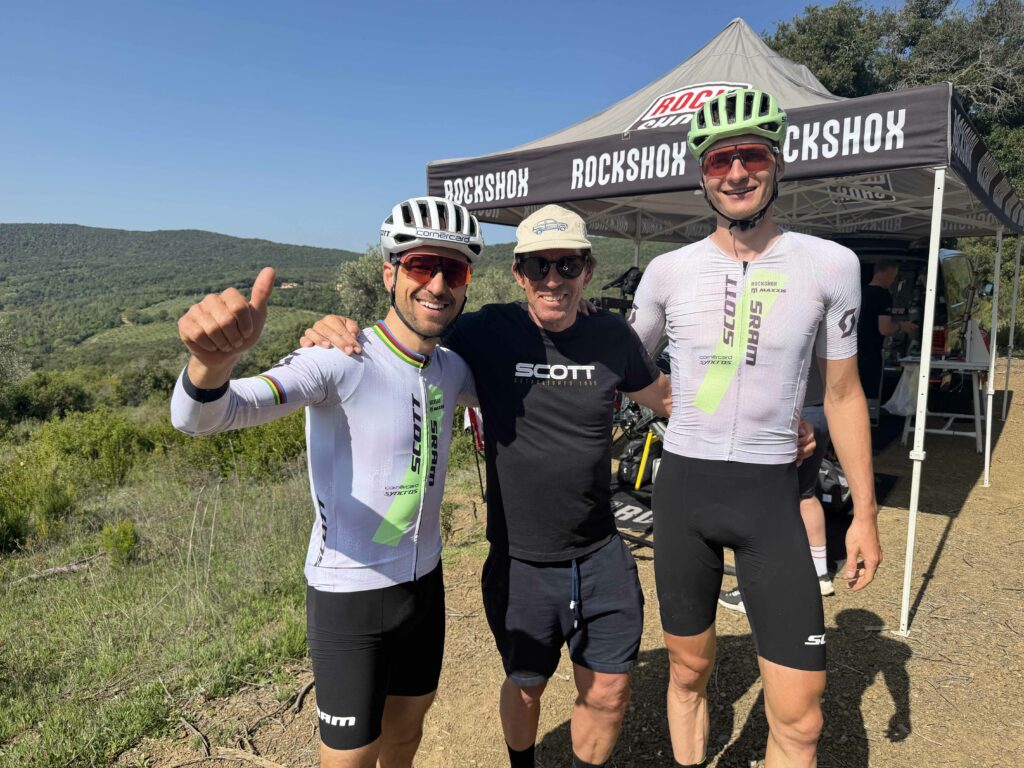
Nino raced his entire career for the same team, which is now known as SCOTT-SRAM, and has been led from the outset by Frischi himself. The team is known as one of the closest-knit and most successful of all time.
Under the close guidance of his mentor, Nino progressed to become the grand master of the sport. Not only did he come away with his record 10 elite world titles, 36 World Cup wins, nine overall series titles, an Olympic title, and three Cape Epic victories, but he was also one of the most flamboyant, stylish, admired, and approachable racers on the circuit.
As the SCOTT-SRAM team prepares to race into the 2026 World Series without Nino, we asked Frischi himself if there could ever be another Nino, and a fair bit more, too. This is what he had to say…
ORCC: How different will it be for you and the team going into the season without Nino racing?
Thomas Frischknecht: Yes indeed, not having Nino around anymore is a change after 23 years; the team was pretty much built around him. He’s still part of the SCOTT-SRAM team and is part of the team camp we have right now here in Tuscany, but most of the time, he’s not around.
With the young team we have, we have some fresh blood coming in, and it’s an interesting and great time we’re having with the new riders. So, no regrets – the world is still turning without Nino.
ORCC: Will there ever be, could there ever be, another Nino Schurter given the evolution of the sport?
TF: I doubt there will ever be a new Nino Schurter coming up. He was so dominant for such a long time. For sure, there will be the next talent coming up who is as good as Nino, but I doubt that new talent or new athlete will last as long as Nino did.
I think this is the most outstanding accomplishment of Nino, it’s not just the way he won the races, and what he did win, but also for how long he won World Championship titles and World Cups, over a very long time span.
With the very fast living sport that we have now, I doubt that there will ever be someone who’s winning as many World Cup races and World Championship titles.
ORCC: It seems like more and more mountain bikers are being lured to road racing at an early stage, and some of the major road teams even sign up young talent for many years, even before they leave the junior ranks. This was very different during your own era, and even through much of Nino’s career; is this very noticeable?
TF: Yes, road racing is taking away a lot of the young talent. You see it with Tom Pidcock, he was originally a mountain biker (and cyclo cross racer), you see it with (Adrien) Boichis, who was a World Champion mountain biker who is now switching to the road, and even the older riders like Alan Hatherly.
There’s just a big difference in earnings. You can be one of the best mountain bikers in the world and still make less money than an average road pro who’s on a World Tour team. Unfortunately, that money is calling, and some have moved to the road, probably because of that.
It’s not the road scouts who are watching mountain biking closely, but when they see a new talent popping up, they start to chase those young mountain bike talents. It’s a fact that we are losing great talents to road racing.
ORCC: Of the riders around now, and those breaking through, who do you see as the most likely and capable of reaching Nino’s past level?
TF: I think there that there are quite a few athletes out there who can, for a certain period of time, absolutely be at the level Nino was when he was at his best; someone like Alan Hatherly, Victor Koretzky, Christoper Blevins, and others.
But it’s hard; you won’t see an athlete dominating from the spring until the fall, like Nino usually did in the good years. He was dominant throughout the whole season in those years, whereas now you see a lot of different winners in the World Cup. There are always strong guys in the spring, and someone strong in the mid-season, and then you’ll see some new faces again towards the end of the season.
There’s a mix of more riders sharing the glory in mountain bike racing at the moment, which is also a good thing, and a very positive thing, not a monologue, as it was in Nino Schurter’s time.
ORCC: As Nino said goodbye, late last season, you signed Fabio Punterner to the team, who was on the tail end of what was a remarkable breakout year. Can he potentially win a World Cup this year?
TF: Absolutely!
Steve’s likely lads for the post-Nino era
Riders evolve and develop at very different stages of life, although, with the advancements in technology, nutrition and training – not to mention the ever-growing support networks and frameworks out there (the latter being more so in road racing), they are seemingly coming to the fore at an overall younger age now.
As Frischi mentions, many are picked up at a young age and signed for multiple years to pro road teams – such as the Danish ‘wonder kid’ Albert Phillipsen, who dominated road and MTB as a junior. This now somewhat makes it harder to look to the junior and U23 ranks for a spot of crystal ball gazing, as those promising mountain bike riders may well find themselves taking a turn to skinny tyre side more than those of a decade ago.
That said, I wouldn’t be at all surprised to see a few part-time side turns from those young prodigal sons in the next two to three years, as the 2028 Olympics near.
For the moment, flipping the obvious established top dogs, I‘d like to think that Britain’s Charlie Aldridge will make the leap to an XCO round top spot this season. Also of great note is the latest Swiss sensation, Fabio Puntener, who has been climbing the rungs gradually over the last few years. He made a huge and consistent mark on the 2025 World Series last year, and ended the season as the world’s number one UCI-ranked racer; I’d expect a solid and consistent season from him.
Cube’s U23 World Champ Finn Treudler of Switzerland should also make huge progress in the next year or two. Also looking extremely promising are French rider Mathis Azzaro and Italian racer Simone Avendetto, both of whom made their mark in the 2025 series and will likely be even more prominent this year.
It’s also worth looking out for Durango’s Trek racer Riley Amos, who finished a great seventh in the 2024 Paris Olympics. Could this be the year he finally cracks the Elite World Series, too?
With the series starting out on a new footing in Asia over the Bank Holiday weekend, we could well see something of a changing of the old guard kick in.




















8 thoughts on ““It’s a fact that we are losing great talents to road racing”: Thomas Frischknecht on XC’s future without the great Nino Schurter”
If the world of pro XC MTB racing had been run far better, and more professionally, the sport would be more known, and bring in more sponsors/ money. We don’t see very many non bike industry sponsors….look at the title sponsors, Whoop, Monster, etc all connected to cycling……
9 World Cups with 2 races per weekend, so 18 opportunities a season for exposure. And a long off season with nothing happening…….
Is it any wonder sponsors want WT road racing? And young talents go road racing……
Thomas Frischknecht is the GOAT of XC from the time before suspension was even invented – Nino is just a young pup.
Nine World Cups and thirty-eight career race wins and nine World Championships versus three World Cups and seventeen career race wins with three World Championships would appear to show otherwise.
Oh, and here’s TF winning his first world championship in 1996 on a suspension mountain bike; he turned pro in 1990, the year the RockShox RS-1 fork made its first appearance in the world championships.
.
That’s a rather small picture – I can’t quite make it out.
I’ll try again but not sanguine, the site doesn’t seem to like pictures today…
Such a long article and not a single woman’s name in it. What’s going on!?
Why would you expect an interview with someone who runs a men’s team with much of it focused on the retirement of one of his riders to contain any references to women? If the article was an interview with a women’s team manager talking about one of her riders retiring would you complain that it didn’t reference any men?