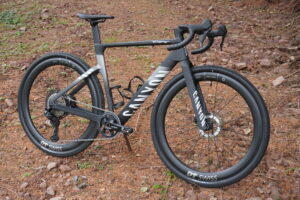
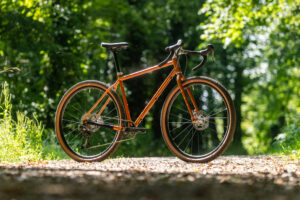
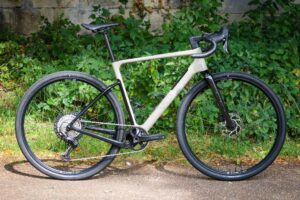
The Lauf Seigla is a modern-day gravel racer that achieves huge tyre clearances without sacrificing its geometry or performance. The leaf-sprung fork is a tidy, albeit odd-looking solution to gravel bike suspension and completes a bike that’s comfortable, controlled and fun to ride. The decent spec list (although tested with wheels borrowed from a higher model) makes it a hard bike to beat both in terms of value for money and when putting the hammer down on dirt tracks.
- The best gravel and adventure bikes you can buy for under £2,000
- 2021 Canyon Grizl CF SL8 review
- Buyer’s guide to gravel & adventure bikes – everything you need to know before you buy
The Lauf Seigla will begin to phase out the Truegrit as the brand’s race-ready gravel bike and as mentioned in my first ride article on the Seigla, the geometry remains almost identical. That’s no bad thing seeing as it was a bike that scored 4.5 stars overall when we reviewed it back in 2018.
The bike I’ve been riding around on is actually a pre-release spec so slightly different from the options available to purchase on the Lauf website. In essence, it’s a “Weekend Warrior Wireless” but with the carbon seat post and e*thirteen XCXR carbon wheels borrowed from the “Race Wireless”. All of the frames get the same carbon lay-up, Lauf’s own Smoothie carbon bars and a choice of either a rigid or 3rd generation Grit suspension fork.
That fork is sure to divide opinion but whether you like the aesthetics or not, it really does function well. Having now used the bike in the UK for the past 6 weeks on a range of terrain I’ve struggled to find places where the 30mm or so of travel detracts from the overall riding experience.
The 12 glass fibre springs are really quite stiff so you don’t feel it bobbing up and down on tarmac climbs like with traditional telescopic forks and as you pick up speed the undamped suspension deals with high frequency vibrations of gravel very well, this helps to reduce hand and wrist fatigue. When it comes to really rocky descents where perhaps a mountain bike would be better suited, then the fork does have its limitations but is still much better than full rigid, there’s no rebound adjustment for example so repeated big hits can confuse the fork somewhat.
The stiffness of the springs is tuned to each frame size though (with X-Small and small frames have forks that are 15% softer, than medium and large frames, with the X-Large getting 15% stiffer fork). So, in general, the stiffness feels about right, I weigh about 72kg and ride a size medium for reference.

If you really do find the suspension fork a turn-off then Lauf also offers the Seigla fully rigid; as a rider who likes my gravel bikes to feel as direct and race orientated as possible I thought that perhaps I would be one of those people but having used the Grit fork, I’m a convert. It delivers nearly all of the advantages of suspension without the accompanying drawbacks, for example, it adds just 430g to the total bike weight which is very competitive as a Specialized FutureShock system weighs a similar amount but is certainly not maintenance free like Lauf’s solution. The Rockshox Rudy XPLR is another way of adding 30mm of travel to your gravel bike and although it performs exceptionally well, it’s heavier, offers less tyre clearance, and once again will require servicing.
So, the fork’s a winner, what about the rest of the bike? Well, the ‘if it ain’t broke so don’t fix it’ mentality regarding the geometry seems to have really paid off and is no mean feat considering the hefty increase in tyre clearances. Just like the Truegrit, the bike features a long top tube which can then be paired with a shorter stem for snappy steering and the chainstays are impressively short at 425mm further adding to the agile feel. To put this into context, 425mm is what you’d typically find on a cyclocross bike.
The head tube and seat tube angles of 70.5 and 72.5 degrees respectively in a size medium are quite slack but not uncommon for a modern race orientated gravel bike and balance stability and responsiveness well.
The wheelbase is longer than some other gravel bikes we’ve tested, for example, at 1040mm it’s 28mm longer than a 3T Exploro in a comparable size. This makes the bike track straight and stable on descents and because most of this length has been found in the front centre it’s very confidence inspiring on steep techy descents where you don’t feel like the front wheel is going to disappear underneath you on sharp corners.
The bottom bracket is higher than on the Specialized Diverge that I usually ride and the extra ground clearance was welcome without being so high that you feel unstable. I also didn’t get any toe-overlap, where your foot crashes into the front tyre whilst turning tight corners, a real bugbear of mine on gravel and cx bikes.
One of the most visual changes, when compared to the old Truegrit, is the now dropped seat stays. Lauf says that this is to aid vertical compliance at the rear and the Seigla is indeed a very comfortable place to be. The idea is that when the rear wheel hits a bump, the chainstays will flex, and the seat stays will push against the seat tube that has been kept as long as possible for maximum deformation.
You’ll also notice that the top tube is vertically slim and Lauf has opted for a standard 27.2mm seat tube clamp instead of an integrated one, claiming it would have negatively impacted comfort. All of this results in about 10mm of displacement at the saddle, it doesn’t sound like a lot but is a similar number to what you’ll find on the latest generation Trek Checkpoint with Isospeed and soaks up imperfections and allows more consistent power delivery.

As with any gravel bike, the biggest difference in comfort comes down to the tyres. The Seigla has room for 57mm rubber on 700c wheels which equates to 2.25 inches; that’s some of the largest clearances we’ve seen on a gravel bike and removes the need for a separate 650b wheelset.
Lauf has achieved such huge clearances by doing a few things: Firstly, there’s the use of a wider threaded BSA73 bottom bracket as appose to the road standard of BSA68, to achieve the appropriate q-factor this requires the use of a long spindle version of Sram’s road cranks. Secondly, the Seigla is 1x only, Lauf says that removing the space required for an inner chainring gains them a valuable few millimeters which are usually wasted as the vast majority of their customers never use a double setup.

The third quirk is that the drive side chainstay is a solid plate of carbon, this does mean that mechanical gears can only be routed as far as the BB, but as more and more bikes use electronic shifting I’m sure we will see more and more bikes have solutions similar to this.
If you do wish to run a mechanical or wired Di2 groupset then the rubber chainstay protector doubles as outer routing, I wouldn’t say this is ideal but it is a solution nonetheless. At the time of writing the Seigla only ships with Sram’s Rival, Force, or Red AXS XPLR groupsets depending on spec level, these are of course all wireless so there’s no messy routing to worry about there. Mine came with a Rival groupset and despite being at the bottom of Sram’s electronic range it performed very well and includes a crank-based power meter as standard.

I won’t go into too much detail about the groupset but it’s a strong choice for a gravel bike. It’s not the lightest option but sacrifices very little in terms of performance compared to the more expensive electronic offerings.
The XPLR bit in the groupset’s name means that you get a 1x specific rear mech capable of taking up to a 10-44T cassette and the Seigla ships with just that and either a 40T or 42T chainring up front depending on the model. In both guises, the Seigla gets a gear ratio under 1:1 to help get up the steeper stuff. Similar to many people, my gravel rides often involve a fair portion of paved riding as well and the 12-speed groupset means you can happily shift along at up to 55kph before wishing you had another gear. The gaps between the gears aren’t too bad, but if you’re happy to forgo some range then the 10-36T cassette will be a better choice for flat riding.
Other noteworthy components include Lauf’s own Smoothie bar which features the same glass fibre technology as the springs used in the front fork. You can read all about it here but going by our tester’s report on the Smoothie, it does an excellent job of reducing road buzz. It has a slight sweep backwards, a fair amount of flare and it costs far bit more than most bars you’ll find on a bike of this price. My size medium shipped with bars measuring 42cm across the tops which seems like a sensible choice for the bike’s intended purpose.

Moving on to the wheels and as mentioned earlier the bike that I’ve been mile munching on came equipped with e*thirteen’s carbon XCXR wheelset, ordinarily, the “Weekend Warrior Wireless” spec would get the cheaper aluminium e*thirteen XCX wheelset which weighs in at 1820g and would be one of the first areas I’d upgrade in the name of performance. Either set of wheels comes tubeless-ready and fitted with an XDR freehub.
During testing, I’ve ridden on both 45mm and 50mm Maxxis Rambler tyres but I was a little disappointed to see that the Seigla ships with 40mm width rubber. Apparently, there are plans to remedy this by switching it up to 45mm, and in my opinion that can’t come soon enough. The Maxxis Ramblers themselves is a strong choice for dry to moist riding and they roll well on hard surfaces, offer good puncture protection for their weight and generally outperform most stock tyres.

As far as storage is concerned, the frame gets a trio of bottle cage mounts, two in the main triangle, one on the underside of the downtube, and a bento box mount on the top tube. The lack of mounts on the fork is suspicious in their absence but Lauf says that if heavy bike packing is your thing, then the Lauf Anywhere would be the better buy.
Another thing that might be a deal-breaker is the total lack of rack or mudguard mounts; Lauf has stuck to its guns and made a gravel racer rather than an off-road tourer or commuter and whilst this does help to keep the weight down it does have a negative impact on the bike’s versatility which up until this point, the Seigla really is a do anything bike.

Speaking of weight, Lauf has published a figure of 1163g for the frameset including paint and hardware such as axles and bottle cage screws which is competitive albeit not the very lightest out there. One reason for this is that they’ve opted to forgo high modulus fibres, high modulus fibres are stiffer which means that you can use less of them and still get a bike through the necessary safety tests. However, the shorter fibres are also more brittle so they aren’t without their negatives. As someone who’s smashed up my fair share of both carbon road and gravel bikes, I’m personally more than happy to sacrifice a few grams in favour of rock strike protection and crash impact strength. It’s also reassuring to see that the Seigla has not only passed the necessary safety tests but has gone one step further by passing the mountain bike ones as well.
As you’d expect, my fully built-up pre-launch spec bike weighs more than a suspension Race wireless (8.4kg) and less than a suspension Weekend Warrior Wireless (9.11kg). Even so, it climbs admirably thanks to not just the low weight but also the sizeable bottom bracket providing a stiff base for putting the power through and the fat tyres and compliance making sure that none gets wasted.
If you’re after maximum performance then there’s the aptly named “Ultimate” spec which weighs in at just 8.25kg. Compared to the competition all of those weights are really really competitive, for example, the equivalent Sram Force AXS, suspension Canyon Grizl is just over a kilogram heavier despite being £599 more expensive. The cheaper non-suspension Rival AXS Grizl doesn’t fare much better than its counterpart either, coming in at 0.44kg heavier than the rigid Lauf with the same groupset and once again is more expensive, this time £259 splits the two.

The prices for each spec level can be found on the Lauf website, ranging from £2890 for the cheapest build, up to £5650 for the most expensive. That’s no loose change but compared to the competition it fairs very well. A carbon Specialized Diverge for example, which by the way I think rides great, starts at £4500 and you’ll need to pay £6100 before you start thinking about electronic groupsets or carbon wheels, even then it’s heavier, has less clearance, and has a suspension system that requires maintenance every 500 hours. A BMC URS is in a very similar position to the Specialized and if you’re after a gravel bike and have racing in mind then you might also be looking at the Cervelo Aspero, the RRP for the Rival AXS version of that is £5499 so once again a huge amount more.
In my opinion, one of the only drawbacks of the Lauf is the fairly limiting 4 colours to choose from. Each is inspired by Lauf’s home country of Iceland, there’s this Moss Campion pink, which is a flower that grows in the highlands, a black that we assume represents the lava rock, a glacial white, and Silfra Blue, Silfra being Iceland’s most popular diving spot. It is worth noting that the rigid bikes are only available in white or black and everything other than black costs a premium; £190 for Whte and £390 for the pink and blue options. That is a little bit cheeky but the conclusion is still the same; that this is a very good value bike but even better value in black…
Overall the Seigla is fast, comfortable, innovative in its approach to increasing tyre clearances, and very good value. There really is a lot to like here, it’s been impressively capable both on rides here in the UK and in Iceland, fast or technical and Lauf has done a great job of speccing quality components whilst keeping the price cheaper than the competition.
You might also like:
- The best money-no-object gravel and adventure bikes we’ve tested
- The ultimate guide to frame materials: what’s best for bikes?
About the bike
Tell us what the bike is for, and who it’s aimed at. What do the manufacturers say about it? How does that compare to your own :
Frame & Fork
How much suspension travel does the fork have?:
Was the bike comfortable to ride? Tell us how you felt about the ride quality.:
How was the bike in terms of sizing and angles? How did it compare to other bikes of the same stated size and intent?:
Overall rating for frame
How much suspension travel does the rear end have?:
Did the bike feel stiff in the right places? Did any part of the bike feel too stiff or too flexible?:
Tell us about the build quality and finish of the frame:
Tell us about the geometry of the frame:
Tell us about the materials used in the frame:
Riding
How did the bike transfer power? Did it feel efficient?:
How would you describe the steering? Was it lively, neutral or unresponsive?:
Tell us some more about the handling. How did the bike feel overall? Did it do particular things well or badly?:
Rate the bike for sprinting:
Rate the bike for high speed descending
Rate the bike for technical descending:
Rate the bike for flat cornering:
Rate the bike for technical climbing:
Rate the bike for climbing efficiency:
Rate the bike for agility:
Suspension
Rate the fork for performance:
Rate the fork for durability:
Any comments on fork durability?:
Rate the fork for efficiency:
Any comments on fork efficiency?:
Rate the fork for value:
Tell us some more about the fork. Anything you particularly did or didn’t like? Any features which didn’t work well together?:
Rate the balance and performance of the suspension overall:
Drivetrain
Rate the drivetrain for performance:
Rate the drivetrain for durability:
Rate the drivetrain for weight:
Tell us some more about the drivetrain. Anything you particularly did or didn’t like? Any components which didn’t work well to:
Rate the drivetrain for value:
Any comments on drivetrain value?:
Wheels & tyres
Rate the wheels for performance:
Rate the wheels for durability:
Rate the wheels for weight:
Rate the wheels for comfort:
Rate the wheels for value:
Tell us some more about the wheels.Did they work well in the conditions you encountered? Would you change the wheels? If so, wha:
Rate the tyres for performance:
Rate the tyres for durability:
Rate the tyres for weight:
Rate the tyres for value:
Tell us some more about the tyres. Did they work well in the conditions you encountered? Would you change the tyres? If so, what:
Controls
Rate the controls for performance:
Rate the controls for durability:
Rate the controls for weight:
Rate the controls for comfort:
Rate the controls for value:
Tell us some more about the controls. Any particularly good or bad components?:
Anything else you want to say about the componentry? Comment on any other components (good or bad):
Summary
Did you enjoy riding the bike?:
Would you consider buying the bike?:
Which components had the most effect (good or bad) on the bike’s performance? would you recommend any changes?:
Would you recommend the bike to a friend?:
Rate the bike overall for performance:
Rate the bike overall for value:
Use this box to explain your score:
Product purpose:
Build extra:
Rear Derailleur SRAM Rival AXS XPLR, wireless shifting
Shifters SRAM Rival AXS, wireless shifting
Brakes SRAM Rival Flat mount Hydraulic (160mm rotors)
Crank SRAM Rival 1 Wide DUB 42t
Power meter Single-side, SRAM Rival AXS power meter spindle
Saddle Fizik Aliante R5
Seat post FSA SL-K 27.2mm, Carbon
Wheels e*thirteen XCX Race Carbon (6-bolt, xDR freehub, tubeless ready)
Tyres Maxxis Rambler 50c (120tpi)
Stem FSA V-Drive, 6° (90mm)
Headset FSA Orbit, IS 42/52 (45°lower)
Bartape Lauf Lush
Cassette SRAM 1251, 12 speed, 10-44t
Chain SRAM Rival flat-top
Bottom Bracket SRAM DUB BSA73
Hanger SRAM UDH
Weight 8.68kg in this spec
Fork Lauf Grit Sl gen 3 (28mm travel) 12×100
57mm tyre clearance
Product construction
Product performance
Product durability
Product weight
Product comfort
product value
All the deals displayed on our review pages are pulled from a constantly updating database feed of the best affiliate deals available. The criteria for deciding on what are the best deals is who is offering the lowest, delivered price. In most cases we will be showing the very best deal available online, but sometimes you may be able to find an item cheaper. If you can please feel free to post a link in the comments box below. To find out more about affiliate links on road.cc click here.