
[Header image by @fjimz10]
This Saturday, in the high Colorado Rockies, there will be a whole lot of agony and ecstasy strewn on the high-rise and rough-cut trails out of the old mining town of Leadville, as one of mountain biking’s oldest and most iconic marathon races takes place, the Leadville Trail 100 MTB.
- Rising from the Dust – the Lachlan Morton interview
- The rise of the cycling multi-disciplinarian
- Unbound Gravel 2025: intriguing new tech, solo victories, and what’s next for the world’s biggest gravel race
‘Leadville’, as most of us two-wheeled types like to call it, is one of those great and mythical challenges within cycling as a whole, not just in mountain biking terms, and the highbrow list of racers and winners from over the years reads like a who’s who of off-road cycling from the past 30 years.
Leadville sits around 3000 metres high on a plain in the Rockies, and in the past was one of several mining boom towns in the area; although, as the mines closed, many of these once thriving towns fell upon lonely and harsh times.
In an attempt to help boost awareness of Leadville and to encourage visitors to come along and sample its epic views and trails, the Leadville Trail 100-mile running race was launched in 1983, and it did indeed help put this place on the trail running and endurance sports map. Some 11 years later, in 1994, the organisers decided to introduce a mountain bike version of the race, which has evolved to be one of the toughest single-day bike races around.
Although many assume Leadville is the grandaddy of marathon MTB racing, there are a few great grandaddies hanging around that slightly predate it, including the US Wilderness 101 and the Grand Raid in Switzerland; yet Leadville is arguably the best known and most prized of the great elders of marathon racing.
At 6am on Saturday 9th August, many of the sport’s leading single day off-road endurance racers will head out into the dawn light of Leadville to tackle this brutal, mostly out-and-back, 105 mile classic, along a spectacular route which passes by many of the old mines as it takes in a staggering 3,750m of elevation gain.
The most prized reward for finishers? That’ll be the big belt buckle, awarded for the few who manage to break the 9-hour finishing mark, while those who make the final 12-hour time cut get to hold their strides up with a smaller version.
The bikes
The bikes that took on the first Leadville race in 1994 were far removed from the bikes we now see, with a mix of early 90s fully rigid bikes, several short travel hardtails, a few early full suspension cross-country bikes, flex stems, and all on 26-inch wheels. The subsequent technical evolution, combined with training and nutritional evolution, has contributed greatly to the ever-increasing speed and course record times.
Leadville is way removed from a technical and man-made modern XC course, and is far more old-school. It includes a lot of long and thin air climbing, a fair amount of fast trail work, and some rough – but not too technical – descents.
For many years it was fast and light hardtails that ruled the roost at the sharp end of Leadville, though as full suspension XC bikes evolved and skinnied down, their advantages have made them ever more prevalent here.
However, partly through the evolution and rider-specialisation in events such as the LTGP (Life Time Grand Prix) in recent years, the race has become a whole lot more competitive, and in the past three to four years, we’ve seen it become very much a race of experimentation and technical marginal gains.
The days of the top racers using one bike pretty much for everything have long gone, and in the race for seconds and records, combined with increased rewards and technical insights, we now see riders often turning up at Leadville and Unbound with two to three bike options, or in some cases see them specifically pre-Leadville testing an array of different bikes and set-up options in the weeks or months before the race.
Whereas it was once mostly about gearing, tyre and suspension fine-tuning, since the arrival and rise of gravel bikes and racing, plus the blurring of lines between bikes in some areas, some riders have been experimenting with hybrid XC like race rigs, both full and front suspension MTB’s with dropped bars and road shifters and a mix of components.
Why? Surely, most of us thought that argument was settled many moons ago? Well, not when you start to tackle the marginal aero gains in with the specific course demands and distance of a race such as Leadville, and this has led some top riders to opt for the perceived gains of dropped bar aerodynamics over traditional flat bars.
Whereas many early riders were often forced to their feet on climbs in Leadville (and some still are), modern gearing and technical advances have eliminated the footwork needed for most top riders, who now have far more access to specific and personal gearing choices. This means they can opt to use road shoes and pedals, which offer a slight aero, weight, and power transfer gain.
Dropped bar mountain bikes are nothing new, although once John Tomac quit them in the early 90s, they were banished to failed tech history, yet they started re-appearing at Leadville a few years back. In 2021, the 24-Hour World Champion Cory Wallace even finished 11th on a gravel bike.
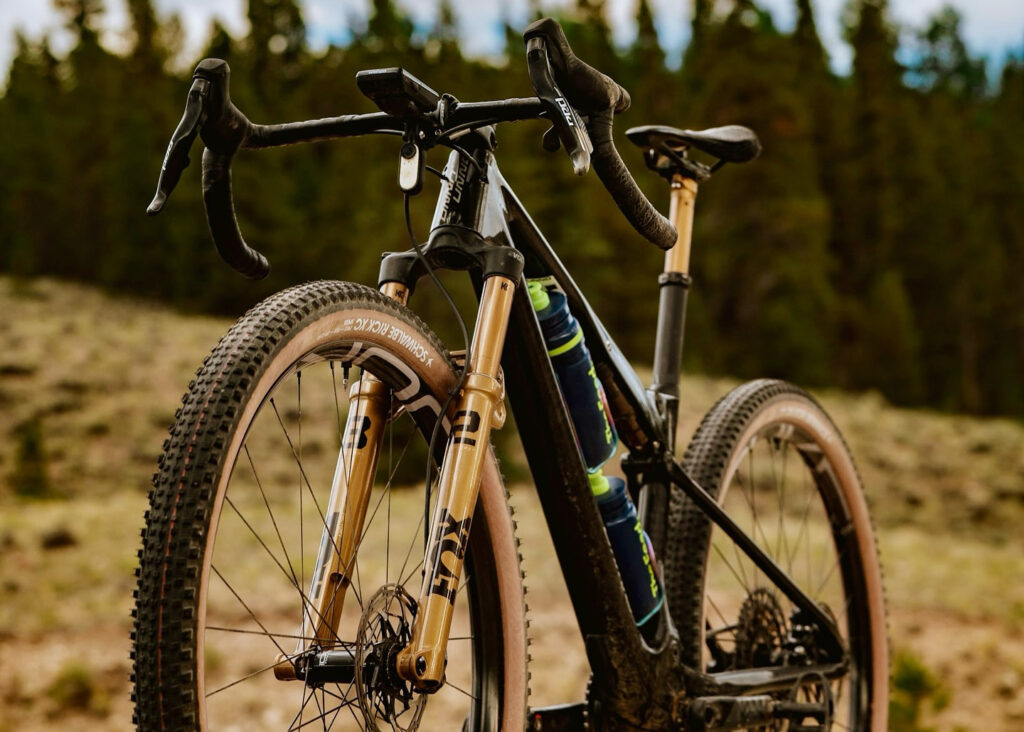
[Image by @fjimz10]
Perhaps the biggest champion for full suspension and drops for Leadville is Dylan Johnson, a rider known for his technical refinements and statistical analysis, who, all said and done, in balancing out descending losses with aerodynamic gains, reckons on around a six-minute time advantage to drops at Leadville. He was also one of the first to take the dropped bar MTB approach here, though his was pretty much the same as on flats.
The big dropped bar rouse came last year, when Keegan Swenson showed up and won on a Santa Cruz Highball drop bar hardtail. His aim was to break his record set in 2023, but due to a flat tyre, he lost a lot of time and failed to beat it, although he did still win.
Despite this, he will most likely be riding dropped again this year – and as far as we know, has settled on a full suspension dropped bar set up, in an attempt to gain the aero advantage while reducing puncture risks. Even so, during a video of his testing the bike on the course, along with rival Alexy Vermueluen, they both conceded that climbing “sucked” on drops and descending was a bit harsh too, and that drops are not for the vast majority of riders.
Either way, his belief in drops will likely see many more mullet-like bikes on the grid this year. We also understand that there’s a high chance of his partner, Sofia Gomez Villafane, riding drops this year, which will be a first for the women.
The racers
The first 1994 edition of the race had a field of 142 riders (18 being women), and the men’s event was won by legendary US offroad endurance racer, later turned trail runner, John Stamstead (USA/Ritchey), who completed the course in a time of 7.52.03, while Laurie Brandt of the USA was the fastest woman with a time of 9.03.50.

Over the next decade, the race grew rapidly in prominence, the field got bigger (but was still restricted), and some of the biggest names in cycling took on the Leadville challenge. The US XC racing legend Dave Weins took six back-to-back wins from 2003-08 and beat the likes of since “deleted” Tour de France champions Lance Armstrong and Floyd Landis along the way, while at the height of their careers (Floyd now runs a CBD business in Leadville). Armstrong returned to win Leadville in 2009, while his teammate Levi Leipheimer rode to victory in 2010.
Over the decades, the overall level and speeds of Leadville have risen dramatically from Stanstead’s 7.52.53 opener to Armstrong’s 6.28.51 in 2009 through to Keegan Swenson’s fastest ever time of 5.43.31 in 2023, while. Danish XC ace Anika Langvad set the fastest women’s time of 6.59.24 in 2015.
In recent years, it’s been the emerging breed of off-road endurance specialists who have dominated in Leadville, which became part of the Life Time group in 2010, and which is now one of the Life Time GP series races.
Entry for Leadville is via qualification (through results in qualifying races), plus a number of lottery-awarded slots. Although numbers and start lists are not announced until the last moment, we expect around 1600+ riders to line up this weekend, including all of the prime LTGP suspects.
For the Elite men’s race, Keegan Swenson (USA) is surely odds-on favourite to take his fifth victory, and we know he’s all out to crush his course record to sub-5.40, and if all goes well, he’ll be a hard man to beat here. Close behind him, we expect to see former road pros turned endurance racers Alexy Vermeulen (USA) and Lachlan Morton (AUS) in with a shot amongst others.
The woman’s race could prove a little less predictable, though we expect former winners Sofia Gomez Villafane (ARG), Hanna Otto (USA) and Melissa Rollins (USA) to lead the charge.
Watching live
The great news for fans is that you don’t need an expensive subscription to watch Leadville, as, for the first time ever, Life Time will have full live coverage from 5.45 am MST on their YouTube channel, with highlights to follow later.